History Labs: High Quality Assessments that Engage Students in - - PDF document

history labs
SMART_READER_LITE
LIVE PREVIEW

History Labs: High Quality Assessments that Engage Students in - - PDF document

History Labs Houle/Kitchen History Labs: High Quality Assessments that Engage Students in History Content and Historical Thinking Skills Tiffany Houle Paul Kitchen USD 259 Wichita Kansas 21 st Century Skills What skills are most important


slide-1
SLIDE 1

History Labs Houle/Kitchen 1

History Labs:

High Quality Assessments that Engage Students in History Content and Historical Thinking Skills

Paul Kitchen Tiffany Houle

USD 259 Wichita Kansas

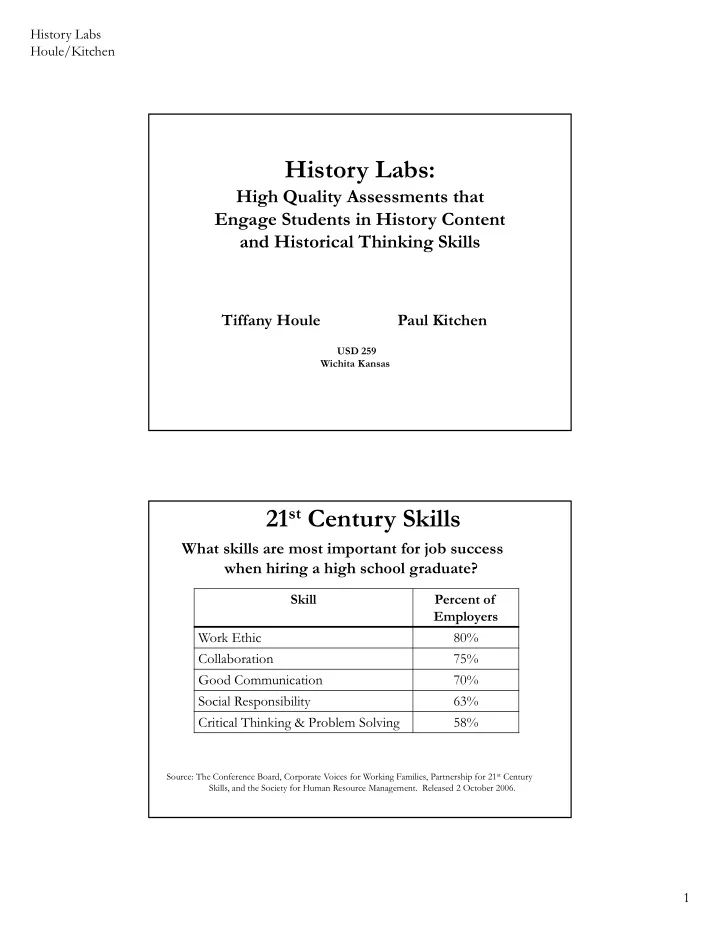
21st Century Skills

What skills are most important for job success when hiring a high school graduate?

Skill Percent of Employers Work Ethic 80% Collaboration 75% Good Communication 70% Social Responsibility 63% Critical Thinking & Problem Solving 58%

Source: The Conference Board, Corporate Voices for Working Families, Partnership for 21st Century Skills, and the Society for Human Resource Management. Released 2 October 2006.

slide-2
SLIDE 2

History Labs Houle/Kitchen 2 20th Century 21st Century # of Jobs 1-2 Jobs 10-15 Jobs Job Skill Master of One Field Flexibility and Adaptability Teaching Model Subject Matter Mastery Integration of 21st Century Skills into Subject Matter Mastery Assessment Model Subject Matter Mastery Integration of 21st Century Skills into Subject Matter Mastery

Source: Number of Jobs Held and Labor Market Activity among Younger Baby Boomers: Recent Results from a Longitudinal Survey Summary, U.S. Department of Labor, 2004.

21st Century Learners 21st Century Learners

“In an age where ‘I found it

  • n the Internet’

masquerades as knowledge, history serves as a vital counterweight to intellectual sloppiness.”

Sam Wineburg, Reading Like a Historian, ix.

slide-3
SLIDE 3

History Labs Houle/Kitchen 3

21st Century Learners

“Historians have developed powerful ways of reading that allow them to see patterns, make sense of contradictions, and formulate reasoned interpretations when others get lost in the forest of detail and throw up their hands in frustration.”

Sam Wineburg, Reading Like a Historian, ix.

WHAT IS HISTORY?

  • History is an account of the past.
  • Accounts differ depending on one’s

perspective.

  • We rely on evidence to construct accounts of

the past.

  • We must question the reliability of each

piece of evidence.

Thinking Like a Historian

  • Any single piece
  • f evidence is

insufficient to build a plausible account.

slide-4
SLIDE 4

History Labs Houle/Kitchen 4

SOURCING

Before reading a document:

  • Who produced this?
  • When was it produced?
  • Where was it produced?
  • Why was it produced (bias)?
  • What is the author’s perspective?

Thinking Like a Historian

  • Who was the

intended audience?

  • Is this source

reliable? Why? Why not?

CONTEXTUALIZING

  • What was happening at the time this

document was produced?

  • How might the circumstances in which the

document was created affect its content?

Thinking Like a Historian

  • How might the

document fit into the larger story of the development of the U.S.? Think about Themes

slide-5
SLIDE 5

History Labs Houle/Kitchen 5

CORROBORATING

  • What are other possible documents?
  • What do other documents say?
  • What conflicting historical evidence exists

among these documents?

  • Why does this conflicting evidence exist?

Thinking Like a Historian

  • What

supportable inferences and appropriate conclusions can be made?

History Lab

Text: The sentence itself. Pretext: The valid basis for the sentence, from previous events and experience. Context: How does the sentence apply to the specific, current factors of this situation? Subtext: What is not said? What is below the surface? What is soft, vague, or hard to quantify?

slide-6
SLIDE 6

History Labs Houle/Kitchen 6

Celebration of Knowledge Resources

http://tinyurl.com/HistorianThinking

http://tinyurl.com/HistorianThinking