
SLIDE 1
Historical Statistical Analysis Manganese Advisory Committee - - PowerPoint PPT Presentation
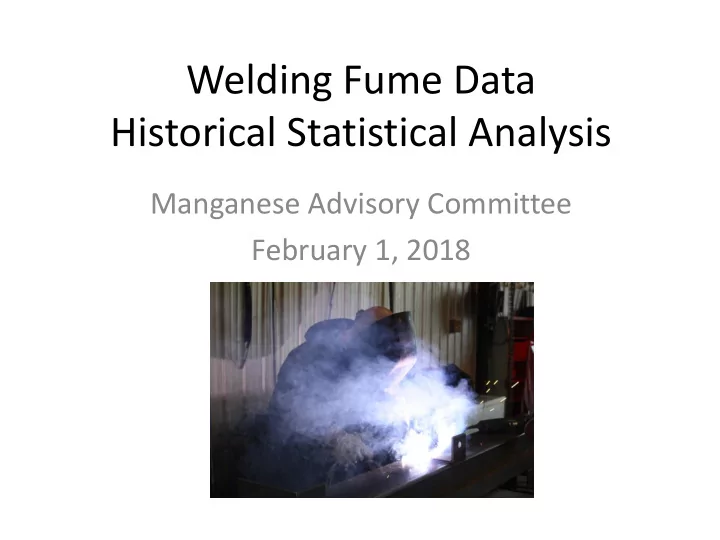
Welding Fume Data Historical Statistical Analysis Manganese Advisory Committee February 1, 2018 References Statistic Modeling Reference Statistical Modeling to Determine Sources of Variability in Exposures to Welding Fumes , The Annals
TIG Welding MIG Solid Wire Flux Core Wire Air Arc Gouging
TIG, 65 (2%) MIG SW, 956 (29%) MIG-Flux, 311 (9%) Stick, 88 (3%) Grinding, 256 (8%) Hand Torch, 176 (5%) Plasma, 47 (1%) Carbon Arc, 76 (2%) Unclassified, 1380 (41%)
DESCRIPTIVE STATISTICS Number of samples (n) 546 Maximum (max) 5.44 Minimum (min) 0.005 Range 5.435 Percent above OEL (%>OEL) 0.000 Mean 0.271 Median 0.140 Standard deviation (s) 0.450 Mean of logtransformed data (LN)
0.732 Geometric mean (GM) 0.117 Geometric standard deviation (GSD) 2.079 LOGNORMAL PARAMETRIC STATISTICS Estimated Arithmetic Mean - MVUE 0.152 LCL1,95% - Land's "Exact" 0.144 UCL1,95% - Land's "Exact" 0.162 95th Percentile 0.388 UTL95%,95% 0.528 Percent above OEL (%>OEL) 0.000 LCL1,95% %>OEL <0.1 UCL1,95% %>OEL <0.1
99% 98% 95% 90% 84% 75% 50% 25% 16% 10% 5% 2% 1% 1 10 100 1000 Concentration
Logprobability Plot and Least-Squares Best-Fit Line
– (0.1 mg/mg3 *480 minutes)/UCI
– (0.1 mg/mg3*480 minutes)/0.780 = 61.5 minutes
– (1.0 mg/mg3*480 minutes)/UCI
– (1.0 mg/mg3*480 minutes)/1.251 = 383.6 minutes
Condition Protective Measures
Confined Space Airline Respirator or Local Exhaust Ventilation
Indoors Fume Respirator or Local Exhaust Ventilation
Confined Space Airline Respirator or Local Exhaust Ventilation
Indoors or Outdoors Fume Respirator or Local Exhaust Ventilation
Confined Space Airline Respirator or Local Exhaust Ventilation
Indoors or Outdoors Fume Respirator or Local Exhaust Ventilation
Other workers Local Exhaust or Airline Respirator
Confined Space or Indoors Airline Respirator or Local Exhaust Ventilation
Outdoors Fume Respirator
Confined Space Local Exhaust and Airline Respirator
Confined Space or Indoors Airline Respirator or Local Exhaust Ventilation
Outdoors Approved Respirator
Confined Space Airline Respirator or Local Exhaust Ventilation
Confined Space Airline Respirator or Local Exhaust Ventilation
Indoors or Outdoors Airline Respirator and Local Exhaust Ventilation
Other Workers Local Exhaust or Airline Respirator in Immediate Vicinity
Indoors or Outdoors Fume Respirator or Comp. Local Exhaust Ventilation
Welding Process Sample Size (n) Mean (mg/m3) S.D. (mg/m3) % Population Overexposed PEL = 0.1 mg/m3 % Population Overexposed TLV = 0.02 mg/m3 Minutes to Overexposure Based on PEL & (95% UCI mg/m3) Minutes to Overexposure Based on PEL & (95% LCI mg/m3) TIG 65 0.044 0.054 12% 59% >480 mins (0.057) >480 mins (0.031) MIG (Solid Wire) 956 0.332 0.643 61% 93% 132 mins (0.363) 171 mins (0.281) MIG-Flux Core /Dual Shield 311 0.665 1.034 81% 97% 62 mins (0.780) 87 mins (0.550) Stick 88 0.631 1.514 57% 99% 50 mins (0.952) 155 mins (0.310) Grinding tasks related to the welding process 256 0.438 0.821 54% 85% 89 mins (0.539) 142 mins (0.337) Hand Torch Cutting 176 0.369 1.447 31% 70% 82 mins (0.584) 312 mins (0.154) Hand Held Plasma Cutting 47 0.223 0.345 53% 92% 140 mins (0.342) 393 mins (0.122) Carbon Arc Gauging /Scarfing 76 1.172 1.948 95% 97% 38 mins (1.251) 44 mins (1.093) Unclassified Welding 1390 0.335 0.998 56% 90% 124 mins (0.388) 170 mins (0.282)
Welding Process Respirator with APF=10 Respirator with APF=25 Engineering Controls TIG (T) GTAW Not Required Not Required Not Required MIG-Solid Wire (M) SMAW >2 hr – >3 hr MIG-Flux Core (F) FCAW >1 hr – >1.5 hr Stick (S) SMAW >1 hr – >2.5 hr Grinding Tasks directly related to Welding (G) >1.5 hr – >2.5 hr Hand-Held Torch Cutting (H) >1.5 hr – >5 hr Hand-Held Plasma Cutting (P) >2.5 hr – >6.5 hr Carbon Arcing (C) >30 mins >6 hr >1 hr
Welding Process Respirator with APF=10 Respirator with APF=25 TIG (T) GTAW >2.5 hrs NA MIG-Solid Wire (M) SMAW >30 min >4.5 hours MIG-Flux Core (F) FCAW >15 min > 2 hrs Stick (S) SMAW >10 min >1.5 hrs Grinding Tasks directly related to Welding (G) >15 min > 3 hrs Hand-Held Torch Cutting (H) >15 min >2.5 hrs Hand-Held Plasma Cutting (P) >30 min >5hrs Carbon Arcing (C) >5 min > 1hr