??? His Central Dogma: DNA is a Read-Only-Memory. Who manages the - - PowerPoint PPT Presentation

his central dogma dna is a read only memory who manages
SMART_READER_LITE
LIVE PREVIEW

??? His Central Dogma: DNA is a Read-Only-Memory. Who manages the - - PowerPoint PPT Presentation

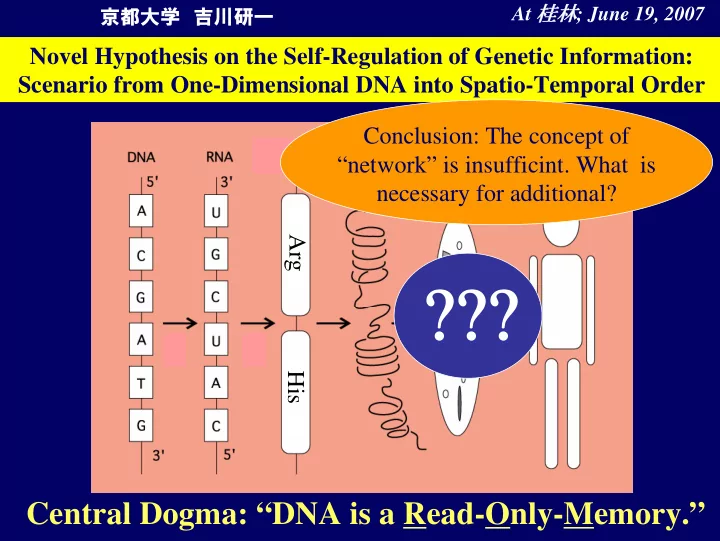
At ; June 19, 2007 Novel Hypothesis on the Self-Regulation of Genetic Information: Scenario from One-Dimensional DNA into Spatio-Temporal Order Protein Conclusion: The concept of network is insufficint.


slide-1
SLIDE 1

Novel Hypothesis on the Self-Regulation of Genetic Information: Scenario from One-Dimensional DNA into Spatio-Temporal Order

Central Dogma: “DNA is a Read-Only-Memory.”

At 桂林; June 19, 2007

Arg His

Cell

???

ProteinConclusion: The concept of

“network” is insufficint. What is necessary for additional?

京都大学 吉川研一

slide-2
SLIDE 2

Current network hypothesis gives the answer:

Hypothesis of Jacob & Monod (1961)

Who manages the expression of 20,000 genes?

slide-3
SLIDE 3

Difficulties in Complicated Network

  • 5. Who can choose the certain fix point? And

how? Absence of CPU.

  • 2. Almost impossible to explain the simultaneous

switching on hundreds of senes.

  • 4. Appearance of a large number of metastable states:

Difficulty of simultaneous switching on many genes.

  • 1. Fluctuation in the number of key-lock interactions

diminishes the stability of the fix points in the network: Difficulty of robust on/off switching.

  • 3. Are there 103 regulatory factors to control 104 genes?

Effect of cross-talk

We should think of something else!

slide-4
SLIDE 4

AFM Microscopy

Broadening with Gaussian (~300 nm)

1.5μm 1.5μm 1.5μm Fluorescence Microscopy

Yoshinaga, et al., J.Chem.Phy.2002.

T4DNA: 155 kbp

slide-5
SLIDE 5

Persistence Length; 50 nm (170 base pairs) Short DNA is a stiff rod.

Giant DNA is a flexible rope.

DNA above several kilo base pairs is “giant”. All of the genomic DNAs are giant (above 1 mm).

slide-6
SLIDE 6

Helix-Coil Transition Coil-Globule Transition

Melting Transition of Double Stranded DNA Folding Transition of Giant DNA

Continuous Transition On/Off Transition

slide-7
SLIDE 7

Coil (Unfolded) Rc ~ λN 3/5

Large Change in Density

Ratio on the Density

When N = 100 (30kbp), λ= 100nm, s = 4nm2

ρg/ρc ~ Rc

3/Rg 3 ~ 105

Globule (Folded) Rg ~ (λsN) 1/3

Globule Coil N: Number of segments λ: Kuhn length s: Cross section of segment

Continuous or Discrete?

slide-8
SLIDE 8

Most Experimental Studies Reported As Continuous

Monomolecular Condensation of λ-DNA Induced by Cobalt Hexammine

  • J. Widom and R. L. Baldwin, Biopolymers, 22, 1595-1620 (1983).

In Abstract: "Some interesting properties of monomolecular condensation are noted. (1) The transition is not a two-state reaction, as judged by measurements of the diffusion coefficient through the transition zone. (2) The transition for monomolecular condenstation is diffuse. ‥‥‥‥"

R R

Condensing Chemical

Current concept

slide-9
SLIDE 9

T4DNA(166kbp) Contour length:57μm

Discrete: Single chain Continuous: Ensemble of chains

Folding transition induced by spermine (4+)

See e.g.; JCP,102,6595(’95); PRL, 76,3029(’96); JPCB, 101, 9396 (‘97).

Observation on Single DNA Molecules

slide-10
SLIDE 10

density Free Energy

slide-11
SLIDE 11

1

10 ~ n

Always Continuous

2

10 ~ n

First-Order Phase Transition Liquid Solid

Cf: Ar-Cluster, H2O-cluster

N=100 corresponds to DNA with 30kbp, where Kuhn length is 100nm (300bp)

slide-12
SLIDE 12

Experiment

Matsuzawa, et al., JACS(’96)

Nucleation & Growth in a Single Chain

Time Interval : 2s

10μm

Single DNA Observation (T4DNA: 57μm)

Simulation

Sakaue, et al., JCP(’02)

slide-13
SLIDE 13

RNA pH ATP

Switching of DNA conformation by environment parameters

high low high low Alkaline Acid

slide-14
SLIDE 14

Network: key-lock interactions

Recognition of specific base-sequences on DNA by individual regulatory factors.

Variable: Finite number (discrete; the density of “N”)

Field: Environment

Nonspecific abundant chemicals such as ATP; Na,K-ions; RNA; pH; etc.

Environmental species: Large number (concentration is almost given by the density of “R”)

slide-15
SLIDE 15

Makita, et al., FEBS Letters, 460 (1999)

“Environment” causes on/off switching.

  • Dr. Makita
slide-16
SLIDE 16

Luckel, Tsumoto, et al., Biophys. Chem.(2003).

Compaction of DNA completely inhibits the transcriptional activity of genes

slide-17
SLIDE 17

不連続転移は、100 kbp 以上の領域 (10 ~ 100 以上の 遺伝子を含む)で初めて起こる。

DNA mRNA DNA

  • nly

Yamada et al., APL, 2005

Structural transition and transcriptional activity of DNA

Coil state ⇒ Transcriptional activity ON Globule state ⇒ Transcriptional activity OFF I n the region larger than 100 kbp (more than 10 ~ 100 genes), discrete transition occurs.

slide-18
SLIDE 18

Switching of the Transcriptional Activity is Caused by the changa

  • f “Energy State”

Biomacromol.(2003)

Giant DNA Short DNA

slide-19
SLIDE 19

Shindo, et al., J.Biotech.(2007).

slide-20
SLIDE 20

Summary on Genetic Regulation

1) Environmental parameters induce On/Off switching on the conformation of giant DNA. 2) The correlation length in intra-chain segregation is determined by the cross-talk between DNA and environment. 3) On/Off switching of gene expression is driven by the conformational transition of giant DNA. 4) Network hypothesis may stand for the soft control of gene expression. Robust control will be managed by the conformational transition in giant DNA.

slide-21
SLIDE 21

Outer Environment

Metabolic Network

Loose Packing

Intra-cellular Network Genetic Regulators

Expression

Transcription Nuclear Environment Folder of genes Tight Packing Unfolded DNA

Network: Fluctuating pairs of key-locks Environment: Robust owe to large number

Life is a hybrid system between network and environment.

slide-22
SLIDE 22

Missing Link between DNA and Spatio-Temporal Order in Life

1) Selective on/off switching on a large number of genes Cell Differentiation, Cancer, AIDS, etc. 2) Construction of the own body Turing Pattern, Apoptosis, etc.

slide-23
SLIDE 23

Current Model on the Construction of Own Body

4. Reaction-Diffusion System (Turing Pattern)

  • 1. Positioning through chemical gradient

1.Positioning

2. Cell automaton

2.Cell Automaton

3. Neighboring Interaction

3.Neighboring Interaction

slide-24
SLIDE 24

∂u ∂t = γf u,v

( )+ ∇

2u,

∂v ∂t = γg u,v

( )+ d∇

2v

f u, v

( ) = a − u − h u,v ( ), g u,v ( ) = α b − v ( )− h u,v ( )

h u,v

( ) =

ρuv 1 + u + Ku

2
slide-25
SLIDE 25
  • Y. Bessho, R. Kageyama Curr.Opinion Gene.Dev., 13, 379, (2003).

Tail Head

Soma is generated with traveling waves.

Mouse Zebrafish Periodicity: 90-120min Periodicity: 30min

slide-26
SLIDE 26
slide-27
SLIDE 27

⎪ ⎪ ⎪ ⎩ ⎪ ⎪ ⎪ ⎨ ⎧ − + + − = + + + − = ∇ + − + − = z k x k xz k z k x k y k y x D x k y k xz k x

8 2 7 1 6 2 5 4 2 3 2 1

1 1 & & &

x: Hes1 protein y: hes1 mRNA z: E2A(?) protein

slide-28
SLIDE 28

Somite Segmentation is Generated through Traveling Waves

Experiment Numerical

Oscillation is robust.

slide-29
SLIDE 29

Oscillation of Hes-1 Ensemble of Cells Individual Cells

Fluctuating rhythm

  • n single cells
slide-30
SLIDE 30

Numerical Example

Isolated Cells 1-D Couples Cells

slide-31
SLIDE 31

Missing Link between DNA and Spatio-Temporal Order in Life

1) Selective on/off switching on a large number of genes Cell Differentiation, Cancer, AIDS, etc. 2) Construction of the own body Turing Pattern, Apoptosis, etc. Nonlinear dynamics under far- from-equilibrium conditions

slide-32
SLIDE 32

Fusion between Physico-Mathmatics and Bioscience will open the next era.

Message for the young scientists:

20th Century: Accumulation of the knowledge on Elements.

What is Life?

21th Century: Understanding of System Dynamics.

slide-33
SLIDE 33

謝謝

馬 劉

Research Colleagues at Kyoto Univ.