Highly Palatable Foods: The Brain Reward Pathways and Connections to - - PowerPoint PPT Presentation

highly palatable foods the brain reward pathways and
SMART_READER_LITE
LIVE PREVIEW

Highly Palatable Foods: The Brain Reward Pathways and Connections to - - PowerPoint PPT Presentation

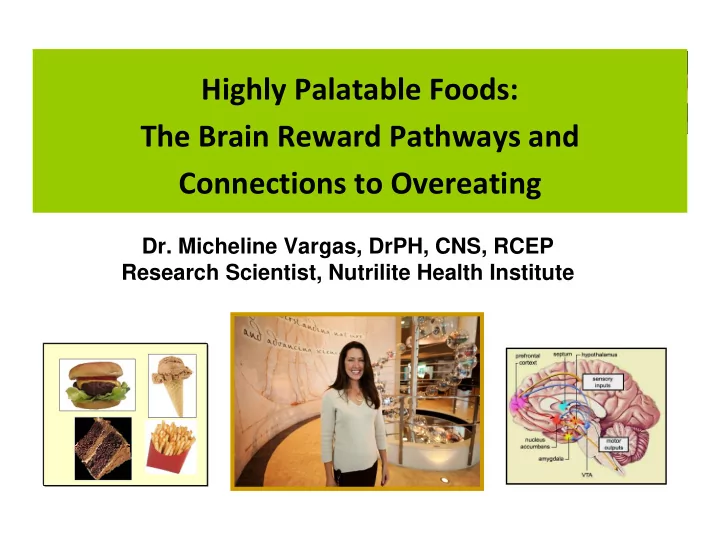
Highly Palatable Foods: The Brain Reward Pathways and Connections to Overeating Dr. Micheline Vargas, DrPH, CNS, RCEP Research Scientist, Nutrilite Health Institute Agenda Excessive food consumption and the brains pleasure pathways


slide-1
SLIDE 1

Highly Palatable Foods: The Brain Reward Pathways and Connections to Overeating

  • Dr. Micheline Vargas, DrPH, CNS, RCEP

Research Scientist, Nutrilite Health Institute

slide-2
SLIDE 2

2

Agenda

  • Excessive food consumption and the brain’s

pleasure pathways

  • Obesity and reduced food reward
  • Connection between the pleasure pathways, habits,

and addiction

  • Drives for highly palatable foods
  • Brain reward circuitry and stress related food

intake

  • Treating obesity by changing the brain
slide-3
SLIDE 3

3

Global Obesity Epidemic

World Health Organization Estimates

2015 2.3 million overweight 700 million obese adults 2005 1.6 million overweight & 400 million obese 20 million children under 5 y/o overweight

Causes

Too many calories Not enough exercise

Health Risks

Cardiovascular disease Diabetes Osteoarthritis Some cancers

slide-4
SLIDE 4

4

slide-5
SLIDE 5

5

slide-6
SLIDE 6

6

slide-7
SLIDE 7

7

slide-8
SLIDE 8

8

slide-9
SLIDE 9

The Brain is Reward Driven

slide-10
SLIDE 10

10

Brain Pleasure Centers

  • Reward circuit

– Ventral tegmental area (VTA) – Nucleus accumbens – Septum – Amygdala – Prefrontal cortex

slide-11
SLIDE 11

11

Brain Pleasure Centers

  • Higher dopamine levels = higher gratification
  • Pleasure perception
  • “Incentive value” and “pleasure seeking”
  • Gratifying behavior
  • Memory

Higher dopamine levels = higher gratification Pleasure perception “Incentive value” and “pleasure seeking” Gratifying behavior Memory

slide-12
SLIDE 12

Obesity & Reduced Food Reward

slide-13
SLIDE 13

13

Brain Pleasure Centers

  • Lower dopamine D2 receptors

in obese than control subjects

  • Lower D2 make the obese

individual less sensitive to reward stimuli

  • Obese similar to drug addicted

Wang et al., Lancet 2001 Wang et al., Lancet 2004

What do the colors mean?

RED

high dopamine normal pleasure & interest

YELLOW

medium dopamine difficult feeling joy

  • r pleasure

GREEN

low dopamine lack of pleasure

slide-14
SLIDE 14

14

BRAIN REWARD CENTER

What do the colors mean?

RED high dopamine normal pleasure & interest YELLOW medium dopamine difficult feeling joy

  • r pleasure

GREEN low dopamine lack of pleasure

slide-15
SLIDE 15

15

Genetic Variations

  • A genetic variation may be

the cause in some obese

  • Association between the

Taq 1 A allele and lower levels of dopamine D2 receptors

Stice E, et al., J Abnorm Psychol. 2008 Felsted JA, et al., The J Neurosci, 2010

slide-16
SLIDE 16

Connection Between Pleasure Pathways, Habits, and Addiction

slide-17
SLIDE 17

17

The Brain is Plastic

  • The brain is plastic, meaning it can

change

  • Experience‐dependent plasticity
  • Learning occurs in the brain through

the process of strengthening or weakening synapses

  • The brain will be modified by the

repeated act of overeating

slide-18
SLIDE 18

18

Memories, Learning & Conditioning

  • The brain creates memories about eating behaviors
  • Glutamate, an excitatory neurotransmitter, plays a role in

synaptic plasticity

– Involved in cognitive functions such as learning and memory – Important in storing information about eating experiences, such as pleasure felt when eating.

  • Cues in the environment can “trigger” memories of the

pleasurable experience.

  • Pleasurable memories can lead to cravings and relapse
slide-19
SLIDE 19

19

Addiction

  • Pleasure circuits are “hijacked”
  • There is a cascade of pleasure neurotransmitters

– serotonin, dopamine, enkephalin, and GABA

  • With repeated abuse the amount of

neurotransmitter released in response to normal stimuli is reduced

  • More substance is needed to get the same sense of

pleasure

slide-20
SLIDE 20

Drives for Highly Palatable Foods

slide-21
SLIDE 21

21

Killgore et al., 2003

Low calorie foods lead to little activation in the brain reward centers

Why Don’t We Binge on Broccoli?

High calorie foods with high reward lead to significant activation in the brain reward centers

slide-22
SLIDE 22

22

Neurotransmitters Involved in Food Intake Regulation

Stimulate Feeding (usually decrease energy expenditure)

  • Anandamide
  • β-endorphin
  • Dynorphin
  • GABA
  • Ghrelin
  • Growth hormone releasing hormone
  • Neuropeptide Y
  • Norepinephrine

Inhibit Feeding (usually increase energy expenditure)

  • Cholecytystokinin (CCK)
  • Corticotropin-releasing factor (CRF)
  • Dopamine
  • Insulin
  • Leptin
  • Neurotensin
  • Thyrotropin-releasing hormone
  • Melanocyte-stimulating hormone
slide-23
SLIDE 23

23

Are We Addicted to Sugar?

  • Behavioral and neurochemical changes in the brain

resemble those seen in after taking drugs

  • Behavioral patterns after sugar‐binging

– Withdrawal, craving, and relapse

  • Neurochemical changes after learning to binge on sugar

– Binging on sugar triggered a surge of dopamine in the nucleus accumbens – Fewer dopamine receptors than before and more opioid receptors

  • Dopamine and opioid systems are involved in reward and motivation

and are important in controlling wanting and liking something.

Hoebel, et al., Neurosci Biobehav Rev. 2008

slide-24
SLIDE 24

24

Are We Addicted to Sugar?

  • The pleasure from the sweet taste of sugar‐dense foods and

beverages initially motivates over‐consumption

  • Sweet taste may be more rewarding and possibly more

addictive than cocaine

  • Choice between water sweetened with saccharin and

intravenous cocaine ‐ 94% of the animals preferred the saccharin

  • Supra‐normal stimulation of sweet receptors by sugar‐rich

diets could create a supra‐normal reward signal in the brain

  • Self‐control mechanisms could be overriden and lead to

addiction

Lenoir et al., PloS one. 2007

slide-25
SLIDE 25

25

Does Eating High Fat Stimulate Eating?

  • Animals fed a small HF meal early in the day ate

more calories throughout the day compared to those fed a low fat meal

  • TG levels increased 2‐3 times in the HF group
  • No changes in leptin or insulin levels
  • Expression of orexigenic peptides were increased

– galanin – orexin

Gaysinskaya et al., Physiol Behav. 2007

slide-26
SLIDE 26

26

Does Eating High Fat Stimulate Eating?

  • Maternal HF diet exposure lead to changes in rodent
  • ffspring following weaning
  • In as little as two weeks of exposure to a HF diet, offspring

increased

– intake of calories – body weight – a stronger drive for fat intake – brain peptides that are stimulated by fat

  • Brain systems involved in reward and palatability can each

stimulate and be stimulated by the intake of diets rich in fat

Chang et al., Neuroscience. 2008

slide-27
SLIDE 27

Brain Reward Circuitry & Stress Related Food Intake

slide-28
SLIDE 28

28

UCSF Department of Psychiatry ‐ Reward Based Stress Eating Model

  • Relationship between stress, eating,

and potential neuroendocrine mediators

  • Cortisol and the reward circuitry affect

motivation for calorically dense food intake

  • Reward value of food may be

influenced by cortisol via neuroendocrine & peptide mediators

Epel ES. Physiol Behav, 2007

slide-29
SLIDE 29

29

Stress, Opioids & HPA Axis

Epel ES. Physiol Behav, 2007

  • Stress stimulates hypothalamic‐pituitary‐

adrenal (HPA) axis activity

– Intake of comfort foods reduces HPA axis activity

  • Stress can stimulate endogenous release
  • f opioids
  • Opioids (+) excessive intake of palatable

food

– Suppress brain mechanisms responsible for terminating eating

  • Sensation of pain reduced by sucrose
  • Withdrawal symptoms from opiates

relieved by sweets

slide-30
SLIDE 30

Treating Obesity by Changing the Brain

slide-31
SLIDE 31

31

Strategies Aiming at Improving Dopamine Function

Comprehensive behaviorally based programs designed to “re‐wire” the brains reward pathways can be an effective way to reduce food cravings and overeating.

slide-32
SLIDE 32

32

Treating Obesity by Changing the Brain

  • A variety of professionals along with a variety of

formats might be incorporated

  • Treatment should be individualized and incorporate

a variety of cognitive and behavioral tools

– decrease the reward value of the food or behavior – increase the reward of the new positive behaviors – reduce the power of triggers – strengthen new neural circuits by learning new habits

slide-33
SLIDE 33

33

Treating Obesity by Changing the Brain

  • Analysis of stimuli, situations,

and cues that trigger out‐of‐ control‐eating is critical

– Initially avoiding certain triggers

  • r foods may be necessary
  • Stress management tools

should be incorporated daily to weaken neural circuits that promote stress

– Exercise – Mindfulness meditation

slide-34
SLIDE 34

To weaken the strong neural circuits that favor

  • vereating, cognitive and behavioral tools

must be practiced repeatedly.

slide-35
SLIDE 35

35

Questions & Answers

Thank You!