
SLIDE 1
DERDOUR ROUMAISSA1, LEBBAL MOHAMED REDHA2, SOUHEIL MOUETSI1, T.BOUCHEMAT2, M.BOUCHEMAT2 1 Department of Electronics Faculty of Engineering, University of Larbi Ben M’hidi OUM EL BOUAGHI, Algeria 2 Department of Electronics Faculty of Engineering, Mentouri University Constantine, Algeria
High transmission in All-optical Logic gate formed by crystal photonic Y- junction
Introduction Theory Simulation Setup Results Conclusion References
[1] Ref. 1K. Sakoda, Optical Properties of Photonic Crystals, Springer-Verlag, Berlin, 2001 [2] Ref. 2Z. Wu, K. Xie, H. Yang, Band gap properties of two-dimensional photonic crystals with rhombic lattice, Optik 123 (2012) 534–536 [3] Ref. 3F. Mehdizadeh, H. Alipour-Banaei, Z. Daie-Kuzekanani, All optical multi reflection structure based on one dimensional photonic crystals for WDM communication systems”, Optoelectronics Adv. Mater-Rapid Commun 6 (2012) 527–531 [4] Ref. 4H. Alipour-Banaei, F. Mehdizadeh, A proposal for anti-uvb filter based on
- nedimensional photonic crystal structure, DigestJ. Nanomater. Biostruct. 7 (2012) 361–367
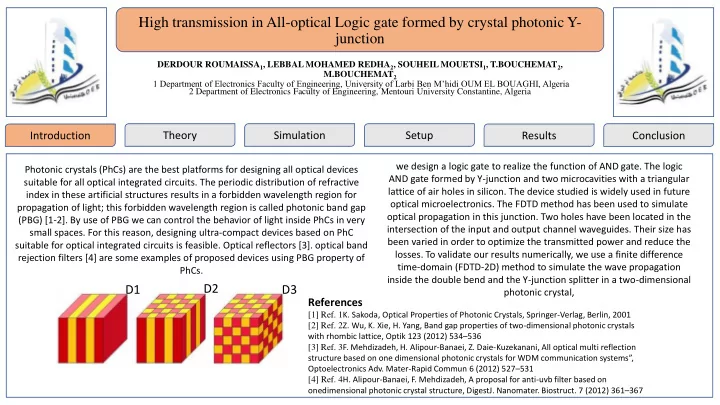
Photonic crystals (PhCs) are the best platforms for designing all optical devices suitable for all optical integrated circuits. The periodic distribution of refractive index in these artificial structures results in a forbidden wavelength region for propagation of light; this forbidden wavelength region is called photonic band gap (PBG) [1-2]. By use of PBG we can control the behavior of light inside PhCs in very small spaces. For this reason, designing ultra-compact devices based on PhC suitable for optical integrated circuits is feasible. Optical reflectors [3]. optical band rejection filters [4] are some examples of proposed devices using PBG property of PhCs. we design a logic gate to realize the function of AND gate. The logic AND gate formed by Y-junction and two microcavities with a triangular lattice of air holes in silicon. The device studied is widely used in future
- ptical microelectronics. The FDTD method has been used to simulate
- ptical propagation in this junction. Two holes have been located in the
intersection of the input and output channel waveguides. Their size has been varied in order to optimize the transmitted power and reduce the
- losses. To validate our results numerically, we use a finite difference