SLIDE 1
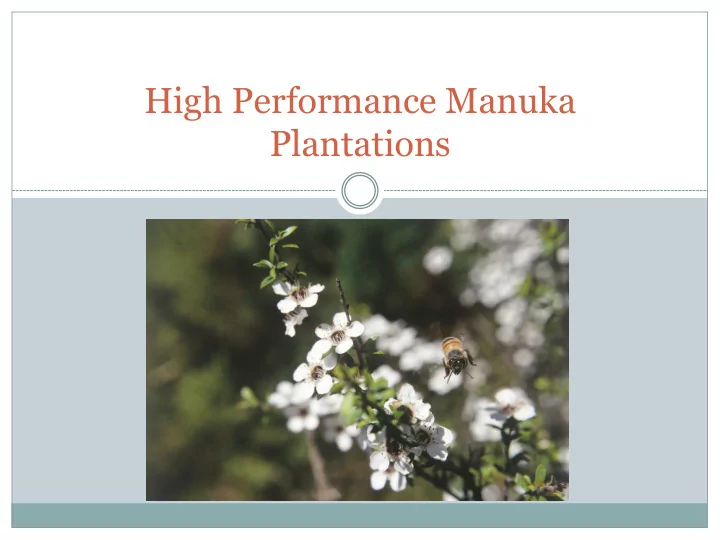
High Performance Manuka Plantations
SLIDE 2
Manuka Research Partnership Ltd – PGP Project
$2.7 M Manuka Plantation PGP Research Project
with Ministry of Primary Industries
8 Year Timeline - 2011 to 2018 Massey University – Research Provider Comvita providing Manuka Plants to the Project
from its Plant Breeding Program
SLIDE 3
Program Objectives
To develop the necessary Manuka Plantation husbandry knowledge to enable productivity gains resulting in a 16-fold increase in market returns from Manuka honey by doubling each of:
Hives per ha Manuka honey yield per hive Manuka honey that meets medical grade Land area in Manuka economically accessible to
beekeepers Net effect $1b Exports
SLIDE 4 The MRPL Co-investors
Comvita New Zealand Ltd
23,000 + hives, brand and distribution, ≈$100 M turnover
D and C Tweeddale
19,000+ hives ~ 60 Ha of Manuka plantation over 2 sites
Nukuhau Carbon Ltd
26 Ha planted at Rangitatau West
Arborex Industries – Te Awaiti station, Wairarapa Landcorp
State Owned Enterprise operating 137 properties totalling
377,000 ha across the North and South Islands of NZ
SLIDE 5 The MRPL Co-investors
Hawkes Bay Regional Council
150 ha planted at Lake Tutira Seeking to prove Manuka plantation as viable investment to
encourage an alternative land use option
New Partner who has agreed in principle to join:
Te Tumu Paeroa
100,000 ha approx under Management Including 30,000ha approx of marginal land
SLIDE 6 Manuka Plantation Deliverables for Land Owners
- Best Practice Seedling Propagation
- Best Practice Plantation Establishment
- Assess Manuka Provenance & Hybrid Performance
- Build Flowering & Production Profile & Parameters
- Prove Financial Business Case to retire Marginal Land
- WORK IN PROGRESS – 4 YEAR REMAINING TIMELINE
SLIDE 7 Sample of Current Projects
1.
Glasshouse & growth chamber studies on Manuka cultivars to examine influence of environmental factors on performance
- 2. Commercial field trials to understand best practice
plantation establishment & management
3.
Develop predictive tools to advise most suitable cultivars and best practice husbandry under particular plantation conditions
SLIDE 8 Programme so far > 2011-2013
From glasshouse
& plantations:
Major soil effects Cultivar effects Aspect and local effects
Variability creates
SLIDE 9 Assess variability & exploit
Site 1 DHA in nectar
SLIDE 10 Early plantation success
Plantation manuka Plantation manuka theoretical harvest Local manuka 2012 Local manuka historical
SLIDE 11
Hives on ordinary site
Pasture Pasture Kanuka Kanuka Kanuka Manuka Mixed Manuka & Kanuka
SLIDE 12
Improved cultivars, extend flowering, increase value
SLIDE 13
Commercial Field Trials
SLIDE 14 Current Sites
- 30 sites totalling 745ha including 596ha Comvita
Plantations
- Sites targeted to provide a regional and
environmental spread of field data
- Intend Plantations to provide a showcase to regions
>>> encouraging faster uptake
SLIDE 15
SLIDE 16
Map of Expanded PGP Field Trial Sites
SLIDE 17 Current Modelling
- Establishment costs of approximately $2,000 per ha
- Planting density of 1,100 stems per Ha (3m * 3m
spacings)
- 25 Year production life
- Floral Maturity in 6 years
SLIDE 18 Establishment at Tutira (HBRC)
- Summer-dry
- Exposed
- Range of seed
lines examined
established
SLIDE 19 Establishment at Tutira (HBRC)
95% in good summer 85% in bad summer
≈ 80cm 1st year ≈ 130cm 2nd year
≈ 100% for most lines in 2nd year
SLIDE 20 Comvita Manuka Breeding Program
- Commenced in 2006
- Plant Variety Rights registered on Hybrids
- Breeding of 2nd Generation Hybrids
underway
- Manuka seedlings provided to MRPL
project which are being evaluated in Glasshouse & Field Trials
SLIDE 21
A contrast, wild vs improved Manuka
SLIDE 22
Integrated Plantation & Apiary Management
Manuka plantation performance > 1st Leg Conversion of nectar into honey > 2nd Leg Understanding/optimising apiary performance >
critical to value
SLIDE 23
Proving the Business Case is When “The Rubber Hits the Road”
KEY VARIABLES [AT MATURITY]
NATURAL MANUKA WORSE CASE? MID-CASE? BEST CASE? HIVES PER HA
1.0 1.0 1.5 2.0
PRODUCTION PER HIVE (KG)
20 30 35 40
UMF HONEY VALUE PER KG
$15.00 $20.00 $30.00 $40.00
APIARY REVENUE PER HA
$300.00 $600.00 $1,575.00 $3,200.00
LANDOWNER REVENUE SHARE
15% 30% 30% 30%
LANDOWNER INCOME PER HA **
45 $ 180 $ 473 $ 960 $
LANDOWNER INVESTMENT RETURN (MARGINAL IRR)???
4.60% 16.70% 29.30%
PLANTATION MANUKA
SLIDE 24
- MRPL project is work in progress – 2018 completion
date
- Initial results are promising
- New generation of Manuka hybrids in the pipeline
- Comvita looking to expand its Plantation program
and are keen to talk to Owners wishing to retire land
- Consider “Trees for Bees” integration into planting
Take Home Messages
SLIDE 25 Plantation Manuka - Benefits to rural NZ
- Commercialise alternative land use for marginal land in NZ
- Macro environmental & economic benefit – Pure NZ Story
- Flow-on benefits of wealth creation through honey industry
- Capability development – new beekeepers & cadets