
SLIDE 1
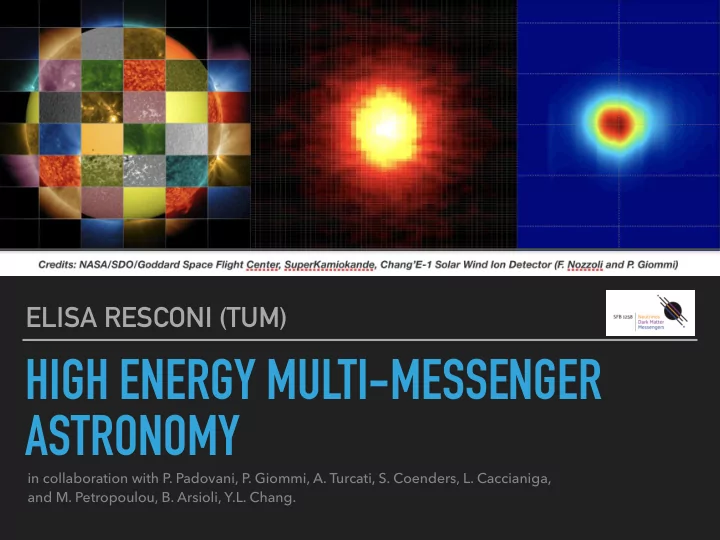
HIGH ENERGY MULTI-MESSENGER ASTRONOMY
ELISA RESCONI (TUM)
1
in collaboration with P. Padovani, P. Giommi, A. Turcati, S. Coenders, L. Caccianiga, and M. Petropoulou, B. Arsioli, Y.L. Chang.
HIGH ENERGY MULTI-MESSENGER ASTRONOMY in collaboration with P. - - PowerPoint PPT Presentation
1 ELISA RESCONI (TUM) HIGH ENERGY MULTI-MESSENGER ASTRONOMY in collaboration with P. Padovani, P. Giommi, A. Turcati, S. Coenders, L. Caccianiga, and M. Petropoulou, B. Arsioli, Y.L. Chang. 2 ICRC 2017
1
in collaboration with P. Padovani, P. Giommi, A. Turcati, S. Coenders, L. Caccianiga, and M. Petropoulou, B. Arsioli, Y.L. Chang.
ICRC 2017 E. RESCONI
2
▸ No gravitational waves ▸ Focus on observations ▸ Focus on searches for HE neutrinos counterparts ▸ Focus on searches for UHECR counterparts
ICRC 2017 E. RESCONI
3
4
Chandra Deep Field South : Deepest X-ray Image Ever Reveals Black Hole Treasure Trove
http://chandra.harvard.edu/photo/2017/cdfs/
ICRC 2017 E. RESCONI
▸ The Messengers ▸ The Observations ▸ The Scenarios ▸ The Searches ▸ Final remarks
5
ICRC 2017 E. RESCONI
(UHE) Cosmic Rays (HE) Neutrinos (Gamma) Photons 6
↳Primaries ↳Charged ↳Composition ↳Interact, limited horizon Reconstruction: ↳good angular resolution, bending ↳good energy resolution ↳Secondaries ↳Not charged ↳Three flavours ↳Interact weakly, nearly unlimited horizon Reconstruction:
resolution in shower, good in tracks
resolution in tracks, good in showers ↳Secondaries ↳Not charged ↳Interact, limited horizon Reconstruction:
resolution
resolution
ICRC 2017 E. RESCONI
7
Third Catalog of Hard Fermi-LAT Sources (3FHL)
e-Print: arXiv:1702.00664 Galactic Coordinates
1556 sources
ICRC 2017 E. RESCONI
8
IceCube Coll., Astrophys.J. 835 (2017) no.2, 151
+PoS 997
0 sources
ICRC 2017 E. RESCONI
9
data from IceCube, PoS 998 credit to A. Turcati
ICRC 2017 E. RESCONI
10
data from TA, AUGER (2014 - 2015), 20 deg smearing credit to S. Coenders
ICRC 2017 E. RESCONI
11
preliminary
ICRC 2017 E. RESCONI
12
preliminary
⁇ ⁇
ICRC 2017 E. RESCONI
13
Fermi-LAT Coll., PRL (2015)
blazars Yνγ = ?
ICRC 2017 E. RESCONI
14
Synchrotron peak
νS
High energy peak LBL LSP IBL ISP HBL HSP
[Padovani, Giommi, ’95]
ν (Hz) νFν
1- Blazars:
Spectral Energy Distribution (SED)
✤ Flat Spectrum Radio Quasars:
broad emission features (emission lines) in the optical spectrum
✤ BL Lacs: no broad emission lines.
Eem(FSRQ) < Eem(BL Lacs)
1015 1014 Jet dominated AGN. The radiation output is mostly due to non-thermal radia.on from a rela.vis.c jet. ~ 10% of all AGN
ICRC 2017 E. RESCONI
15
1- Blazars: in reality
~ 90 pages review submitted to The Astronomy and Astrophysics Review 2017 - To appear on ArXiv soon
ICRC 2017 E. RESCONI
16
8 10 12 14 16 18 20 22 24 26 28 30 32 42 42.5 43 43.5 44 44.5 45 45.5
2 4 6 8 10 12 14 16 log νFν (erg/sec/cm2) log νLν (erg/sec) log ν (Hz) logε (eV) leptonic + pe leptonic + pπ leptonic + p-syn leptonic pe pπ p-syn all processes π0 νe+νµ νµ IC neutrino 22 NED archival radio ROSAT 1FGL (2008-2009) 2FGL (2008-2010) 2FGL_lc (2008-2010)
z
0,137
B(G)
5
R(cm)
3 x 10¹⁵
δ
18
l(e,inj)
6 x 10⁻⁵
l(p,inj)
10-2
Yνγ
2,0
H 1914-194
GeV TeV PeV
16
[M. Petropoulou, S. Dimitrakoudis, P. Padovani, A. Mastichiadis, E.R., MNRAS (2015)]
1- Blazars: γ ∝ ν
ICRC 2017 E. RESCONI
17
1- Blazars: Bzcat5; 2WHSP; 3FHL [10GeV– 2TeV]
17
BL Lac
712
FSRQ
141 blazar candidate 309 SFR, SBG 1, 4 SNR 17 PWN 8
[Massaro et al. (2015); Y. L. Chang et al., A&A (2016); Fermi Collaboration, arXiv:1702.00664]
3FHL: 1556 objects As of today, well over 4,000 blazars are known. This number is increasing rapidly but it remains a small percentage of the over one million AGN known
ICRC 2017 E. RESCONI
18 1- Blazars: cosmic evolution is different for HSP
18
… the evolution of BL Lacs slows down with luminosity, becoming negative for objects with Lγ ≤1045.5 erg s−1[…] Subdividing the sample in HSP, ISP and LSP objects we find that the negative evolution is in fact isolated to the HSP population, while the ISP and LSP evolve positively from the lowest luminosities.
[M. Ajello 2013, P. Giommi et al. 1999; V. Beckmann et al. 2003]
HSP
ICRC 2017 E. RESCONI
19
[E. Waxman & J. Bahcall, (1997)] [Murase et al, ApJL,651 (2006)] [Ando, Beacom, (2005) Razzaque, Meszaros,(2004)]
2- Stellar collapses
credit to Anna Franckowiak
ICRC 2017 E. RESCONI
2- Stellar collapses: GRBs
20
[F. Lyu, et al., (2014); H.F. Yu, H.J. Eerten, J. Greiner, et al.,(2015)] peak luminosity vs. peak-energy plane Physical understanding of GRBs incomplete: (i) most γ-ray spectra of the prompt emission are too sharp to be consistent with synchrotron emission; (ii) simultaneous optical/ γ-ray
suggest that the emission is non- isotropic in the co-moving blast-wave frame; (iii) plateaus in the X-ray light curves of GRB afterglows as well as bright supernovae related to GRBs suggest energy injection over days to weeks, rather than seconds, giving preference to magnetic models rather than black hole formation.
ICRC 2017 E. RESCONI
3- Star-forming galaxies, starburst galaxies
21
ultraluminous infrared galaxy Arp220
[D.A. Perley et al., arXiv:1602.00770; S. Ohm, arXiv:1601.06386; X. Wang and B. D. Fields arXiv:1612.07290; A. Loeb, E. Waxman, JCAP(2006)]
ICRC 2017 E. RESCONI
4- The Galaxy: also a MM source
22
[see talk from Terri J. Brandt this conference]
ICRC 2017 E. RESCONI
23
1- Blazars
[IceCube, PoS(ICRC2017)994]
Stacking based on 7 years through going muon sample and 2FHL, 2WHSP, 3LAC catalogues Unbroken power law assumption Model dependent assumption
blazars < 27% of diffuse
ICRC 2017 E. RESCONI
24
1- Blazars
Neutrinos filter (2FHL, 2WHSP, 3LAT)
[P. Padovani et al., MNRAS (2016); E.R. et al., MNRAS (2017); E.R. et al., PoS(ICRC2017)1016]
ICRC 2017 E. RESCONI
25
1- Blazars
[P. Padovani et al., MNRAS (2016); E.R. et al., MNRAS (2017); E.R. et al., PoS(ICRC2017)1016]
Neutrinos filter updated to 3FHL, 6 years IceCube HESE
ICRC 2017 - NU007 E. RESCONI
2FHL, 4 years HESE, 2.9 σ (trial corrected)
50 GeV
1- Blazars
[P. Padovani et al., MNRAS (2016); E.R. et al., MNRAS (2017); E.R. et al., PoS(ICRC2017)1016]
26
ICRC 2017 - NU007 E. RESCONI
3FHL, 4 years HESE, 3.35 σ (trial corrected)
preliminary preliminary
1- Blazars
[P. Padovani et al., MNRAS (2016); E.R. et al., MNRAS (2017); E.R. et al., PoS(ICRC2017)1016]
27
ICRC 2017 - NU007 E. RESCONI
3FHL, 6 years HESE, 2.3 σ (trial corrected)
preliminary preliminary
1- Blazars
[P. Padovani et al., MNRAS (2016); E.R et al., MNRAS (2017); E.R. et al., PoS(ICRC2017)1016]
28
ICRC 2017 - NU007 E. RESCONI
1- Blazars
[P. Padovani et al., MNRAS (2016); E.R. et al., MNRAS (2017); E.R. et al., PoS(ICRC2017)1016] 10 deg smearing as found at the max correlation
29
ICRC 2017 - NU007 E. RESCONI
[IceCube Coll., Nature, (2012); IceCube Coll., ApJ (2017); ANTARES Eur.Phys.J. C77 (2017) no.1, 20]
2- Stellar collapses: GRBs
90% CL, constraining single-zone fireball models of GRB neutrino
30 30
ICRC 2017 E. RESCONI
31
SN/GRB
Optical Telescopes (iPTF, MASTER, Tarot, Pan-STARRS, ASAS-SN)
ν
X-ray (Swift) Cherenkov Telescopes (MAGIC, Veritas, HESS) Radio Telescopes (MWA)
[IceCube, MAGIC, VERITAS, arXiv: 1610.01814 ANTARES JCAP 1602 (2016) Ackermann et al.arXiv:0709.2640 IceCube A&A 539, A60 (2012)]
2- Stellar collapses
credit to Anna Franckowiak
ICRC 2017 E. RESCONI
32
2- Stellar collapses
credit to Anna Franckowiak
[IceCube, ASAS-SN, AMON, Fermi, VERITAS, HAWC, LCO, Swift, MASTER, arXiv:1702.06131]
32
> Expected from background once every 13.7 yrs > no obvious counterpart found
ICRC 2017 E. RESCONI
33
2- Flares and transients
http://amon.gravity.psu.edu Smith et al., Astropart. Phys., 45 (2013) IceCube, FACT, Magic, PoS(ICRC2017)969
ICRC 2017 - NU007 E. RESCONI
[Michael Unger, Auger Coll., ICRC 2017]
3- Star-forming galaxies, starburst galaxies
34
Note:
1068 (Seyfert galaxy with star forming component)
tested in E.R et al., MNRAS (2017)
ICRC 2017 - NU007 E. RESCONI
4- The Galaxy: is a MM source
The IceCube Coll., PoS(ICRC2017)995 The IceCube Coll., PoS(ICRC2017)1005
[D. Gaggero et al., ApJL (2015)]
35
Entering in the model prediction soon with IceCube
ICRC 2017 E. RESCONI
36
▸ The infancy of multi-messenger astronomy ▸ Rich set of observations in all messengers: best time ever for multi-
messenger astronomy
▸ Many scenarios: equally probable? ▸ Many searches, few hints, a lot still to do ▸ Are we making the best use of the MM data available? ▸ Final remark: 🗤 release data in a regular and coherent way ▸ Maximise scientific return
ICRC 2017 E. RESCONI
37
http://www.uchicago.edu/features/20080218_sloan/
The planners include Donald York, the survey’s founding director and the Horace B. Horton Professor in Astronomy & Astrophysics and the College, and current director Richard Kron, Professor in Astronomy & Astrophysics and the College. “Everybody said we were crazy,” York recalled. But now, added Kron: “Other collaborations look to us to see how we’ve done it.”
38
ICRC 2017 E. RESCONI
39 1- Blazars: multi-wavelength analysis, time domain very important
39
3FHL peak ! = 10%&.() Hz Fitting peak ! = 10%*.& Hz
credits to Yu Ling Chang
40
41
42
43