Hidden deficiency On the structure of Slovenian clitic, strong, and - - PDF document

hidden deficiency
SMART_READER_LITE
LIVE PREVIEW

Hidden deficiency On the structure of Slovenian clitic, strong, and - - PDF document

Hidden deficiency On the structure of Slovenian clitic, strong, and prepositional pronouns Adrian Stegovec UConn adrian.stegovec@uconn.edu SLS, September 5th, 2020 1 Introduction Theories of pronoun types often associate different surface


slide-1
SLIDE 1

Hidden deficiency

On the structure of Slovenian clitic, strong, and prepositional pronouns Adrian Stegovec UConn

adrian.stegovec@uconn.edu

SLS, September 5th, 2020

1 Introduction

Theories of pronoun types often associate different surface pronoun forms to different underlying morpho-syntactic structures with different semantic properties:

  • Slovenian presents an interesting problem for such theories: it has pronouns that appear strong

in their surface form, but pattern with clitic pronouns in terms of their interpretation

  • I develop a theory of pronoun type competition based on fine-grained structural differences

that derives the form-meaning mismatches solely from syntactic differences

2 Slovenian pronoun types and binding/animacy

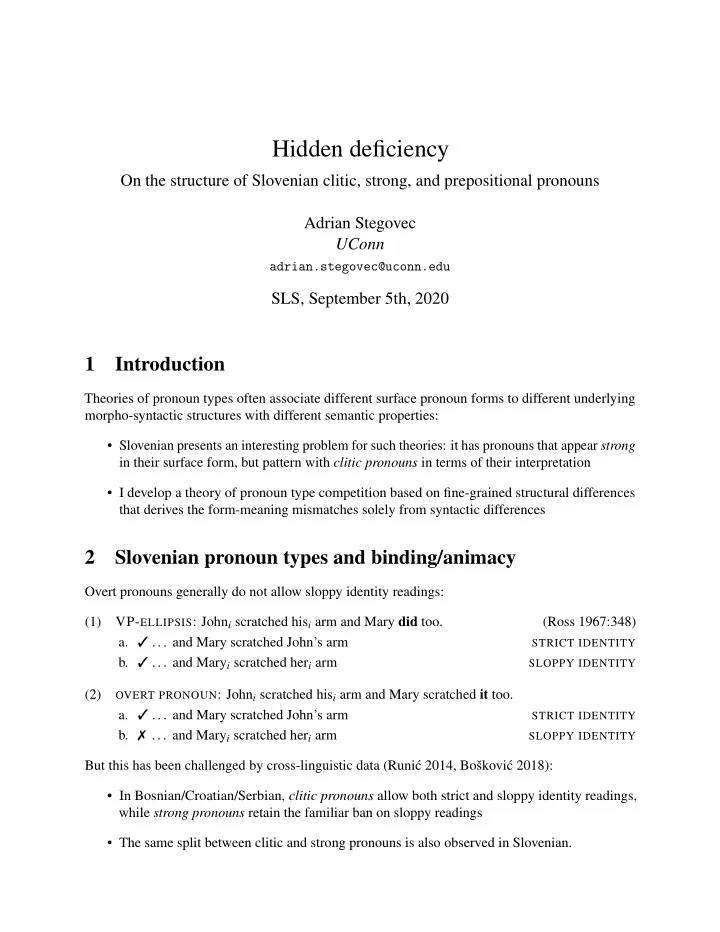
Overt pronouns generally do not allow sloppy identity readings: (1) VP-ELLIPSIS: Johni scratched hisi arm and Mary did too. (Ross 1967:348)

  • a. ✓ ... and Mary scratched John’s arm

STRICT IDENTITY

  • b. ✓ ... and Maryi scratched heri arm

SLOPPY IDENTITY

(2)

OVERT PRONOUN: Johni scratched hisi arm and Mary scratched it too.

  • a. ✓ ... and Mary scratched John’s arm

STRICT IDENTITY

  • b. ✗ ... and Maryi scratched heri arm

SLOPPY IDENTITY

But this has been challenged by cross-linguistic data (Runi´ c 2014, Boškovi´ c 2018):

  • In Bosnian/Croatian/Serbian, clitic pronouns allow both strict and sloppy identity readings,

while strong pronouns retain the familiar ban on sloppy readings

  • The same split between clitic and strong pronouns is also observed in Slovenian.
slide-2
SLIDE 2

SLS 2 September 5th, 2020

2.1 The binding asymmetry between clitic and strong pronouns

(3) a.

STRONG PRONOUN ⇒ ONLY STRICT IDENTITY:

Pero Pero ceni values svojega self’s.M.ACC

  • ˇ

ceta, father.ACC in and Maja Maja njega him.ACC tudi also ceni values ‘Peroi values hisi father and Majak values hisi father too.’ b.

CLITIC PRONOUN ⇒ STRICT AND SLOPPY IDENTITY:

Pero Pero ceni values svojega self’s.M.ACC

  • ˇ

ceta, father.ACC in and Maja Maja ga

3.M.ACC

tudi also ceni values ‘Peroi values hisi father and Majak values {hisi father / herk father} too.’

2.2 The animacy asymmetry between clitic and strong pronouns

(4) a.

STRONG PRONOUN ⇒ MUST BE ANIMATE:

Pero Pero pospravlja tidy.up svojo self’s.F.ACC sobo, room.F.ACC in and Maja Maja #njo her.ACC tudi also pospravlja tidy.up ‘Pero is tidying up his room and Maja is tidying #her up too.’ b.

CLITIC PRONOUN ⇒ CAN BE INANIMATE:

Pero Pero pospravlja tidy.up svojo self’s.F.ACC sobo, room.F.ACC in and Maja Maja jo

3.F.ACC

tudi also pospravlja tidy.up ‘Pero is tidying up his room and Maja is tidying it up too.’

2.3 Strong-only pronouns

Strong pronouns without a weak counterpart pattern with clitics in both respects: (5)

STRONG-ONLY PRONOUN ⇒ STRICT/SLOPPY & CAN BE INANIMATE:

Pero Pero se

SE

igra play s with svojimi self’s.PL.INST Legicami Legos.INST in and Maja Maja se

SE

tudi also igra play z with njimi. them.INST ‘Peroi is playing with hisi Legos and Majak is playing with {hisi Legos / herk Legos} too.’

2.4 Prepositional pronouns

Strong pronouns may have “reduced” counterparts in PPs distinct from clitic forms—henceforth P-pronouns—which also pattern with clitic pronouns in terms of interpretation: (6) a.

STRONG PRONOUN ⇒ ONLY STRICT IDENTITY:

Pero Pero misli think na

  • n

svojega self’s.M.ACC

  • ˇ

ceta, father.ACC in and Maja Maja tudi also misli think na

  • n

njéga. him.ACC ‘Peroi is thinking of hisi father and Majak is thinking of hisi father too.’

  • b. P-PRONOUN ⇒ STRICT AND SLOPPY IDENTITY:

Pero Pero misli think na

  • n

svojega self’s.M.ACC

  • ˇ

ceta, father.ACC in and Maja Maja tudi also misli think ná_nj.

  • n_him.ACC

‘Peroi is thinking of hisi father and Majak is thinking of {hisi father / herk father} too.

slide-3
SLIDE 3

Hidden deficiency 3 Adrian Stegovec (UConn) (7) a.

STRONG PRONOUN ⇒ MUST BE ANIMATE:

Pero Pero je is padel fell na

  • n

(svojo) (self’s.F.ACC) rit, butt.F.ACC in and Maja Maja je is tudi also padla fell.F na

  • n

#njó. her.ACC ‘Pero fell on his butt and Maja also fell on #her.’

  • b. P-PRONOUN ⇒ CAN BE INANIMATE:

Pero Pero je is padel fell na

  • n

(svojo) (self’s.F.ACC) rit, butt.F.ACC in and Maja Maja je is tudi also padla fell.F ná_njo.

  • n_her.ACC

‘Pero fell on his butt and Maja also fell on it.’

2.5 Summary of the pattern

PRONOUN STRICT IDENTITY SLOPPY IDENTITY ANIMATE INANIMATE

clitic ✓ ✓ ✓ ✓ P-pronoun ✓ ✓ ✓ ✓ strong-only ✓ ✓ ✓ ✓ strong with counterpart ✓ ✗ ✓ ✗ Table 1: Summary of pronoun type distribution in Slovenian Why this is important:

  • 1. Pronouns other than clitic pronouns can get sloppy and inanimate readings
  • 2. Even strong pronouns can get sloppy and inanimate readings

Issues: (i) Pronouns rigid in form (strong-only) may be semantically flexible (ii) The interpretation of pronouns appears to be determined based on prosodic factors: Descriptive generalization Only pronouns that ... (a) cannot be stressed, or (b) do not have unstressed counterparts in the relevant context ... license sloppy readings and inanimate referents. I propose an analysis of Slovenian pronouns where the apparent modularity issue in (ii) can be resolved entirely in the syntax via a fine-grained approach to pronoun structure.

slide-4
SLIDE 4

SLS 4 September 5th, 2020

3 A closer look at Slovenian pronoun types

3.1 Clitic pronouns

Clitic pronouns (which are 2nd position clitics) exist for ACC, GEN, and DAT case:

SINGULAR PLURAL DUAL REFL

1P 2P 3P.M 3P.F 1P 2P 3P 1P 2P 3P

ACC

se me te ga jo nas vas jih naju vaju ju

GEN

se me te ga je nas vas jih naju vaju ju

DAT

si mi ti mu ji nam vam jim nama vama jima

ACC

sebe mene tebe njega njo nas vas njih naju vaju nju

GEN

sebe mene tebe njega nje nas vas njih naju vaju nju

DAT

sebi meni tebi njemu njej nam vam njim nama vama njima Table 2: Slovenian clitic vs. strong pronouns (distinctive morphemes in boldface)

3.2 Strong-only pronouns

Clitic pronouns in Slovenian are disallowed as objects of PPs (cf. Abels 2003a,b)

  • Whether a pronoun has a clitic counterpart is relative to the particular context
  • Possibility of sloppy readings is also contextual: the same strong pronouns that disallow them
  • utside PPs (8) allow them in PPs (9) (same for inanimate readings):

(8) a.

STRONG PRONOUN ⇒ ONLY STRICT IDENTITY:

Pero Pero pomaga help svojim self’s.PL.DAT prijateljem friends.DAT in and Maja Maja tudi also njim them.DAT pomaga. help ‘Peroi hels hisi friends and Majak helps hisi friends too.’ b.

CLITIC PRONOUN ⇒ STRICT AND SLOPPY IDENTITY:

Pero Pero pomaga help svojim self’s.PL.DAT prijateljem friends.DAT in and Maja Maja jim

3PL.DAT

tudi also pomaga. help ‘Peroi helps hisi friends and Majak helps {hisi friends / herk friends} too.’ (9)

STRONG-ONLY PRONOUN ⇒ STRICT AND SLOPPY IDENTITY:

Pero Pero se

SE

vraˇ ca return k to svojim self’s.PL.DAT koreninam roots.DAT in and Maja Maja se

SE

tudi also vraˇ ca return k to njim. them.DAT ‘Peroi is going back to hisi roots and Majak is going back to {?hisi roots / herk roots} too.’ In Slovenian, LOC and INST cases are only found in PPs, so LOC/INST pronouns are always strong: (10)

  • a. Hodijo

walk.PL *(ob) beside njem. him.LOC ‘They are walking beside him.’

  • b. Hodijo

walk.PL *(z) with njim. him.INST ‘They are walking with him.’

slide-5
SLIDE 5

Hidden deficiency 5 Adrian Stegovec (UConn)

SINGULAR PLURAL DUAL REFL

1P 2P 3P.M 3P.F 1P 2P 3P 1P 2P 3P

LOC

sebi meni tebi njem(u) njej nas vas njih naju vaju n(ji)ju

INST

sabo mano tabo njim njo nami vami njimi nama vama njima Table 3: Slovenian locative/instrumental pronouns (strong-only)

3.3 P-pronouns

Possible with: ‘na’ (‘on / onto’), ‘v/u’ (‘in / into’), and ‘za’ (‘for’); in some dialects/registers also with ‘pod’ (‘under’), ‘ˇ cez’ (‘over’), ‘pred’ (‘before’), but only exist in ACC case forms: (11)

  • a. Padel

fell.M sem am ná_nj.

  • n_him.ACC

‘I fell on it/him.’

  • b. Padel

fell.M sem am na

  • n

njéga. him.ACC ‘I fell on him.’ (12)

  • a. *Stal

stand.M sem am ná_nj(em).

  • n_him.LOC

‘I was atanding on it/him.’

  • b. Stal

stand.M sem am na

  • n

njém. him.LOC ‘I was atanding on it/him.’ Additionally, they do not have 1/2P plural and dual forms:

SINGULAR PLURAL DUAL REFL

1P 2P 3P.M 3P.F 1P 2P 3P 1P 2P 3P ná_se ná_me ná_te ná_nj ná_njo ná_nje ná_nju na sébe na méne na tébe na njéga na njó na nás na vás na njíh na náju na váju na njú

Table 4: Slovenian P-pronouns vs. strong pronouns (‘on’+ ACC pronoun) LF properties can not be localized to a single morphological property across pronouns: PATTERN 1 PATTERN 3

STRONG CLITIC

P-PRON.

STRONG CLITIC

P-PRON.

3.M

njé-ga ga ná-nj

3.PL

n-jíh jih ná-nj-e PATTERN 2 PATTERN 4

1.SG

m-en-e m-e ná-m-e

3.F

n-jó jo ná-n-jo

2.SG

t-eb-e t-e ná-t-e

3.DU

n-jú ju ná-n-ju

REFL

s-eb-e s-e ná-s-e Table 5: P-pronouns compared to strong/clitic pronouns

slide-6
SLIDE 6

SLS 6 September 5th, 2020 The only constant for P-pronouns is that P always bears stress: PATTERN 1: clitic and P-pronoun have no morphemes in common; PATTERN 2: clitic and P-pronoun are identical, apart from the P part; PATTERN 3: inflection on a P-pronoun differs from the clitic/strong forms; PATTERN 4: strong and P-pronoun are identical apart from stress. There is no single morpheme we can blame for the LF split; the pronouns appear to be grouped into their respective class at LF based on idiosyncratic PF properties. ⇒ Descriptive generalization: Only pronouns that (a) cannot be stressed (clitic and P-pronouns)

  • r (b) do not have an unstressed counterpart in the relevant context (strong-only pronouns)

license sloppy readings and inanimate referents; ⇒ Unexpected from the perspective of the Y-model of grammar (Chomsky 1995).

3.4 Previous analyses or the strict/sloppy pronoun split

Both existing approaches to the phenomenon draw direct parallels to East Asian-style argument ellipsis, which can also license sloppy readings (see Whitman 1988, Otani and Whitman 1991, Tomioka 2003, Saito 2007, Sakamoto 2017, i.a.): Runi´ c (2014): Clitic pronouns that license sloppy readings are property anaphora of type e,t (Tomioka 2003), but their strong counterparts are type e, attributed to focus:

  • This does not explain the semantically flexible strong-only pronouns
  • It also leaves the animacy restriction unexplained

Boškovi´ c (2018): Similar to the other approach, but sloppy reading is restricted to clitic-doubling configurations with an elided NP double of type e,t

  • Does not explain sloppy readings with strong-only pronouns and P-pronouns
  • It also leaves the animacy restriction unexplained

4 Analysis

The LF differences arise as a result of differences in the structural complexity of the different pronoun types (cf. Cardinaletti and Starke 1994, 1999, Déchaine and Wiltschko 2002, Patel-Grosz and Grosz 2017), where less structure entails greater semantic flexibility

  • However: All pronouns in Slovenian have a corresponding competing structure, even strong-
  • nly pronouns, which appear to always have the same form at PF
  • As a result, a pronoun that appears strong, may behave like a clitic/P-pronoun
slide-7
SLIDE 7

Hidden deficiency 7 Adrian Stegovec (UConn)

4.1 Semantic behavior

4.1.1 Deriving semantically flexible pronouns I adopt a Tomioka (2003)/Runi´ c (2014)-style approach to sloppy identity pronouns:

  • This analysis builds on Chierchia’s (1998) treatment of semantic differences between DP

languages (like English) NP languages (like Slovenian);

  • In the latter, bare NPs, of type e,t, can function as arguments and are mapped to individual-

type (e) elements via type shifting semantic rules. Tomioka (2003) proposes that Japanese null arguments, which license sloppy readings, are property anaphors of type e,t and can shift to individual-type the same way

  • Runi´

c (2014) extends this to clitic pronouns in NP languages, and I will extend it to clitic, strong-only, and P-pronouns in Slovenian ⇒ We will see below why these three pronoun types form a natural class. (13)

STRICT IDENTITY READING (coreference):

  • a. Pero1 loves [his1 father](=Jaka) and Maja2 loves him(=Jaka) too
  • b. Input LF: [TP Maja2 [ 2 [vP t2 loves [R4 u5]]]]

(R is a is a relation type e,e,t or also just e,t)

  • c. u5g = Jaka

(where g(5) = Jaka) R4g = λz.λx.[x = z] (where g(4) = λz.λx.[x = z]) (14)

SLOPPY IDENTITY READING (binding into pronoun):

  • a. Pero1 loves his1 father and Maja2 loves him(=her2 father) too
  • b. Input LF: [TP Maja2 [ 2 [vP t2 loves [R3 u2]]]]
  • c. u2g = Maja

(where g(2) = Maja) R3g = λz.λx.[father(x)(y)] (where g(3) = λy.λx.[father(x)(y)]) 4.1.2 Deriving semantically rigid pronouns Both demonstrative and rigid strong pronouns in Slovenian require a linguistic antecedent: (15) a. ˇ Ce if sem am noseˇ ca, pregnant { ga

3.M.ACC

} bom will.1 { #njega him.ACC / / #tega

DEM.M.ACC

} obdržala. keep ‘If I am pregnant, I will keep {it / #him / #that child}.’ b. ˇ Ce if dobim get.1

  • troka,

child.M.ACC { ga

3.M.ACC

} bom will.1 { njega him.ACC / / tega

DEM.M.ACC

} obdržala. keep ‘If I get a child, I will keep {it / him / that child}.’

slide-8
SLIDE 8

SLS 8 September 5th, 2020 Patel-Grosz and Grosz (2017) extend Schwarz’s (2009) analysis of German weak vs. strong definite articles respectively to personal vs. demonstrative pronouns:1

  • Demonstrative pronouns differ from personal ones in requiring an anaphoric index, imposing

identity of the pronoun’s referent with a salient discourse referent;

  • I adopt here Hanink (2017, 2018)’s reinterpretation of Schwarz (2009), which associates the

anaphoric index to a dedicated syntactic head (idx). I propose that all semantically rigid Slovenian pronouns (always strict and animate) are structurally complex, in that they are a personal pronoun dominated by an idx head: (16) idxkg= λx.[animate(x) & x = g(k)] ⇒ This idx is an identity function which also imposes animacy. The idx head ensures that only strict readings are possible: (17)

STRICT IDENTITY READING (coreference):

  • a. Pero1 loves [his1 father](=Jaka) and Maja2 loves him(=Jaka) too
  • b. Input LF: [TP Maja2 [ 2 [vP t2 loves [idxP idx5 [R4 u5]]]]]
  • c. u5g = Jaka

(where g(5) = Jaka) R4g = λz.λw.[w = z] (where g(4) = λz.λw.[w = z]) ☞ idx5g = λx.[animate(x)& x = g(5)] = λx.[animate(x)& x = Jaka] (18)

LACK OF SLOPPY READING:

  • a. *Pero1 loves his1 father and Maja2 loves him(=her2 father) too
  • b. Input LF: [TP Maja2 [ 2 [vP t2 loves [idxP idx7 [R3 u2]]]]]
  • c. TPg = loves(ιx[animate(x)& x = g(7)& father(x)(Maja)])(Maja)

⇒ TPg will always be undefined in the relevant context because Maja’s father has not been introduced as a linguistic antecedent (cf. (15a) above) 4.1.3 Picking the right pronoun in the derivation The proposal above introduces a lot of redundancy, which is actually our goal: in most contexts the two types of pronouns will be semantically equivalent ⇒ Choosing the right pronoun in a given derivation is then going to be governed by Economy of Representation principles, favoring structurally simpler pronouns. Avoid Pronoun (Chomsky 1981:65), Minimal Structure Principle (Law 1991), Structural Economy Principle (Safir 1993:64), Speas (1994:186-187), Minimize Structure (Cardinaletti and Starke 1994:89) Chomsky (1995:294), Minimize Restrictors! (Schlenker 2005:391), . . .

1See Wiltschko (1998), Bosch et al. (2003), Bosch and Umbach (2007), Patel-Grosz and Grosz (2017), i.a.

slide-9
SLIDE 9

Hidden deficiency 9 Adrian Stegovec (UConn) Given the approach I am taking to semantically rigid pronouns, I adopt: (19) Minimize DP! (Patel-Grosz and Grosz 2017:279) An extended NP projection α is deviant if α contains redundant structure; i.e.:

  • a. if there exists an extended NP projection β that has fewer syntactic nodes than α, and
  • b. Referential Irrelevance: if β is grammatical and has the same denotation as α, and
  • c. Pragmatic Irrelevance: if using α instead of β does not serve another purpose.

But we must also ensure that pronouns with fewer interpretable features with marked values (if these correspond to nodes in the pronoun) are not picked over pronouns with more of them: ⇒ Interpretable features on pronouns introduce presuppositions (Cooper 1983); ⇒ Maximize Presupposition! (Heim 1991) ensures we pick the pronouns that carry the strongest presupposition compatible with the context.

4.2 Explaining the morphological and phonological split

The syntactic building blocks for personal pronouns: √pro LF: Maps to property variable ([Ri x j] from above) PF: Provides lexical accent (Σ), required for stress assignment ((Σ)) ϕ LF: Maps to property variable ([Ri x j]) + ϕ-feature presuppositions PF: Spells-out values of ϕ-features K LF: Is uninterpretable [uK] if structural and interpretable [iK] with presuppositions if lexical (cf. Franks 1994, Boškovi´ c 2006, 2007) PF: Spells-out case features; can condition spell-out of ϕ-features (Slovenian inflection is fusional); delimits the phonological word (ω) idx LF: Ensures animacy and introduces anaphoric index PF: Always null (∅) P PF: Depending on the P, may or may not be lexically accented (Σ); can condition spell-out of ϕ-features if K is missing in the structure. K-less pronouns: P can license a pronoun either by assigning it Case or incorporating it (cf. Baker 1988), in which case K is redundant—unless K is interpretable Stress-shift to P: In Bosnian/Croatian/Serbian stress may shift from NP to P, but not if NP is structurally complex (Tali´ c 2018); I propose a similar process is active with Slovenian pronouns: (20) Prosody & stress rules (simple version; cf. Russian stress rule, Kiparsky and Halle 1977):

  • a. KP/PP is a prosodic word ω iff it dominates at least 1 accented syllable Σ
  • b. An accented syllable Σ must be part of a prosodic word ω
  • c. Within a prosodic word ω stress the leftmost accented syllable: (ω(ΣΣ)), if ω contains

no accented syllables, stress the leftmost syllable: (ω(σσ))

slide-10
SLIDE 10

SLS 10 September 5th, 2020 As a result there are two different ways for a pronoun to be prosodically deficient: (i) Pronoun lacks √pro and thus lexical accent: all clitic pronouns, some P-pronouns (ii) Pronoun lacks KP and cannot project prosodic word boundary: some P-pronouns 4.2.1 Strong vs. clitic pronouns Example for 3rd person masculine dative—same difference with all strong-clitic pairs: (21)

  • a. Strong:

idxP KP(ω) ϕ √pro njé (Σ) ϕ[sg,m]

  • m

K[dat]

  • u

(σ) idx ∅

  • b. Clitic:

KP(σ) ϕ[sg,m] m K[dat]

  • u

(σ)

LF: Strong pronoun semantically rigid, due to idx PF: Strong pronoun can be stressed, due to √pro mapping to Σ; clitic pronoun is prosodically deficient (σ), has no √pro/Σ in KP and requires a non-deficient host 4.2.2 Strong vs. P-pronouns In PPs, prosodically deficient pronouns cannot move out of PP (cf. Abels 2003a,b) and cliticize to a prosodically non-deficient host; but some Ps may serve as such a host.

  • The absence of KP is permitted as ACC assigned by the Ps is structural uninterpretable Case

⇒ In the syntax, incorporation of the pronoun into PP will license the pronoun PATTERN 1. Different morphemes in the two types of reduced pronouns (3.M.SG.ACC): (22)

  • a. Strong:

PP(ω) P ná (Σ) idxP KP(ω) ϕ √pro njé (Σ) ϕ[sg,m]

  • ga

(σ) K[acc] ∅ idx ∅

  • b. P-pronoun:

PP(ω) P[acc] ná (Σ) √pro

  • nj
  • c. Clitic:

KP(σ) ϕ[sg,m] ga (σ) K[acc] ∅

LF: Strong pronoun semantically rigid, due to idx PF: Strong pronoun can be stressed, due to √pro/Σ; P-pronoun is prosodically deficient: √pro/Σ is not dominated by KP, but it is dominated by an accented P

slide-11
SLIDE 11

Hidden deficiency 11 Adrian Stegovec (UConn) PATTERN 2. Same morphemes in P-pronoun and clitic pronoun (1.SG.ACC): (23)

  • a. Strong:

PP(ω) P ná (Σ) idxP KP(ω) # π π[1] m- √pro én (Σ) #[sg]

  • e

(σ) K[acc] ∅ idx ∅

  • b. P-pronoun:

PP(ω) P[acc] ná (Σ) # π[1]

  • m

#[sg]

  • e

(σ)

  • c. Clitic:

KP(σ) # π[1] m #[sg]

  • e

(σ) K[acc] ∅

LF: Strong pronoun semantically rigid, due to idx PF: Strong pronoun can be stressed, due to √pro/Σ; P-pronoun is prosodically deficient: lacks √pro/Σ and KP, but can cliticize to accented P PATTERN 3. Different inflection in P-pronoun vs. strong and clitic pronoun (3.PL.ACC): (24)

  • a. Strong:

PP(ω) P ná (Σ) idxP KP(ω) # √pro n (Σ) #[-sg]

[+aug]#+K[acc]

  • h

idx ∅

  • b. P-pronoun:

PP(ω) P[acc] ná (Σ) # √pro

  • nj

(Σ) #[-sg,+aug]

  • e
  • c. Clitic:

KP(σ) #[-sg]

(σ)

[+aug]#+K[acc]

  • h

LF: Split is yielded the same way as above (via idx) PF: Same as above, lack of KP leads to incorporation into PP

  • Plural vs. dual contrast requires [−singular] and [±augmented] features—here K is fused

(Halle and Marantz 1993) with the # head that yields [±augmented]

  • If K is absent, the two #s are fused, requiring a different morpheme (cf. relative pronoun

katere (‘which.PL.ACC’); demonstrative pronoun te (‘this.PL.ACC’)

slide-12
SLIDE 12

SLS 12 September 5th, 2020 PATTERN 4. P-pronoun and strong pronoun differ only in stress-shift (3.F.SG.ACC): (25)

  • a. Strong:

PP(ω) P ná (Σ) idxP KP(ω) ϕ √pro n (Σ) ϕ[sg,f]

K[acc] ∅ idx ∅

  • b. P-pronoun:

PP(ω) P[acc] ná (Σ) ϕ √pro

  • n

(Σ) ϕ[sg,f]

  • jo
  • c. Clitic:

KP(σ) ϕ[sg,f]

(σ) K[acc] ∅

LF: Split is yielded the same way as above (via idx) PF: Lack of KP leads to incorporation into PP; only idx and K can be dropped 4.2.3 Strong-only pronouns In the context of unaccented interpretable lexical-Case assigning Ps, there are never any surface clitic/P-forms, but there can still be an underlying structural difference: (26) a.

PP(ω) P[inst] zá (σ) idxP KP(ω) # √pro n (Σ) #[pl]

K[inst]

  • mi

(σ) idx ∅

b.

PP(ω) P[inst] zá (σ) KP(ω) # √pro n (Σ) #[pl]

K[inst]

  • mi

(σ)

LF: Split is yielded the same way as above (via idx) PF: No difference, as idx never makes any PF contribution Smaller versions of such pronouns are impossible and yield ungrammatical results: (27) a.

*PP(σ) P[inst] zá (*σ) idxP KP(σ) #[pl]

  • ji

K[inst]

  • mi

(*σ) idx

b.

*PP(ω) P[inst] za (σ) # √pro n (Σ) #[pl]

  • jí/-é
slide-13
SLIDE 13

Hidden deficiency 13 Adrian Stegovec (UConn)

  • Absence of √root yields a crash at PF (cf. (27a)): stress assignment requires a prosodic word

(ω), which cannot be formed here due to lack of Σ’s both in KP and PP

  • Absence of KP is unrecoverable (violates Maximize Presupposition!):

lexical instrumental case assigned by P is interpretable (introduces pressupositions).

5 Conclusion

  • Slovenian pronouns show that what we see is not always what we get: the form of a pronoun

at PF may be misleading in relation to its underlying structure

  • However, I have shown that an analysis in terms of purely syntactic differences is possible—

but to arrive at it, we have to carefully consider both PF and LF factors

References

Abels, Klaus. 2003a. *[P clitic]!—Why? In Proceedings of FDSL 4, Potsdam 2001, eds. P. Kosta, J. Blaszczak,

  • J. Frasek, L. Geist, and M. Zygis, 443–460. Frankfurt am Main: Peter Lang.

Abels, Klaus. 2003b. Successive cyclicity, anti-locality, and adposition stranding. PhD diss, UConn. Baker, Mark C. 1988. Incorporation. Chicago: University of Chicago Press. Bosch, Peter, and Carna Umbach. 2007. Reference determination for demonstrative pronouns. In Intersenten- tial pronominal reference in child and adult language, eds. Dagmar Bittner and Natalia Gargarina. Vol. 48

  • f Zas papers in linguistics, 39–51. Berlin: ZAS.

Bosch, Peter, Tom Rozario, and Yufan Zhao. 2003. Demonstrative pronouns and personal pronouns: German der vs. er. In Proceedings of the eacl 2003 workshop on the computational treatment of anaphora, 61–68. East Stroudsburg, PA: Association for Computational Linguistics. Boškovi´ c, Željko. 2006. Case and agreement with genitive of quantification in russian. In Agreement systems,

  • ed. Cedric Boeckx, 99–121. Amsterdam: John Benjamins.

Boškovi´ c, Željko. 2007. On the locality and motivation of Move and Agree: An even more minimal theory. Linguistic Inquiry 38 (4): 589–644. Boškovi´ c, Željko. 2018. On clitic doubling and argument ellipsis: Argument ellipsis as predicate ellipsis. English Linguistics 35: 1–37. Cardinaletti, Anna, and Michal Starke. 1994. The typology of structural deficiency: On the three grammatical

  • classes. Working Papers in Linguistics 4 (2): 41–109. University of Venice.

Cardinaletti, Anna, and Michal Starke. 1999. The typology of structural deficiency: A case study of the three classes of pronouns. In Clitics in the languages of europe, 145–233. New York: Mouton de Gruyter. Chierchia, Gennaro. 1998. Reference to kinds across languages. Natural Language Semantics 6: 339–405. Chomsky, Noam. 1981. Lectures on government and binding. Dordrecht: Foris. Chomsky, Noam. 1995. The minimalist program. Cambridge: MIT Press. Cooper, Robin. 1983. Quantification and semantic theory. Dordrecht: Riedel. Déchaine, Rose-Marie, and Martina Wiltschko. 2002. Decomposing pronouns. Linguistic Inquiry 33 (3): 409–442. Franks, Steven. 1994. Parametric properties of numeral phrases in slavic. Natural Language & Linguistic Theory 12 (4): 597–674. Halle, Morris, and Alec Marantz. 1993. Distributed morphology and the pieces of inflection. In The view from Building 20, eds. K. Hale and S. J. Keyser, 111–176. Cambridge: MIT Press.

slide-14
SLIDE 14

SLS 14 September 5th, 2020

Hanink, Emily. 2017. The german definite article and the ‘sameness’ of indices. University of Pennsylvania Working Papers in Linguistics 23: 9. Hanink, Emily. 2018. Structural sources of anaphora and sameness. PhD diss, University of Chicago. Heim, Irene. 1991. Artikel und definitheit. In Semantik: Ein internationales handbuch der zeitgenössischen forschung, eds. Arnim von Stechow and D. Wunderlich, 487–534. Berlin: de Gruyter. Kiparsky, Paul, and Morris Halle. 1977. Towards a reconstruction of the Indo-European accent. In Studies in stress and accent, ed. Larry M. Hyman. Vol. 4 of Southern california occasional papers in linguistics, 209–238. Los Angeles: Department of Linguistics, University of Southern California. Law, P. 1991. Effects of head movement on theories of subjacency and proper government. PhD diss, MIT. Otani, Kazuyo, and John Whitman. 1991. V-raising and VP-ellipsis. Linguistic Inquiry 22: 345–358. Patel-Grosz, Pritty, and Pagrtrick G. Grosz. 2017. Revisiting pronominal typology. Linguistic Inquiry 48 (2): 259–297. https://doi.org/10.1162/LING_a_00243. Ross, John Robert ‘Haj’. 1967. Constraints on variables in syntax. PhD diss, MIT. Runi´ c, Jelena. 2014. A new look at clitics, clitic doubling, and argument ellipsis. PhD diss, UConn. Safir, Ken. 1993. Perception, selection, and structural economy. Natural Language Semantics 2: 47–70. Saito, Mamoru. 2007. Notes on East Asian argument ellipsis. Language Research 43: 203–227. Sakamoto, Yuta. 2017. Escape from silent syntax. PhD diss, UConn. Schlenker, Philippe. 2005. Minimize restrictors! (notes on ddefinite descriptions, condition c and epiteths). In Proceedings of SuB 9, eds. Emar Maier, Corien Bary, and Janneke Huitink, 385–416. Nijmegen: Nijmegen Centre of Semantics. Schwarz, Florian. 2009. Two types of definites in natural language. PhD diss, UMass, Amherst. Speas, Peggy. 1994. Null arguments in a theory of economy of projection. In University of massachusetts

  • ccasional papers 17: Functional projections, eds. E. Banedicto and J. Runner, 179–208. Amherst, MA:

GLSA. Tali´ c, Aida. 2018. Upward p-cliticization, accent shift, and extraction out of pp. Natural Language & Linguistic Theory online only. Tomioka, Satoshi. 2003. The semantics of null arguments and its cross-linguistic investigations. In The interfaces: deriving and interpreting omitted structures, eds. Kerstin Schwabe and Susanne Winkler, 321–339. Amsterdam: John Benjamins. Whitman, John. 1988. Discourse ellipsis and the identity of zero pronouns. In Linguistics in the morning calm 2: Selected papers from the SICOL-1986, ed. The Linguistics Society of Korea, 149–175. Seoul: Hanshin Publishing Company. Wiltschko, Martina. 1998. On the syntax and semantics of (relative) pronouns and determiners. Journal of Comparative Germanic Linguistics 2: 143–181.

slide-15
SLIDE 15

Hidden deficiency 15 Adrian Stegovec (UConn)

Appendix A Full semantic derivations

A.1 Deriving semantically flexible pronouns

(28) Iota rule of interpretation: A non-branching node α dominating β of type e,t can be interpreted as either (i) βg or as (ii) ιz[βgz] (whichever leads to a well-formed derivation). (29)

STRICT IDENTITY READING (coreference):

  • a. Pero1 loves [his1 father](=Jaka) and Maja2 loves him(=Jaka) too
  • b. Input LF: [TP Maja2 [ 2 [vP t2 loves [R4 u5]]]]

(R is a is a relation type e,e,t or also just e,t)

  • c. u5g = Jaka

(where g(5) = Jaka) R4g = λz.λx.[x = z] (where g(4) = λz.λx.[x = z]) [R4 u5]g = g(4)(g(5)) = λz.λx.[x = z](Jaka) = λx.[x = Jaka] vPg = loves(ιx[x = Jaka])(g(2)) (via Iota rule) TPg = λy.[loves(ιx[x = Jaka])(y)](Maja) = loves(ιx[x = Jaka])(Maja) TPg is defined iff there is a unique x such that x is Jaka (which is met), so TPg is true if Maja loves Jaka, false otherwise (30)

SLOPPY IDENTITY READING (binding into pronoun):

  • a. Pero1 loves his1 father and Maja2 loves him(=her2 father) too
  • b. Input LF: [TP Maja2 [ 2 [vP t2 loves [R3 u2]]]]
  • c. u2g = Maja

(where g(2) = Maja) R3g = λz.λx.[father(x)(y)] (where g(3) = λy.λx.[father(x)(y)]) [R3 u2]g = g(3)(g(2)) = λy.λx.[father(x)(y)](g(2)) = λx.[father(x)(g(2))] vPg = loves(ιx[father(x)(g(2))])(g(2)) (via Iota rule) TPg = λy.[loves(ιx[father(x)(y)])(y)](Maja) = loves(ιx[father(x)(Maja)])(Maja) TPg is defined iff there is a unique x such that x is Maja’s father; if defined TPg is true if Maja loves Maja’s father, false otherwise

slide-16
SLIDE 16

SLS 16 September 5th, 2020

A.2 Deriving semantically rigid pronouns

(31) idxkg= λx.[animate(x) & x = g(k)] (32)

STRICT IDENTITY READING (coreference):

  • a. Pero1 loves [his1 father](=Jaka) and Maja2 loves him(=Jaka) too
  • b. Input LF: [TP Maja2 [ 2 [vP t2 loves [idxP idx5 [R4 u5]]]]]
  • c. u5g = Jaka

(where g(5) = Jaka) R4g = λz.λw.[w = z] (where g(4) = λz.λw.[w = z]) [R4 u5]g = g(4)(g(5)) = λz.[λw.[w = z]](Jaka) = λw.[w = Jaka] ☞ idx5g = λx.[animate(x)& x = g(5)] = λx.[animate(x)& x = Jaka] ☞ idxPg = λx.[animate(x)& x = Jaka] (via Predicate Modification) vPg = loves(ιx[animate(x)& x = Jaka])(g(2)) (via Iota rule) TPg = λy.[loves(ιx[animate(x)& x = Jaka])(y)](Maja) = loves(ιx[animate(x)& x = Jaka])(Maja) TPg is defined iff there is a unique x such that x is Jaka and animate (which is met), so TPg is true if Maja loves Jaka, false otherwise (33)

LACK OF SLOPPY READING:

  • a. *Pero1 loves his1 father and Maja2 loves him(=her2 father) too
  • b. Input LF: [TP Maja2 [ 2 [vP t2 loves [idxP idx7 [R3 u2]]]]]
  • c. TPg = loves(ιx[animate(x)& x = g(7)& father(x)(Maja)])(Maja)

TPg is defined iff there is a unique x such that x is animate, the salient individual denoted by g(7), and Maja’s father ⇒ TPg will always be undefined in the relevant context because Maja’s father has not been introduced as a linguistic antecedent (cf. (15a) above)

slide-17
SLIDE 17

Hidden deficiency 17 Adrian Stegovec (UConn)

B The delights and dangers of ambiguity

In the system I adopted above, there are two ways to derive fusional inflectional morphology. Consider the two alternatives for strong pronoun structures: (34)

  • a. ALLOMORPHY + FUSION:

PP(ω) P ná (Σ) idxP KP(ω) # √pro n (Σ) #[-sg]

[+aug]#+K[acc]

  • h

idx ∅

  • b. ALLOMORPHY:

PP(ω) P ná (Σ) idxP KP(ω) # √pro n (Σ) #[+aug]

  • jíh

K[acc] ∅ idx ∅

There is evidence from dialectal variation that both options might be in use:

SINGULAR PLURAL DUAL REFL

1P 2P 3P.M 3P.F 1P 2P 3P 1P 2P 3P ná_se ná_me ná_te ná_nj ná_njo ná_nje ná_nju na sébe na méne na tébe na njéga na njó na nás na vás na njíh na náju na váju na njú

Table 6: Standard Slovenian P-pronouns vs. strong pronouns (‘on’+ ACC pronoun)

REFL SINGULAR PLURAL DUAL

1P 2P 3P.M 3P.F 1P 2P 3P 1P 2P 3P ná_se ná_me ná_te ná_njga ná_njo ná_nas ná_vas ná_njih ná_nju na sébe na méne na tébe na njéga na njó na nás na vás na njíh na náju na váju na njú

Table 7: Gorica Slovenian P-pronouns vs. strong pronouns (‘on’+ ACC pronoun)

P-pronoun alternatives: (35)

  • a. ALLOMORPHY + FUSION (standard):

PP(ω) P[acc] ná (Σ) # √pro

  • nj

(Σ) #[-sg,+aug]

  • e
  • b. ALLOMORPHY (Gorica):

PP(ω) P[acc] ná (Σ) # √pro

  • nj

(Σ) #[+aug]

  • jih ([+aug] / __ [acc])

The difference lies in the reanalysis of plural ([-sg,+aug]) # heads: Do they only encode number or also case information, as in (35b) (conditioned by the case feature on K or P).