
SLIDE 1
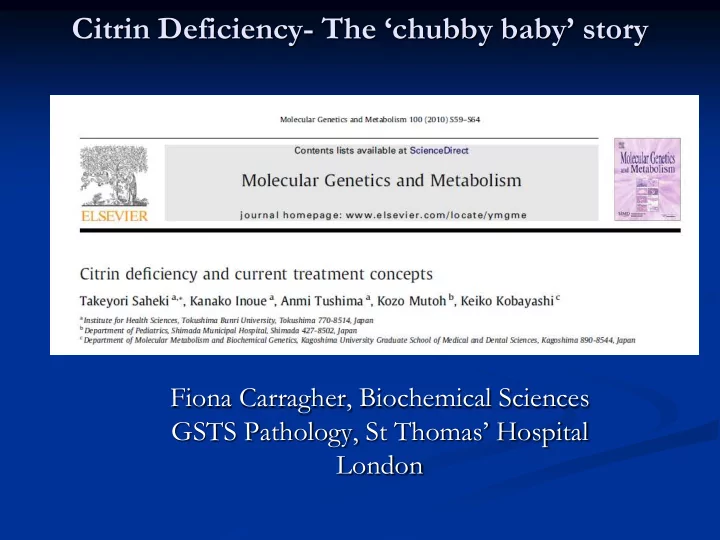
Citrin Deficiency- The chubby baby story Fiona Carragher, - - PowerPoint PPT Presentation
Citrin Deficiency- The chubby baby story Fiona Carragher, Biochemical Sciences GSTS Pathology, St Thomas Hospital London Citrin Deficiency First described in Japan/East Asia Now increasingly recognised worldwide Mutations in
Adult onset type II Citrullinaemia (CTLN2) Neonatal intrahepatic cholestasis (NICCD)
Transports cytosolic NADH-reducing equivalents in
Part of malate-aspartate shuttle
Provides aspartate from mito to cytosol Required for synthesis of proteins, nucleotides and
Argininosuccinate
Increased Citrulline Decreased Arginine Urine orotic acid
Classically presents with
Liver specific decrease in ASS activity
Secondary to citrin deficiency Citrullinaemia present during hyperammonaemia Exact cause not clear
Hyperammonaemia in early adulthood
Neuropsychiatric symptoms Disorientation and delirium Seizures and Coma Mortality
Non-alcoholic fatty liver disease
Not-overweight
Growth retardation /FTT Severe intrahepatic Cholestasis
Aminoacidaemia (cit/thr/met/tyr/arg) Galactosaemia Hypoproteinaemia Fatty liver
Healthy period may last decades
May require liver transplantation
NICCD have a characteristic food preference
Carbohydrate avoidance Prefer protein and fat rich foods
Markedly different from know UCD (protein avoid)
14 cases with hyperammonaemic brain oedema 12/14 treated with glycerol died 2/14 treated with mannitol survived
Sister with CTLN2 – liver transplant Fatigue, skinniness, abdominal disorder
High CHO diet
Drowsy with increase
‘Normal’ diet, high
Slight increase NH4
Linear relationship
Under controlled state
Glu formed from NH3 leaves mito instead of Asp Converted in cytosol to Asp by aspartate aminotransferase Formed Asp used by ASS and formation of citrulline
Urea may be synthesised in citrin def
Oxaloacetate essential, formed from malate
Reaction requires NADH to be oxidised
If increased CHO load in citrin def NADH accumulates
Urea cycle inhibited as asp cannot be formed Glycolysis inhibited causing energy deficit
Low protein/ high CHO diet May cause hyperammonaemia in Citrin def
Metabolically normal (but long term immunosup)
Oxidises NADH