
SLIDE 1
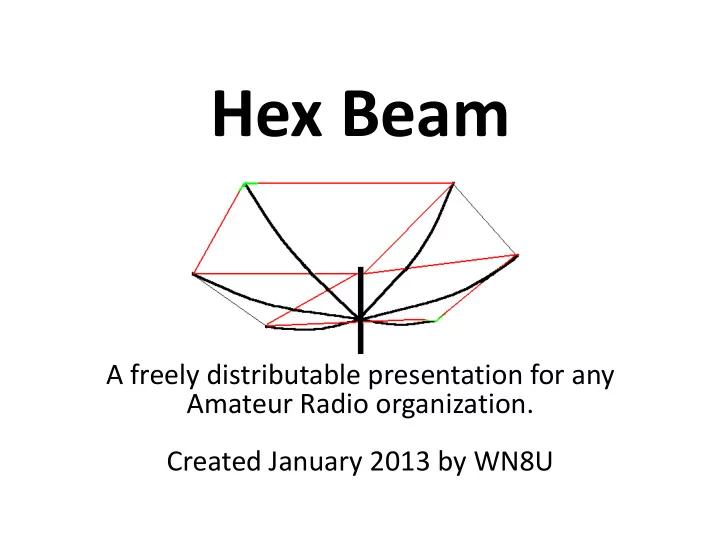
Hex Beam
A freely distributable presentation for any Amateur Radio organization. Created January 2013 by WN8U
Hex Beam A freely distributable presentation for any Amateur Radio - - PowerPoint PPT Presentation
Hex Beam A freely distributable presentation for any Amateur Radio organization. Created January 2013 by WN8U Two kinds of antennas Non-directional: Dipoles, end- feds, NVIS Verticals Directional: Beams and Yagis Traditional beams
A freely distributable presentation for any Amateur Radio organization. Created January 2013 by WN8U
Non-directional: Dipoles, end-feds, NVIS… Verticals… Directional: Beams and Yagis
Beam antennas are typically large, heavy, and require a strong tower to support them. That’s expensive. Beam antennas usually require extensive guying due to wind loads Beam antennas usually only work on three bands or less Beam antennas are usually expensive.
A Hex Beam or hexagonal beam is a two element, directional antenna Typically supports up to six bands (20, 17, 15, 12, 10, 6) Can be configured mono-band or multi-band (most common) No tuner required, no loading coils or traps in design, single feed point, full legal limit, weighs under 25lbs, wind load of under 5 sq ft, and turning radius of 11 ft. Typically better than 6dB of gain, F/B ratio comparable to a 2- element yagi.
There are two versions of the Hex Beam
We will focus on the G3TXQ Broadband Hex Beam design and it’s variants. Advantages over the classic beam is broader band coverage, better gain and better F/B ratio.
Because of the light weight and low wind load of a typical Hex Beam, a large tower (Rohn 25G and such) isn’t needed. The push-up mast/hex beam combo is best used with a rotor mounted at the bottom of the mast. A Yaesu G-450 is adequate for such an installation ($250 or less). A push-up mast (such as Rohn 9H50, 35ft, $150 or less) can be used.
Here is an example of a ground mounted push-up mast with a hex beam:
Here is an example of a post mounted push-up mast with a hex beam using a thrust bearing for more support:
Another example, this time of the rotor at the bottom of a post- mounted mast.
Here is an example of a ground mounted push-up mast with a hex beam, using part of the house for additional support:
1.0 1.1 1.1 1.2 1.2 1.3 1.3 1.4 1.4 1.5 14.000 14.025 14.050 14.075 14.100 14.125 14.150 14.175 14.200 14.225 14.250 14.275 14.300 14.325 14.350 SWR Frequency
20 Meters
1.0 1.1 1.2 1.3 1.4 1.5 18.068 18.100 18.125 18.168 SWR Frequency
17 Meters
1.0 1.1 1.2 1.3 1.4 1.5 1.6 21.000 21.025 21.050 21.075 21.100 21.125 21.150 21.175 21.200 21.225 21.250 21.275 21.300 21.325 21.350 21.375 21.400 21.425 21.450 SWR Frequency
15 Meters
1.0 1.1 1.1 1.2 1.2 1.3 1.3 1.4 24.890 24.925 24.950 24.975 24.990 SWR Frequency
12 Meters
1.0 1.1 1.2 1.3 1.4 28.000 28.050 28.100 28.150 28.200 28.250 28.300 28.350 28.400 28.450 28.500 28.550 28.600 28.650 28.700 28.750 28.800 28.850 28.900 28.950 29.000 SWR Frequency
10 Meters
1.0 1.5 2.0 50.000 50.200 50.400 50.600 50.800 51.000 51.200 51.400 51.600 51.800 52.000 52.200 52.400 52.600 52.800 53.000 53.200 53.400 53.600 53.800 54.000 SWR Frequency
6 Meters
Build Your own: – Base plate – Fiberglass rods – Center post – Support cords – Antenna wire – Odds/ends (hooks, eyelets, coax ends, etc)
Home Brew Hex Beam Page by W1GQL http://midcoast.com/~w1gql/hex/buildyour.htm G3TXQ Broadband Hexbeam http://www.karinya.net/g3txq/hexbeam/broadband/ KE4NU Broadband Hex Beam http://www.hamuniverse.com/ke4nuhexbeam.html
There are a number of indivudals who made excellent hex beam kits: – K4KIO – Very popular, requires some tuning – N4NRR – Gaining popularity, pre-tuned – K5BOB – More expensive, uses minimal metal – DX Engineering – Brand Name $500 - $700 average cost.
The folding beam is a 2-element directive antenna for five amateur bands (20/17/15/12/10m band, 6m band
It consists of wire elements attached to a support structure in a concentric way. The center post carries the support cords and is a coaxial feeder for the drivers. The driver/reflector arrangements are fixed to the fibreglass spreaders.
The feed point cord support is molded onto the center post. Connector SO-239 (N type socket optional at no extra cost)
The hub takes up six swivel spreaders and electrically isolates the center post from the mast or rotator underneath
The spreader sections are connected with locking swivel joints
An open swivel joint
The spreader tips have rounded heads with zig zag slots for the support cords
Clamping the wires onto the spreaders is a snap with special clips!
Antenna collapsed to only 1.15 m (45") total length