Heterogenous Resources for data processing Heterogenous Execution - - PowerPoint PPT Presentation

heterogenous resources for data processing
SMART_READER_LITE
LIVE PREVIEW

Heterogenous Resources for data processing Heterogenous Execution - - PowerPoint PPT Presentation

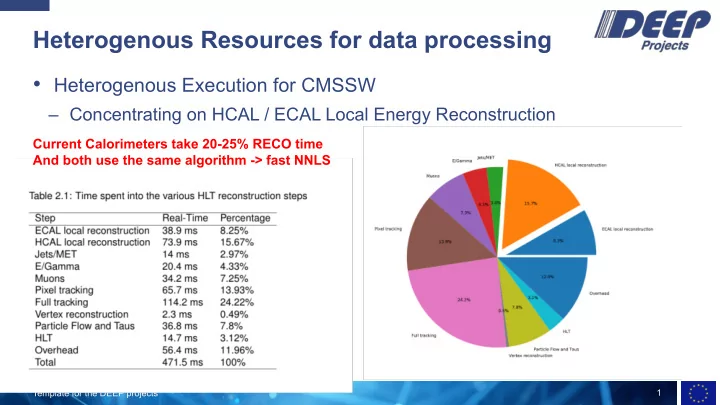
Heterogenous Resources for data processing Heterogenous Execution for CMSSW Concentrating on HCAL / ECAL Local Energy Reconstruction Current Calorimeters take 20-25% RECO time And both use the same algorithm -> fast NNLS 1 Template


slide-1
SLIDE 1
  • Heterogenous Execution for CMSSW

– Concentrating on HCAL / ECAL Local Energy Reconstruction

Template for the DEEP projects 1
Heterogenous Resources for data processing

Current Calorimeters take 20-25% RECO time And both use the same algorithm -> fast NNLS

slide-2
SLIDE 2

Template for the DEEP projects 2

Standalone Implementation

CPU: Intel(R) Core(TM) i7-4770K CPU @ 3.50GHz Tested with Tesla and Volta GPUs

CPU version runs single threaded as it is done for production jobs. Given a fully loaded CPU, no benefit from additional concurrency The point is to remove this load from CPU And understand if this removal is beneficial (transfer + exe + transfer back)

We observe factor of 5x speed up w.r.t. Single threaded CPU implementation In standalone version For #calo channels >= 8K with Volta cards

slide-3
SLIDE 3

Template for the DEEP projects 3

More exotic? Testing Intel FPGAs

Data Flow for FNNLS

  • Standalone implementation of Fast NNLS in OpenCL
  • Offloading N channels
  • impl details
  • Single-work item kernel and no replication (for now)
  • No pipes {yet}, monolithic {=> suboptimal}
  • Essentially c with fpga-specific pragmas

BSP is ~ half total logic Very Very Very preliminary ~5x slower than a cpu version with eigen (but no logic replication, etc…) But with Identical results (up to 10^-4)

slide-4
SLIDE 4

The DEEP projects have received funding from the European Union’s Seventh Framework Programme (FP7) for research, technological development and demonstration and the Horion2020 (H2020) funding framework under grant agreement no. FP7-ICT-287530 (DEEP), FP7-ICT-610476 (DEEP-ER) and H2020-FETHPC-754304 (DEEP-EST).