
SLIDE 1
Expanding t the W World o
- f H
Heterogenous Mem emory H y Hier erarchies The Evolving Non-Volatile Memory Story
16 May 2019 Bill Gervasi Principal Systems Architect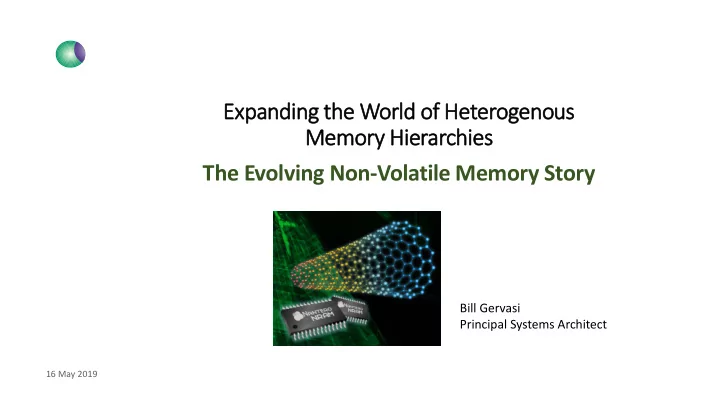
Expanding t the W World o of H Heterogenous Mem emory H y Hier - - PowerPoint PPT Presentation
Expanding t the W World o of H Heterogenous Mem emory H y Hier erarchies The Evolving Non-Volatile Memory Story Bill Gervasi Principal Systems Architect 16 May 2019 2 Data Memory Checkpointing Processing Tiers Challenges
Expanding t the W World o
Heterogenous Mem emory H y Hier erarchies The Evolving Non-Volatile Memory Story
16 May 2019 Bill Gervasi Principal Systems Architect Data Processing Challenges Checkpointing Memory Tiers Persistence Current Solutions Agenda Seeking the Ideal A New Standard Mixed Mode Solutions Distributed Processing Security Sharing Time
Data processing is great
Data processing is great Until something goes wrong
The Cost of Power Failure
Checkpointing degrades performance Checkpointing burns power Checkpointing sucks
FAIL!
Run CheckpointRESTART
But checkpointing avoids data loss from failure
Data persistence is essential System failure is a key factor in server software design Storage access time impacts transaction granularity
The game we play to trade off performance, capacity, and cost
…move non-volatile storage closer to the CPU To reduce the penalties from checkpointing…
Traditional Server Architecture Review
CPU I/O Memory Control
Memory Memory Memory Memory … Network …$
… Memory Memory … Memory Memory …Faster, lower latency
The holy Grail
DATA PERSISTENCE
When we no longer fear power failure…
What if you could replace DRAM with a non-volatile memory? You’d call it Memory Class Storage
The non-volatile memory revolution is under way 3DXP ReRAM PCM MRAM
NRA RAM™
When was the last time you read about a new volatile memory?
From vacuum tubes To core memory To DRAM To NVRAM
THIS is why the term “Persistent Memory” is insufficient The industry must distinguish between deterministic and non-deterministic persistent memory Only “Memory Class Storage” is fully deterministic AND persistent
Not all “persistence” is created equal SRAM DRAM Flash 3DXpoint NRAM FeRAM MRAM ReRAM
“Write endurance” determines HOW persistent Wear leveling needed if writes are limited
Temperature sensitivity impacts long term retention
Weeks of Data Retention DRAM interface is deterministic Data latency is FIXED
READ WRITE WRITE READ WRITE DATA DATA DATA HOUSEKEEPINGAny endurance limit breaks determinism
X X
Full DRAM Speed No endurance limits Fully deterministic
Memory Class Storage
NVRAM
is a
Memory Class Storage
Memory Class Storage NVRAM =
For now…
NVRAM
Memory Class Storage
In the future?
Storage Class Memory
Is NOT a
Memory Class Storage
Flash Storage
Magnetic RAM Resistive RAM 3DXpoint Phase Change 3D NORStorage Class Memory
DDR NVRAM
≥ DRAM performance = DRAM endurance ≥ DRAM capacity
Memory Class Storage
Hard Disk SSD NVMe DDR DRAM Wasteland
Deterministic Non-Deterministic Deterministic Non-Deterministic Deterministic Non-Deterministic
DRAM NVDIMM-N Optane NVRAM Memory Class Storage NVDIMM-P
DRAM
ACT RD WR PRE ACT RD WR PRE ACT RD WR PRE REFRESH ACT RD WR PRERefresh time consumes up to 15% of bandwidth Itty bitty leaky capacitors lose charge
On power fail, you lose
Run
FAIL!
DRAM
NVDIMM-N
DRAM Array Flash Backup NVM Control Isolation Buffers Voltage Regulator Voltage RegulatorHost System
CPUEnergy Source
Power FailNVDIMM-N Use DRAM normally On Power Fail, copy to Flash Power restored, copy to DRAM
Run
FAIL!
NVDIMM-N
Run
Switch to Battery Power Copy DRAM to Flash Copy Flash to DRAM
RESTORE
NVDIMM-N
Copy DRAM to Flash Copy Flash to DRAM 1-2 MINUTES 1-2 MINUTES
One power fail cycle pays for a LOT of protection
Optane
3DXpoint Array NVM ControlHost System
CPU RD DataReads are slow
WR DataWrites are deathly slow Could be used as a very slow DRAM but more common as expansion
Faster than Flash!!! But vs DRAM? Meh Decent capacity, though
Host System
CPUApp Direct
3DXpoint Array NVM ControlHost System
CPU DRAM as CacheMemory Mode
512GB = 512GB 512GB + 64GB = 512GB
Optane
NVDIMM-P
DRAM Cache Non-Volatile Memory Array – Any Kind NVM ControlHost System
CPU Small Energy Source Read A RSP Data A Read B Read C Send Data C Data B RSP Send RSP SendNew non-deterministic protocol Not backward compatible with DDR Requires NVDIMM-P aware CPU NVDIMM-P Protocol
NVDIMM-P Persistence Options
Volatile Mode No Persistence Explicit FLUSH Command Battery Backup ala NVDIMM-N Reduced Energy, Cacheless
DRAM speed Non-volatility Scalable beyond DRAM Low power Low cost Unlimited write endurance Wide temperature range Flexible fabrication & application
NVRAM
Host System Drop in replacement for DRAM Permanently persistent Always available
DRAM NVRAM Memory Class Storage
Fully Deterministic
DDR5 NVRAM
NRAM™ ReRAM * MRAM * PCM *
* Future generation devices Compari ring DRAM AM & NVRA NVRAM
No refresh is required “Self refresh” can be power OFF Some timing differences (but deterministic!) Data persistence definitions Greater per-die capacity
NRAM™ ReRAM MRAM PCM
Timings Precharge requirement Persistence definition DDR5 NVRAM Specification brings coherence
IDLE REFRESH
DRAM
“350 ns”IDLE REFRESH = NOP
NVRAM
Refresh command is not needed Decoded as NOP for compatibility
“0 ns” IDLE SELF REFRESH
DRAM
REFRESH FREQUENCY CHANGE Power burned IDLE
NVRAM
FREQUENCY CHANGE SELF REFRESH “No” power burned
IDLE ACTIVATE PRECHARGE WRITE READ
DRAM
IDLE READ WRITE
NVRAM
Precharge command is not needed Decoded as NOP for compatibility
Persistence Definitions*
Intrinsic: Immediately After WRITE Extrinsic: After FLUSH Command Power Fail: On NVRAM RESET
* Discussions on-going WR WR WR
Data is persistent
Intrinsic Persistence WR WR FLUSH WR WR FLUSH Extrinsic Persistence WR WR WR WR WR RESET Power Fail Persistence
DDR5 DRAM is limited to 32Gb per die
DDR5 NVRAM enables up to 128Tb per die
ACT RD WR ACT RD WR ACT RD WR DDR5 SDRAM REXT ACT RD WR ACT RD WR REXT ACT RD WR DDR5 NVRAM Row Extension adds up to 12 more bits of addressing Backward compatible with DDR5 – Acts like REXT = 0 until needed
Bank buffer 0 ROW COLUMNS Bank buffer 31 ROW
…
DDR5 SDRAM Bank buffer 0 ROW COLUMNS Bank buffer 31 REXT ROW REXT
…
DDR5 NVRAM
“ROW” includes bank group & bank… Row Extension Example
Row Extension Replacement Example
NVRAM Memory Class Storage
Checkpointing can be made to persistent memory Checkpointing can be turned
Phase 1
Run NVRAM Run RunNo checkpoint No checkpoint Phase 2
Keep in mind… Power failure is not the only thing to fear Checkpoints may include system failure Knowing when a task may resume is complicated
Remember Those Persistence Definitions
Immediately After WRITE
Tasks may be safe in nanosecondsAfter FLUSH Command
Tasks may be safe in microsecondsOn NVRAM RESET
Tasks may not be safe until system stability confirmed Performance Capacity Persistence
System designers have a lot of options to balance
Homogenous
Main Memory DRAM MCS Optane NVDIMM-N NVDIMM-P
DRAM + Optane MCS + NVDIMM-P MCS + Optane
Heterogenous
Main Memory
DRAM NVDIMM-N Optane NVRAM Memory Class Storage NVDIMM-P
32GB 64GB 512GB
When capacity meets persistence
DRAM NVDIMM-N Optane MCS
Homogenous
Main Memory Combinations NVDIMM-P Data Safe No Yes Yes Yes Yes Performance Best Best Worst Mid Best+ Capacity 1.0 X 0.5 X 10 X 10 X 1 X+
DRAM + Optane MCS + Optane MCS + NVDIMM-P Data Safe No Yes Yes DRAM + NVDIMM-P No Performance High High High High Capacity 6 X 6 X 6 X 6 X
Heterogeneous
Main Memory Combinations
Homogenous
Main Memory Combinations Software need not care All functions take the same time
Heterogeneous
Main Memory Combinations Software encouraged to put critical functions in faster memory Often mount slower memory as RAM drive
Software support via DAX assists in moving… from mounted drives… …to direct access mode …to RAM drive…
The P Power
Zero Power
Putting a Node to Sleep Operating Mode Self Refresh Mode Instant On means power must stay alive Refresh operations burn significant power
Memory Class Storage can be turned off entirely Operating Mode Power Off
DDR5 memory modules have on-DIMM voltage regulation (PMIC) DIMM power may be shut off independently
System Power
Module PowerPMIC Memory Module (DIMM) System Motherboard
System Power
Module PowerPMIC
Data Buffers Memory Media Module PowerPMIC Multiple power management options System power off; both DIMMs off System power on & both DIMMs off System power on & DIMM1 on, DIMM2 off DIMM1 DIMM2
Nantero NRAM™ My favorite NVRAM
Full presentation on Wednesday… Van der Waals energy barrier keeps CNTs apart or together Data retention >300 years @ 300 ֯C, >12,000 years @ 105 ֯C Stochastic array of hundreds nanotubes per each cell
ELECTRODE ELECTRODE 5 ns balanced read/write performance No temperature sensitivity
2,500 years ago 4,500 years ago 10,000 years ago NRAM Data Retention = 12,000 Years
Array size tuned to the size of drivers & receivers
Drivers Receivers Z Y X NRAM LAYER I/O PHY 64 Kb tile X 256 K tiles = 16 GbChip-level timing is a function of bit line flight times Replicate this “tile” as needed for device capacity Add I/O drivers to emulate any PHY needed
DDR4, DDR5 NRAM
Architectural improvements improve data throughput 15% or greater at the same clock frequency
15-20% Bandwidth: larger is better Elimination of inter-die delays DDR4/DDR5 NRAM NVRAM Memory Class Storage
NRAM NRAM NRAM NRAM NRAM NRAM NRAM NRAM NRAM NRAM NRAM NRAM NRAM NRAM NRAM NRAM NRAM NRAMPlugs into an RDIMM slot Appears to the CPU as DRAM Memory controller may optionally be tuned for NVRAM
One less layer of marshmallows to deal with Fully deterministic Non- deterministic Persistence Persistence
A LEGO?
Know Your Enemy
Would you rather… Step on broken glass? Or some jacks?
…about those energy stores… Batteries Supercapacitors Tantalums (etc.)
Batteries Supercapacitors Tantalums (etc.) High capacity High energy density Low reliability Medium capacity Low energy density Degrade over time Low capacity Low energy density …but stable
Flash or Storage Class Memory Storage Controller DRAM
Energy I/O Energy needed for backup of DRAM cache
Flash or Storage Class Memory Storage Controller
NVRAM
Energy I/O
Eliminate need for backup energy
More room for storage
NVRAM Changes the Math
DRAM cache limited by energy available No DRAM? Cache size dictated by cost/performance 1GB/TB
…to Systems Evolution Switching gears again…
Pop quiz How many CPUs in a 1980s PC?
One?
Graphics Adapter Modem Network Adapter Sound Blaster
They were called “DSPs” Digital Signal Processors They put processing next to the data They were killed by “Native Signal Processing”
DriversAnalog front end devices
$ W WW
With NSP… So why do it?
Now We Are Trending Back
Distributed resources In-memory computing Application-specific computing Artificial intelligence and deep learning Security
Low Latency Fabric
Artificial Intelligence Accelerator Search Engine Graphics Accelerator Human interface Standard CPU HTML processing Human interface management Memory Array Filesystem Aware Storage …
I/O NNP ControlSIMD architectures Matrix interconnections Fast pipes still limit load/save time Challenges:
Tbps links
Example AI accelerator
I/O
Back propagation algorithms complicate things Data loss problems are amplified Checkpointing highly time and bandwidth consuming
The more distributed memory gets, the harder to load and unload
MEM MEM MEM MEM MEM MEM MEM MEM MEM MEM MEM MEM NVRAM TO THE RESCUE! Replacing dynamic memory with persistent memory resolves the data loss issues
…
I/O NNP Control MCS MCS MCS MCS MCS MCS MCS MCS MCS MCS MCS MCSJust leave the data in place as long as you want
HBM HBM HBM HBM MCS HBM MCS HBM MCS HBM MCS HBMReplace DRAM with NVRAM Replace eRAM with NVRAM
SRAM & Registers
The final frontier…
Continuing to look for ways to bring Memory Class Storage down under 1ns
It will happen
Faster edge rates Voltage adjustment Better error check Shadow registers Getting smarter
DATA PERSISTENCE
When we no longer fear power failure…
Full END TO END persistence
Are we getting near the day when we look back at volatile memory…
…and LAUGH?
Persistent data introduces challenges, too
Data is ALWAYS there! Data security is a growing concern
So many potential breaches
Application opens data from previous application Memory moved from one system to another Spy devices on memory buses
Infection via hack Infection via spy devices
Password: X2.Hd44**3#jj0%
General trend is to encrypt data before transmission or storage
Keep the bad guys out
X2.Hd44**3#jj0% X2.Hd44**3#jj0% Host System
CPU Small Energy SourceSome are adding in-memory compute functions including encryption Works as long as the bus is secure Encryption quality may be limited by block transfer size Management of many keys can get complicated quickly
Password: X2.Hd44**3#jj0% ISO/IEC 11889
Power Fail Sucks Saving Data is a Pain Need tiers
& storage Persistence is Essential Today’s Solutions Help Summary But We Can Do Better DDR5 NVRAM Spec in Progress Mix & Match Memories Data Distribution Challenges Persistence Complications Sharing Time
Thank you for your time Bill Gervasi bilge@Nantero.com
I’m here to learn too What do you deal with?