SLIDE 1
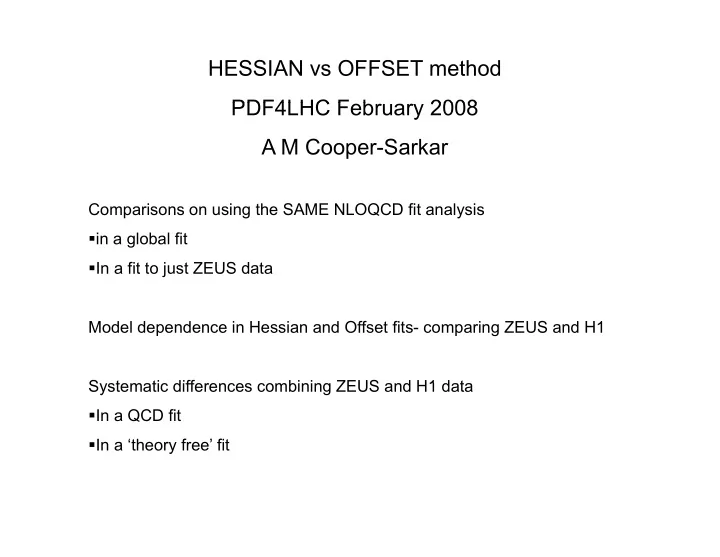
HESSIAN vs OFFSET method PDF4LHC F b 2008 PDF4LHC February 2008 A M Cooper-Sarkar
Comparisons on using the SAME NLOQCD fit analysis in a global fit in a global fit In a fit to just ZEUS data Model dependence in Hessian and Offset fits- comparing ZEUS and H1 Systematic differences combining ZEUS and H1 data Systematic differences combining ZEUS and H1 data In a QCD fit In a ‘theory free’ fit y
SLIDE 2
Treatment of correlated systematic errors
χ2 = Σi [ Fi
QCD (p) – Fi MEAS]2
(σi
STAT)2+(Δi SYS)2
(
i
) (
i
) Errors on the fit parameters, p, evaluated from Δχ2 = 1, THIS IS NOT GOOD ENOUGH if experimental systematic errors are correlated between data points- between data points χ2 = Σi Σj [ Fi
QCD(p) – Fi MEAS] Vij-1 [ Fj QCD(p) – Fj MEAS]
Vij = δij(бi
STAT)2 + Σλ Δiλ SYS Δjλ SYS
Vij δij(бi ) + Σλ Δiλ Δjλ Where Δiλ
SYS is the correlated error on point i due to systematic error source λ
It can be established that this is equivalent to χ2 = Σi [ Fi
QCD(p) –ΣλsλΔiλ SYS – Fi MEAS]2 + Σsλ 2
(σi
STAT) 2
Where sλ are systematic uncertainty fit parameters of zero mean and unit variance This has modified the fit prediction by each source of systematic uncertainty CTEQ, ZEUS, H1, MRST/MSTW have all adopted this form of χ2 – but use it differently in the OFFSET and HESSIAN methods …hep-ph/0205153
SLIDE 3
How do experimentalists often proceed: OFFSET method Perform fit without correlated errors (sλ = 0) for central fit, and propagate statistical errors to the PDFs < б2
q > = T Σj Σk ∂ q Vjk ∂ q q j j
∂ pj ∂ pk Where T is the χ2 tolerance, T = 1. 1. Shift measurement to upper limit of one of its systematic uncertainties (sλ = +1) 2. Redo fit, record differences of parameters from those of step 1 3 Go back to 2 shift measurement to lower limit (sλ = -1) 3. Go back to 2, shift measurement to lower limit (sλ 1) 4. Go back to 2, repeat 2-4 for next source of systematic uncertainty 5. Add all deviations from central fit in quadrature (positive and negative d i ti dd d i d t t l ) deviations added in quadrature separately)
6. This method does not assume that correlated systematic uncertainties are Gaussian distributed
Fortunately, there are smart ways to do this (Pascaud and Zomer LAL-95-05, Botje hep-ph-0110123)
A5
SLIDE 4 Slide 3 A5
Cooper-Sarkar, 3/15/2004
SLIDE 5
Fortunately, there are smart ways to do this (Pascaud and Zomer LAL-95-05) Define matrices Mjk = 1 ∂2 χ2 C jλ = 1 ∂2 χ2 Define matrices Mjk 1 ∂ χ C jλ 1 ∂ χ 2 ∂pj ∂pk 2 ∂pj ∂sλ Then M expresses the variation of χ2 wrt the theoretical parameters, Then M expresses the variation of χ2 wrt the theoretical parameters, accounting for the statistical errors, and C expresses the variation of χ2 wrt theoretical parameters and systematic uncertainty parameters. Then the covariance matrix accounting for statistical errors is Vp = M-1 and the g covariance matrix accounting for correlated systematic uncertainties is Vps = M-1CCT M-1. The total covariance matrix Vtot = Vp + Vps is used for the standard propagation of errors to any distribution F which is a function of the theoretical parameters theoretical parameters < б2
F > = T Σj Σk ∂ F Vjk tot ∂ F
∂ pj ∂ pk ∂ pj ∂ pk Where T is the χ2 tolerance, T = 1 for the OFFSET method. This is a conservative method which gives predictions as close as possible to the central values of the published data. It does not use the full statistical power of the fit to improve the estimates of sλ, since it chooses to distrust that systematic uncertainties are Gaussian distributed.
SLIDE 6
There are other ways to treat correlated systematic errors- HESSIAN method (covariance method) Allow sλ parameters to vary for the central fit. The total covariance matrix is
λ p
y then the inverse of a single Hessian matrix expressing the variation of χ2 wrt both theoretical and systematic uncertainty parameters. If we believe the theory why not let it calibrate the detector(s)? Effectively the y y ( ) y theoretical prediction is not fitted to the central values of published experimental data, but allows these data points to move collectively according to their correlated systematic uncertainties The fit determines the optimal settings for correlated systematic shifts such that the most consistent fit to all data sets is obtained. In a global fit the systematic uncertainties of one experiment will correlate to those of another through the fit through the fit The resulting estimate of PDF errors is much smaller than for the Offset method for Δχ2 = 1 CTEQ have used this method with Δχ2 = 100 for 90%CL limits MRST have used Δχ2 = 50 H1 Al khi h d Δ 2 1 H1, Alekhin have used Δχ2= 1
SLIDE 7
Luckily there are also smart ways to do this: CTEQ have given an analytic method CTEQ hep-ph/0101032,hep-ph/0201195 χ2 = Σi [ Fi
QCD(p) – Fi MEAS]2 - B A-1B
(si
STAT) 2
where where Bλ = Σi Δiλ
sys [Fi QCD(p) – Fi MEAS] , Aλμ = δλμ + Σi Δiλ sys Δiμ sys
(
STAT) 2
(
STAT) 2
(si
STAT) 2
(si
STAT) 2
such that the contributions to χ2 from statistical and correlated sources can be evaluated separately.
SLIDE 8 20 30 40 Eigenvector 4 MSp MSd S Cp Cr R2 R3 5 w 6 t jet
illustration for eigenvector-4
WHY change the
20 BCDM BCDM H1a H1b ZEUS NMCp NMCr CCFR2 CCFR3 E605 CDFw E866 D0jet CDFjet
CTEQ6 look at eigenvector combinations of their parameters rather than the parameters themselves They determine the
Distance
30 20 10
- themselves. They determine the
90% C.L. bounds on the distance from the global minimum from ∫ P(χe
2, Ne) dχe 2 =0.9
f h i t
D This leads them to suggest a modification of the χ2 tolerance, Δχ2 = 1, with which errors are evaluated such that Δχ2 = T2, T = 10.
for each experiment
Why? Pragmatism. The size of the tolerance T is set by considering the distances from
the χ2 minima of individual data sets from the global minimum for all the eigenvector combinations of the parameters of the fit.
All of the world’s data sets must be considered acceptable and compatible at some level, even if strict statistical criteria are not met, since the conditions for the application of strict statistical criteria, namely Gaussian error distributions are also not met. One does not wish to lose constraints on the PDFs by dropping data sets, but the level of inconsistency between data sets must be reflected in the uncertainties on the PDFs.
SLIDE 9
Compare gluon PDFs for HESSIAN and OFFSET methods for the ZEUS global PDF fit analysis Offset method Hessian method T2=1 Hessian method T2=50 The Hessian method gives comparable size of error band as the Offset method, The Hessian method gives comparable size of error band as the Offset method, when the tolerance is raised to T2 ~ 50 – (similar ball park to CTEQ, T2=100) BUT this was not just an effect of having many different data sets of differing levels of compatibility in this fit levels of compatibility in this fit
SLIDE 10 Comparison off Hessian and Offset f S S 200
1 ZEUS-JETS
xf ZEUS
2
= 10 GeV
2
Q
1
methods for ZEUS-JETS FIT 2005 which uses only ZEUS data For the gluon and sea distributions the H i th d till i h
0.6 0.8 0.6 0.8 ZEUS-JETS )=0.1180
Z
(M
s
α
ZEUS-JETS
v
xu
0.6 0.8
Hessian method still gives a much narrower error band. A comparable size
- f error band to the Offset method, is
again achieved when the tolerance is
0.4 0.4
v
xd 0.05) × xg (
0.4
g raised to T2 ~ 50. Note this is not a universal number T2 ~5 is more appropriate for the valence
0.2 0.2
0.05) × xS (
0.2
pp p distributions. It depends on the relative size of the systematic and statistical experimental
10
10
10
10 1
x
errors which contribute to the distribution
SLIDE 11
Model dependence is also important when comparing Hessian and Offset methods
The statistical criterion for parameter error estimation within a particular hypothesis is Δχ2 = T2 = 1. But for judging the acceptability of an hypothesis the criterion is that χ2 lie in the range N ±√2N, where N is the number of degrees of freedom degrees of freedom There are many choices, such as the form of the parametrization at Q2
0, the
value of Q0
2 itself, the flavour structure of the sea, etc., which might be
considered as superficial changes of hypothesis but the χ2 change for these considered as superficial changes of hypothesis, but the χ2 change for these different hypotheses often exceeds Δχ2=1, while remaining acceptably within the range N ±√2N. The model uncertainty on the PDFs generally exceeds the experimental The model uncertainty on the PDFs generally exceeds the experimental uncertainty, if this has been evaluated using T=1, with the Hessian method. Compare ZEUS-JETS 2005 and H1 PDF2000 b th f hi h t i t d d t t both of which use restricted data sets, both use Δχ2=1 but with OFFSET and HESSIAN methods respectively p y
SLIDE 12 For the H1 analysis model uncertainties are larger than the HESSIAN experimental uncertainties
0.2 0.4 0.6 10
10
10
1 2 4 6 10
10
10
1
xdv xD
x
xD H1 Collaboratio
x
xg
H1 PDF 2000: Q2 = 4 GeV2
Fit to H1 data experimental errors model uncertainties Fit to H1 + BCDMS data parton distribution
because each change of model assumption can give a different set
parameters sλ and thus a different
0.2 0.4 0.6 10
10
10
1 2 4 6 10
10
10
1
xdv xD
x
xD H1 Collaboratio
x
xg
H1 PDF 2000: Q2 = 4 GeV2
Fit to H1 data experimental errors model uncertainties Fit to H1 + BCDMS data parton distribution
parameters, sλ, and thus a different estimate of the shifted positions of the data points. For the H1 fit √2N ~ 35
0.2 0.4 0.6 10
10
10
1 2 4 6 10
10
10
1
xdv xD
x
xD H1 Collaboratio
x
xg
H1 PDF 2000: Q2 = 4 GeV2
Fit to H1 data experimental errors model uncertainties Fit to H1 + BCDMS data parton distribution
For the ZEUS analysis model uncertainties are smaller than the OFFSET experimental OFFSET experimental uncertainties because s
SLIDE 13
10
10
10
10 1
xg
2
= 10 GeV
2
Q ZEUS-JETS fit
10 10 10 10 1 10 15
xg
H1 PDF 2000
model uncert. 5 10 model uncert.
10
10
10
10 1
x
ZEUS/H1 published fits comparison including d l t i ti i i il t t l t i t model uncertainties gives similar total uncertainty
SLIDE 14 QCD fits to both ZEUS and H1 data
One can make an NLOQCD fit to both data sets using the Hessian method OR bi th d t t i th H i th d ith th ti l OR one can combine the data sets using the Hessian method with no theoretical assumption- other than that the data measure the same ‘truth’ The systematic shift parameters as determined by these two fits are quite different. systematic shift sλ QCDfit ZEUS+H1 ‘theory free’ ZEUS+H1
zd1_e_eff 1.65 -0.41 zd3_e_theta_b -1.26 -0.29 zd4 e escale
1.05 zd4_e_escale 1.04 1.05 zd6_had2 -0.85 0.01 zd7_had3 1.05 -0.73 h2_Ee_Spacal -0.51 0.63 h8 H Scale L
h8_H_Scale_L 0.26 0.99 h9_Noise_Hca 1.00 -0.43 h11_GP_BG_LA -0.36 1.44
What then is the optimal setting for these parameters? One can also make an NLOQCD fit to the combined data set The QCDfit to the combined HERA data set gives different central values from the QCDfit to the separate data sets
SLIDE 15 20 20
xf
2
= 10 GeV
2
Q
20 20 20
xf
2
= 10 GeV
2
Q
20
QCD PDF fit to H1 and ZEUS separate data sets QCD PDF fit to the H1 and ZEUS combined data set
15 15 Combined ZEUS+H1 Data (A.Glazov)
H1 PDF 2000
x
= 10 GeV Q
15 15 15 ZEUS+H1 (Hessian)
xf
2
= 10 GeV
2
Q
15
The central values of the
5 10 5 10 ZEUS-JETS Fit
xS xg
5 10 5 10 5 10
xS xg
5 10
PDFs are rather different particularly for gluon and dv because the systematic shifts determined by these
10
10
10
10 1
x xf
10
10
10
10 1
x
xS
xf
shifts determined by these fits are different NOTE: this is very preliminary and there is no
1 Combined ZEUS+H1 Data (A.Glazov)
H1 PDF 2000 ZEUS-JETS
xf
2
= 10 GeV
2
Q
v
xu
1 1 ZEUS+H1 (Hessian)
xf
2
= 10 GeV
2
Q
v
xu
1
preliminary and there is no model uncertainty applied
10-1 10
v
xd
10
10-1 10
v
xd
10 0.1 0.2 0.3 0.4 0.5 0.6 0.7 0.8 0.9 1
10 0.1 0.2 0.3 0.4 0.5 0.6 0.7 0.8 0.9 1
10
x
0.1 0.2 0.3 0.4 0.5 0.6 0.7 0.8 0.9 1
10 0.1 0.2 0.3 0.4 0.5 0.6 0.7 0.8 0.9 1
10 0.1 0.2 0.3 0.4 0.5 0.6 0.7 0.8 0.9 1
10
x
0.1 0.2 0.3 0.4 0.5 0.6 0.7 0.8 0.9 1
10
SLIDE 16
Summary
OFFSET method is non Bayesian and non-optimal in terms of using the full OFFSET method is non Bayesian and non-optimal in terms of using the full statistical power of the fit to set the systematic shifts sλ BUT it does produce uncertainty estimates compatible with those of the HESSIAN method with increased tolerance T2 ~50-100 HESSIAN method with increased tolerance T 50 100 The uncertainty estimates are also generous enough to encompass a large variety of model dependent uncertainties S t ti hift t b th H i th d d d th th ti l i t f Systematic shifts set by the Hessian method depend on the theoretical input of the fit- this makes experimentalists feel uncomfortable
SLIDE 17