
SLIDE 1
Di Digi gital tal Ex Expe perim rimental ental Archaeology haeology: : Her ero
- of
- f Alexa
xandria ndria and d His s Aut utomata
- mata in
Her ero o of of Alexa xandria ndria and d His s Aut utomata - - PowerPoint PPT Presentation
Di Digi gital tal Ex Expe perim rimental ental Archaeology haeology: : Her ero o of of Alexa xandria ndria and d His s Aut utomata omata in n CAD Duncan Keenan-Jones Classics, University of Glasgow Digital Classicist Seminar,
Woodcroft 1851 (wikimedia commons) Schmidt 1899 (wikimedia commons) …ἥτις ἁρμόσει πάσῃ διαθέσει πρὸς τὸ δύνασθαι τὸν προαιρούμενον ἑτέρως διατίθεσθαι ….so that whoever chooses to arrange differently will be able to do it (Hero, Automata 1.1, trans. Grillo)
6.1 Ἐπειληθείσης γὰρ τῆς σπάρτου περὶ τὴν ἐξελίκτραν ἐπί τι μέρος, περιτεθεῖσα περὶ τὸν Ξ τύλον τὰ ἐναντία ἐπειλείσθω τῇ πρότερον περὶ τὴν ἐξελίκτραν. …πάλιν οὖν καταφερομένη ἡ λεία ἀπειλήσει τὴν πρώτην ἐπείλησιν, καὶ τὸ πλινθίον πορευθήσεται. (2.) εἶτα ἀποστᾶσα ἀπὸ τοῦ τύλου εἰς τὰ ἐναντία ἐπιστρέψει τοὺς τροχούς. καὶ οὕτως ἔσται ἡ ἀποπορεία τοῦ πλινθίου. ἐὰν δὲ βουλώμεθα πορευθὲν τὸ πλινθίον στῆναι…ἐπειλήσαντες τὴν σπάρτον καὶ περιβαλόντες περὶ τὸν τύλον οὐκ εὐθέως τὰ ἐναντία ἐπειλησόμεθα, ἀλλὰ μηρυμάτιον ποιήσαντες καὶ προσκολλήσαντες [ἐπειλήσομεν] ἐπὶ τὴν ἐξελίκτραν καὶ πάλιν τὰ ἐναντία ἐπειλήσαντες ἀποδώσομεν εἰς τὴν λείαν, καὶ ἔσται τὸ προκείμενον. (3.) ἐὰν δὲ καὶ πολλάκις βουλώμεθα πορεύεσθαί τε καὶ ἀποπορεύεσθαι τὸ πλινθίον, πλεονάκις καὶ τὰς ἐναλλὰξ ἐπειλήσεις ποιησόμεθα καὶ τὰ διαστήματα ἡλίκα ἂν προαιρώμεθα καὶ τοὺς τῶν δαιμόνων χρόνους ποιήσομεν διὰ τῶν μηρυμάτων ἡλίκους ἂν προαιρώμεθα. 6.1 When the cord has been wound to a certain extent around the cylinder, let it be looped around the knob Ξ and wound around the cylinder in the direction opposite to the preceding one. … So again, the fall of the counterweight will unroll the first winding, and the case will move. (2.) Then, after the cord detaches from the peg, it will turn the wheels in the opposite direction. This is how the case will come back . However, if we want the case, once it has travelled, to stand still… we will wind the cord and put it around the peg without winding it the other way around immediately. Instead, we will form
Rossi & Pagano 2011 J. Mech. Design
a little bundle, glue it onto the cylinder, wind the cord again contrariwise and attach it to the counterweight, and what has been said before will happen.(3.) If we also want the case to move forward and backward many times, we will make alternate windings more frequently and the intervals between them the size we choose; we will also make the timings of the deities whatever period of time we choose by means of loops of slack.
13(1) After the sacrifice, milk must spurt from the thyrsus, and wine from the cup. (2) So, this occurs as follows: a pipe is attached under Dionysos’ feet, with two holes near one another on its surface; from these, small pipes extend up into the inner part of Dionysos,
ΑΒ be the base of Dionysos, ΓΔ the pipe connected to it, Ε and Ζ the holes in the pipe, and ΖΗ and ΕΘ the small pipes stretching from these: ΖΗ to the thyrsus, ΕΘ to the cup. Let ΚΛΜ be a knob (πυρὴν) placed on top of the shrine. Inside this let ΝΞ be a container with a partition ο in the middle. From the container ΝΟ let a pipe ΠΡΣΤ lead to a certain other pipe ΥΦ, fitted tightly (συνεσμηρισμένον) to the pipe ΓΔ and attached from below to the surface on which the shrine rests. (trans. Grillo) σωλὴν (pipe) πυρὴν (knob) ἀγγεῖον (container)
1.8 ἐν μὲν οὖν τούτῳ τῷ βιβλίῳ περὶ τῶν ὑπαγόντων γράφομεν ἐκθέμενοι διάθεσιν ποικίλην κατά γε ἡμᾶς, 1.8 Therefore, in this book I will write on mobile automata and set forth a complex configuration
5.1 Οἱ μὲν οὖν πρὸ ἡμῶν τὴν ἐπὶ μιᾶς ὁδὸν τῆς τε πορείας καὶ τῆς ἀποπορείας παρέδωκαν ἡμῖν καὶ ταύτην κακοπαθῆ τε καὶ ἐπικίνδυνον· σπάνιον γὰρ ἐπιτυχεῖν κατακολουθοῦντα ταῖς ὑπ’ αὐτῶν ἀναγεγραμμέναις μεθόδοις, ὡς ἔστι φανερὸν τοῖς πεπειραμένοις αὐτῶν. 5.2 ἡμεῖς δὲ ὑποδείξομεν, ὡς ἔστι τὴν ἐπ’ εὐθείας πορείαν καὶ ἀποπορείαν γίνεσθαι εὐκόπως τε καὶ ἀκινδύνως. 5.1 So, our ancestors have handed down to us a way of achieving forward and backward motion along a single line, though troublesome and involving danger; for success is rarely achieved by following the methods they have written down, as is clear to those who have tried them. (2.) I will show that forward and backward motion along a straight line can be performed both easily and without danger…. 20.1 …καὶ γὰρ εὐκόπως καὶ ἀκινδύνως καὶ ξένως παρὰ τὰ πρὸ ἡμῶν ἀναγεγραμμένα κατακεχωρίκαμεν, ὡς ἔστι δῆλον τοῖς πεπειραμένοις τῶν πρότερον ἀναγεγραμμένων. 20.1 …for I have recorded methods which are feasible, riskless and innovative compared to those described by our ancestors, as is clear to anyone who has tested the earlier devices. (Hero, On the making of the Automata, translation F. Grillo)
Tap (κλεὶς & ἐπιτονίον, kleis & epitonion)
(13.5) ἵν’ οὖν στέγῃ τὰ ὑγρὰ τὸν πρότερον χρόνον, κλεὶς ἔστω ἡ ϙ͵Τ ἀποκλείουσα, ὡς εἴρηται, τὰ ὑγρὰ δι’ ἐπιτονίου τοῦ ͵Α, περὶ ὃ ἀγκύλη σπάρτου περιβεβλήσθω χάλασμα †ἔχουσα καὶ ἀποδεδομένη εἰς τὴν λείαν, ὅπως κατὰ τὸν δέοντα καιρὸν ταθεῖσα ἐπιστρέψῃ τὸ ἐπιτόνιον καὶ ἐνεχθῇ τὰ ὑγρά.
(13.5) So, to keep the liquids in beforehand, let ϙ͵τ be a key, which, as stated, shuts the liquids off by means of a stop-cock ͵α; let a loop of cord be put around this, with some slack to it and attached to the counterweight, so that when it has been pulled taut at the appropriate time, it will turn the stopcock and the liquids will be conveyed. (Trans. Grillo)
tympanum quemadmodum epitonium in maiore circumagendo arte leniterque versetur
Kretzschmer 1960
http://rarehistoricalphotos.com/caligula-nemi-ships-1932/
Kretzschmer 1960 κλεὶς ἔστω ἡ ϙ͵Τ ἀποκλείουσα, ὡς εἴρηται, τὰ ὑγρὰ δι’ ἐπιτονίου τοῦ ͵Α
(13.5) ἵν’ οὖν στέγῃ τὰ ὑγρὰ τὸν πρότερον χρόνον, κλεὶς ἔστω ἡ ϙ͵Τ ἀποκλείουσα, ὡς εἴρηται, τὰ ὑγρὰ δι’ ἐπιτονίου τοῦ ͵Α, περὶ ὃ ἀγκύλη σπάρτου περιβεβλήσθω χάλασμα †ἔχουσα καὶ ἀποδεδομένη εἰς τὴν λείαν, ὅπως κατὰ τὸν δέοντα καιρὸν ταθεῖσα ἐπιστρέψῃ τὸ ἐπιτόνιον καὶ ἐνεχθῇ τὰ ὑγρά.
(13.5) So, to keep the liquids in beforehand, let ϙ͵τ be a key, which, as stated, shuts the liquids off by means of a stop-cock ͵α; let a loop of cord be put around this, with some slack to it and attached to the counterweight, so that when it has been pulled taut at the appropriate time, it will turn the stopcock and the liquids will be conveyed. (Trans. Grillo)
Peleg 1996:34 Casa del Torello, Pompeii (Leander Touati 2011 Opuscula)
13.7 δεῖ δὲ τοὺς ρσ, ψω σωλῆνας δι᾿ ἑνὸς κιονίσκου τῶν ἐν τῷ ναΐσκῳ κοίλου ὄντος ἐνεχθῆναι ὑπὸ τὴν βάσιν τοῦ ναΐσκου, ὅπως ἀφανεῖς ὑπάρχωσιν. The pipes ΡΣ and ΨΩ must run through one of the shrine’s little columns which is hollow under the shrine’s base, in order to be invisible. (trans. Grillo)
codex Guelferbitanus Gudianus gr. 19, XVI c.
mentioned:
– Bacchants (16.3) – pulleys for cords to turn Dionysos and Nike (13.7-8)
pulleys at bottom
17.2…αἱ δὲ σπάρτοι ἐκ τοῦ κάτωθεν μέρους ἀνενεχθήσονται εἰς τὴν ΓΔΕΖ χώραν καὶ ἀποδοθήσονται εἰς τὴν λείαν τὴν ἐν τῇ ΑΒΖΕ χώρᾳ διὰ τροχίλου· οὕτως γὰρ ἀφανεῖς ἔσονται πᾶσαι αἱ κάτωθεν ἀναφερόμεναι σπάρτοι. 17.2…the cords from below will be brought upwards into section ΓΔΕΖ and attached to the counterweight inside section ΑΒΖΕ by means of a pulley; for all the cords which are brought up from below will thus be out of sight. (Trans. Grillo)
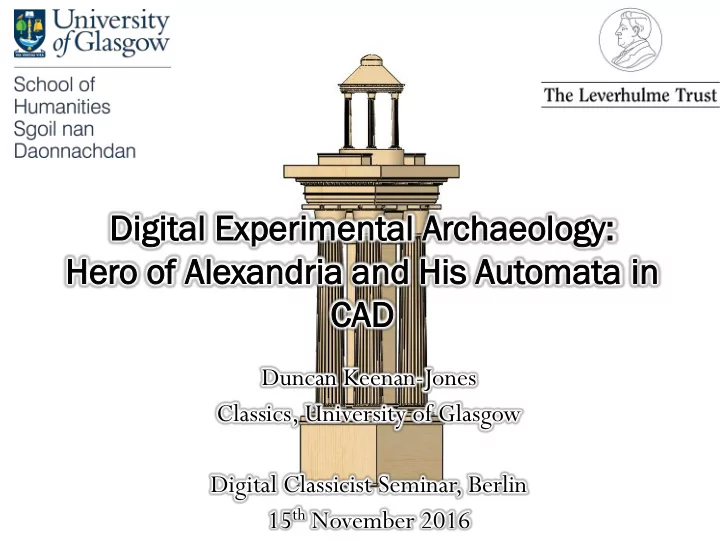
3.1 <Ἔστω> βάσις μῆκος ἔχουσα ὡς πήχεος, πλάτος δὲ ὡς παλαιστῶν τεσσάρων, ὕψος δὲ ὡς παλαιστῶν τριῶν, κυμάτιον ἔχουσα περιτρέχον εἴς τε τὸ ἄνω καὶ τὸ κάτω μέρος. ἐπὶ δὲ τῶν γωνιῶν αὐτῆς ἐφέστηκε κιόνια τέσσαρα, ὕψος μὲν ἔχοντα ὡς παλαιστῶν ηʹ, πλάτος δὲ παλαιστῶν δύο, ἔχοντα ὑποκείμενα σπειρία καὶ τούτοις ἁρμοζούσας κεφαλὰς ἐπικειμένας. ἐπὶ δὲ τῶν κεφαλίων ἐπίκειται καθάπερ ἐπιστύλιον κύκλῳ ὕψος ἔχον ὄγδοον τοῦ κίονος ὅλου, ὡς δακτύλων εʹ. (2.) κατὰ δὲ τῶν ἐπιστυλίων κατέστρωται σανίδια καλύπτοντα τὴν ἐπάνω ἐπιφάνειαν, καὶ περίκειται κύκλῳ κυμάτιον. ἐπὶ δὲ τοῦ καταστρώματος ἐφέστηκε μέσον ναΐσκος στρογγύλος περιφανὴς ἔχων κίονας ἕξ. ἐπὶ δὲ τούτου πυργίον κωνοειδὲς ἐφέστηκεν ἐντεταμένην ἔχον τὴν ἐπιφάνειαν, καθάπερ εἴρηται. (3.) ἐπὶ δὲ τῆς κορυφῆς ἐφέστηκε Νίκη ἐκπεπετακυῖα τὰς πτέρυγας καὶ ἐν τῇ δεξιᾷ χειρὶ στέφανον κατέχουσα. ἐν δὲ μέσῳ τοῦ ναΐσκου ζῴδιον Διονύσου ἐφέστηκεν ἐν μὲν τῇ ἀριστερᾷ χειρὶ θύρσον κατέχον, ἐν δὲ τῇ δεξιᾷ σκύφον. παρακαθέζεται δὲ πανθηρίσκος πρὸς τοῖς τοῦ Διονύσου ποσίν. (4.) ἐν δὲ τοῖς ἔμπροσθεν καὶ τοῖς ὄπισθεν μέρεσι τοῦ Διονύσου ἐπὶ τοῦ καταστρώματος βωμὸς ἐπίκειται ἔχων ξύσματα τῶν σανίδων τεκτονικὰ ξηρὰ ὥστε εὔκαυστα εἶναι. κατὰ δὲ κίονα τῶν ἐν τῷ ναΐσκῳ τοῦ Διονύσου παρέστηκεν ἐκτὸς τοῦ ναΐσκου Βάκχη διεσκευασμένη ὡς ἄν τις προαιρῆται. 3.1 Let there be a base approximately one cubit long, about four palms wide and nearly three palms high, with a small wavy moulding running around both its upper and lower part. Four little columns, roughly eight palms high and two palms wide, stand on the corners, with little base-mouldings placed at the bottom and capitals in line with them placed on the top. On the capitals lies a kind of entablature running all around and one-eighth the height of the entire column, approximately five fingers. (2.) On the entablature are laid small boards covering its upper surface, and a small moulding runs all around. On the covering stands prominently, in the middle, a circular little shrine with six pillars. On this stands a little cone-shaped dome with a projecting surface , as stated. (3.) On the peak stands a Nike with spread wings and holding a wreath in her right hand. In the middle of the shrine stands a figure of Dionysos holding a thyrsus in his left hand and a cup in his right. A little panther sits by Dionysos’ side at his feet. (4.) In the spaces before Dionysos and behind him, on the surface, is an altar with shavings made from working the boards, dry enough to burn
Theatrum tectum (covered theatre, Pompeii)
13.7 δεῖ δὲ τοὺς ρσ, ψω σωλῆνας δι᾿ ἑνὸς κιονίσκου τῶν ἐν τῷ ναΐσκῳ κοίλου ὄντος ἐνεχθῆναι ὑπὸ τὴν βάσιν τοῦ ναΐσκου, ὅπως ἀφανεῖς ὑπάρχωσιν. The pipes ΡΣ and ΨΩ must run through one of the shrine’s little columns which is hollow under the shrine’s base, in order to be invisible. (trans. Grillo)
(Pompeii, www.gettyimages.co.uk/detail/illust ration/italy-naples-museo- archeologico-nazionale-sistrums-
Wright 2007 Interdisciplin. Sci. Rev.
2/2g – hL =
codex Guelferbitanus Gudianus gr. 19, XVI c.
Schmidt