Helping The Conservation Of Orkney Bere By Developing New Markets - - PowerPoint PPT Presentation

helping the conservation of orkney bere by developing new
SMART_READER_LITE
LIVE PREVIEW

Helping The Conservation Of Orkney Bere By Developing New Markets - - PowerPoint PPT Presentation

Helping The Conservation Of Orkney Bere By Developing New Markets John Wishart and Peter Martin Agronomy Institute, Orkney College UHI NPA CEREAL Project Conference, Orkney Oct 23 rd 2015 Bere Historical Background Ancient type of


slide-1
SLIDE 1

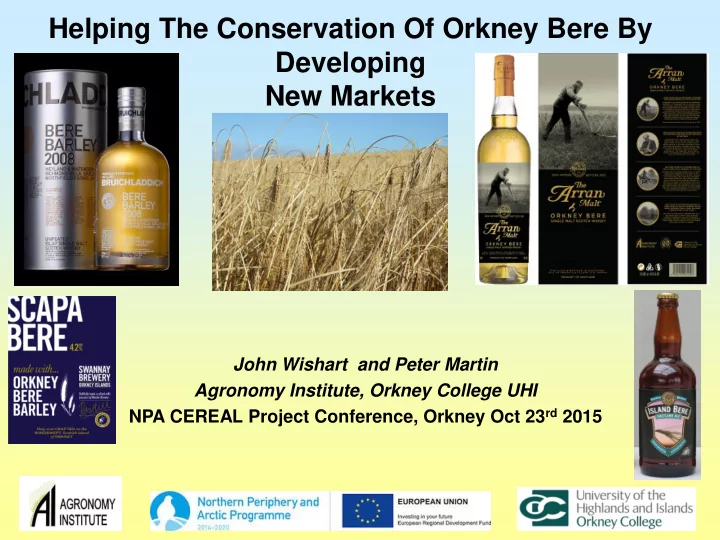
Helping The Conservation Of Orkney Bere By Developing New Markets

John Wishart and Peter Martin Agronomy Institute, Orkney College UHI NPA CEREAL Project Conference, Orkney Oct 23rd 2015

slide-2
SLIDE 2

Bere – Historical Background

  • Ancient type of Scottish 6-row barley

(landrace).

  • Like most landraces, it has long straw and

is very susceptible to lodging

  • Origins uncertain but cultivated in

Orkney for at least 1000 years

  • Well-suited to N Scotland:
  • Early maturing / short growing season;
  • Tolerant of poor soils; low inputs
  • Traditionally, a multi-use crop:
  • Milling (beremeal)
  • Malting (beer and later whisky)
  • Feed
  • Straw for animal bedding and thatching
  • A staple (with oats) in parts of the

Highlands & Islands until early 20th C

  • Gradually replaced by higher yielding

modern varieties

slide-3
SLIDE 3

Need For Conservation / Opportunities For New Products

  • In 1912, c. 1,590 ha Bere grown in
  • Orkney. By 2002, only c. 4 ha grown.
  • Conserved because of the local market

for beremeal.

  • Elsewhere in Scotland, Bere is only

grown in Shetland & W. Isles.

  • As a valuable heritage and genetic

resource, conservation of Bere in cultivation is important.

  • AI recognised that conservation

would be most effectively achieved by developing new markets.

  • Considering historical use of Bere,

two possible new markets were especially attractive:

  • Brewing
  • Distilling for whisky
slide-4
SLIDE 4

Bere For Brewing

  • With Leader + funding, the AI started

collaborating with Valhalla Brewery in Shetland in 2005. A beer, Island Bere, was released in 2006

  • Still a core product of the brewery.
  • Successful test brewing with Bere has

also been done by Orkney’s Swannay Brewery

  • For breweries, the main disadvantages
  • f using Bere are:
  • Its low extract compared with modern

varieties – ca. 20% more Bere malt needed.

  • High additional costs of sending the grain

away for malting

  • But, it has a unique taste, is well-

adapted to local growing and has a traditional brewing link with the Northern Isles.

slide-5
SLIDE 5

Bere For Distilling

  • Distilling industry hesitant about using Bere:
  • Not a recommended malting barley variety -

uncertainty about its malting & distilling qualities

  • Small quantities not easy to deal with and

expensive to process

  • In 2004 AI obtained Leader + funding for a

feasibility project with Isle of Arran Distillers:

  • 19 t Bere sent to Bairds in Inverness and

successfully malted

  • Distilled at Lochranza on Arran in 2004
  • Matured in Bourbon casks:
  • Thought to be quicker maturing than spirit

from modern varieties

  • Two successful limited edition releases:
  • An 8-year old single malt in Dec

2012.(6,000 bottles)

  • A 10-year-old release in 2014 (5,000

bottles).

  • Collaboration with Arran provided a one-off

demonstration of the feasibility of using Bere, But, for conservation Bere needed a long-term commitment.

slide-6
SLIDE 6

Collaboration With Bruichladdich Distillery

  • Bruichladdich Distillery:
  • An Islay distillery producing artisanal single malt

whiskies.

  • Places a special emphasis on barley provenance.
  • Recognised that using Bere for whisky production

would result in a totally unique product

  • With AI assistance, Bere was grown on

Islay in 2005 and 2006:

  • New-make spirit very impressive.
  • But grain quantities insufficient
  • Bruichladdich asked AI to develop an

Orkney supply chain producing Bere for the distillery from 2007:

  • AI and 2-3 growers
  • Aim to produce about 45 t of Bere annually (1

batch of malt)

  • Supply chain – co-ordinated and managed

by AI

  • AI provides seed to growers and buys back crop.
  • AI dries and stores grain until needed
  • Bere malted in Inverness on transit to distillery
slide-7
SLIDE 7

Supply Chain Considerations

  • Grain Supply Contract. Realistic, recognises that Bere is

not a modern malting barley variety:

  • No penalties for grain nitrogen > 1.65%
  • No penalties for small grain (high screenings)
  • Grower Production Strategies
  • Mixed, but most use low levels of inputs or more

marginal land to reduce production costs.

  • Low levels of nitrogen are required to reduce lodging
  • One grower investigating straw shortener with higher

levels of nitrogen

  • Production of seed needs to be built into the growing
  • programme. Reserves also needed in case of crop failures.
  • Supply Chain Challenges
  • For growers – low yields (2.6-3.5 t/ha) and crop

lodging

  • Grain drying. Difficult in wet harvests. With few

harvesting opportunities, farmers may need to harvest at high moistures. Can result in lengthy drying. With

  • nly one 10-t batch dryer, drying can be difficult.

Helped if harvesting spread over several weeks.

slide-8
SLIDE 8

Supply Chain Performance

  • Quantity Of Grain Supplied:
  • 2007 to 2014: 44-70 t per year (av. 59 t).
  • 2015- ………?
  • Grain moisture at harvest: very variable (17-

26%)

  • Rejected Crop
  • From 2007 to 2014, only the crop from one

field could not be purchased as it had started germinating in the ear.

  • Area of Bere Grown Annually:
  • 2007 to 2014: c 25 ha
  • 2015: c. 45 ha
  • Release of Bere whiskies
  • 2014 – Release of first Bruichladdich single

malt made from 2007 crop of Orkney-grown Bere (Bere Barley 2008)

  • Further annual releases will follow as each

vintage matures

slide-9
SLIDE 9

2015 Bere Harvest

slide-10
SLIDE 10

Benefits From The Bere Supply Chain

  • Produces a unique, high-value product for

the distillery because of

  • Bere
  • Marketing benefits of a joint Orkney & Islay

product.

  • Provides income for Orkney growers and

contractors

  • Has strengthened the conservation of

Bere:

  • (Area grown, seed stocks)
  • Raised profile of Bere nationally and

internationally

  • Demonstrates that landraces still have

commercial relevance in 21st C.

  • Provides a model for conservation of other

landraces.