Help us keep the Big Picture in mind Please introduce yourself: - - PDF document

help us keep the big picture in mind
SMART_READER_LITE
LIVE PREVIEW

Help us keep the Big Picture in mind Please introduce yourself: - - PDF document

9/17/2019 MnDOT District 8 Freight Plan Advisory Committee Meeting September 12, 2019 Renville, MN mndot.gov Welcome Back to the Advisory Committee Help us keep the Big Picture in mind Please introduce yourself: Name, organization What


slide-1
SLIDE 1

9/17/2019

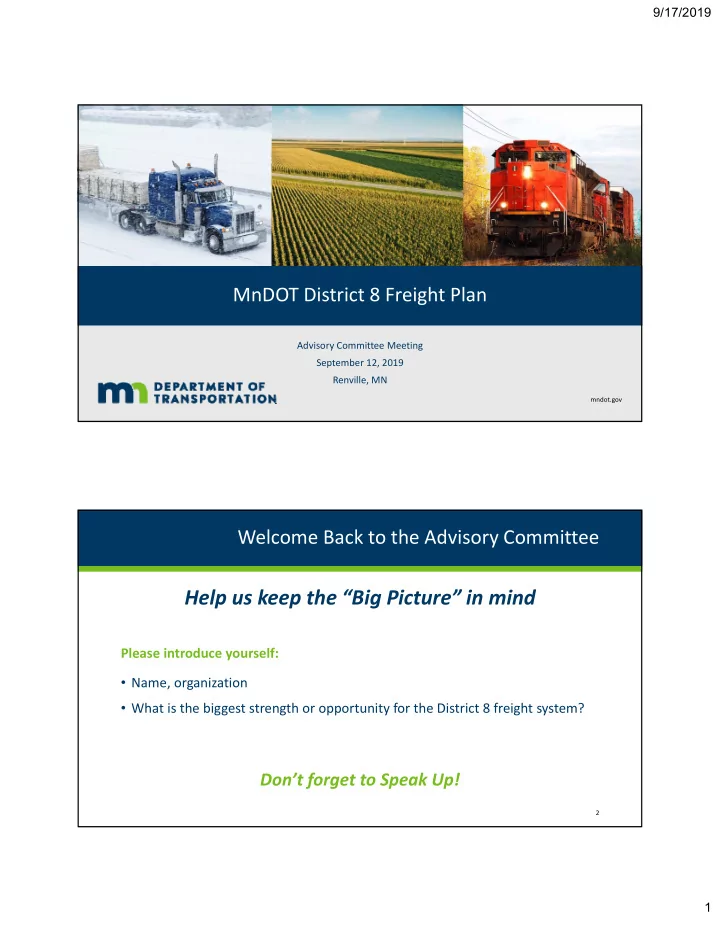
MnDOT District 8 Freight Plan

Advisory Committee Meeting September 12, 2019 Renville, MN

mndot.gov

Welcome Back to the Advisory Committee

Help us keep the “Big Picture” in mind

Please introduce yourself:

  • Name, organization
  • What is the biggest strength or opportunity for the District 8 freight system?

Don’t forget to Speak Up!

2

1

slide-2
SLIDE 2

9/17/2019

Presentation Map

Review Work Plan Economic and Freight System Profiles Condition and Performance Future Outlook and SWOT Assessment Next Steps & Discussion

3

Work Plan Overview

Complete Underway

4

2

slide-3
SLIDE 3

9/17/2019

Consultation Progress

30 consultations are expected in total – 19 complete, to date.

Trucking (5) Rail (2)

  • FedEx
  • BNSF
  • Anderson Trucking
  • TC&W / MPL
  • Truck Transport
  • Viessman Trucking

Agri‐Food (4)

  • Woody`s Trucking
  • Jennie‐O Turkey
  • Ralco Nutrition

Manufacturers and Shippers (6)

  • Southern Minnesota Beet Sugar Coop
  • Schwans
  • ADM
  • Friendship Homes
  • Central MN Fabricating

Public Agencies (2)

  • Haug Implement
  • Highway 23 Corridor Coalition
  • West Central Steel
  • South Dakota DOT
  • Suzlon Wind Power

5

Presentation Map

Review Work Plan Economic and Freight System Profiles Condition and Performance Future Outlook and SWOT Assessment Next Steps & Discussion

6

3

slide-4
SLIDE 4

9/17/2019

District 8 Multimodal Freight Transportation System

7

Transportation and Industry: Freight‐Related Clusters

8

4

slide-5
SLIDE 5

9/17/2019

Agricultural Production

9

Manufacturing Areas

10

5

slide-6
SLIDE 6

9/17/2019

Manufacturing Employment

11

Specialty Freight: Wind Components

12

6

slide-7
SLIDE 7

9/17/2019

Average Annual Daily Traffic (All Vehicles)

13

Average Annual Daily Traffic (Trucks)

14

7

slide-8
SLIDE 8

9/17/2019

Origins of Truck Trips

15

Destinations of Trucks Originating in D8

16

8

slide-9
SLIDE 9

9/17/2019

Destinations of Trucks Originating in D8

17

Truck Destinations in D8

18

9

slide-10
SLIDE 10

9/17/2019

Interpreting StreetLight Data

19

Origins of Trucks Destined for District 8

20

10

slide-11
SLIDE 11

9/17/2019

Highway Infrastructure: Bridges

21

Highway Infrastructure: Truck Stations

22

11

slide-12
SLIDE 12

9/17/2019

Rail Corridors

23

Rail Volumes and Track Speeds

24

12

slide-13
SLIDE 13

9/17/2019

Rail Crossings and Bridges

25

District 8 Multimodal Freight Transportation System

26

13

slide-14
SLIDE 14

9/17/2019

Intermodal Infrastructure

27

Discussion

Questions

  • Are there any missing assets (grain elevators?)
  • Are there other trends or assets we should profile?

28

14

slide-15
SLIDE 15

9/17/2019

Presentation Map

Review Work Plan Economic and Freight System Profiles Condition and Performance Future Outlook and SWOT Assessment Next Steps & Discussion

29

System Evaluation

Assessment driven by criteria advanced from MnDOT District Freight Plan Guidance

Freight System Freight Safety Freight Mobility Condition

  • Previous crashes
  • Bridge Condition*
  • Truck Speed
  • Crash risk factors
  • Travel Time Index
  • Grade crossing
  • Travel Time Reliability

incidents

*Roadways considered as

  • Grade crossing risk

part of other MnDOT

  • Bridge Clearance

factors

activities

  • OSOW Movement

30

15

slide-16
SLIDE 16

9/17/2019

Context: Total Traffic Volume

31

Context: Total Truck Volume

32

16

slide-17
SLIDE 17

9/17/2019

Road Safety: Background Information

700 600

Between 2009 and 2013

500

District 8 had the 4th

400 300

highest number of

200 100

severe crashes.

3 6 1 8 7 4 2 District (Metro not included)

Commercial vehicle

Crash Severity Total

crashes are primarily

Fatality 61

concentrated in areas

Injury 579

with higher traffic

Property Damage Only 1,460

Count of Severe Crashes

Unknown 3

volumes.

33

Safety: Truck‐Related Crashes

34

17

slide-18
SLIDE 18

9/17/2019

Safety: Assessing Risk

Truck‐involved crashes are concentrated in areas with higher traffic volumes, but severe and fatal crashes are distributed across the system more “randomly”

Review

  • f

risk factors for crashes can help guide safety investment and ensure planners are not “chasing” more “random” severe crashes Example Risk Factors:

Vehicle Median Shoulder Intersection Curve Volume Width Width Density Density

35

Safety: District 8 High‐Risk Areas

36

18

slide-19
SLIDE 19

9/17/2019

Grade Crossing Safety

Incidents at Passively‐Protected Crossings (2004‐2013)

80 7 4 8 1 6 M 2 3 Count of Incidents 60 40 20

District 8’s active grade crossing crash rate compares favorably to other Districts,

District Property Damage Injury Fatality

but it has a relatively high

Incidents at Actively‐Protected Crossings (2004‐2013)

number of crashes at

80

passively‐protected crossings.

Count of Incidents 60 40 20 M 6 3 4 7 8 1 2 District Property Damage Injury Fatality 37

Previous Grade Crossing Incidents

38

19

slide-20
SLIDE 20

9/17/2019

Safety: Grade Crossing Risk Factors

Like severe road crashes, grade crossing incidents exhibit a similar “randomness” in distribution.

Review of risk factors for crashes can help guide safety investment and ensure planners are not “chasing” more “random” severe crashes Example Risk Factors:

Vehicle Distance to Number Skew Sight Lines Speeds Intersection

  • f Tracks

39

Active Grade Crossing Risk Ratings

40

20

slide-21
SLIDE 21

9/17/2019

Passive Grade Crossing Risk Ratings

41

Safety Summary

District 8’s safety performance is mixed.

  • District 8 has a relatively high count of severe crashes, particularly at higher‐traffic

intersections.

  • Road segments identified as high‐risk had little overlap with severe truck crashes.
  • Active grade crossing incident rates compare favorably to other Districts, but there is

a high rate of accidents at passively‐protected crossings.

  • Grade crossing incidents are concentrated on higher‐volume corridors: CN line from

Willmar to Marshall.

  • Consider freight‐specific risk factor evaluations?

42

21

slide-22
SLIDE 22

9/17/2019

Safety Discussion

Questions

  • Should MnDOT look at specific grade crossings as part of rail grant programs?
  • Are there any safety considerations that are unique to District 8?
  • Is our understanding of District 8’s safety accurate?
  • How have these issues affected you?

43

Bridge Condition

Bridge condition is primarily a concern on local roads, and trunk highways (major freight corridors) are in good condition. Count of Deficient Bridges, by System and County:

County Trunk County Township City Total Chippewa 1 7 13 2 23 Kandiyohi 4 4 8 Lac Qui Parle 5 9 14 Lincoln 16 22 38 Lyon 1 5 4 1 11 McLeod 1 1 1 3 Meeker 1 1 1 3 Murray 6 7 13 Pipestone 1 14 20 35 Redwood 1 23 34 4 62 Renville 34 15 49 Yellow Medicine 2 1 6 9 Total 6 117 136 9 268 % of District 8’s Total Bridges 1.7% 10.6% 10.7% 17.3% 9.6%

44

22

slide-23
SLIDE 23

9/17/2019

Condition Discussion

Questions

  • Are there any specific bridges that are a concern?
  • Are there any condition considerations that are unique to District 8?
  • Is our understanding of District 8’s condition accurate?
  • How have these issues affected you?

45

Mobility

Mobility measures how “easily” freight moves in the District.

  • Truck Speed
  • Travel Time Index
  • Travel Time Reliability
  • Bridge Clearance
  • OSOW Movement

46

23

slide-24
SLIDE 24

9/17/2019

Average Truck Speed

47

Travel Time Index (TTI)

48

24

slide-25
SLIDE 25

9/17/2019

Truck Travel Time Index

49

Truck Travel Time Reliability (TTR)

50

25

slide-26
SLIDE 26

9/17/2019

Mobility: Travel Speed Summary

Truck congestion and travel speed is not an issue for District 8, but appropriate infrastructure can continue to support safe mobility.

51

OSOW Operations in District 8

Oversize‐Overweight permits were broken into three types:

Transactional Collaborative Consultative

Source: US Cargo Control. Source: MnDOT Source: MnDOT

Gross Vehicle Weight Permit Type Height Width Length (1000s of lbs) No Permit Up to 13.5 feet Up to 8.5 feet Up to 75 feet Up to 80 Transactional 13.5 to 15 feet 8.5 to 15 feet 75 to 140 feet 80 to 187 Collaborative 15 to 16.5 feet 15 to 17 feet 140 to 180 feet 187 to 255 Consultative Over 16.5 feet Over 17 feet Over 180 feet Over 255

Source: MnDOT

52

26

slide-27
SLIDE 27

9/17/2019

OSOW Load Dimensions in District 8

Height

Height and vertical clearances are key considerations for OSOW permits in D8

500 1000 1500 2000 No Permit Transactional Collaborative Consultative Number of Perits 1500

Width Length Weight

Number of Number of Number of Permits Permits Permits 1000 500 No Permit Transactional Collaborative Consultative 1500 1000 500 No Permit Transactional Collaborative Consultative 2000 1500 1000 500

53

No Permit Transactional Collaborative Consultative

Bridge Clearances

54

27

slide-28
SLIDE 28

‐ ‐ ‐

9/17/2019

OSOW Permit Origins and Destinations

Destination

Most OSOW permits mentioning District 8 were for loads originating in the District and bound for other Districts or South Dakota

Origin South Other State Interior Other MN Dakota (IA, ND, WI, and Total District 8 District (through SD) through District 8)

  • ther Districts

Interior District 8 182 197 59 66 504 Other MN District 736 N/A 56 N/A 792 South Dakota (through 751 81 25 857 District 8) Other State (IA, ND, WI, and 226 N/A 10 N/A 236 SD) through other Districts Total 1,895 278 125 91 2,389

55

OSOW Permit Origins and Destinations

Routes and destinations reflect outbound flow of OSOW freight.

Top Origins

Origins Trips

Key Routes

Redwood Falls 544 Route Count Montevideo 543 US212 W 733 Olivia 132 US71 N 628 Blomkest 109 MN19 W 371 Danube 107 MN29 S 355 MN7 E 305 US212 E 300

Top Destinations

US71 S 298 MN23 N 295 Destinations Trips MN23 S 280 US 212 at SD 581 US59 N 211 US 14 at SD 127 MN 19 at SD 105 Fergus Falls 48 Lakeville 46

Source: MnDOT. “District 8 2016 Oversized/Overweight Permit Data.”

56

28
slide-29
SLIDE 29

9/17/2019

Mobility Discussion

Questions

  • Is our understanding of District 8’s performance accurate?
  • Are there any mobility considerations that are unique to District 8?
  • How have these issues affected you?

57

Presentation Map

Review Work Plan Economic and Freight System Profiles Condition and Performance Future Outlook and SWOT Assessment Next Steps & Discussion

58

29

slide-30
SLIDE 30

9/17/2019

What Future Trends will Affect District?

Think “STEEP” factors

What STEEP factors

  • Social

could influence

  • Technological

freight in District 8?

  • Environmental

How could these

  • Economic

factors influence

  • Political

freight in District 8?

59

STEEP Factors – examples, only

Factors considered will reflect District 8’s unique context

60

30

slide-31
SLIDE 31

9/17/2019

Translating STEEP Factors into Effects

Source: Chris Caplice, MIT 61

Potential District 8 STEEP Trends

  • Social: declining population or

workforce base.

  • Technological: autonomous or

connected vehicles

  • Environmental: extreme rainfall

events, energy use

Source: Tesla

  • Economic: effects of tariffs on

demand for commodities

  • Political: funding uncertainty

Source: AgFax

31

slide-32
SLIDE 32

9/17/2019

Strengths, Weaknesses, Opportunities, and Threats

Use the information presented today to help us identify District 8’s S, W, O, and Ts

Strengths Weaknesses

 Strong agricultural and manufacturing  Lack of interstate highways. industry base.  Captive rail service in some  Removed from Twin Cities congestion. communities.

Opportunities Threats

 Renewable energy development  Declining or flat population. (electricity and biofuels).  Need to repair or maintain  Willmar Wye development. infrastructure.

63

Report Back and Open Discussion

Questions

  • What are your top 2‐3 most important findings?
  • How are these findings relevant to District 8 or MN as a whole?
  • What should MnDOT do to leverage or address these findings?

64

32

slide-33
SLIDE 33

9/17/2019

What we heard…

Strengths  Good work ethic.  Good job on preventative maintenance (trunk highways).  Rural nature of District, and removed from Twin Cities congestion.  Strong agricultural and manufacturing industry base. Opportunities  Communications (to improve operations, construction, education, operation life saver, etc.)  Emerging sources of good data to inform planning and

  • perations.

 Low cost improvements with big benefits (esp for safety).  Transloading facilities.  Explore potential for backhaul movements.  Changing energy future (e.g., renewable energy development). Weaknesses  Lack of interstate highways and 4‐lane capacity.  Non‐trunk highways have condition issues (as compared to trunk highways).  Overall road condition expected to decline.  Lack of roadway access control/management.  Roads viewed as “single use.”  Captive rail service in some communities. Threats  Weather events (more, and more severe) that impact infrastructure.  Industry changes that impact transport system use and condition (e.g., I‐29 Dairy Corridor development, farmers holding product to sell at better prices, etc.).  Limited ability and/or funds to invest.  Declining or flat population limits workforce.

Presentation Map

Review Work Plan and Role of Advisory Committee Initial Economic and Freight System Profiles Condition and Performance Future Outlook and SWOT Assessment Next Steps & Discussion

66

33

slide-34
SLIDE 34

9/17/2019

Next Steps

Next 2 Weeks

  • Complete remaining stakeholder consultations.
  • Complete SWOT and STEEP analysis.
  • Begin analysis of needs and issues.

Before Next Meeting

  • Complete identification of geographically‐specific needs and issues.
  • Identify need/issue “gaps” not addressed by programmed investments.
  • Prioritize “gaps” as slate of initial project recommendations.

67

Future Meetings

Work will be conducted over 12 months, through March 2020

 

Next meeting expected in November 2019

68

34

slide-35
SLIDE 35

9/17/2019

Consultant Team

Erika Witzke, PE Project Manager ewitzke@cpcstrans.com Eric Oberhart Justin Black, PE Project Coordinator Local Coordination & Outreach eoberhart@cpcstrans.com jblack@sehinc.com

69

Thank you!

70

35