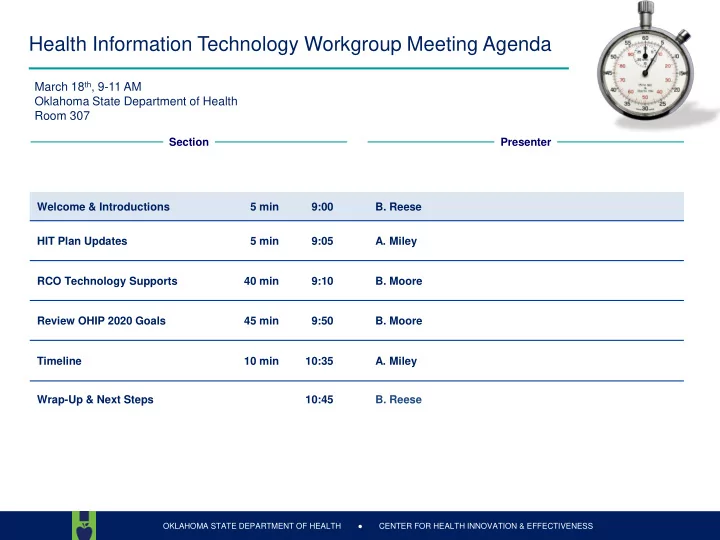
Health Information Technology Workgroup Meeting Agenda March 18 th , - - PowerPoint PPT Presentation

health information technology workgroup meeting agenda
SMART_READER_LITE
LIVE PREVIEW

Health Information Technology Workgroup Meeting Agenda March 18 th , - - PowerPoint PPT Presentation

Health Information Technology Workgroup Meeting Agenda March 18 th , 9-11 AM Oklahoma State Department of Health Room 307 Section Presenter Welcome & Introductions 5 min 9:00 B. Reese HIT Plan Updates 5 min 9:05 A. Miley RCO


slide-1
SLIDE 1

OKLAHOMA STATE DEPARTMENT OF HEALTH CENTER FOR HEALTH INNOVATION & EFFECTIVENESS

  • Health Information Technology Workgroup Meeting Agenda

Presenter Section Welcome & Introductions 5 min 9:00

  • B. Reese

HIT Plan Updates 5 min 9:05

  • A. Miley

RCO Technology Supports 40 min 9:10

  • B. Moore

Review OHIP 2020 Goals 45 min 9:50

  • B. Moore

Timeline 10 min 10:35

  • A. Miley

Wrap-Up & Next Steps 10:45

  • B. Reese

March 18th, 9-11 AM Oklahoma State Department of Health Room 307

slide-2
SLIDE 2

OKLAHOMA STATE DEPARTMENT OF HEALTH CENTER FOR HEALTH INNOVATION & EFFECTIVENESS

  • Health Information Technology Workgroup Meeting Agenda

Presenter Section Welcome & Introductions 5 min 9:00

  • B. Reese

HIT Plan Updates 5 min 9:05

  • A. Miley

RCO Technology Supports 40 min 9:10

  • B. Moore

Review OHIP 2020 Goals 45 min 9:50

  • B. Moore

Timeline 10 min 10:35

  • A. Miley

Wrap-Up & Next Steps 10:45

  • B. Reese

March 18th, 9-11 AM Oklahoma State Department of Health Room 307

slide-3
SLIDE 3

OKLAHOMA STATE DEPARTMENT OF HEALTH CENTER FOR HEALTH INNOVATION & EFFECTIVENESS

  • This section details objectives and strategies to achieve HIT

interoperability in Oklahoma and move toward value-based purchasing. Health Information Technology (HIT) Plan

HIT Goal 1 HIT Goal 2 Establish a state-level solution for integrated clinical, claims, and social determinants of health data to support a value- based analytics (VBA) system. Establish statewide interoperability; facilitate exchange/consolidation of health information through a Health Information Network (HIN).

  • Statewide Interoperability
  • Health Information Exchange
  • EHR Adoption and Utilization
  • VBA System
  • Privacy and Security
  • HIT Metrics
  • HIT Governance, Policy

Factors and Strategies for Success

slide-4
SLIDE 4

OKLAHOMA STATE DEPARTMENT OF HEALTH CENTER FOR HEALTH INNOVATION & EFFECTIVENESS

  • HIT Plan Updates: Review of the HIT Plan status & Comment Period
  • Progress to date – The HIT plan has been drafted and is available
  • n the SharePoint site (https://portal.okhca.org/OSIM) and on the

website (OSIM.health.ok.gov)

  • HIT Plan Comments– Updates to HIT plan based on feedback
  • Next Steps-

− Meet with HIEs − Continue to refine the concept diagram to show how the HIN supports the RCO model − Create a one pager that explains HIT Plan architecture and concept − Continue to refine the HIT governance structure

4

slide-5
SLIDE 5

OKLAHOMA STATE DEPARTMENT OF HEALTH CENTER FOR HEALTH INNOVATION & EFFECTIVENESS

  • Health Information Technology Workgroup Meeting Agenda

Presenter Section Welcome & Introductions 5 min 9:00

  • B. Reese

HIT Plan Updates 5 min 9:05

  • A. Miley

RCO Supporting HIT 40 min 9:10

  • B. Moore

Review OHIP 2020 Goals 45 min 9:50

  • B. Moore

Timeline 10 min 10:35

  • A. Miley

Wrap-Up & Next Steps 10:45

  • B. Reese

March 18th, 9-11 AM Oklahoma State Department of Health Room 307

slide-6
SLIDE 6

OKLAHOMA STATE DEPARTMENT OF HEALTH CENTER FOR HEALTH INNOVATION & EFFECTIVENESS

  • RCO Technology Supports
  • The goal of the HIT plan is to help accomplish the goals and
  • bjectives set out in OHIP 2020
  • As well, the goal of the HIT plan is to create the necessary tools

and technology infrastructure that will support the RCO model design

  • The plan outlines two broad strategies for achieving both of

these aims:

− Create a health information network (HIN) that supports interoperability between RCO participating Health Information Exchanges (HIEs) − Create a value-based analytics tool that will evaluate the performance of the RCOs, manage population health outcomes for RCO attributed beneficiaries, and inform RCO value-based payment strategies

6

slide-7
SLIDE 7

OKLAHOMA STATE DEPARTMENT OF HEALTH CENTER FOR HEALTH INNOVATION & EFFECTIVENESS

  • RCO Technology Supports: VBA / HIN Conceptual Design

Health System Behavioral Health

RCO VBA

PCP

‏RCO Member ‏Electronic Health

Records and Data

MyHealth Health-e Oklahoma CCO

County Health Data State Agency Data

HIN MPI

$ $ $

‏RCO Payment/Claim ‏Information

MPI MPI

‏RCO Performance and ‏Population ‏Health Analytics ‏Health

Information Network

‏De-identified Data

MPI

slide-8
SLIDE 8

OKLAHOMA STATE DEPARTMENT OF HEALTH CENTER FOR HEALTH INNOVATION & EFFECTIVENESS

  • RCO Technology Supports: HIE Use Case

MyHealth

MPI

CCO

MPI

‏Health

Information Network

Health-e Oklahoma

Reduce duplicate data entry Point of Care Support Clinical Decision Support Exchange of CHD data w/providers

‏HIEs ‏RCO HIE Use Case ‏Scope

Streamline data exchange and reporting

MyHealth

  • Collects patient information to

create opportunities for early intervention with at-risk patients

  • Assist in treatment decisions

during the patient visit

  • Enable population management

programs through analytics and reporting tools

Coordinated Care of Oklahoma

  • Provide physicians secure

access to health information for their patients for treatment purposes

Health-e Oklahoma

  • Health and Human Service

Interoperability Solution MPI

slide-9
SLIDE 9

OKLAHOMA STATE DEPARTMENT OF HEALTH CENTER FOR HEALTH INNOVATION & EFFECTIVENESS

  • RCO Technology Supports: HIN Use Case

‏Health

Information Network

MyHealth

MPI

CCO

MPI

Health-e Oklahoma

HIN MPI

‏RCO HIN Concept ‏RCO HIN Use Case ‏Scope ‏Health

Information Network Facilitate comprehensive record for Point

  • f Care

Support Facilitate comprehensive record for Clinical Decision Support Facilitate linkage between claims and clinical data for VBA Facilitate comprehensive record for Claims / Clinical Analysis

  • Supporting

interoperability among RCO participating HIEs

MPI

slide-10
SLIDE 10

OKLAHOMA STATE DEPARTMENT OF HEALTH CENTER FOR HEALTH INNOVATION & EFFECTIVENESS

  • RCO Technology Supports: VBA Use Case

‏Health

Information Network

‏RCO VBA Concept ‏RCO VBA Use Case ‏Scope

HIN MPI

‏HIN

Provide reports for payment reform Provide reports for setting RCO rates Facilitate evaluation of RCO performance using quality measures

  • Integrate clinical and

claims-related data

  • Evaluate health
  • utcomes for attributed

RCO members

  • Analyze integrated

value-based data to evaluate RCO performance

  • Analyze integrated

value-based data to inform payment strategies RCO VBA

$ $ $

‏RCO Payment/Claim ‏Information

slide-11
SLIDE 11

OKLAHOMA STATE DEPARTMENT OF HEALTH CENTER FOR HEALTH INNOVATION & EFFECTIVENESS

  • RCO Supporting Technology: Feedback and comment

Considerations

  • The various technology pieces (i.e. the

HIN and VBA) are there to support both OHIP goals and the RCO model design

  • HIT will require a governance

structure(s) that can help guide the state as it develops and purchases technology

Discussion Questions

  • Where should HIT governance occur

to support the RCO model (e.g. the VBA level, the HIN level)?

  • How do we ensure RCO supporting

technology is developed in a comprehensive way and accounts for the multiple facets of system transformation using governance (e.g. avoid siloed decision making)?

slide-12
SLIDE 12

OKLAHOMA STATE DEPARTMENT OF HEALTH CENTER FOR HEALTH INNOVATION & EFFECTIVENESS

  • Health Information Technology Workgroup Meeting Agenda

Presenter Section Welcome & Introductions 5 min 9:00

  • B. Reese

HIT Plan Updates 5 min 9:05

  • A. Miley

RCO Supporting HIT 40 min 9:10

  • B. Moore

Review OHIP 2020 Goals 45 min 9:50

  • B. Moore

Timeline 10 min 10:35

  • A. Miley

Wrap-Up & Next Steps 10:45

  • B. Reese

March 18th, 9-11 AM Oklahoma State Department of Health Room 307

slide-13
SLIDE 13

OKLAHOMA STATE DEPARTMENT OF HEALTH CENTER FOR HEALTH INNOVATION & EFFECTIVENESS

  • Five-Year Vision

Within the next five years, the Health IT workgroup will develop an interoperable ecosystem capable of supporting the delivery of better health, better care at lower costs by ensuring availability and enabling the use of appropriate health data, promoting patient, families and caregivers engagement with their own health data, goals of care and plans, and fostering health innovation in Oklahoma. Goal Improve quality, safety, effectiveness, and efficiency of health services through the use of interoperable health information technology.

OHIP 2020: Health IT Vision and Goal

slide-14
SLIDE 14

OKLAHOMA STATE DEPARTMENT OF HEALTH CENTER FOR HEALTH INNOVATION & EFFECTIVENESS

  • Objective 1: By‏2020,‏ensure‏that‏each‏Oklahoman’s‏safety,‏quality,‏and‏convenience‏of‏

care is improved by ensuring that providers access a multi-sourced comprehensive medical record on 30% of patients they treat.

  • Strategy 1: Facilitate Secure Health Information Exchange (HIE) adoption and

implementation.

  • Strategy 2: Enhance communication among healthcare stakeholders (including patients

and families) with respect to the use of health IT.

  • Strategy 3: Establish training programs to increase provider knowledge and abilities in

clinical informatics and health IT.

OHIP 2020 Health IT Objectives

slide-15
SLIDE 15

OKLAHOMA STATE DEPARTMENT OF HEALTH CENTER FOR HEALTH INNOVATION & EFFECTIVENESS

  • OHIP 2020 Health IT Objectives: Strategies not included in OHIP 2020

Objective 1: By‏2020,‏ensure‏that‏each‏Oklahoman’s‏safety,‏quality,‏and‏convenience‏of‏ care is improved by ensuring that providers access a multi-sourced comprehensive medical record on 30% of patients they treat.

  • Increase adoption of Electronic Health Records (EHR), HIE and achievement of

Meaningful Use (MU)

  • Facilitate Health Information Exchange (HIE) adoption and implementation
  • Facilitate statewide and cross-jurisdictional exchange of health information
  • Service level monitoring to ensure the timeliness of health data exchange
  • Enforcement of appropriate consent restrictions on access to HIE data
  • Accurate Patient Matching through one or more Master Patient Indexes (MPI)
slide-16
SLIDE 16

OKLAHOMA STATE DEPARTMENT OF HEALTH CENTER FOR HEALTH INNOVATION & EFFECTIVENESS

  • Objective 1: By‏2020,‏ensure‏that‏each‏Oklahoman’s‏safety,‏quality,‏and‏convenience‏of‏

care is improved by ensuring that providers access a multi-sourced comprehensive medical record on 30% of patients they treat.

  • Utilization of patient attribution to providers
  • Provider directory to ensure accurate provider identity
  • Establish training programs to increase provider knowledge and abilities in clinical

informatics and health IT

  • Enhance communication among healthcare stakeholders (including patients and families)

with respect to the use of health IT

  • Collaborate on legislation as needed to improve health by using health IT services
  • Consider state level policies to protect purchasers of EHR and ensure adequate

interoperability

OHIP 2020 Health IT Objectives: Strategies not included in OHIP 2020

slide-17
SLIDE 17

OKLAHOMA STATE DEPARTMENT OF HEALTH CENTER FOR HEALTH INNOVATION & EFFECTIVENESS

  • Objective 2: By 2020, a majority of Oklahomans will experience improved health and

reduced costs of care by ensuring that population-level, multi-sourced, comprehensive health data is used to support the public health, quality improvement, and value-based payment models.

  • Strategy 1: Increase adoption of Electronic Health Records (EHR), HIE and achievement
  • f Meaningful Use (MU).
  • Strategy 2: Extend voluntary participation multi-payer claims databases.

OHIP 2020 Health IT Objectives

slide-18
SLIDE 18

OKLAHOMA STATE DEPARTMENT OF HEALTH CENTER FOR HEALTH INNOVATION & EFFECTIVENESS

  • Objective 2: By 2020, a majority of Oklahomans will experience improved health and

reduced costs of care by ensuring that population-level, multi-sourced, comprehensive health data is used to support the public health, quality improvement, and value-based payment models.

  • Plan and design a multi-payer claims database
  • Facilitate the creation of a business intelligence tool, reporting structure, dashboard,

among other instruments to make use of the data collected by the multi-payer claims database

  • Encourage participation in voluntary multi-payer claims databases
  • Implement strong data use agreements and patient consent models linked with consent
  • Promote transparency of analytic policies and procedures
  • Assess stakeholder satisfaction with respect to health IT

OHIP 2020 Health IT Objectives: Strategies not included in OHIP 2020

slide-19
SLIDE 19

OKLAHOMA STATE DEPARTMENT OF HEALTH CENTER FOR HEALTH INNOVATION & EFFECTIVENESS

  • Initiate, support, and foster health innovation in Oklahoma.
  • Provide open standard Application Programming Interfaces for identity verification,

credentialing, data access, etc.

  • Identify funding opportunities for health IT development to foster and encourage

collaboration

  • Actively propose solutions to achieve broadband coverage and adequate quality to

support health

  • Support public-private‏partnerships‏including‏Oklahoma’s‏universities‏and‏technology‏

centers to achieve health improvement by developing innovative health IT solutions

Additional Health IT Objectives not included in OHIP 2020

slide-20
SLIDE 20

OKLAHOMA STATE DEPARTMENT OF HEALTH CENTER FOR HEALTH INNOVATION & EFFECTIVENESS

  • RCO OHIP 2020 Goals: Feedback and comment

Considerations

  • OHIP goals were developed prior to

SIM

  • The goals are complementary to the

RCO model design

Discussion Questions

  • What strategies should be kept?
  • What are the next steps to achieving

the selected HIT strategies (action steps)?

  • What is the role of the HIT workgroup

in achieving the OHIP 2020 goals?

slide-21
SLIDE 21

OKLAHOMA STATE DEPARTMENT OF HEALTH CENTER FOR HEALTH INNOVATION & EFFECTIVENESS

  • Health Information Technology Workgroup Meeting Agenda

Presenter Section Welcome & Introductions 5 min 9:00

  • B. Reese

HIT Plan Updates 5 min 9:05

  • A. Miley

RCO Supporting HIT 40 min 9:10

  • B. Moore

Review OHIP 2020 Goals 45 min 9:50

  • B. Moore

Timeline 10 min 10:35

  • A. Miley

Wrap-Up & Next Steps 10:45

  • B. Reese

March 18th, 9-11 AM Oklahoma State Department of Health Room 307

slide-22
SLIDE 22

OKLAHOMA STATE DEPARTMENT OF HEALTH CENTER FOR HEALTH INNOVATION & EFFECTIVENESS

  • Comments on plan will be taken through March 25th
  • Plan will be submitted to CMS on March 31st.

− After submission the CMS will give their final feedback. The grant period will close 90 days after submission.

  • The submission of the SHSIP is NOT:

− A test grant application − A waiver submission − The final discussion of plan components

Submit the State Health System Innovation Plan

slide-23
SLIDE 23

OKLAHOMA STATE DEPARTMENT OF HEALTH CENTER FOR HEALTH INNOVATION & EFFECTIVENESS

  • All workgroups will continue to meet

− Workgroup meetings will begin to address specific work areas and plans for OHIP − Workgroups will be engaged in operationalizing SIM as it relates to their OHIP work.

Continue Stakeholder Engagement

slide-24
SLIDE 24

OKLAHOMA STATE DEPARTMENT OF HEALTH CENTER FOR HEALTH INNOVATION & EFFECTIVENESS

  • Establish committee structures to start meeting around the SIM vision

− State Governing Body − Quality Metrics Committee − Episodes of Care Task Force − Administrative Burden Task Force

  • Seek funding for infrastructure improvements to support vision

− DSRIP − HIT − CDC

  • Begin work toward State and Federal Authorization

Operationalize SHSIP

slide-25
SLIDE 25

OKLAHOMA STATE DEPARTMENT OF HEALTH CENTER FOR HEALTH INNOVATION & EFFECTIVENESS

  • 2016

2017 2018 2019 Q1 Q2 Q3 Q4 Q1 Q2 Q3 Q4 Q1 Q2 Q3 Q4 Q1 Q2 Q3 Q4 Milestones Quality Metrics DSRIP – The Oklahoma Plan Episodes

  • f Care

Regional Care Organizations Program Milestones Milestone

OSIM Operational Roadmap – Healthcare System Initiatives Timeline

Deliberate on Core RCO Metrics Form Metrics Committee

Payer Metrics Alignment Meeting Initial Multi Payer Metrics Report

Form EOC Task Force

Determine Episodes Scope & Definition

Initial Episodes Tracking & Assessment Episodes Reporting & Evaluation Model Development Stakeholder Engagement RCO Enabling Legislation RCO RFI & RFP Evaluation Process CMS Waiver Development CMS Waiver Approval CMS Waiver Submission RCO Development & Transition Process RCO Go-Live Initial RCO Metrics Report Annual RCO Metrics Report Episodes of Care for Payment CMS Waiver Development CMS Waiver Submission CMS Waiver Approval DSRIP Implementation and payments

slide-26
SLIDE 26

OKLAHOMA STATE DEPARTMENT OF HEALTH CENTER FOR HEALTH INNOVATION & EFFECTIVENESS

  • Health Information Technology Workgroup Meeting Agenda

Presenter Section Welcome & Introductions 5 min 9:00

  • B. Reese

HIT Plan Updates 5 min 9:05

  • A. Miley

RCO Supporting HIT 40 min 9:10

  • B. Moore

Review OHIP 2020 Goals 45 min 9:50

  • B. Moore

Timeline 10 min 10:35

  • A. Miley

Wrap-Up & Next Steps 10:45

  • B. Reese

March 18th, 9-11 AM Oklahoma State Department of Health Room 307