HEALTH DISPARITIES AMONG POLICE OFFICERS Depressive symptoms in - - PowerPoint PPT Presentation

health disparities among police officers
SMART_READER_LITE
LIVE PREVIEW

HEALTH DISPARITIES AMONG POLICE OFFICERS Depressive symptoms in - - PowerPoint PPT Presentation

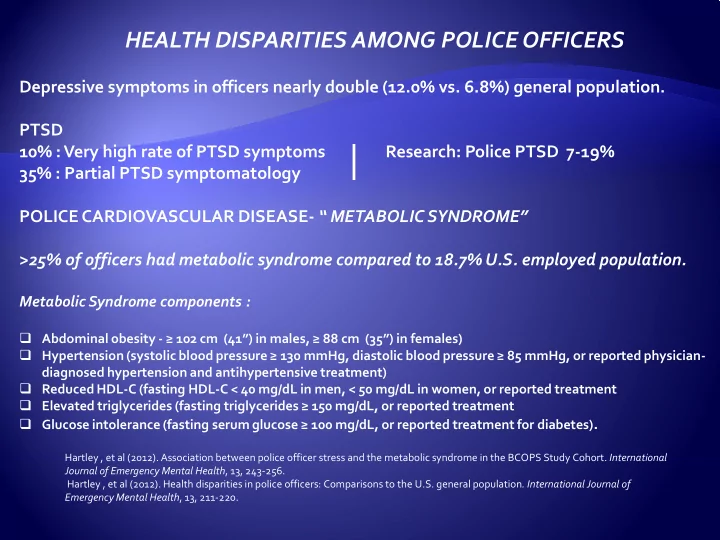
HEALTH DISPARITIES AMONG POLICE OFFICERS Depressive symptoms in officers nearly double (12.0% vs. 6.8%) general population. PTSD 10% : Very high rate of PTSD symptoms Research: Police PTSD 7-19% 35% : Partial PTSD symptomatology


slide-1
SLIDE 1

HEALTH DISPARITIES AMONG POLICE OFFICERS Depressive symptoms in officers nearly double (12.0% vs. 6.8%) general population. PTSD 10% : Very high rate of PTSD symptoms Research: Police PTSD 7-19% 35% : Partial PTSD symptomatology POLICE CARDIOVASCULAR DISEASE- “ METABOLIC SYNDROME” >25% of officers had metabolic syndrome compared to 18.7% U.S. employed population.

Metabolic Syndrome components :

 Abdominal obesity - ≥ 102 cm (41”) in males, ≥ 88 cm (35”) in females)  Hypertension (systolic blood pressure ≥ 130 mmHg, diastolic blood pressure ≥ 85 mmHg, or reported physician- diagnosed hypertension and antihypertensive treatment)  Reduced HDL-C (fasting HDL-C < 40 mg/dL in men, < 50 mg/dL in women, or reported treatment  Elevated triglycerides (fasting triglycerides ≥ 150 mg/dL, or reported treatment  Glucose intolerance (fasting serum glucose ≥ 100 mg/dL, or reported treatment for diabetes).

Hartley , et al (2012). Association between police officer stress and the metabolic syndrome in the BCOPS Study Cohort. International Journal of Emergency Mental Health, 13, 243-256. Hartley , et al (2012). Health disparities in police officers: Comparisons to the U.S. general population. International Journal of Emergency Mental Health, 13, 211-220.

slide-2
SLIDE 2

SHIFT WORK , SLEEP, AND METABOLIC SYNDROME Officers who worked nights and had <6 hrs. sleep had a 4-fold greater number of metabolic syndrome components than

  • fficers working the day shift.

0.0 0.5 1.0 1.5 2.0 2.5 3.0 Overall < 6 hrs of Sleep ≥ 6 hrs of Sleep

  • No. of MS Components

Day Afternoon Night

p=0.013 p=0.863 p=0.213

 Police 4 x more likely to sleep <6 hrs. than population (33%

  • vs. 8%).

 Stress- High stress led to poor Sleep quality in both men and women officers.

Violanti, et al (2009). Atypical Work Hours and Metabolic Syndrome Among Police Officers. Archives of Environmental and Occupational Health, 64, 194-201. Charles et al (2012). Associations of perceived stress with sleep duration and sleep quality: The BCOPS Study. International Journal of Emergency Mental Health, 13, 229-242

slide-3
SLIDE 3

Night shift workers had a significantly diminished response pattern compared to afternoon and day shift workers. 2 4 6 8 10 12 14 16 18 20 10 20 30 40 50 Cortisol (nmol/L) Time from awakening (minutes)

Day Afternoon Night

Wirth et al (2011). Shift work duration and patterns of salivary cortisol secretion among police officers. Chronobiology International, 28, 446-457.

slide-4
SLIDE 4

The incidence of first injury was over 2-fold higher in midnight shift workers compared to day shift workers: 11.2 vs. 5.2 injuries per 100,000 person-hours.

0.0 2.0 4.0 6.0 8.0 10.0 12.0 Day Afternoon Midnight Incidence per 100,000 person-hours

5.2 6.3 11.2

Violanti, et al (2012). Shift work and the incidence of injury among police officers. American Journal of Industrial Medicine, 55, 217-227

slide-5
SLIDE 5

Trends in Police Suicide: CDC National Ocupational Mortality Surveilance1984-1998

20 40 60 80 100 120

1984 1985 1986 1987 1988 1989 1990 1991 1992 1993 1994 1995 1996 1997 1998

Police Suicides

  • Log. (Police Suicides)

OUR MOST RECENT STUDY

  • Approx. 18/100,000
  • 2008: 141 POLICE SUICIDES
  • 2009: 143 POLICE

SUICIDES

  • 2010 147 POLICE SUICIDES
  • 2012- 96 suicides (as of 9-1)
  • Most- white male (95%)
  • 35-44 age group (40%)
  • Patrol level (90%)
  • Used firearm (94%)

POLICE SUICIDE

O’Hara, A.F. & Violanti, J.M.. Police suicide: A web surveillance of national

  • data. International Journal of Emergency

Mental Health, 11, 17-24.

Violanti, J.M. (2010). Police suicide: A national comparison with fire-fighter and military

  • personnel. International Journal of Police Strategies & Management, 33, 270-286. DOI

10.1108/13639511011044885.