HDFC Equity Savings Fund 10% to 35% 15% to 40% (An open ended - - PowerPoint PPT Presentation

hdfc equity savings fund
SMART_READER_LITE
LIVE PREVIEW

HDFC Equity Savings Fund 10% to 35% 15% to 40% (An open ended - - PowerPoint PPT Presentation

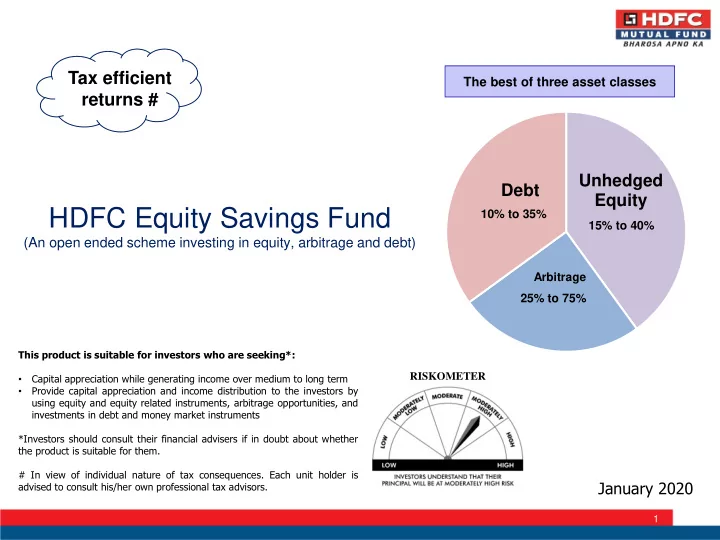
Tax efficient The best of three asset classes returns # Unhedged Debt Equity HDFC Equity Savings Fund 10% to 35% 15% to 40% (An open ended scheme investing in equity, arbitrage and debt) Arbitrage 25% to 75% This product is suitable for


slide-1
SLIDE 1

1

Tax efficient returns #

The best of three asset classes

HDFC Equity Savings Fund

(An open ended scheme investing in equity, arbitrage and debt)

This product is suitable for investors who are seeking*:

  • Capital appreciation while generating income over medium to long term
  • Provide capital appreciation and income distribution to the investors by

using equity and equity related instruments, arbitrage opportunities, and investments in debt and money market instruments *Investors should consult their financial advisers if in doubt about whether the product is suitable for them. # In view of individual nature of tax consequences. Each unit holder is advised to consult his/her own professional tax advisors.

January 2020

RISKOMETER

Unhedged Equity

Arbitrage

Debt

10% to 35% 15% to 40% 25% to 75%

slide-2
SLIDE 2

Content

2

  • HDFC Equity Savings Fund (Slide 3 – 5)
  • Fund Positioning (Slide 6 – 8)
  • Returns Profile, Suitability and Taxation (Slide 9 – 11)
  • Statutory Disclosures (Slide 12 – 18)
  • Economy and Market Outlook (Slide 19 – 26)
slide-3
SLIDE 3

Why HDFC Equity Savings Scheme?

3

  • Long Term Growth – Controlled equity allocation to take advantage of the long term potential of

equities (15-40%)

  • Regular Income – Debt securities (10-35%) and arbitrage opportunities (25-75%) reduce volatility

and aid regular income

  • Low Fund Volatility – Fixed Income exposure and hedged equity exposure (arbitrage) reduces

fund volatility inherent to directional equity exposure

  • Efficient Taxation – Better tax efficiency than debt funds #
  • Diversified Asset Allocation – Regular balancing between asset classes based on market

conditions and outlook

HDFC Mutual Fund/AMC is not guaranteeing return on investments made in the scheme. # In view of individual nature of tax consequences, each unit holder is advised to consult his/her own professional tax advisors

A Fund with an optimal mix of equity, debt and arbitrage opportunities

slide-4
SLIDE 4

Investment Strategy and Fund Positioning Risk Quotient

4

Product Return

Debt Funds Hybrid Debt Funds Equity Savings Funds Hybrid Equity Funds Equity Funds

The current investment strategy is subject to change depending on the market conditions. For complete details on investment strategy, refer SID/KIM of the scheme. For complete portfolio details visit www.hdfcfund.com # Provided the scheme meets the criteria as an equity oriented scheme as per prevalent Income tax laws. HDFC Mutual Fund/AMC is not guaranteeing return on investments made in the scheme. In view of individual nature of tax consequences. Each unit holder is advised to consult his/her own professional tax advisors.

Product Risk

  • Equity Strategy
  • Maintains an effectively diversified portfolio
  • Follows a multi cap strategy, flexibility to invest across large cap, midcap and small cap stocks
  • Fixed Income Strategy
  • The fixed income portion is invested in corporate bonds and bank perpetual bonds and GILTS
  • The maturity profile of debt portion depends on interest rate outlook.
  • Equity Arbitrage Strategy
  • Hedged equity allocation to gain from spread between future and spot prices
slide-5
SLIDE 5

Performance Scenario Analysis of Hybrid Portfolio Strategy

5

The scenarios of hybrid portfolio of equity, arbitrage and fixed income provided in the table above does not in any manner offer any assured returns and is subject to market risks. The above scenario analysis does not take fund expenses into account. The rates of return shown are assumed figures and not to be construed as actual returns and/or guaranteed

  • returns. HDFC Mutual Fund/AMC is not guaranteeing returns on investments made in the Scheme. The information provided herein is used to explain the concept and is given

for illustrative purposes only. The same is not sufficient and shouldn’t be used for the development or implementation of an investment strategy. It should not be construed as an investment advice to any party. Past performance may or may not be sustained in future.

Scenario Analysis

Assumed Un-hedged Equity Portion returns (35% weight) 25% 20% 15% 12% 10% 5% 0%

  • 5%
  • 10%
  • 15%
  • 20%

Assumed Hedged + Fixed Income returns (65% weight) 6% 12.7% 10.9% 9.2% 8.1% 7.4% 5.7% 3.9% 2.2% 0.4%

  • 1.4%
  • 3.1%

7% 13.3% 11.6% 9.8% 8.8% 8.1% 6.3% 4.6% 2.8% 1.1%

  • 0.7%
  • 2.5%

8% 14.0% 12.2% 10.5% 9.4% 8.7% 7.0% 5.2% 3.5% 1.7%

  • 0.1%
  • 1.8%

How to read the table? Lets take an example of the cell shaded in red Arbitrage & Fixed Income: 7% return * 65% exposure = 4.6% contribution; Equity: 12% return * 35% exposure = 4.2% contribution Performance of the Hybrid Portfolio Strategy = 8.8% return

slide-6
SLIDE 6

HDFC Equity Savings Fund - Portfolio Positioning

6 Data as on Dec 31, 2019. For complete portfolio details refer www.hdfcfund.com

Total Number of stocks in the Portfolio 44 Top 10 Holdings (%) 29.1 Large Cap (%) 34.2 Mid Cap (%) 2.2 Small Cap (%) 2.4 Equity (Unhedged) Average Maturity* 1.82 years Macaulay Duration* 1.59 years Modified Duration* 1.47 years Yield to Maturity* 7.82% Debt

* Computed on the invested amount for debt portfolio.

Gross Equity Exposure 68.7% Hedged Equity Exposure (Arbitrage) 30.1% Unhedged Equity Exposure 38.6% Monthly Average AUM (Rs in crores) 4346

slide-7
SLIDE 7

HDFC Equity Savings Fund - Portfolio Positioning

7

0.7 0.7 1.2 2.4 3.0 4.3 4.6 6.0 7.2 8.6 5 10 Consumer Discretionary Health Care Consumer Staples Materials Retail Bank & Financials Information Technology Energy Industrials Utilities Corporate Bank & Financials

Sectoral Holding - Unhedged Exposure

Data as on Dec 31, 2019. For complete portfolio details refer www.hdfcfund.com; OW – Overweight, UW - Underweight Sector OW/ UW Rationale Corporate Banks & Financials OW The recognition phase of NPAs is largely over; with falling slippages and increasing resolution of NPAs, provisioning costs are expected to fall sharply. Utilities OW Change in CERC (Central Electricity Regulatory Commission) regulations; capacity - led growth; very attractive valuations versus history. Energy OW Increase in tariffs and more to come for the larger gas transmission companies; positive outlook for refining margins; marketing companies trading at very attractive valuations on low expectations Industrials OW Massive infrastructure spending thrust announced by Government

  • f India; order books remain strong for most companies in the

sector; resolution of IBC cases in core sector will aid capex cycle. Retail Banks & Financials UW Underweight on NBFCs due to an inherently risky business model and high valuations Health Care UW Adverse action from US FDA has resulted in uncertainty. Growth in India business has continued, albeit a lower pace; R&D expenses are also increasing and margins are under pressure. Consumer Discretionary UW Auto sector is facing multiple headwinds. The transition to BSVI will lead to higher vehicle prices and is a near term headwind. EVs are likely to emerge as a threat in 3Ws followed by 2Ws over the next few years. Non auto consumer durable companies face headwinds such as lower demand and increased competition leading to lower margins.

slide-8
SLIDE 8

HDFC Equity Savings Fund - Portfolio Positioning

8

Name Of the Instrument Sector % to NAV NTPC Limited Utilities 4.33 Infosys Limited Information Technology 4.09 ICICI Bank Ltd. Corporate Bank & Financials 3.92 State Bank of India Corporate Bank & Financials 3.89 Reliance Industries Ltd. Energy 3.25 Larsen and Toubro Ltd. Industrials 3.06 HDFC Bank Ltd. Retail Bank & Financials 3.00 GAIL (India) Ltd. Utilities 1.35 ITC Ltd. Consumer Staples 1.22 Vedanta Ltd. Materials 1.04 Total 29.15

Top 10 Holdings – Unhedged Equity Exposure

Data as on Dec 31, 2019. For complete portfolio details refer www.hdfcfund.com

Portfolio Classification by Rating Class(%) – Debt Exposure

Short Term Deposits as margin for Futures & Options 7.59 A+ & below 6.64 AA+ 6.08 AAA/AAA(SO)/A1+/A1+(SO) & Equivalent 3.48 Cash, Cash Equivalents and Net Current Assets 3.45 AA/AA- 2.34 Sovereign 1.65

slide-9
SLIDE 9

Return Profile & Suitability

9

3 Year Rolling Returns (15th Dec 2015* – 31st Dec 2019)

Particulars % Number of Observations 255

Less than 6% Greater than 6% 255

Minimum 6.02 Maximum 12.56 Average 9.37

  • Std. Deviation

2.09

  • The fund has delivered an average return of 9.37% based on

3 year rolling basis with very low volatility.

  • The fund has delivered greater than 6% return in 100%
  • bservations based on 3 rolling basis.

* Returns have been shown since 15th Dec’15 as there was a change in the fundamental attributes of the scheme viz; from HDFC Multiple Yield Fund, open ended Income Scheme to HDFC Equity Savings Fund. For complete performance details, please refer slide 14-17.

Suitability

  • The fund is suitable for conservative and

risk averse investors looking for moderate participation in equity markets

  • The

fund is an ideal alternative to traditional saving options

  • Investors having an investment horizon of

2-3 years

slide-10
SLIDE 10

Equity Taxation

10

For Resident Individuals/HUF$

Taxes Applicable Equity Oriented Funds Liquid Funds/ Debt Funds

Dividend Distribution Tax& 11.648% 29.12% Short Term Capital Gains@ 15% + Surcharge as Applicable+4% Cess 17.94%/17.16% 30% + Surcharge as Applicable+4% Cess 42.744%/39%/35.88%/34.32% Long Term Capital Gains@@ 10% without Indexation + Surcharge as Applicable+4% Cess 11.96%/11.44%# 20% with Indexation + Surcharge as Applicable+4% Cess 28.496%/26%/23.92%/22.88%

& For the purpose of determining the tax payable, the amount of distributed income be increased to such amount as would, after reduction of tax from such increased amount, be equal to the income distributed by the Mutual Fund. The impact of the same has not been reflected above @ Short Term Capital gains will be considered for equity assets held for a period of up to 12 months and up to 36 months in case of debt assets @@ Assets not falling under short term assets will be treated as long term assets. $ In case of Individual, HUF, AOP, BOI, AJP, the Finance (No. 2) Act, 2019 read with the Taxation Laws (Amendment) Ordinance, 2019 provides for -(a) surcharge at 10% where income exceeds Rs 50 lakhs but does not exceed Rs. 1 crore and surcharge at 15% where income exceeds Rs. 1 crore but does not exceed Rs. 2 crores (including capital gains u/s 111A and 112A); (b) surcharge at the rate 25% where income exceeds Rs. 2 crores but does not exceed Rs. 5 crores and surcharge at 37% where income exceeds Rs. 5 crores (excluding capital gains u/s 111A and 112A); (c) surcharge at 15% where income exceeds Rs. 2 crores (including capital gains u/s 111A and 112A) and not covered in (b). The information set out is neither a complete disclosure of every material fact of Income-tax Act 1961 nor does it constitute tax or legal advice. In view of the individual nature of the tax consequences, each investor is advised to consult his/her own professional tax advisor.

slide-11
SLIDE 11

Equity Taxation

11

For Domestic Companies$

Taxes Applicable Equity Oriented Funds Liquid Funds/ Debt Funds

Dividend Distribution Tax& 11.648% 34.944% Short Term Capital Gains@ 15% without Indexation + Surcharge as Applicable+4% Cess 17.472%/16.692% 30% + Appl.SC $ + 4% Cess - 34.944%/33.384% ^25% + Appl.SC $ + 4% Cess - 29.120%/27.820% ^^22%+10% SC +4% Cess - 25.17%^ ^^15%+10% SC +4% Cess - 17.16%^ Long Term Capital Gains@@ 10% without Indexation + Surcharge as Applicable+4% Cess $ 11.648%/11.128%# 20% with Indexation + Surcharge as Applicable+4% Cess $ 23.296%/22.256%

& For the purpose of determining the tax payable, the amount of distributed income be increased to such amount as would, after reduction of tax from such increased amount, be equal to the income distributed by the Mutual Fund. The impact of the same has not been reflected above @ Short Term Capital gains will be considered for equity assets held for a period of up to 12 months and up to 36 months in case of debt assets @@ Assets not falling under short term assets will be treated as long term assets. $- Surcharge at the rate of 7% is levied for domestic corporate unit holders where the income exceeds Rs 1 crore but is less than Rs 10 crores and at the rate of 12%, where income exceeds Rs 10 crores. ^ If total turnover or Gross receipts during the financial year 2017-18 does not exceed Rs. 400 crores. ^^ - The taxation Laws (Amendment) Ordinance, 2019 provided for corporate tax rates for domestic companies(not claiming specified incentives and deductions) @ 22% u/s 115BAA and domestic manufacturing companies (not claiming specified incentives and deductions) set-up and registered on or after 1 October 2019 @ 15% u/s 115BAA. Surcharge Applicable @ 10%. #Exemption granted w.r.t. equity oriented fund u/s 10(38) of the Income-tax Act, 1961 has been withdrawn and tax at 10% (without indexation) will be charged on long-term capital gain exceeding Rs. 1 lakh provided that transfer of such units is subject to STT.

  • Domestic companies may subject to minimum alternate tax which is not specified in above tax rates. Not applicable in case domestic company has opted for sec 115BAA

The information set out is neither a complete disclosure of every material fact of Income-tax Act 1961 nor does it constitute tax or legal advice. In view of the individual nature of the tax consequences, each investor is advised to consult his/her own professional tax advisor.

slide-12
SLIDE 12

Asset Allocation Pattern-Normal

12

Under normal circumstances, the asset allocation of the scheme’s portfolio will be as follows:

Types of Instruments Minimum (% of Total Assets) Maximum (% of Total Assets) Risk Profile Equity & Equity related instruments 65 90 Medium to High Of which net long equity and equity related instruments* 15 40 High Of which Derivatives including index futures, stock futures, index options and stock options, etc. 25 75 Medium to High Other Derivative opportunities 20 Medium to High Debt securities (including securitized debt) & Money Market instruments 10 35 Low to Medium Units issued by REITs and InvITs 10 Medium to High Non-convertible preference shares 10 Low to Medium

* This net long equity exposure is aimed to gain from potential capital appreciation and thus is a directional equity exposure which will not be hedged. The Scheme may invest in the schemes of Mutual Funds in accordance with the applicable extant SEBI (Mutual Funds) Regulations as amended from time to time.

slide-13
SLIDE 13

Asset Allocation Pattern-Defensive

13

Under defensive circumstances, the asset allocation of the scheme’s portfolio will be as follows:

Types of Instruments Minimum (% of Total Assets) Maximum (% of Total Assets) Risk Profile Equity & Equity related instruments 15 65 Medium to High Of which net long equity and equity related instruments* 15 40 High Of which Derivatives including index futures, stock futures, index options and stock options, etc. 50 Medium to High Other Derivative opportunities 20 Medium to High Debt securities (including securitized debt) & Money Market instruments 35 85 Low to Medium Units issued by REITs and InvITs 10 Medium to High Non-convertible preference shares 10 Low to Medium

* This net long equity exposure is aimed to gain from potential capital appreciation and thus is a directional equity exposure which will not be

  • hedged. The Scheme may invest in the schemes of Mutual Funds in accordance with the applicable extant SEBI (Mutual Funds) Regulations

as amended from time to time.

slide-14
SLIDE 14

Scheme Performance as on 31st December 2019

14

^^Effective December 16, 2015, certain changes, including changes to fundamental attributes, were effected in the erstwhile HDFC Multiple Yield Fund, (an

  • pen ended income scheme) which was renamed as HDFC Equity Savings Fund, an open ended equity scheme. On account of these changes, the performance

during the period(s) from September 17, 2004 to December 15, 2015 is not comparable. Returns greater than 1 year period are compounded annualized (CAGR). N.A. Not Available. # 40% NIFTY 50 Arbitrage Index, 30% CRISIL Short Term Bond Fund Index and 30% NIFTY 50 (Total Returns Index); ## NIFTY 50 Total Returns Index. Scheme performance may not strictly be comparable with that of its Additional Benchmark, since a portion of scheme’s investments are made in debt instruments. Performance of dividend option under the schemes for the investors would be net of distribution tax as applicable. For performance of other schemes managed by Vinay Kulkarni (Equities), Krishan Kumar Daga (Equities) and Anil Bamboli (Debt), refer subsequent slides. Different plans viz. Regular Plan and Direct Plan have a different expense structure. The expenses

  • f the Direct Plan under the Scheme will be lower to the extent of the distribution expenses / commission charged in the Regular Plan. Past performance

may or may not be sustained in the future. Load is not taken into consideration for computation of performance.

Value of Rs 10,000 invested Period^^ Scheme Returns (%) Benchmark Returns (%) # Additional Benchmark Returns (%) ## Scheme Benchmark (Rs)# Additional Benchmark (Rs)##

Last 1 year 5.83 9.74 13.48 10,583 10,974 11,348 Last 3 years 7.55 9.03 15.63 12,443 12,965 15,468 Last 5 years 7.70 7.81 9.38 14,491 14,570 15,661 Since inception 9.04 NA 15.03 37,583 NA 85,121

slide-15
SLIDE 15

Other Schemes managed by Vinay Kulkarni, co-fund manager of HDFC Equity Savings Fund

15

Scheme

Managing scheme since

1 year 3 year CAGR (in %) 5 year CAGR (in %)

Vinay Kulkarni manages 4 schemes (including HDFC Equity Savings Fund)

HDFC Tax Saver 21/Nov/2006

3.73 8.6 5.25

NIFTY 500 TRI1

8.97 13.64 9.11

HDFC Focused 30 Fund 21/Nov/2006

3.77 7.11 5.67

NIFTY 500 TRI1

8.97 13.64 9.11

HDFC Growth Opportunities Fund 18/Feb/1994

6.58 9.87 5.57

NIFTY Large Midcap 250 TRI1

6.03 13.14 9.84

Past performance may or may not be sustained in the future. Returns greater than 1 year period are compounded annualised (CAGR). The above returns are of Regular plan -growth

  • ption. Load is not taken into consideration for computation of performance. 1. Benchmark. On account of difference in the type of the Scheme, asset allocation, investment strategy,

inception dates, the performance of these schemes are strictly not comparable. Returns as on 31st Dec 2019. Different plans viz. Regular Plan and Direct Plan have a different expense

  • structure. The expenses of the Direct Plan under the Scheme will be lower to the extent of the distribution expenses/ commission charged in the Regular Plan. TRI – Total Returns

Index.

slide-16
SLIDE 16

Other Schemes managed by Krishan Kumar Daga, co-fund manager of HDFC Equity Savings Fund

16

Scheme Managing scheme since 1 year 3 year CAGR (in %) 5 year CAGR (in %) Krishan Kumar Daga manages 13 schemes (including HDFC Equity Savings Fund) (Schemes which have completed more than 1 year) Performance of Top 3 schemes managed by Krishan Kumar Daga (excluding HDFC Equity Savings Fund) HDFC Arbitrage Fund 19/Oct/15

5.96 5.65 6.24

NIFTY 50 Arbitrage Index 1

6.64 5.12 5.91

HDFC SENSEX ETF 19/Oct/15

15.59 17.05 NA

S&P BSE SENSEX TRI 1

15.66 17.11 NA

HDFC Charity Fund for Cancer Cure - Arbitrage Plan 27/Mar/17

6.14 NA NA

NIFTY 50 Arbitrage Index 1

6.64 NA NA

Performance of Bottom 3 schemes managed by Krishan Kumar Daga (excluding HDFC Equity Savings Fund) HDFC DAF - III - 1304D August 2016 $ 12/Sep/16

7.39 6.28 NA

NIFTY 50 Hybrid Short Duration Debt 40:60 Index1

11.02 10.81 NA

HDFC DAF - III - 1267D October 2016 $ 25/Oct/16

7.46 6.07 NA

NIFTY 50 Hybrid Short Duration Debt 40:60 Index1

11.02 10.81 NA

HDFC DAF - III - 1224D November 2016 $ 07/Dec/16

7.44 6.08 NA

NIFTY 50 Hybrid Short Duration Debt 25:75 Index1

10.34 9.54 NA

Past performance may or may not be sustained in the future. Returns greater than 1 year period are compounded annualized (CAGR). The above returns are of Regular plan - growth option. $ The scheme is co-managed by Anil Bamboli and Krishan Kumar Daga. 1 Benchmark. Top 3 and bottom 3 schemes managed by the Fund Manager have been derived

  • n the basis of since inception returns. In case the benchmark is not available on the Scheme’s inception date, the returns for the concerned scheme is considered from the date the

benchmark is available. On account of difference in the type of the Scheme, asset allocation, investment strategy, inception dates, the performance of these schemes is strictly not

  • comparable. Returns as on 31

stDec 2019. Different plans viz. Regular Plan and Direct Plan have a different expense structure. The expenses of the Direct Plan under the Scheme will

be lower to the extent of the distribution expenses/ commission charged in the Regular Plan. Load is not taken into consideration for computation of performance.
slide-17
SLIDE 17

Other Schemes managed by Anil Bamboli, co-fund manager of HDFC Equity Savings Fund

17

Scheme

Managing scheme since

1 year 3 year CAGR (in %) 5 year CAGR (in %) Anil Bamboli manages 40 schemes (including HDFC Equity Savings Fund) (Schemes which have completed more than 1 year) Performance of Top 3 schemes managed by Anil Bamboli (excluding HDFC Equity Savings Fund) HDFC FMP 1309D September 2016 (1) 20/Sep/2016

9.29 8.34 NA

CRISIL Composite Bond Fund Index1

10.72 7.08 NA

HDFC FMP 1218D December 2016 (1) 12/Jan/2017

9.76 NA NA

CRISIL Composite Bond Fund Index1

10.72 NA NA

HDFC FMP 1302D September 2016 (1) 28/Sep/2016

9.33 8.35 NA

CRISIL Composite Bond Fund Index1

10.72 7.08 NA

Performance of Bottom 3 schemes managed by Anil Bamboli (excluding HDFC Equity Savings Fund) HDFC FMP 1146D April 2018 (1) (40) 10/May/18

5.44 NA NA

CRISIL Composite Bond Fund Index1

10.72 NA NA

HDFC DAF - III - 1267D October 2016 $ 25/Oct/16

7.46 6.07 NA

NIFTY 50 Hybrid Short Duration Debt 40:60 Index1

11.02 10.81 NA

HDFC DAF - III - 1224D November 2016 $ 07/Dec/16

7.44 6.08 NA

NIFTY 50 Hybrid Short Duration Debt 25:75 Index1

10.34 9.54 NA

Past performance may or may not be sustained in the future. Returns greater than 1 year period are compounded annualized (CAGR). The above returns are of Regular plan -growth option. $ The scheme is co-managed by Anil Bamboli and Krishan Kumar Daga. 1 Benchmark. Top 3 and bottom 3 schemes managed by the Fund Manager have been derived on the basis of since inception returns. In case the benchmark is not available on the Scheme’s inception date, the returns for the concerned scheme is considered from the date the benchmark is available. On account of difference in the type of the Scheme, asset allocation, investment strategy, inception dates, the performance of these schemes is strictly not comparable. Returns as on 31st Dec 2019. Different plans viz. Regular Plan and Direct Plan have a different expense structure. The expenses of the Direct Plan under the Scheme will be lower to the extent of the distribution expenses/ commission charged in the Regular Plan. Load is not taken into consideration for computation of performance.

slide-18
SLIDE 18

Product Features

18 Name HDFC Equity Savings Fund Type of Scheme An open ended scheme investing in equity, arbitrage and debt Inception Date (Date of allotment) September 17, 2004 Investment Objective To provide capital appreciation by investing in Equity & equity related instruments, Arbitrage opportunities, and Debt & money market instruments. There is no assurance that the investment objective of the scheme will be realized. Fund Manager(s) $ Vinay Kulkarni & Krishan Kumar Daga (Equities), Anil Bamboli (Debt) Investment Plans

  • Direct Plan
  • Regular Plan

Investment Option Under Each Plan: Growth & Dividend. The Dividend Option offers Dividend Payout and Reinvestment facility Minimum Application Amount (Under Each Plan /Option) Purchase: Rs. 5,000 and any amount thereafter Additional Purchase: Rs. 1,000 and any amount thereafter Load Structure Entry Load: Not Applicable

  • Upfront commission shall be paid directly by the investor to the ARN Holder (AMFI registered Distributor)

based on the investors’ assessment of various factors including the service rendered by the ARN Holder. Exit Load:

  • In respect of each purchase / switch-in of Units, up to 15% of the units may be redeemed without any exit

load from the date of allotment.

  • Any redemption in excess of the above limit shall be subject to the following exit load:
  • Exit load of 1.00% is payable if Units are redeemed / switched-out within 1 year from the date of allotment
  • f units.
  • No Exit Load is payable if Units are redeemed / switched-out after 1 year from the date of allotment.

In case of systematic transactions such as SIP, GSIP, STP, Flex SIP, Flex STP, Swing STP, Flexindex; exit load, if any, prevailing on the date of registration/enrolment shall be levied. Benchmark 40% NIFTY 50 Arbitrage Index, 30% CRISIL Short Term Bond Fund Index and 30% NIFTY 50 (Total Returns Index) For further details, refer Scheme Information Document and Key Information Memorandum and addenda thereto available on www.hdfcfund.com and at Investor Service Centres of HDFC Mutual Fund. $ Dedicated fund manager for overseas investments Mr. Chirag Dagli

slide-19
SLIDE 19

Economy and Market Outlook

19

slide-20
SLIDE 20

Indian Economy – Growth moderates, other parameters stable

Improving macros FY15 FY17 FY19 FY20E FY21E Real GDP at market price (% YoY) 7.4 8.2 6.8 4.7 5.5 Centre's fiscal deficit (% GDP) 4.1 3.5 3.4 3.8 3.7 Current Account Deficit (CAD) (% GDP) 1.3 0.7 2.1 1.5 1.6 Balance of Payment (% of GDP) 3.0 0.9

  • 0.1

1.2 0.9 Consumer Price Inflation (CPI) (Average) 6 4.5 3.4 4.2 4.5 Foreign Exchange Reserves (USD bn) 341 370 412 454^ NA Source: Kotak Institutional Equities, E-Estimates, ^ as of 13th Dec 19. na – not available

  • Auto sector, especially Passenger vehicles (PV), despite low penetration,

slowed down sharply in 2019. Sharp de-growth of production in auto sector

(~3-4% of GDP) was a key contributor to slowdown (slides 21-22)

  • Slowdown was also observed across other segments like cement, air

travel, consumer durables, etc. (charts 2 to 4)

  • Slides 21-22 explain the key reasons for slowdown, what was sustaining

consumption till now and growth outlook for FY21

  • Over the past few years, most macro economic parameters are improving
  • r are stable; however growth has slowed down in FY20 (Table 1)
  • Both consumption (58% of GDP) and investments (29% of GDP) slowed down

significantly in H1 FY20 (Chart 1)

Table 1 Chart 2 Chart 3 Chart 4 Sources: CMIE, Kotak Institutional Equities

20

Chart 1

slide-21
SLIDE 21

Why do we think Economic growth has bottomed ?

  • Link between Auto sector and GDP slowdown – 2 sides of the same coin

‒ Auto sector accounts for ~3-4% of GDP; thus volume de-growth of ~15%-20% shaves

  • ff 0.5% - 0.8% of GDP growth

‒ With inventory correction over, even if auto volumes are flat next year, GDP growth should be higher by 0.5-0.8% in FY21, on this count alone

  • Lower corporate tax cuts for new manufacturing units

‒ In a path breaking decision, government reduced the corporate tax rate to 15% for all new manufacturing units that commence production before Mar-23 ‒ In our view, given the general time to set up new unit is 2 - 4 years and deadline of Mar-23 to avail tax benefit, private capex should improve in FY21, especially by MNCs

  • Measures taken by Government & RBI

‒ Reduction in corporate tax rates & policy rates (135 bps in 2019); ‒ Multiple steps taken to resolve liquidity issues in NBFCs and Real estate; ‒ Focus on improving ease of doing business; India’s rank improved to 63 from 77 in 2018 & 100 in 2017

  • Post verdict on Essar steel case, most large assets in Power, steel, infrastructure etc. are

likely to be resolved under IBC in FY20. This should improve capex in FY21 as ‒ New owners of IBC assets are likely to incur incremental capex to optimise efficiency

  • etc. E.g.- Arcelor Mittal indicated capex of INR 80 bn in Essar

‒ For growth, now new units will have to be planned as no existing units are available

  • With decline in interest rates (Table 1) and real estate prices (Chart 2), EMIs of home loans

have reduced, thus improving affordability 21

^assuming 5% decline in real estate prices 2 years ago Currently Saving Home Loan 40,00,000 38,00,000^ Tenor (In years) 20 20 Interest rate 9.2% 8.3% EMI for home loan (36,376) (32,498) 10.7% Sources: CMIE, ICICI Securities, PIB Chart 1 Chart 2 Table 1

slide-22
SLIDE 22

Corporate Tax Rate Cut – Addressing the weak link

  • India lagged China & other Asian countries in manufacturing (Chart 1)

‒ In 2018, China’s manufactured exports were ~8 times of India’s; Even Vietnam’s manufactured exports, which is 1/10th the size of India, are comparable with India’s manufactured exports (Chart 2) Manufacturing – Opportunity knocks again for India

  • Global companies are now looking to shift and diversify their supply chain

from China. This is driven by ‒ China’s edge of low costs has diminished with rising labor costs ‒ Cost of real estate has risen significantly in China ‒ Stringent environmental standards ‒ Increasing trade tensions with the US

  • India was not a preferred destination compared to Asian countries despite a

large domestic market, improving ease of doing business, similar labour costs, availability of skilled resources etc. mainly due to higher tax rates

  • With the recent corporate tax rate cut

(from 30% to 15%) for new

manufacturing units, India’s tax rate is now amongst the lowest in the

  • region. With this, manufacturing in India should get a boost (Chart 5)

22

Sources: Kotak Institutional Equities, JM Financials, Bloomberg, JETRO Chart 1 Chart 2 Chart 3 Chart 4 Chart 5

slide-23
SLIDE 23

Indian equities – Attractive Valuations

  • Over the long term, stock market indices in India are growing around the same rate as the

nominal GDP ‒ This implies that when in any extended period of, say 10 years, indices grow significantly less than nominal GDP, they tend to make up in the future by delivering higher returns & vice versa. Interestingly, we are in a similar situation presently (Table 1)

  • Marketcap to GDP at 61% and CY21(E) P/E of ~15x is attractive, specially at time when

NIFTY50 profit growth is estimated at 18% CAGR over FY19-22E and interest rates are low

  • Gap between 10Y Gsec yield and 1Y-Forward NIFTY 50 Earning yield [i.e. 100/ (one year

forward P/E)] has reduced significantly and is now below 10 year average (1.7%) indicating that equities are attractively valued relative to current bond yields

India market cap to GDP ratio, calendar year-ends 2005-21E (%)

Low Marketcap to GDP, Bond yields equal to Earnings yield and recovery in profit growth make us optimistic on markets over medium to long term

23

Year Previous 10 year NIFTY Return (CAGR) Nominal GDP Growth (Previous 10 year CAGR) Next 10 year NIFTY Return (CAGR) 2001 7% 13% 16% 2002 4% 13% 18% 2003 6% 12% 13% 2004 6% 12% 15% 2006 16% 12% 8% 2007 19% 12% 6% 2016 8% 14% ? 2017 6% 13% ? 2018 14% 13% ? 2019 9% 13% ? Table 1 – Periods when10 year NIFTY Return trailed / exceeded Nominal GDP Growth materially Source: Kotak Institutional Equities, updated till 31st Dec, 2019, From 2005-18, NIFTY50 PE is based on 12 month forward estimated EPS. For 2019E, by Kotak Institutional Equities has calculated PE based on EPS numbers as of Mar-20 end, 2020E based on EPS of Mar-21 end and for 2021E based on EPS of Mar-22 end

69 88 149 56 99 98 61 72 65 81 75 71 92 78 75 67 61

1315 23 11 17 16 13 14 16 20 18 1719 17 18 18 15

  • 5

10 15 20 25 20 40 60 80 100 120 140 160 05 06 07 08 09 10 11 12 13 14 15 16 17 18 19E 20E 21E

Mcap/GDP (%) NIFTY 12M forward P/E (X) (RHS)

slide-24
SLIDE 24

Interest Rates Outlook – Conflicting forces at play

Factors supporting lower yields

  • Accommodative stance to remain till “it is necessary to revive growth” - RBI
  • Attractive term premium over repo rate; Operation TWIST
  • Muted credit growth vs. deposit growth
  • Ample liquidity in the system
  • Capacity utilisation below long term average
  • Healthy real rates* differential between India & US

Factors opposing lower yields

  • Excess SLR securities holding of PSU banks
  • Risk of fiscal slippage remains high
  • Lower OMO purchases
  • Food prices may keep near term inflation over 4%
  • Domestic growth possibly bottoming out

Yields are likely to remain within a range for the foreseeable future

* Month-end 10Y benchmark yield less headline inflation for the month

Key things to watch out for

  • Improvement in economic growth and Inflation trajectory
  • Strategic sale of BPCL, as it would not only ease immediate fiscal pressure but also set an important precedent
  • Steps taken to augment revenues including GST rate changes
  • Changes in Personal income tax rates
  • Global yields movements and stance of major global central banks

24

slide-25
SLIDE 25

Interest Rates Outlook – Factors supporting lower yields

* Month-end 10Y benchmark yield less headline inflation for the month; Updated till 30st Nov’19. CPI-IW is used to calculate real yields for period before 2012 Source:s CMIE, Bloomberg, RBI

  • Term premium is attractive over repo rate; Spread of 10Y yield over repo

rate is near 9 year high

  • RBI’s operation TWIST likely to ease pressure on longer end yields

‒ Under this operation RBI to buy Government bonds of longer maturity and sell bonds of shorter maturity; Impact will depend on quantum under this operations

  • Reasonable differential with US Real yields*
  • Indian real yields have softened with surge in CPI but still remain positive

as against other key economies (US/EU/Japan/China) where real yields have turned negative

10.3% 7.9% 2.0% 4.0% 6.0% 8.0% 10.0% 12.0% 14.0% 16.0% Mar-17 Nov-17 Jul-18 Mar-19 Nov-19

Credit Growth Vs. Deposit Growth

Deposit growth % Credit growth %

  • Credit growth has moderated whereas Deposit growth has improved;

also reflects weak economic activity ‒ Interbanking liquidity remains in surplus for last 2 quarters 25

Chart 1 Chart 2 Chart 3

slide-26
SLIDE 26

Interest Rates Outlook: Factors opposing lower yields

Sources: RBI, Kotak Institutional research, CMIE * Adj SLR = Investments in Statutory Liquidity Ratio (SLR) Securities adjusted for securities under LAF # Regulatory Requirements = SLR + Liquidity coverage requirement requirements (~15-17% of NDTL) – carve out allowed from SLR

  • Headline inflation may remain above RBI target driven by firming food
  • prices. This might result in pause in rate cuts by RBI
  • Fiscal slippage likely, especially with corporate tax rate cuts

‒ Fiscal impact of tax rate cuts is estimated to be ~0.3% of GDP for centre and ~0.2% for states ‒ Given the weak demand, additional supply of dated G-Secs poses risk to yields

Data beyond Nov 2019 are Kotak Institutional Equities estimates 0.0 2.0 4.0 6.0 8.0 Oct/15 Oct/16 Oct/17 Oct/18 Oct/19 Oct/20 %

Inflation may remain over RBI target

  • Excess SLR Investments holdings, especially with PSU banks

‒ Incremental demand for G-secs could remain muted

Updated till Dec 06, 2019

26

Chart 1 Chart 2 Chart 3

slide-27
SLIDE 27

Disclaimer & Risk Factors

27

This presentation dated 28th Jan 2020, has been prepared by HDFC Asset Management Company Limited (HDFC AMC) based on internal data, publicly available information and other sources believed to be reliable. Any calculations made are approximations, meant as guidelines only, which you must confirm before relying on them. The information contained in this document is for general purposes only. The current investment strategies are subject to change depending on market

  • conditions. The document is given in summary form and does not purport to be complete. The views / information

provided do not have regard to specific investment objectives, financial situation and the particular needs of any specific person who may receive this information. The information/ data herein alone are not sufficient and should not be used for the development or implementation of an investment strategy. The statements contained herein may include statements of future expectations and other forward-looking statements that are based on our current views and involve known and unknown risks and uncertainties that could cause actual results, performance or events to differ materially from those expressed or implied in such statements. Stocks/Sectors referred above are illustrative and not recommended by HDFC Mutual Fund / AMC. The Fund may or may not have any present or future positions in these sectors. The above has been prepared on the basis of information which is already available in publicly accessible media. The above should not be construed as an investment advice or a research report or a recommendation by HDFC Mutual Fund/HDFC AMC to buy or sell the stock or any other security covered under the respective sector/s. Past performance may or may not be sustained in future. HDFC Mutual Fund/AMC is not guaranteeing return on investments made in the scheme. Neither HDFC AMC and HDFC Mutual Fund nor any person connected with them, accepts any liability arising from the use of this

  • document. The recipient(s) before acting on any information herein should make his/her/their own investigation and seek

appropriate professional advice and shall alone be fully responsible / liable for any decision taken on the basis of information contained herein. For complete portfolio/details refer to our website www.hdfcfund.com

Mutual fund investments are subject to market risks, read all scheme related documents carefully.

slide-28
SLIDE 28

Thank You

28