HDFC Banking & PSU Debt Fund (An open ended debt scheme - - PowerPoint PPT Presentation

hdfc banking psu debt fund
SMART_READER_LITE
LIVE PREVIEW

HDFC Banking & PSU Debt Fund (An open ended debt scheme - - PowerPoint PPT Presentation

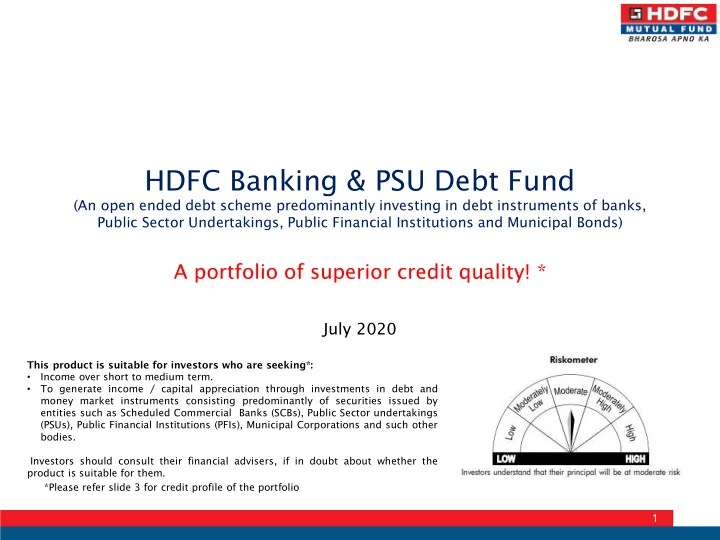
HDFC Banking & PSU Debt Fund (An open ended debt scheme predominantly investing in debt instruments of banks, Public Sector Undertakings, Public Financial Institutions and Municipal Bonds) A portfolio of superior credit quality! * July 2020


slide-1
SLIDE 1

HDFC Banking & PSU Debt Fund

(An open ended debt scheme predominantly investing in debt instruments of banks, Public Sector Undertakings, Public Financial Institutions and Municipal Bonds)

July 2020

This product is suitable for investors who are seeking*:

  • Income over short to medium term.
  • To generate income / capital appreciation through investments in debt and

money market instruments consisting predominantly of securities issued by entities such as Scheduled Commercial Banks (SCBs), Public Sector undertakings (PSUs), Public Financial Institutions (PFIs), Municipal Corporations and such other bodies. Investors should consult their financial advisers, if in doubt about whether the product is suitable for them.

1

A portfolio of superior credit quality! *

*Please refer slide 3 for credit profile of the portfolio

slide-2
SLIDE 2

In the current environment, HDFC Banking and PSU Debt Fund offers a suitable investment opportunity in our opinion.

HDFC Banking and PSU Debt Fund - A Differentiated Fund

Source: B&K Securities; ^ BPSU – Banking and PSU; # other BPSU funds- Funds with AUM over INR 200 crore as of end-June 2020 have been considered. YTM and Modified duration is calculated by taking simple average of 14 other Banking and PSU Debt Funds * Includes all other permitted securities as per Scheme Information document of HDFC Banking and PSU Debt Fund, like debt instruments of Public Financial Institutions, Municipal Corporations and such other bodies. HDFC Mutual Fund/AMC is not guaranteeing/offering/communicating any indicative yields or guaranteed returns on investments made in the scheme(s)

  • Attractive portfolio yield compared to peers#

– Exposure to bank perpetual bonds (refer slide 3)

  • Lower volatility / Interest rate risk as the Fund

intends to maintain short to medium modified duration

  • Consistently maintained high credit quality

– 94.3% of AUM invested in Sovereign/Banking / PSUs* / other AAAs as of end-June’20

2

6.41 5.57 5.0 5.2 5.4 5.6 5.8 6.0 6.2 6.4 6.6 HDFC BPSU^ fund Others BPSU funds# %

YTM as of end June'20

2.58 2.88 1.00 1.50 2.00 2.50 3.00 HDFC BPSU fund Other BPSU funds# Years

Modified duration relative to peers

slide-3
SLIDE 3

^ 9 Operational solar power projects housed under subsidiaries of Greenko, which is held by GIC Singapore (63.6%), ADIA (16%) and rest by Indian promoters. All the projects have off take agreement with NTPC For complete portfolio details refer www.hdfcfund.com. Portfolio details provided as on 30st June, 2020

HDFC Banking and PSU Debt fund – Portfolio composition

Exposure as of June 30, 2020 Rating % of AUM Government Securities Soveriegn 3.4% Public Financial Institutions AAA 42.6% Public Sector Undertakings AAA 16.2% Banks Perpetual bonds A to AA+ 14.0% Banks Non-perpetual bonds AAA / A1+ 4.5% AAA rated, Non PSU AAA 11.3% Others 5.6% Vedanta Ltd. AA 2.1% Greenko SPVs^ AA-(CE) 1.5% The Tata Power Company Ltd. AA- 1.2% TMF Holdings Ltd. AA- 0.4% Shriram Transport Finance Co. Ltd. AA+ 0.3% Hazaribagh Ranchi Expressway Ltd. D 0.1% Cash and equivalent 2.4% Total 100.0% Portfolio Classification (%) AAA/AAA(SO)/A1+ /A1+(SO) & Equivalent AA+ & Below Total Sovereign, Banking & PSU 66.7% 14.0% 80.7% Others (incl. cash) 13.6% 5.6% 19.3% Total 80.3% 19.7% 100.0% Average Maturity Modified Duration YTM 3.33 years 2.58 years 6.41% Exposure to Banks Perpetual Bonds (% of AUM) Total PSU Banks As on June 30, 2020 14.04% 14.04%

3

slide-4
SLIDE 4

HDFC Banking and PSU – Diversified exposures

For complete portfolio details refer www.hdfcfund.com. Portfolio details provided as June 30, 2020. Portfolio holdings are as a percentage of total portfolio

  • holdings. The instruments referred above are not recommended by HDFC Mutual Fund/AMC. The Fund may or may not have any present or future

positions in these instruments.

Diversified Group Exposure

Financial Services % Public Financial Institutions (PFIs) 36.5 Banks 18.6 Housing Finance Companies (HFCs) 6.4 NBFCs 0.8 Top 5 Non-GoI Group Exposures (%) 4.5 L&T 3.1 LIC 2.5 Tata 2.1 Vedanta 2.0 RIL 14.2 Sub-Total 17.7 Total Non-GoI Groups Investments in 9 different groups Major Sector Exposures (%) 62.3 FINANCIAL SERVICES 8.5 POWER 7.8 CONSTRUCTION 4.4 SERVICES 3.9 CHEMICALS 3.3 TELECOM 2.1 METALS 2.1 OIL & GAS

Diversified Sector Exposure

4

slide-5
SLIDE 5

Case for AT-1 bonds

5

Table : 1-Capital Cushions of Banks as on 31-Mar-20 Issuer CET-1 (a) CET-1 Cushion (a)-(b) State Bank of India 9.77% 2.40% Union Bank Of India Ltd. 9.40% 2.03% Punjab National Bank 10.69% 3.32% Bank of Baroda 9.44% 2.07% Canara Bank Ltd 9.39% 2.02% RBI Mandated Requirement 7.375% (b) Table : 2 – Spreads over 3 year Gsec yields

Spread over 3 year Gsec yield (%) 3 Yr average 31-Mar-20 30-Apr-20 31-May-20 30-Jun-20 Gap between current spread and LTA Axis Bank 2.71 4.11 6.54 4.92 4.17 1.46 Bank of Baroda 2.59 3.98 5.8 4.11 3.86 1.27 Canara Bank 3.14 4.12 7.47 5.63 5.13 1.99 EXIM Bank 2.21 3.48 4.36 3.71 3.49 1.28 HDFC Bank 2.14 3.61 4.43 3.47 3.07 0.93 ICICI Bank 2.58 4.12 5.89 4.31 4.04 1.46 Punjab National Bank 3.49 4.68 7.88 6.77 6.25 2.75 State Bank of India 2.10 3.38 4.44 3.47 3.19 1.09 Union Bank of India 3.25 4.48 7.93 5.6 5.31 2.06

  • AT-1 Bonds are quasi debt instruments
  • Do not have a fixed maturity date but generally have a call
  • ption after 5 years and annually thereafter
  • Rated one or two notches lower than issuer credit rating
  • HDFC Banking and PSU Debt Fund has invested in PSU Banks

and/or large private sector banks

  • PSU Banks are less risky as historically, the government

has infused equity to maintain capital adequacy in these banks.

  • Historically, PSU banks have called AT-1 bonds despite

being placed under Prompt correction Action framework

  • Rationale for Investments by HDFC Banking & PSU Debt Fund

in AT-1 Bonds

  • Healthy capital level of the issuing banks (refer table 1)
  • Demonstrated track record of support by GoI
  • Spreads over 3 year Gsec yield higher than long term

average, might ease as situation normalises (refer table 2)

  • High spreads over securities like Fixed deposits, Tier-2

bonds, infrastructure bonds, etc. issued by same bank

slide-6
SLIDE 6
  • Short to medium end of the yield curve looks attractive considering the risk-reward (refer slide 8)
  • Longer end yield likely to trade range bound given the large supply of dated Gsec
  • Quality portfolio with low credit risk, preferable in current credit environment
  • Liquidity concerns remain for select NBFCs (especially with high yield real estate exposure);

cautious approach reduces risk

  • In view of the above, HDFC Banking & PSU Debt Fund offers:

 Large exposure to GoI owned entities  Healthy Spread over 91 days T-bill yields*  Controlled duration  Exposure to perpetual bonds, mainly to PSU banks

Investments must be tailored to investor’s individual situation and objectives and therefore, investors should consult their financial advisors to ascertain whether the products are suitable for them. * Spread between month-end YTMs and cut off yield of 91 days T-bill in last auction of the month

Why HDFC Banking and PSU Fund ?

6

3.2

  • 1.0
  • 1.0

2.0 3.0 4.0 5.0 %

Spread between Month-end YTMs and 91-Tbills yield*

slide-7
SLIDE 7

Analysis of Distribution of Returns since inception

1 Year Daily Rolling Returns

Annual Rolling - Since inception, the fund has given 6%

  • r higher returns ~83% of the times.

3 Year Daily Rolling Returns

3 year Rolling - Since inception, the fund has given more than 7.5% returns – 76% of the times.

1 year and 3 year Rolling returns are calculated since inception of the fund based on daily frequency. For Detailed performance refer Slide no 11 Past performance may or may not be sustained in the future. HDFC Mutual Fund/AMC is not guaranteeing/offering/communicating any indicative yields or guaranteeing returns on investments made in the scheme. Inception date: March 26, 2014 . Data is updated till July 8, 2020.

Annual Returns (%) % of times More than 6% 82.9% More than 7.5% 71.1% More than 9% 64.6% Annual Returns (%) % of times More than 6% 100% More than 7.5% 75.7% More than 9% 23.3%

7

slide-8
SLIDE 8

Interest Rates Outlook

Factors supporting lower yields

  • Sharp rate cuts by RBI and major central banks; easing bias

likely to continue

  • Accommodative stance to remain till “it is necessary to revive

growth & mitigate the impact of COVID-19 on the economy” - RBI

  • Concerns over global growth due to disruption caused by

spread of coronavirus

  • Weak growth and soft commodity prices likely to result in

lower inflation in medium term

  • Unconventional tools used by RBI to improve transmission of

rate cuts (Operation TWIST, LTROs, Targeted LTROs)

  • Muted credit growth vs. deposit growth; Ample global and

domestic liquidity

Factors opposing lower yields

  • Excess SLR securities holding of PSU banks
  • Large supply of dated securities by Central and State

Governments

  • Food prices may keep near term inflation over RBI’s

target of 4%

  • Sharp reductions in oil production might lead to higher
  • il prices over a year

Short to medium end of the yield curve offers better risk adjusted returns, in our judgement

8

slide-9
SLIDE 9
  • Benefit of indexation for holding period more than 3 years (1096 days), gives an edge to Banking & PSU

Debt funds vis-à-vis conventional investment avenues without a significantly higher credit risk.

Source: MFI Explorer, Note: The tax rate assumed is the highest rate based on the current tax slabs for Individuals/HUFs with income above Rs. 5 crore. For domestic corporate, corresponding tax rate applicable would be 34.94% for interest on term deposits and 23.30% for long term capital gains for open ended debt funds. # Indexation @ 3.30% p,a. (Average of % change in cost inflation index over last 3 years)

Particulars Taxation of Conventional Fixed Income Investments Taxation of Banking and PSU Debt Fund investments (with Indexation) Amount Invested (in Rs.) 100,000 100,000 Assumed Annualized Rate of Interest/Returns (%) 6% 7% 8% 6% 7% 8% Gross value at Maturity/Redemption (in Rs.) 119,121 122,527 125,998 119,121 122,527 125,998 Indexed Cost of Acquisition (in Rs.) # NA NA NA 110,230 110,230 110,230 Capital Gains/ Interest on investments (in Rs.) 19,121 22,527 25,998 8,890 12,297 15,767 Applicable Tax Rate (%) 42.744% 42.744% 42.744% 28.496% 28.496% 28.496% Taxable Income (in Rs.) 19,121 22,527 25,998 8,890 12,297 15,767 Tax Liability (in Rs.) 8,173 9,629 11,112 2,533 3,504 4,493 Post Tax value at Maturity/Redemption (in Rs.) 110,948 112,898 114,885 116,587 119,023 121,505 Post Tax Gain (in Rs.) 10,948 12,898 14,885 16,587 19,023 21,505 Post Tax Gain (CAGR%) 3.52% 4.12% 4.73% 5.24% 5.97% 6.70%

Attractive Post tax return on risk adjusted basis

9

This is a hypothetical illustration to explain the concept of indexation and its benefit and actual figures would vary. The Scheme is not providing any assured or guaranteed returns, neither forecasting any returns. HDFC Mutual Fund/HDFC AMC is not guaranteeing/offering/ communicating any indicative yield on investments for the said Scheme. The features of conventional fixed income investments and Banking & PSU Debt Funds are not comparable. The comparison is limited to tax efficiency, which is subject to changes in prevailing tax laws. Changes in tax structure may affect post tax returns. Interest calculation is assumed on yearly cumulative basis. In view of individual nature of tax consequences, each investor is advised to consult his/her own professional tax advisor.
slide-10
SLIDE 10

Taxation

Resident Individual/HUF $ Domestic Companies @ NRI $/# Dividend Distribution Tax Applicable To Schemes Other Than Equity Oriented Schemes (Payable By The Scheme)* 25% + 12% Surcharge + 4% Cess = 29.12% 30% + 12% Surcharge + 4% Cess = 34.944% 25% + 12% Surcharge + 4% Cess = 29.12% Capital Gains Taxation Applicable To Schemes Other Than Equity Oriented Schemes Long Term Capital gains (Units held for a period of more than 36 months) Unlisted Units 20% with indexation + Surcharge as applicable + 4% Cess = 28.496% or 26% or 23.92% or 22.88% 20% with indexation + Surcharge as applicable + 4% Cess = 23.296% + 22.256% 10% without indexation and foreign currency fluctuation benefits + Surcharge as applicable + 4% Cess = 14.248% or 13% or 11.96% or 11.44% Tax Deducted at Source Nil Nil 14.248% or 13% of 11.96% or 11.44% Short Term Capital gains (Units held for a period of less than 36 months) 30%^ + Surcharge as applicable+ 4% Cess = 42.744% or 39% or 35.88% or 34.32% 30% + Surcharge as applicable + 4% Cess 25%^^^ + Surcharge as applicable + 4% Cess 22%& + 10% Surcharge& + 4% Cess 15%& +10%Surcharge +4% Cess = 34.944% or 33.384% = 29.120% or 27.820% = 25.17% = 17.16% 30%^ + Surcharge as applicable + 4% Cess = 42.744% or 39% or 35.88% or 34.32% Tax Deducted at Source Nil Nil Tax deducted at Source =42.744% or 39%

  • r 35.88% or 34.32%

(Listed and Unlisted)^

Transfer of units upon consolidation of mutual fund schemes of two or more schemes of equity oriented fund or two or more schemes of a fund other than equity oriented fund in accordance with SEBI (Mutual Funds) Regulations, 1996 is exempt from capital gains. Transfer of units upon consolidation of plans within mutual fund schemes in accordance with SEBI (Mutual Funds) Regulations, 1996 is exempt from capital gains. The cost of acquisition of the units in the consolidated plan shall be the cost of units in consolidating plan of mutual fund scheme and period of holding of the units of consolidated plan shall include the period of holding for which the units in consolidating plan of mutual fund scheme were held. * For the purpose of determining the tax payable, the amount of distributed income be increased to such amount as would, after reduction of tax from such increased amount, be equal to the income distributed by the Mutual Fund. The impact of the same has not been reflected above. $ In case of Individual, HUF, AOP, BOI, AJP, the Finance (No. 2) Act, 2019 read with the Taxation Laws (Amendment) Ordinance, 2019 provides for -(a) surcharge at 10% where income exceeds Rs 50 lakhs but does not exceed Rs. 1 crore and surcharge at 15% where income exceeds Rs. 1 crore but does not exceed Rs. 2 crores (including capital gains u/s 111A and 112A); (b) surcharge at the rate 25% where income exceeds Rs. 2 crores but does not exceed Rs. 5 crores and surcharge at 37% where income exceeds Rs. 5 crores (excluding capital gains u/s 111A and 112A); (c) surcharge at 15% where income exceeds Rs. 2 crores (including capital gains u/s 111A and 112A) and not covered in (b). @ - Surcharge at the rate of 7% is levied for domestic corporate unit holders where the income exceeds Rs 1 crore but is less than Rs 10 crores and at the rate of 12%, where income exceeds Rs 10 crores. # - Short term/ long term capital gains tax will be deducted at the time of redemption of units in case of Non Resident Individual investors only. ^ - Assuming the investor falls into highest tax bracket. ^^^ - If total turnover or Gross receipts during the financial year 2017-18 does not exceed Rs. 400 crores. Health and Education cess shall be applicable @ 4% on aggregate of base income tax plus surcharge. & The Taxation Laws (Amendment) Ordinance, 2019 provided for corporate tax rates for domestic companies (not claiming specifed incentives and deductions) at the rate of 22% u/s 115BAA and domestic manufacturing companies (not claiming specified incentives and deductions) set-up and registered on or after 1 October 2019 at the rate of 15% u/s 115BAB. Surcharge at the rate of 10% applicable.

Taxation

10

slide-11
SLIDE 11

Performance

11

slide-12
SLIDE 12

Scheme Performance : HDFC Banking & PSU Debt Fund

12

Value of Rs 10,000 invested Scheme Returns (%) Benchmark Returns (%) # Additional Benchmark Returns (%) ## Scheme Benchmark (Rs)# Additional Benchmark (Rs)## Last 1 year 11.36 11.66 7.69 11,136 11,166 10,769 Last 3 years 8.26 7.91 7.14 12,690 12,569 12,302 Last 5 years 8.70 8.31 7.12 15,179 14,909 14,111 Since inception – March 26, 2014 8.91 8.74 7.41 17,074 16,905 15,656 Returns greater than 1 year period are compounded annualized (CAGR). Performance of dividend option under the schemes for the investors would be net of Dividend Distribution Tax as applicable. The above scheme has been managed by Mr Anil Bamboli, the fund manager, since March 26, 2014. Past performance may or may not be sustained in the future. Returns greater than 1 year period are compounded annualized (CAGR). Load is not taken into consideration for computation of performance. #NIFTY Banking & PSU Index ## CRISIL 1 year T Bill Index. Different plans viz. Regular Plan and Direct Plan have a different expense structure. The expenses of the Direct Plan under the Scheme will be lower to the extent of the distribution expenses / commission charged in the Regular Plan. Returns as on 30th June 2020 of Regular Plan-Growth Option 12

slide-13
SLIDE 13

SIP Performance : HDFC Banking & PSU Debt Fund

13

Since Inception SIP * 5 Years SIP 3 Years SIP 1 Year SIP Total Amount Invested (Rs in ‘000) 760 600 360 120 Market Value as on June 30,2020 (Rs in ‘000) 1009.25 749.79 416.46 127.39 Returns (%) 8.85 8.85 9.71 11.67 Benchmark Returns (%) # 8.53 8.58 9.60 12.12 Additional Benchmark Returns (%) ## 7.23 7.18 7.54 7.73 Above performance is for Regular Plan – Growth Option. CAGR returns are computed after accounting for the cash flow by using XIRR method (investment internal rate of return). The above investment simulation is for illustrative purposes only and should not be construed as a promise on minimum returns and safeguard of capital. SIP - Systematic Investment Plan. # NIFTY Banking & PSU Index, ## CRISIL 1 Year T-Bill Index. 13

SIP since inception * of 10,000 invested systematically on the first business day of every month (total investment 7.60 lakh) in HDFC Banking and PSU Debt Fund would have grown to ~10.09 lakh by June 30, 2020 (refer below table).

slide-14
SLIDE 14

Performance Summary of other Scheme(s) managed by the Fund Manager

14

Scheme Managing scheme since Performance 1 year (in %) 3 year 5 year CAGR (in %) CAGR (in %) Anil Bamboli manages total 35 other schemes which have completed 1 year Performance of Top 3 schemes managed by Mr. Anil Bamboli HDFC Ultra Short Term Fund Sep 25, 18 7.61 NA NA CRISIL Ultra Short Term Debt Index 7.43 NA NA HDFC Overnight Fund Jul 25, 12 4.31 5.46 5.84 CRISIL Overnight Index 4.48 5.58 5.96 HDFC Short Term Debt Fund Jun 25, 10 11.47 8.59 8.59 CRISIL Short-Term Bond Fund Index 11.44 8.36 8.57 Performance of Bottom 3 schemes managed by Mr. Anil Bamboli HDFC FMP 1344D October 2018(1) Oct 24, 18 10.15 NA NA CRISIL Composite Bond Fund Index 13.08 NA NA HDFC FMP 1146D February 2019 (1) (43) Feb 21, 19 11.40 NA NA CRISIL Composite Bond Fund Index 13.08 NA NA HDFC FMP 1146D April 2018 (1) (40) May 10, 18 8.08 NA NA CRISIL Composite Bond Fund Index 13.08 NA NA

Past performance may or may not be sustained in the future. Returns greater than 1 year period are compounded annualised (CAGR). The above returns are of Regular Plan - Growth Option. Load is not taken into consideration for computation of performance. On account of difference in the type of the Scheme, asset allocation, investment strategy, inception dates, the performance of these schemes is strictly not comparable. Performance of close-ended schemes is not strictly comparable with that of open- ended schemes since the investment strategy for close-ended schemes is primarily buy-and-hold whereas open-ended schemes are actively managed. Top 3 and bottom 3 schemes managed by the Fund Manager have been derived on the basis of since inception returns vis-à-vis the benchmark. In case the benchmark is not available on the Scheme’s inception date, the returns for the concerned scheme is considered from the date the benchmark is available. Returns as on 30th June 2020. Different plans viz. Regular Plan and Direct Plan have a different expense structure. The expenses of the Direct Plan under the Scheme will be lower to the extent of the distribution expenses/ commission charged in the Regular Plan. Performance of dividend option under the schemes for the investors would be net of Dividend Distribution Tax as applicable.

14

slide-15
SLIDE 15

$ Mr. Chirag Dagli. (Dedicated Fund Manager for Overseas Investments) Type of Scheme An open ended debt scheme predominantly investing in debt instruments of banks, Public Sector Undertakings, Public Financial Institutions and Municipal Bonds. Inception Date March 26, 2014 Investment Objective To generate income / capital appreciation through investments in debt and money market instruments consisting predominantly of securities issued by entities such as Scheduled Commercial Banks (SCBs), Public Sector undertakings (PSUs), Public Financial Institutions (PFIs), Municipal Corporations and such other bodies. There is no assurance that the investment objective of the Scheme will be realized. Investment Plans Direct Plan Regular Plan Investment Options Under both the Plans: Growth Option and Dividend Option. Dividend Option offers Payout and Reinvestment facility. Minimum Application Amount (Under each Plan/Option) Purchase: Rs 5,000 and any amount thereafter Additional Purchase: Rs 1,000 and any amount thereafter Load Structure Entry Load:

  • Not Applicable. Upfront commission shall be paid directly by the investor to the ARN Holder (AMFI registered

Distributor) based on the investors’ assessment of various factors including the service rendered by the ARN Holder. Exit Load

  • Nil

In respect of Systematic Transactions such as SIP, GSIP, STP, Flex STP, Swing STP, Flex index, Exit Load, if any, prevailing on the date of registration / enrolment shall be levied. For further details on load structure, please refer to the Scheme Information Document/Key information memorandum of the Scheme. Fund Manager $ Anil Bamboli Benchmark NIFTY Banking & PSU Index

Product Features

15

slide-16
SLIDE 16

Types of Instruments Allocation (% of Total Assets) Risk Profile Min Max Debt (including securitized debt) and Money Market Instruments issued by Scheduled Commercial Banks, Public Sector Undertakings (PSU), Public Financial Institutions (PFI), Municipal Corporations and such other bodies 80 100 Low to Medium Debt (including government securities) and Money Market Instruments issued by entities other than the above# 20 Low to Medium Units issued by REITs and InvITs 10 Medium to high

Under normal circumstances, the asset allocation (% of net assets) of the Scheme’s portfolio will be as follows:

# The Scheme may seek investment opportunity in the Foreign Securities (not exceeding 20% of total assets), in accordance with guidelines stipulated in this regard by SEBI and RBI from time to time. For complete details on PSU, PFI etc, refer to the Scheme Information Document.

Asset Allocation Pattern

16

slide-17
SLIDE 17

This presentation dated 22nd July 2020 has been prepared by HDFC Asset Management Company Limited (HDFC AMC) based on internal data, publicly available information and other sources believed to be reliable. Any calculations made are approximations, meant as guidelines only, which you must confirm before relying on them. The information contained in this document is for general purposes

  • nly. The document is given in summary form and does not purport to be complete. The document

does not have regard to specific investment objectives, financial situation and the particular needs of any specific person who may receive this document. The information/ data herein alone are not sufficient and should not be used for the development or implementation of an investment strategy. The statements contained herein may include statements of future expectations and other forward- looking statements that are are based on our current views and involve known and unknown risks and uncertainties that could cause actual results, performance or events to differ materially from those expressed or implied in such statements. Past performance may or may not be sustained in

  • future. Stocks/Sectors referred above are illustrative and not recommended by HDFC Mutual Fund /
  • AMC. The Fund may or may not have any present or future positions in these sectors. HDFC Mutual

Fund/AMC is not guaranteeing any returns on investments made in the Scheme(s). The data/statistics are given to explain general market trends in the securities market, it should not be construed as any research report/research recommendation. Neither HDFC AMC and HDFC Mutual Fund nor any person connected with them, accepts any liability arising from the use of this document. The recipient(s) before acting on any information herein should make his/her/their own investigation and seek appropriate professional advice and shall alone be fully responsible / liable for any decision taken on the basis of information contained herein. Mutual fund investments are subject to market risks, read all scheme related documents carefully.

Disclaimer & Risk Factors

17

slide-18
SLIDE 18

Thank You

18