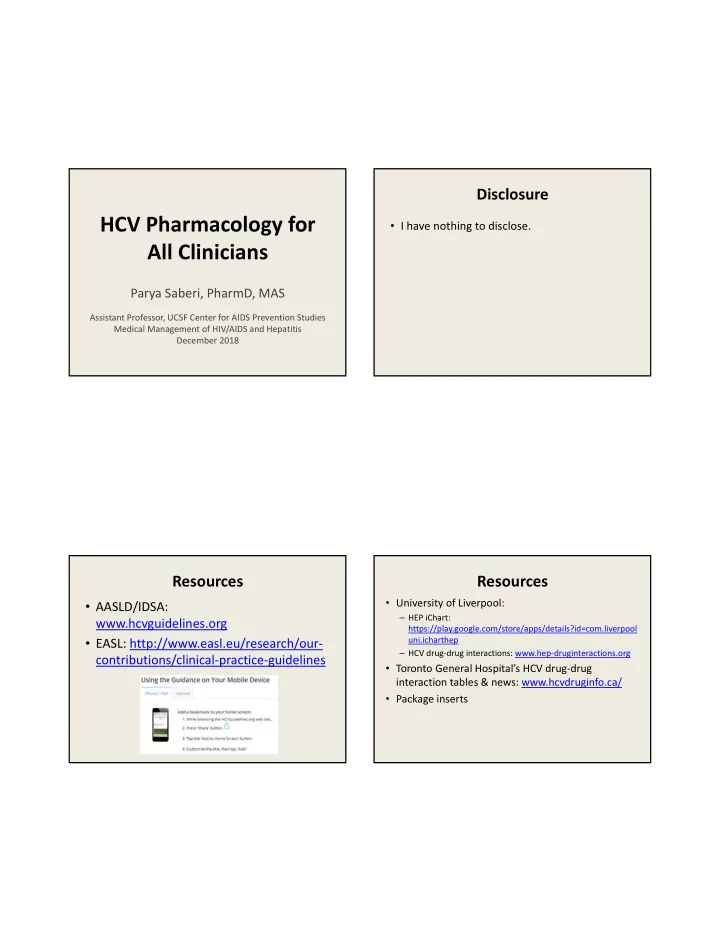
HCV Pharmacology for I have nothing to disclose. All Clinicians - - PDF document

hcv pharmacology for
SMART_READER_LITE
LIVE PREVIEW

HCV Pharmacology for I have nothing to disclose. All Clinicians - - PDF document

Disclosure HCV Pharmacology for I have nothing to disclose. All Clinicians Parya Saberi, PharmD, MAS Assistant Professor, UCSF Center for AIDS Prevention Studies Medical Management of HIV/AIDS and Hepatitis December 2018 Resources Resources


slide-1
SLIDE 1

HCV Pharmacology for All Clinicians

Parya Saberi, PharmD, MAS

Assistant Professor, UCSF Center for AIDS Prevention Studies Medical Management of HIV/AIDS and Hepatitis December 2018

Disclosure

  • I have nothing to disclose.

Resources

  • AASLD/IDSA:

www.hcvguidelines.org

  • EASL: http://www.easl.eu/research/our‐

contributions/clinical‐practice‐guidelines

Resources

  • University of Liverpool:

– HEP iChart: https://play.google.com/store/apps/details?id=com.liverpool uni.icharthep – HCV drug‐drug interactions: www.hep‐druginteractions.org

  • Toronto General Hospital’s HCV drug‐drug

interaction tables & news: www.hcvdruginfo.ca/

  • Package inserts
slide-2
SLIDE 2

https://www.hcvguidelines.org/unique‐populations/hiv‐hcv

2 new ARVs (bictegravir & doravirine): limited data for BIC but looks compatible with all DAAs. DOR is compatible with all DAAs.

Selecting & Refining HCV Treatment Options

Patients being considered for HCV therapy Determine all possible DAA options based on genotype, presence of cirrhosis, treatment‐naïve or ‐experienced, & drug resistance Review all prescription & OTC meds & herbal supplements Screen for interactions using resources & package inserts Refine DAA options based on interactions, prior AEs, & patient preferences

Quick DAA Recap

Brand Generic MOA Gt HD Decomp. Cirrhosis EFV/ ETR PI/r /c

Epclusa sofosbuvir (SOF) + velpatasvir (VEL) NS5B inhibitor + NS5A inhibitor 1, 2, 3, 4, 5, 6 √ √ Harvoni sofosbuvir (SOF) + ledipasvir (LDV) NS5B inhibitor + NS5A inhibitor 1, 4, 5, 6 √ √ √ Mavyret glecaprevir (GLE) + pibrentasvir (PIB) NS3/4A protease inhibitor + NS5A inhibitor 1, 2, 3, 4, 5, 6 √ CTP‐A (√) Vosevi sofosbuvir (SOF) + velpatasvir (VEL) + voxilaprevir (VOX) NS5B inhibitor + NS5A inhibitor + NS3/4A protease inhibitor 1, 2, 3, 4, 5, 6 CTP‐A (DRV) Zepatier elbasvir (EBR) + grazoprevir (GZR) NS5A inhibitor + NS3/4A protease inhibitor 1, 4 √ CTP‐A

Case #1

A 52 year‐old African American woman comes in for her appointment with the clinical pharmacist to start SOF/VEL (Epclusa).

  • HCV: Tx‐naïve, Gt 1a, stage 2 fibrosis, no

cirrhosis (APRI= 0.3), HCV VL= 10 million

  • Labs: Normal liver function, CrCl= 75
  • Meds:

– TDF/FTC/EFV: 1 tablet once‐daily – Omeprazole: 20mg once‐daily

slide-3
SLIDE 3

Regimens Dose Duration EBR/GZR* QD fixed‐dose combo EBR(50mg)/GZR (100mg) x12 weeks GLE/PIB QD fixed‐dose combo GLE (300mg)/PIB (120mg) x8 weeks SOF/LDV** QD fixed‐dose combo SOF (400mg)/LDV (90mg) x12 weeks SOF/VEL QD fixed‐dose combo SOF (400mg)/VEL (100mg) x12 weeks

Case #1 Recommended Treatment Options:

Tx‐Naïve, HCV Gt 1a, not cirrhotic

*If no baseline NS5A RAVs detected (for EBR) ** x8 weeks if HCV VL< 6 million, non‐black, HIV seronegative

Question #1: Which ARVs have a major drug‐drug interaction with SOF/VEL

(Epclusa)?

  • a. Efavirenz
  • b. Darunavir/r
  • c. Tenofovir alafenamide
  • d. Elvitegravir/c
  • e. All of the above

Mechanism of SOF/VEL (Epclusa) Drug‐Drug Interactions

  • SOF: substrate for P‐gp & BCRP

VEL: substrate for P‐gp, BCRP, OATP, CYP3A4, CYP2C8, & CYP2B6

  • Inducers of P‐gp, CYP2B6, CYP2C8, or CYP3A4 (e.g.,

rifampin, St. John’s wort, EFV) ↓ plasma concentrations of SOF or VEL

– Not recommended

  • VEL is inhibitor of P‐gp, BCRP, & OATP

– Co‐administration of substrates of these transporters may ↑exposure of such drugs – Substrate of CYP3A4

SOF/VEL (Epclusa)‐ARV Interactions

Drug Class Drug Name Recommendation NNRTIs RPV, DOR No dose adjustments needed EFV, ETR Not recommended PIs DRV/r/c, ATV/r/c, LPV/r No dose adjustments needed InSTI RAL No dose adjustments needed EVG/c No dose adjustments needed DTG No dose adjustments needed BIC No dose adjustments needed N(t)RTI TDF/FTC or TAF/FTC No dose adjustments needed ABC/3TC No dose adjustments needed

slide-4
SLIDE 4

Case #1: Options

  • 1. Change ART to non‐EFV‐containing regimen

compatible with SOF/VEL

(e.g., DTG‐, BIC‐, or RPV‐based)

OR

  • 2. Change DAA

– EBR/GZR & GLE/PIB (substrates of CYP3A & P‐ gp): incompatible with EFV – Consider SOF/LDV (Harvoni)x 12 weeks: compatible with EFV

x 12 weeks: patient is African American, living with HIV, & HCV RNA>6 million

https://www.hcvguidelines.org/unique‐populations/hiv‐hcv

Case #1: OTC Interactions

  • 52 y/o woman, tx‐naïve, Gt 1a, no cirrhosis,

CrCl=75

  • Change ART to ABC/3TC/DTG
  • Monitor for side effects & continued HIV VL

suppression for 1‐2 months before starting DAAs

  • 6 weeks later…
  • Ready to start SOF/VEL (Epclusa)
  • You ask her about any OTCs & she reminds you

that she is taking omeprazole 20mg once daily for reflux

Question #2: What should you tell her about omeprazole?

a. Nothing b. Try to avoid acid blockers but, if you must, take SOF/VEL with food & 4 hours before OMP c. Try to avoid acid blockers but, if you must, take OMP 40mg once daily d. Take famotidine or antacids instead of OMP, given lack of interactions

slide-5
SLIDE 5

VEL‐OMP Interaction

  • ↑pH results in ↓VEL solubility &↓VEL

concentration

  • Try to avoid acid blockers altogether…

– PPIs: SOF/VEL with food & 4 hrs before PPI (at max dose comparable to omeprazole 20mg) – H2‐RAs: Given simultaneously with or 12 hours apart from SOF/VEL at ≤ famotidine 40mg BID – Antacid: Separate by 4 hours

No statistically significant difference in SVR12 between high & low PPI doses with GLE/PIB across genotypes; reasonable to avoid high dose PPI if possible

SOF/LDV SOF/VEL EBR/GZR GLE/PIB SOF/VEL/VOX Antacids Separate by 4 hrs Separate by 4 hrs Separate by 4 hrs H2RA Together or 12hrs apart; FAM 40mg BID Together or 12hrs apart; FAM 40mg BID Together or 12hrs apart; FAM 40mg BID PPIs Together with OMP 20mg With food, 4hrs before OMP 20mg Can use with OMP 20 mg

Flamm S, et al. World Congress of Gastroenterology at ACG 2017; 2017; Orlando, FL. P1435.

Case #1: Acid Blockers and PPIs

Case #1: Conclusion

  • Pt’s ART changed to ABC/3TC/DTG

–Monitored for 6 weeks to ensure tolerating & HIV RNA suppressed

  • Starts SOF/VEL (Epclusa) & attains

SVR12

–Stopped PPI when starting SOF/VEL & able to control GERD with PRN famotidine

Case #2

A 45 year‐old male patient is being seen at the clinical pharmacy office to get started

  • n GLE/PIB (Mavyret).
  • HCV: Tx‐naïve, Gt1b, cirrhotic (Child‐Pugh

score A)

  • Meds: DRV/c/TAF/FTC, rosuvastatin

Reminder: GLE/PIB can’t be used in decompensated cirrhosis (i.e., Child‐Pugh B/C)

slide-6
SLIDE 6

Regimens Dose Duration GLE/PIB QD fixed‐dose combo GLE (300mg)/PIB (120mg) x12 weeks EBR/GZR QD fixed‐dose combo EBR(50mg)/GZR (100mg) x12 weeks SOF/LDV QD fixed‐dose combo SOF (400mg)/LDV (90mg) x12 weeks SOF/VEL QD fixed‐dose combo SOF (400mg)/VEL (100mg) x12 weeks

Case #2 Recommended Treatment Options:

Tx‐naïve, HCV Gt 1b, compensated cirrhosis

Question #4: With which ARV is GLE/PIB (Mavyret) compatible?

a. ATV/r or DRV/r b. ELV/c c. EFV or ETR d. RAL,DTG or BIC e. All of the above a. ATV/r or DRV/r b. ELV/c c. EFV or ETR d. RAL,DTG or BIC e. All of the above

GLE/PIB ↑ELV/c Cmax by 36%, AUC by 47%. GLE Cmax & AUC 2.5‐ & 3.1‐fold higher, respectively, vs. GLE/PIB alone; PIB AUC 57% higher. No clinically significant interactions, but caution when using together. Very limited clinical data.

Question #4: With which ARV is GLE/PIB (Mavyret) compatible?

Effect of Inhibitors on GLE/PIB (Mavyret)

  • GLE/PIB contraindicated with ATV/r/c
  • GLE/PIB may be okay with DRV/r & LPV/r but not

recommended due to lack of clinical data

  • ELV/c leads to elevated GLE/PIB levels but may be

used with caution

slide-7
SLIDE 7

GLE/PIB (Mavyret)‐ARV Interactions

Drug Class Drug Name Recommendation NNRTIs RPV, DOR No dose adjustments needed EFV, ETR Not recommended PIs ATV/r Not recommended DRV/r, LPV/r Not recommended (yet) InSTI RAL, DTG No dose adjustments needed BIC No data; probably ok ELV/c Caution N(t)RTI TDF, TAF No dose adjustments needed

  • GLE/PIB (Mavyret) inhibit BCRP, P‐gp, OATP

– Rosuvastatin (substrate of BCRP & OATP)

  • Cmax ↑5.6x, AUC ↑2.2x
  • Do not exceed 10mg/d

– Pravastatin: reduced dose by 50% – Atorvastatin: do not co‐administer

Case #2: Statin & HCV DAAs

SOF/LDV SOF/VEL EBR/GZR GLE/PIB SOF/VEL/VOX Atorvastatin ND ND ≤20mg Lowest dose Pitavastatin ND ND Lowest dose Pravastatin ↓dose by 50% ≤40mg Rosuvastatin ≤10mg ≤10mg ≤10mg Simvastatin Lowest dose Lowest dose

Side Note: Warfarin

  • Updated SOF, SOF/LDV, SOF/VEL, SOF/VEL/VOX:

“Fluctuations in INR values may occur in patients receiving warfarin concomitant with HCV treatment... Frequent monitoring of INR values is recommended during treatment and post‐treatment...”

  • Interaction more significant with ribavirin & PrOD
  • Interaction usually results in ↓INR, needing ↑Warfarin

dose (≥15%)

  • Mechanism unclear but eradication of HCV improves liver

function to increase clotting factor synthesis &/or warfarin metabolism

Side Note: Antiplatelet & DOACs

  • Limited data
  • Limited ability to monitor patients on DOACS with

clinically available lab assays

SOF/LDV SOF/VEL EBR/GZR GLE/PIB SOF/VEL/VOX Clopidogrel Caution Caution Ticagrelor Dabigatran 2hr apart 2hr apart Edoxaban ND ND ND ND Apixaban ND ND ND ND Rivaroxaban Caution Caution Caution Caution

slide-8
SLIDE 8

Case #2: Options

  • 1. Change ART

– Suggestions: DTG‐, BIC‐ or RPV‐based

  • r
  • 2. Change DAA

– SOF/LDV x12 weeks – SOF/VEL x12 weeks 45 y/o man starting GLE/PIB (Mavyret). Gt1b, cirrhotic, tx‐naïve; DRV/c/TAF/FTC, rosuvastatin.

Case #2: Conclusion

  • Due to insurance coverage of GLE/PIB

(Mavyret), we decide to change ART to DTG/ABC/3TC.

– Monitor HIV VL x1‐2 months on new ART before starting DAAs

  • Reduce rosuvastatin dose to 10mg.
  • Start GLE/PIB.

Case #3

You’re seeing a 58 year‐old White male on hemodialysis who would like to start HCV

  • treatment. Provider is not sure what to use

given patient’s renal function.

–HCV: Tx‐naïve, Gt 3, no cirrhosis –Meds: DTG + ABC + 3TC (renally‐dosed)

Question #5: Which DAA agents are okay to use in those with eGFR< 30 mL/min?

  • 1. EBR/GZR (Zepatier)
  • 2. GLE/PIB (Mavyret)
  • 3. SOF/LDV (Harvoni)
  • 4. SOF/VEL (Epclusa)
  • 5. 1 & 2
  • 6. All of the above
slide-9
SLIDE 9

CKD DAA No dose adjustment Duration 1‐3 EBR/GZR QD EBR (50mg)/GZR (100mg) x12 weeks GLE/PIB QD GLE (300mg)/PIB (120mg) X8‐16 weeks SOF/LDV QD SOF (400mg)/LDV (90mg) x12 weeks SOF/VEL QD SOF (400mg)/VEL (100mg) x12 weeks DCV + SOF QD DCV (60mg**) + SOF (400mg) x12 weeks SMV + SOF QD SMV (150mg) + SOF (400mg) x12 weeks SOF/VEL/VOX QD SOF (400mg)/VEL (100mg)/VOX (100mg) x12 weeks 4‐5 EBR/GZR QD EBR (50mg)/GZR (100mg) x12 weeks GLE/PIB QD GLE (300mg)/PIB (120mg) X8‐16 weeks

Case #3 Treatment Options:

Renal Impairment

Chronic Kidney Disease (CKD) stages: 1= normal (eGFR >90 mL/min); 2= mild CKD (eGFR 60‐89 mL/min); 3= moderate CKD (eGFR 30‐59 ml/min) 4= severe CKD (eGFR 15‐29 mL/min); 5= end‐stage CKD (eGFR <15 mL/min)

Case #3 General Options: Tx‐Naïve, Gt 3, no cirrhosis

Regimens Dose Duration SOF/VEL QD fixed‐dose combo SOF (400mg)/VEL (100mg) x12 weeks GLE/PIB QD fixed‐dose combo GLE (300mg)/PIB (120mg) x8 weeks

Case #3: Conclusion

  • He initiates GLE/PIB (Mavyret)
  • He does very well & has SVR post‐

treatment

Important Points

  • Only SOF/LDV (Harvoni) can be used with EFV or ETR.
  • SOF/LDV & SOF/VEL (Epclusa) can be used with PI/r &

EVG/c.

  • EBR/GZR (Zepatier) & GLE/PIB (Mavyret) okay with PPIs.
  • Pravastatin seems okay with most DAAs.
  • EBR/GZR & GLE/PIB can be used in ESRD.
  • SOF/VEL & SOF/LDV can be used in decompensated

cirrhosis (treat in consultation with a liver specialist) – GLE/PIB, EBR/GZR, & SOF/VEL/VOX (Vosevi) should not be used in those with Child‐Pugh B & C.

slide-10
SLIDE 10

Acknowledgements

  • Annie Luetkemeyer, MD
  • Meg Newman, MD, FACP
  • Diane V. Havlir, MD