Haza zard rds s Bo Boundary ry Cause ses s of Harm rm Now - - PowerPoint PPT Presentation

haza zard rds s bo boundary ry cause ses s of harm rm
SMART_READER_LITE
LIVE PREVIEW

Haza zard rds s Bo Boundary ry Cause ses s of Harm rm Now - - PowerPoint PPT Presentation

Haza zard rds s Bo Boundary ry Cause ses s of Harm rm Now that we have identified the harms/loss that we want to avoid (this defines safety for the system), we need to identify hazards -- interactions of the system with its


slide-1
SLIDE 1

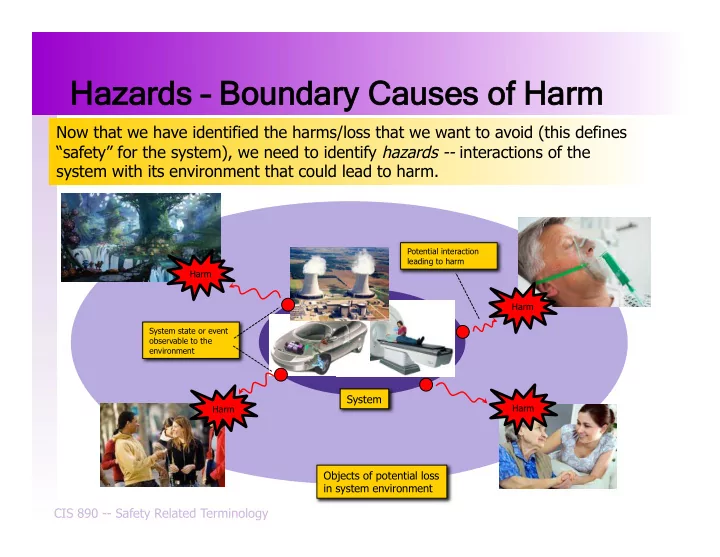
Objects of potential loss in system environment

Haza zard rds s – – Bo Boundary ry Cause ses s of Harm rm

CIS 890 -- Safety Related Terminology

Now that we have identified the harms/loss that we want to avoid (this defines “safety” for the system), we need to identify hazards -- interactions of the system with its environment that could lead to harm.

Harm Harm Harm Harm

System

System state or event

  • bservable to the

environment Potential interaction leading to harm

slide-2
SLIDE 2

Haza zard rd

  • “state or set of conditions of a system (or an object) that, together

with other conditions in the environment of the system, will lead inevitably to an accident (loss event)” [Leveson, Safeware, p. 177]

  • “state or set of conditions of a system (or an object) that, together

with a particular set of worst-case environment conditions, will lead to an accident (loss event)” [Leveson, Safer World, p. 467]

  • In safety engineering, hazards are our basic unit of management.

We try to think of all of the hazards that are theoretically possible, and then design a system where they are, if not impossible, then at least very unlikely. [Disaster Cast, Episode 1]

To prevent accidents (harm/loss) (and thus to achieve safety), the system designer needs to identify and address the precursors of accidents – which are referred to as “hazards”

CIS 890 -- Safety Related Terminology

Leveson notes that hazards may be defined in terms of events or in terms of conditions. The only difference is that events are limited in time, while the conditions caused by the event persist over time until another event changes the prevailing conditions. For different purposes, one choice might be advantageous over another. [Leveson, Safer World, p. 184]
slide-3
SLIDE 3

St States s vs.

  • vs. Eve

Events s

  • A particular configuration of a

system (+environment) including the current values of system’s memory, resources

  • Intuition – “a snapshot”
  • Example (simplified situations)
  • A program’s execution state

consists of the values of all of its variables together with the program counter)

  • A transition from one state to

another, or something of particular interest that causes a transition from one state to another

  • Examples (simplified

situations)

  • A relay opens or closes
  • An interrupt occurs

CIS 890 -- Safety Related Terminology

State Event On Off

(press power button)

States Event

In the Disaster Cast example, the hazard was a state (two traffic signals green at the same time). The accident was an event (the point in time where the two cars crashed together)

slide-4
SLIDE 4

St States s vs.

  • vs. Eve

Events s

CIS 890 -- Safety Related Terminology

http://www.ni.com/white-paper/6194/en/

States Events

slide-5
SLIDE 5

Not Not an an Accid Accident, but an , but an Incid cident

Incident (aka near miss) -- an event that involves no

loss (or only minor loss) but with the potential for loss under different circumstances. [Leveson, Safeware, p. 176]

“If someone almost got hurt, but escaped through good

luck, we call it an incident.” [Disaster Cast, Episode 1]

CIS 890 -- Safety Related Terminology

Domains such as avionics (which tends to influence Leveson’s definitions) use the term incident to complement the discussion of accidents

slide-6
SLIDE 6

Accid Accident vs.

  • vs. Incid

cident

  • For example, if I’m designing a set of traffic lights, I might worry

about the lights being green in both directions. So I’ll say that it’s a hazard for both sets of lights to be green at once.

  • I’ll design my lights to make the chance of this happening as small

as possible. If I get my design wrong, and the hazard actually happens, that’s an incident.

  • If two cars crash as a result, that’s an accident.

CIS 890 -- Safety Related Terminology

Disaster Cast – Intuition…

slide-7
SLIDE 7

Accid Accident vs.

  • vs. Incid

cident

“The air in the Isolette got too hot” “The Isolette was knocked on its side while

moving a new born infant in another Isolette into the neonatal ward”

“The air temperature in the Isolette was below

the configured limits for five minutes and no alarm sounded”

“The air temperature in the Isolette got too hot

and melted the casing of the enclosure rendering the Isolette inoperable”

CIS 890 -- Safety Related Terminology

Which of the following is an accident and which is an incident? In each case, list additional information that may be needed to make a determination.

slide-8
SLIDE 8

Haza zard rd

  • Sometimes, hazards are defined as something that “has potential to

do harm”, or that “can lead to an accident”. The problem with this definition is that most every system state has the potential to do harm or can lead to an accident

  • An airplane that is in the air is in a hazardous state according to this definition.
  • For practical reasons, the definition should preclude states that the

system must normally be in to accomplish the mission.

  • Remember, a design goal in safety engineering is to “design away” hazardous

states.

  • By limiting the definition to states that the system should never be

in, the designer has greater freedom and ability to design hazards

  • ut of the system.
  • E.g., For air traffic control, the appropriate hazard would not be two planes in

the air, but rather two planes that violate minimum separation standards.

Additional thoughts from Leveson [Leveson, Safer World, p. 184]

CIS 890 -- Safety Related Terminology

slide-9
SLIDE 9

Haza zard rd

  • Release of toxic chemicals or explosive energy will cause a loss only

if there are people or structures in the vicinity.

  • Weather conditions may affect whether a loss occurs in the case of

a toxic release.

  • If the appropriate environmental conditions do not exist, then there

is no loss and, by definition, no accident (i.e., there is only an incident).

Additional thoughts from Leveson [Leveson, Safer World, p. 185]

CIS 890 -- Safety Related Terminology

Hazard + Environmental Conditions => Accident (loss)

Example/Discussion…

Note that when a hazard is defined as an event, then hazards and incidents are identical

slide-10
SLIDE 10

Haza zard rd

A hazard is compromised of the following three

components, each of which must be present in order for the hazard to exist

Hazardous Element (HE) – The basic hazardous resource creating

the impetus for the hazard, e.g., electric shock, explosives being used in the system, a harmful chemical, kinetic energy, etc.

Initiating Mechanism (IM) – The trigger or initiating event(s) (or

states) causing the hazard to occur. This is the mechanism that causes actualization of the hazard from a dormant state to an actual mishap.

Target and Threat (T/T) – Person or thing that is vulnerable to

injury or damage, along with the specific threat (harm) to the person/thing.

CIS 890 -- Safety Related Terminology

Additional thoughts from Ericson [Ericson, Hazard Analysis Techniques for System Safety, p. 452]

slide-11
SLIDE 11

Haza zard rd Tria riangle le

CIS 890 -- Safety Related Terminology

Ericson’s tripartite notion of hazard can be visualized as a triangle

Hazardous Element Initiating Mechanism Target / Threat

Hazard

All three sides of the triangle are necessary in order for a hazard to exist. Remove any one of the triangle sides and the hazard is eliminated because it is no longer able to produce a mishap (i.e., the triangle is incomplete)

Example Hazard: Heating element of the Isolette continues to increase air temperature after reaching high-bound of temperature – to the extent that the infant’s body/health is damaged to due excessive heat. Target

(environment entity)

Threat Hazardous Element (i.e., excessive temperature) Initiating Mechanism

slide-12
SLIDE 12

Haza zard rds s and Desig sign Const stra rain ints s

CIS 890 -- Safety Related Terminology Our goal is to “design away” hazards to as large an extent as possible. Accordingly, each hazard typically imposes one or more safety design constraints. Consider an automated door system that is part of a train control system [Leveson, Safer World, pp. 190-192]

slide-13
SLIDE 13

For r Yo You To Do…

  • Construct a hazard list for the Isolette. Trace each hazard to the notion of

harm defined in the previous step. For each hazard, clearly indicate the target/threat, initiating mechanism, and hazardous element

CIS 890 -- Safety Related Terminology

What might be reasonable examples of hazard for the Isolette?