Hash Tables Outline Overview Implementation style for the Table - - PowerPoint PPT Presentation

hash tables outline overview
SMART_READER_LITE
LIVE PREVIEW

Hash Tables Outline Overview Implementation style for the Table - - PowerPoint PPT Presentation

Hash Tables Outline Overview Implementation style for the Table ADT that is Definition good in a wide range of situations is the hash Hash functions table Open hashing efficient Insert, Delete, and Search operations


slide-1
SLIDE 1

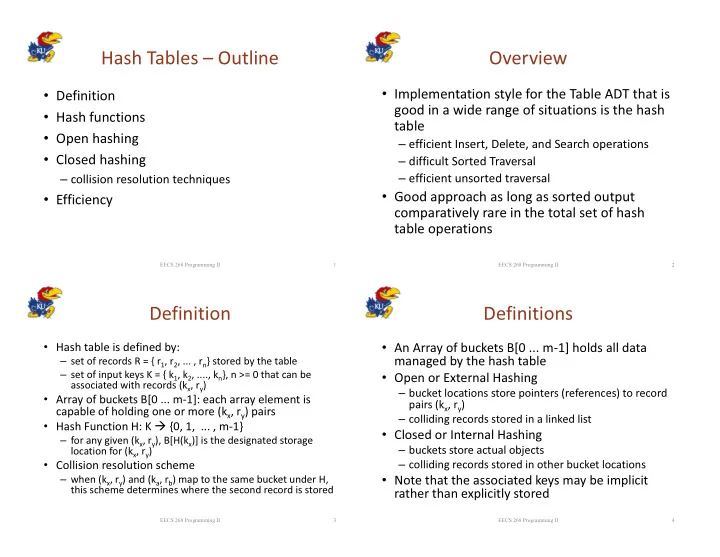
Hash Tables Outline

Definition Hash functions Open hashing Closed hashing

collision resolution techniques

Efficiency

EECS 268 Programming II 1

Overview

Implementation style for the Table ADT that is good in a wide range of situations is the hash table

efficient Insert, Delete, and Search operations difficult Sorted Traversal efficient unsorted traversal

Good approach as long as sorted output comparatively rare in the total set of hash table operations

EECS 268 Programming II 2

Definition

Hash table is defined by:

set of records R = { r1, r2, ... , rn} stored by the table set of input keys K = { k1, k2, ...., kn}, n >= 0 that can be associated with records (kx, ry)

Array of buckets B[0 ... m-1]: each array element is capable of holding one or more (kx, ry) pairs Hash Function H: K {0, 1, ... , m-1}

for any given (kx, ry), B[H(kx)] is the designated storage location for (kx, ry)

Collision resolution scheme

when (kx, ry) and (ka, rb) map to the same bucket under H, this scheme determines where the second record is stored

EECS 268 Programming II 3

Definitions

An Array of buckets B[0 ... m-1] holds all data managed by the hash table Open or External Hashing

bucket locations store pointers (references) to record pairs (kx, ry) colliding records stored in a linked list

Closed or Internal Hashing

buckets store actual objects colliding records stored in other bucket locations

Note that the associated keys may be implicit rather than explicitly stored

EECS 268 Programming II 4

slide-2
SLIDE 2

Hash Functions

H(i) = i

reduces the hash table to an array

Selecting digits

choose some subset of digits in a large number

specific slice or positions

Folding

take digits or slices of a number and add them together with roll-over

H(i) = i modulo m where m is Hash Table size

  • EECS 268 Programming II

5

Hash Function 2

Strings are a common search key in many cases

convert string to an integer

Approaches

add characters or slices of characters together as n-bit unsigned numbers with the sum rolling over within x- bits

bit shifting to form numbers possible x-bits chose for table size or x modulo m

several other options possible

EECS 268 Programming II 6

Open Hashing

Example: take a hash table size of 7 (prime) and a hash function h(x) = x mod 7

insert 64, 26, 56, 72, 8, 36, 42

If data set is large compared to hash table size, or the hash function clusters data, then length of the list holding the bucket contents can be significant

sorted list will reduce the average failure time

can identify failure before the end of the list

use binary search tree instead of list

why not a BST for the whole data set?

use second Hash table

EECS 268 Programming II 7

Open Hashing 2

Advantages of Open Hashing with chaining

simple in concept and implementation insertion is always possible

Disadvantages of hashing with chaining

unbalanced distribution decreases efficiency

O(n) for a linked list, O(log n) for a BST

greater memory overhead higher execution overhead of stepping through pointers

EECS 268 Programming II 8

slide-3
SLIDE 3

Closed Hashing

Closed hashing with Open addressing

storing all data items within single hash table, but

  • Hash table of size m can hold at most m items

items to m different table elements

collisions will generally occur before table is full

Collision resolution is thus crucial to efficient use

  • f closed hash tables

EECS 268 Programming II 9

Closed Hashing Collision Resolution

Create a sequence of collision resolution functions

h0(x) is base hash function h1(x) used to find first alternate storage location after a collision h2(x) used to find the next alternate if first alternate is

  • ccupied

Each hi(x) must be guaranteed to choose different table locations Hash function series should ideally check all table locations

EECS 268 Programming II 10

Collision Resolution Linear Probing

Search hash table sequentially starting from the original location specified by the hash function Insert 64, 26, 56, 72, 8, 36, 42 in an empty table of size 7 Fragile causes primary clusters by occupying adjacent table locations

similar to long chains in open hashing

EECS 268 Programming II 11

Collision Resolution Quadratic Probing

Spread probed locations across the table Example: Insert 64, 26, 56, 72, 8, 36, 42 Series of probed locations is not guaranteed to cover the whole table without duplication Closed hashing schemes can fail even though the table is not full

and secondary clusters may form if the probing scheme will not visit all table locations

  • EECS 268 Programming II

12

slide-4
SLIDE 4

Collision Resolution Linear Probing with Fixed Increment

FI is relatively prime to m linear probing will visit all table locations without repeats

X is relatively prime to Y iff GCD(X,Y) = 1

EECS 268 Programming II 13

Collision Resolution Double Hashing

Use a second hash function (h'(x)) to generate the probe sequence used after a collision

(x mod R), where R < m is prime

Example: m=7, R=5, insert 64,26,56,72,8,36,42

EECS 268 Programming II 14

Closed Hashing -- Deletions

Example: Insert 64, 56, 72, 8 using linear probling

delete 64; delete 8

creates a problem because the empty cell could be there for two reasons

no further elements exist along this probing sequence deletion of an item along the sequence took place

Two types of empty buckets

bucket has always been empty (AE) (flag 0) bucket emptied by deletion (ED) (flag 1)

EECS 268 Programming II 15

Closed Hashing -- Deletions

During a probing sequence,

if an AE bucket is found, searching can stop if an ED bucket is found, searching must continue

Closed Hashing is thus subject to a form of

  • as cells are deleted, probing sequences generally

lengthen as the probability of encountering ED cells increases failed searches get more expensive because they cannot terminate until

an AE cell is found all cells of the table can be visited

EECS 268 Programming II 16

slide-5
SLIDE 5

Closed Hashing

Advantages of Closed Hashing with Open Addressing

lower execution overhead as addresses are calculated rather than read from pointers in memory lower memory overhead as pointers are not stored

Disadvantages

more complex than chaining can degenerate into linear search due to primary or secondary clustering Delete and Find operations are more complex Insert is not always possible even though the table is not full Delete can increase probe sequence length by making search termination conditions ambiguous

EECS 268 Programming II 17

The Efficiency of Hashing

An analysis of the average-case efficiency

Load factor

ratio of the current number of items in the table to the maximum size of the array table measures how full a hash table is should not exceed 2/3

Hashing efficiency for a particular search also depends on whether the search is successful

unsuccessful searches generally require more time than successful searches

EECS 268 Programming II 18

The Efficiency of Hashing

EECS 268 Programming II 19

Summary

Hash Tables are useful and efficient data structures in a wide range of applications Open hashing with chaining is simple, easy to implement, and usually efficient

length of the chains is key to performance

Closed hashing with various approaches to generating a probe sequence can also be efficient

lower space and computation overhead more complex implementation performance is sensitive to probe sequence

Monitoring load factor and other hash-table behavior parameters is important in maintaining performance

EECS 268 Programming II 20