
SLIDE 1
A JOURNEY OF BECOMING A NETWORKED ORGANIZATION THROUGH SOCIAL TECHNOLOGY AND COMMUNITY MANAGEMENT
Harnessing the Power of “Living Knowledge” at UNICEF
Paola Storchi, Carrie Basham Young ALI Conference, San Francisco, 21 June 2017
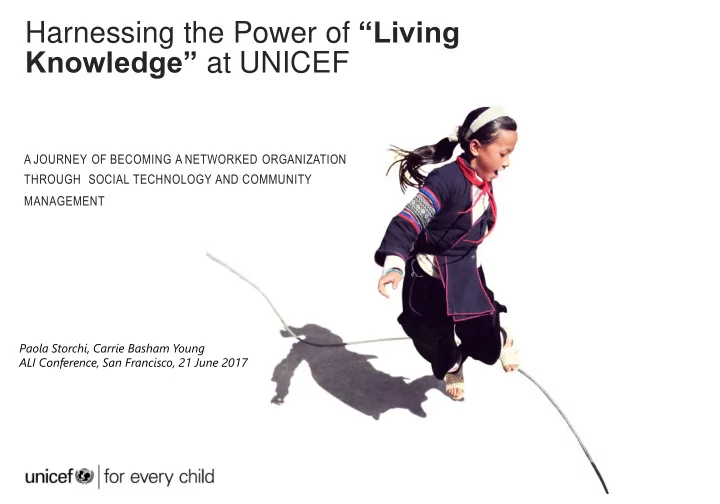
Harnessing the Power of Living Knowledge at UNICEF A JOURNEY OF - - PowerPoint PPT Presentation
Harnessing the Power of Living Knowledge at UNICEF A JOURNEY OF BECOMING A NETWORKED ORGANIZATION THROUGH SOCIAL TECHNOLOGY AND COMMUNITY MANAGEMENT Paola Storchi, Carrie Basham Young ALI Conference, San Francisco, 21 June 2017 WELCOME!
A JOURNEY OF BECOMING A NETWORKED ORGANIZATION THROUGH SOCIAL TECHNOLOGY AND COMMUNITY MANAGEMENT
Harnessing the Power of “Living Knowledge” at UNICEF
Paola Storchi, Carrie Basham Young ALI Conference, San Francisco, 21 June 2017
Today’s Agenda
WELCOME!
2Introductions About UNICEF The History of Communities at UNICEF Digital Trends Shaping UNICEF “Living Knowledge” – Legitimizing the Sharing of Unstructured Information Moving Forward: Mobile Focus, Behavioral Analytics, Content Curation
+12,000 staff worldwide
Storytelling has a unique power to move people to share their knowledge
When the world awoke to the Asian tsunami in December 2004, to central China's earthquake in 2008, and to 2011 earthquakes in Haiti and Chile, Japan, 2016 Italy, relief networks were already springing into action, funneling the global response to vivid images of children's lives crushed or swept away and families changed forever. Also springing into action were new and faster communication channels, such as Facebook, texting, Twitter, IM, 24-7 news channels, safety check, live videos and pictures.
OUR PROCESS AND JOURNEY
Mid 2008: UNICEF embraces Yammer March 2016: Strategic Interventions, Education, and Consultations Re-branding with simplicity – the BUILD model 90-Day Plans Yammer Network Clean Up New member Welcome Campaign Personalized Consultations for Key Teams January 2016: 1,000 Engaged Users February 2016: ReviewReturn to Simplicity
B (ILLBOARD) UI (U &I) L (IBRARY) D (IALOGUE)
Case studies to measure qualitative and quantitative impact will be published soon!
OUR RESULTS
9 OUR RESULTS
10 DAILY PHOTO & VIDEO POSTS
12+ 100 million hours of video watch 9me daily
Visual content performs 4.4 /mes be2er than text-based content on social media (Digiday)
TECHNOLOGY & THE MODERN EMPLOYEE LANDSCAPE
13employer’s location
engines
RESPONDENT DEMOGRAPHICS:REGIONS
ACCESS TO MOBILEDEVICES
Q5.Do you use a mobile device for communica9ng with colleagues and/or accessing UNICEF’s intranet?
581 136 108 41 Yes, iPad orother tablet device 12% “Email, text messaging and WhatsApp are the commonest tools I use to communicate and share information with IPs and colleagues in the office. Its quick and has a wider audience. Everyone owns and uses a mobile phone which they also use to access the internet where ever they may be.”
THE MOBILE PHONEOPPORTUNITY
“Living Knowledge”
The unstructured, informal, information that we build and create in every conversation we have, with every idea we spark, with every opinion we think, when we learn a lesson and debate a position, when we think fast and on a whim without fear of being judged. Living knowledge is an ecosystem of everything we experience across the many moments of our lives. it is simply what we think, see and feel. Enable a Culture where Living Knowledge and Human Relationships are Valued
BENEFITS
10% 0% 30% 50% 20% 40% 60% 70% Toconnect with like- minded people To able to helpothers To find people I mightnot know on thesame kinds of things that Iam Learn about career op- portuni9esFor each of the following reasons that you might use Yammer, indicate which are important to the way that you useit.
OTHEROUTCOMES
“I have a sensor that enables me know what issues colleagues in my practice area are encountering and solutions they are sharing.” “I have learnt more about what is going
the organization.”
“The NatCom Child Rights Education Network has pretty much replaced emails with Yammer.”
WASH IN SCHOOLS
Sharing the construction in progress of WASH facilities
Q&A