Haringey 14/10/2015 Ones, tens, hundreds N O I T Ones, - - PDF document

haringey 14 10 2015
SMART_READER_LITE
LIVE PREVIEW

Haringey 14/10/2015 Ones, tens, hundreds N O I T Ones, - - PDF document

Haringey 14/10/2015 Ones, tens, hundreds N O I T Ones, twos I S O Fives, tens, P S I D Twos, fives M E U V L I Y . T U C T C L Y N N E M C C L U R E I U I L R D A R R O U R T N


slide-1
SLIDE 1

Haringey ¡ 14/10/2015 ¡ Lynne.mcclure@cambridgemaths.org ¡ 1 ¡

P R O D U C T I V E D I S P O S I T I O N

L Y N N E M C C L U R E

A N D I T S C E N T R A L I T Y I N A M A S T E R Y C U R R I C U L U M

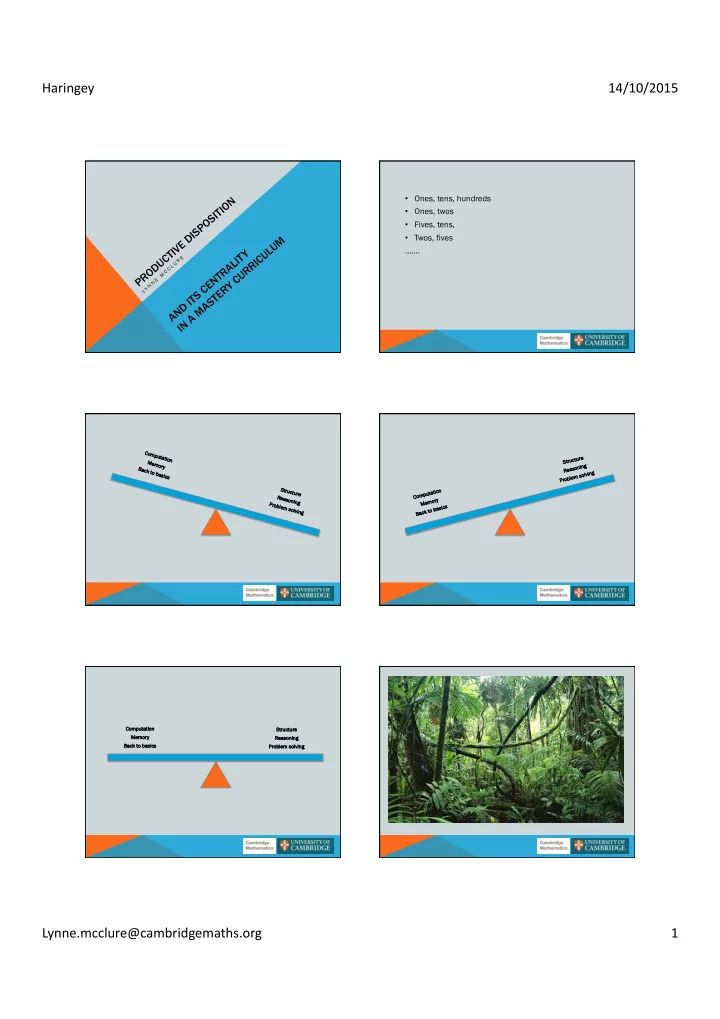
  • Ones, tens, hundreds
  • Ones, twos
  • Fives, tens,
  • Twos, fives

…….

Computation n Memo mory y Back t k to b basics S t S t r r u u c c t t u u r r e e R R e e a a s s

  • n

i n i n g n g P P r r

  • b

b l e l e m s m s

  • l

v l v i i n g n g C C

  • m

m p p u u t t a a t t i i

  • n

n M M e e m

  • m
  • r

r y y B B a a c c k t k t

  • b

b a a s s i i c c s s S t S t r r u u c c t t u u r r e e R R e e a a s s

  • n

i n i n g n g P P r r

  • b

b l e l e m s m s

  • l

v l v i i n g n g Computation n Memo mory y Back t k to b basics St Structure Reasoni ning ng Proble lem s m solv lving ng

slide-2
SLIDE 2

Haringey ¡ 14/10/2015 ¡ Lynne.mcclure@cambridgemaths.org ¡ 2 ¡

MOST S STRONGL GLY AGR GREE MOST S STRONGL GLY DIS DISAGR GREE AND A D AN E EXT XTRA

Ge>ng ¡answers ¡ correct ¡is ¡more ¡ important ¡than ¡ understanding ¡why ¡ the ¡answer ¡is ¡right. ¡ Maths ¡is ¡a ¡ creaBve ¡

  • subject. ¡ ¡

Most ¡maths ¡ problems ¡have ¡

  • nly ¡one ¡way ¡to ¡

solve ¡them. ¡ ¡ Knowing ¡how ¡to ¡ perform ¡a ¡ procedure ¡is ¡ more ¡important ¡ than ¡ understanding ¡ why ¡it ¡works. ¡ ¡ Students ¡can ¡ discover ¡maths ¡ without ¡it ¡being ¡ shown ¡to ¡them. ¡ Students ¡learn ¡ maths ¡beIer ¡ when ¡they ¡work ¡

  • together. ¡ ¡

Students ¡should ¡be ¡ able ¡to ¡figure ¡out ¡for ¡ themselves ¡whether ¡ answers ¡are ¡correct. ¡ ¡ Maths ¡is ¡so ¡ important ¡ everyone ¡ should ¡learn ¡it ¡ There’s ¡some ¡ school ¡maths ¡ which ¡isn’t ¡at ¡all ¡

  • useful. ¡

Ge>ng ¡answers ¡ correct ¡is ¡more ¡ important ¡than ¡ understanding ¡why ¡ the ¡answer ¡is ¡right. ¡ Maths ¡is ¡a ¡ creaBve ¡

  • subject. ¡ ¡

Most ¡maths ¡ problems ¡have ¡

  • nly ¡one ¡way ¡to ¡

solve ¡them. ¡ ¡ Knowing ¡how ¡to ¡ perform ¡a ¡ procedure ¡is ¡ more ¡important ¡ than ¡ understanding ¡ why ¡it ¡works. ¡ ¡ Students ¡can ¡ discover ¡maths ¡ without ¡it ¡being ¡ shown ¡to ¡them. ¡ Students ¡learn ¡ maths ¡beIer ¡ when ¡they ¡work ¡

  • together. ¡ ¡

Students ¡should ¡be ¡ able ¡to ¡figure ¡out ¡for ¡ themselves ¡whether ¡ answers ¡are ¡correct. ¡ ¡ Maths ¡is ¡so ¡ important ¡ everyone ¡ should ¡learn ¡it ¡ There’s ¡some ¡ school ¡maths ¡ which ¡isn’t ¡at ¡all ¡

  • useful. ¡

PRODUCTIVE DISPOSITION

i is t the he i inc ncli lina nation t n to s see ma mathe hema matics a as sens nsible le, u , useful, a l, and nd w worthw hwhi hile le, , couple led w with a h a b beli lief i in d n dili ligenc nce a and nd

  • ne

ne's o

  • wn e

n efficacy. .

slide-3
SLIDE 3

Haringey ¡ 14/10/2015 ¡ Lynne.mcclure@cambridgemaths.org ¡ 3 ¡

PRODUCTIVE DISPOSITION

i is t the he i inc ncli lina nation t n to s see ma mathe hema matics a as , , couple led

PRODUCTIVE DISPOSITION

i is t the he i inc ncli lina nation t n to s see ma mathe hema matics a as , , couple led w with h and nd . .

PRODUCTIVE DISPOSITION

i is t the he i inc ncli lina nation t n to s see ma mathe hema matics a as , , couple led w with h and nd . .

VALUE

Wha hat d does i it me mean t n to ‘v ‘valu lue’ ’ ma maths hs? ? Do Does a all ll ma maths hs ha have t to b be ‘u ‘useful’? l’? Wha hat e ele leme ment nts o

  • f a

a c cla lassroom c m cli lima mate w would ld e enc ncourage viewing ng ma maths hs a as v valu luable le? Valu lue w wha hat t the hey a y are a asked t to d do Und nderstand nd t the he s structure – – i it’s ’s no not ma magic Autho hority li y lies i in t n the he s subje ject no not w with t h the he t teache her – – i it ha has it’s ’s o

  • wn c

n cohe herenc nce. . Appreciating ng t the he a appearanc nce o

  • f ma

maths hs e everyw ywhe here b but und nderstand nding ng s specific c cases Teache her mo models ls a an a n appreciation o n of i it a as a a s subje ject t to eng ngage w with v h volu lunt ntarily ly Foucault lt: “ : “People le kno know w wha hat t the hey d y do; f ; frequent ntly t ly the hey y kno know w why t y the hey d y do i it; b ; but w wha hat t the hey d y don’t n’t kno know i is w wha hat wha hat t the hey d y do d does.” .”

slide-4
SLIDE 4

Haringey ¡ 14/10/2015 ¡ Lynne.mcclure@cambridgemaths.org ¡ 4 ¡

BELIEF

Some me le learne ners b beli lieve t the hey w y will b ll be s

  • successful. W
  • l. Wha

hat beha haviours d do t the hey e y exhi hibit? How c can w n we he help lp s student nts t to b beli lieve t the hey c y can b n be successful a l at ma maths hs? ? Student nts s sho how r resili lienc nce – – p positive r respons nse t to ne negative situations ns – – d don’t n’t g give u up. . Expect t to b be a able le t to d do i it Beli lieve t the hey c y can c n cha hang nge w wha hat t the hey a y are a able le t to d do t thr hrough h applyi lying ng t the hems mselv lves, r , rathe her t tha han t n tha hat a abili lities a are fixed a and nd c can’t n’t c cha hang nge ( (growth v h v f fixed mi mind nd s set) Praise t the he beha haviour no not t the he ‘a ‘abili lity’ y’ ‘Y ‘Yet…’ ’ ‘A ‘Abili lity’ g y’ grouping ng – – r research s h sho hows d don’t g get t the he s same me curriculu lum o m offer Wait t time me a appropriate Teache hers b beli lieve i in t n the heir o

  • wn a

n abili lity t y to e ens nsure s student nts’ ’ success success

EFFORT

Some me le learne ners ju just k keep t tryi ying ng w whi hist o

  • the

hers g give u up easily ly. . Wha hat c can w n we d do t to i inc ncrease t the he mo motivation o n of o

  • ur p

pupils ls? Eng ngaging ng t tasks ks Low t thr hresho hold ld hi high c h ceili ling ng True c colla llaborative o

  • pportuni

nities ( (group g goals ls, i , ind ndividual l account ntabili lity) y) Own p n progress r rathe her t tha han c n competitive Mistakes a as le learni ning ng t tools ls Id Ideas a and nd me metho hods v valu lued Autono nomy i y in c n cho hoice o

  • f me

metho hods Active e eng ngageme ment nt r rathe her t tha han c n cont ntrived ‘f ‘fun’ n’ Empha hasise i int ntrins nsic mo motivation – n – r rewards/puni nishme hment nt can d n distract a and nd u und ndermi mine ne le learni ning ng g goals ls Result lts i ind ndicated t tha hat s student nts w were mo more li likely t ly to ho hold ld productive d dispositions ns ( (autono nomy, b , beli lief t tha hat ma mathe hema matical c l competenc nce i is ma malle lleable le r rathe her t tha han n fixed, f , focus o

  • n u

n und nderstand nding ng o

  • ver t

task c k comple letion) n) i in n a c cla lassroom i m in w n whi hich t h the he t teache her t trans nsferred respons nsibili lity t y to s student nts, s , soli licited mu mult ltiple le s solu lution n strategies, p , provided p process s scaffold lding ng, a , and nd p pressed for c conc nceptual u l und nderstand nding ng. . In c In cont ntrast, s , student nts w were le less li likely t ly to ho hold ld p productive dispositions ns ( (relyi lying ng o

  • n e

n externa nal a l autho horities, b , beli lief t tha hat ma mathe hema matical c l competenc nce i is f fixed r rathe her t tha han n ma malle lleable le, f , focus o

  • n t

n task c k comple letion o n over und nderstand nding ng) i in a n a c cla lassroom i m in w n whi hich t h the he t teache her provided c cont ntent nt he help lp t tha hat lo lowered t the he c cogni nitive dema mand nd f for s student nts, f , focused o

  • n o

n obtaini ning ng a an a n ans nswer rathe her t tha han u n und nderstand nding ng s strategies, a , and nd p pla laced I I "geni nius" i in e n each s h sma mall g ll group ( (expli licitly g ly grouped student nts he heterogene neously) ly). J . Jans nsen n

slide-5
SLIDE 5

Haringey ¡ 14/10/2015 ¡ Lynne.mcclure@cambridgemaths.org ¡ 5 ¡

CHILDREN’S OWN VOICES

Borthw

  • hwick. A

. A. 2 . 2011 C Chi hild ldren’s n’s p perceptions ns o

  • f, a

, and nd a attitudes towards, t , the heir ma mathe hema matics le lessons ns B BSRLM Chi hild ldren a n asked t to d draw p picture o

  • f t

the heir ma mathe hema matics le lessons ns, , cat categori egorised sed a according ng t to c cont ntent nt; ; Chi hild ldren’s n’s e emo motions ns a and nd a attitudes Chi hild ldren’s n’s p perceptions ns o

  • f t

the heir p peers i in ma n mathe hema matics le lessons ns Chi hild ldren’s n’s p perceptions ns o

  • f t

the heir t teache her i in ma n mathe hema matics le lessons ns Mathe hema matics i in t n the he d drawing ngs

QUESTIONS TO ASK

“How w would ld y you d describe ma maths t to s some meone ne?” “Wha hat does does a a M Mathe hema matician d n do?’’ ’’ “Wha hat do y you ne need to b be s successful a l at ma maths?” ?”

Nu Nuo asi asiat at op

  • pit ilma

lman ilo loa uno nohd hdat he help lposti Tho hose t thi hing ngs y you le learn w n witho hout jo joy y y you forget e easily ly. .

slide-6
SLIDE 6

Haringey ¡ 14/10/2015 ¡ Lynne.mcclure@cambridgemaths.org ¡ 6 ¡

lynne lynne.mc .mcclu lure@camb mbridgema maths hs.o .org www. . camb mbridgema maths hs.o .org @clm4 lm4d Tha hank y nk you