Hardware Description Languages Digital Design Using Verilog always - - PowerPoint PPT Presentation

hardware description languages
SMART_READER_LITE
LIVE PREVIEW

Hardware Description Languages Digital Design Using Verilog always - - PowerPoint PPT Presentation

Hardware Description Languages Digital Design Using Verilog always @(posedge clk) begin assign pcinc = pc + 4; > 2 1 2 < 5 : R c : E L 2 S > R A i n o : 1 1 1 for (i=0; i < 31; i = i+1) begin I L L T r u


slide-1
SLIDE 1

L02 – Verilog 1 6.884 – Spring 2005 02/04/05

Digital Design Using Verilog

P C + 4 + 4 * S X T ( C ) A S E L 1 D a t a M e m
  • r
y R D W D A d r R / W W D S E L 1 2 W A R c : < 2 5 : 2 1 > 1 X P P C J T + 4 I n s t r u c t i
  • n
M e m
  • r
y A D R b : < 1 5 : 1 1 > R a : < 2 : 1 6 > R A 2 S E L R c : < 2 5 : 2 1 > + R e g i s t e r F i l e R A 1 R A 2 R D 1 R D 2 B S E L 1 C : S X T ( < 1 5 : > ) Z A L U A B J T W A W D W E A L U F N C
  • n
t r
  • l
L
  • g
i c Z A S E L B S E L P C S E L R A 2 S E L W D S E L A L U F N W r P C + 4 1 W r 1 2 3 4 X A d r I L L O P W A S E L W A S E L I R Q W E R F W E R F P C S E L

always @(posedge clk) begin assign pcinc = pc + 4; module beta(clk,reset,irq,… Input [31:0] mem_data; endmodule If (done) $finish; for (i=0; i < 31; i = i+1) begin L02 – Verilog 2 6.884 – Spring 2005 02/04/05

Hardware Description Languages

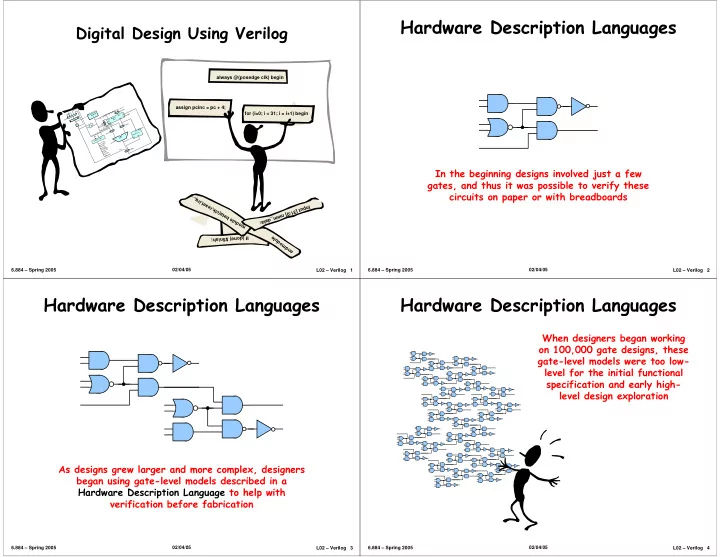
In the beginning designs involved just a few gates, and thus it was possible to verify these circuits on paper or with breadboards

L02 – Verilog 3 6.884 – Spring 2005 02/04/05

Hardware Description Languages

As designs grew larger and more complex, designers began using gate-level models described in a Hardware Description Language to help with verification before fabrication

L02 – Verilog 4 6.884 – Spring 2005 02/04/05

Hardware Description Languages

When designers began working

  • n 100,000 gate designs, these

gate-level models were too low- level for the initial functional specification and early high- level design exploration

slide-2
SLIDE 2

L02 – Verilog 5 6.884 – Spring 2005 02/04/05

Hardware Description Languages

Designers again turned to HDLs for help – abstract behavioral models written in an HDL provided both a precise specification and a framework for design exploration

L02 – Verilog 6 6.884 – Spring 2005 02/04/05

Advantages of HDLs

Allows designers to talk about what the hardware should do without actually designing the hardware itself, or in other words HDLs allow designers to separate behavior from implementation at various levels of abstraction

HDLs do this with modules and interfaces

L02 – Verilog 7 6.884 – Spring 2005 02/04/05

Advantages of HDLs

Allows designers to talk about what the hardware should do without actually designing the hardware itself, or in other words HDLs allow designers to separate behavior from implementation at various levels of abstraction

L02 – Verilog 8 6.884 – Spring 2005 02/04/05

Advantages of HDLs

Allows designers to talk about what the hardware should do without actually designing the hardware itself, or in other words HDLs allow designers to separate behavior from implementation at various levels of abstraction

slide-3
SLIDE 3

L02 – Verilog 9 6.884 – Spring 2005 02/04/05

Advantages of HDLs

Allows designers to talk about what the hardware should do without actually designing the hardware itself, or in other words HDLs allow designers to separate behavior from implementation at various levels of abstraction

Processor A Processor B Processor C Network Memory Bank A Memory Bank B

L02 – Verilog 10 6.884 – Spring 2005 02/04/05

Advantages of HDLs

Allows designers to talk about what the hardware should do without actually designing the hardware itself, or in other words HDLs allow designers to separate behavior from implementation at various levels of abstraction

– Designers can develop an executable functional specification that documents the exact behavior of all the components and their interfaces – Designers can make decisions about cost, performance, power, and area earlier in the design process – Designers can create tools which automatically manipulate the design for verification, synthesis, optimization, etc.

L02 – Verilog 11 6.884 – Spring 2005 02/04/05

A Tale of Two HDLs

Harder to learn and use, DoD mandate Gate-level, dataflow, and behavioral modeling. Synthesizable subset. Design is composed of entities each of which can have multiple architectures Extensible types and simulation engine ADA-like verbose syntax, lots

  • f redundancy

VHDL Verilog

Easy to learn and use, fast simulation Gate-level, dataflow, and behavioral modeling. Synthesizable subset. Design is composed of modules which have just one implementation Built-in types and logic representations C-like concise syntax

L02 – Verilog 12 6.884 – Spring 2005 02/04/05

We will use Verilog …

Advantages

– Choice of many US design teams – Most of us are familiar with C-like syntax – Simple module/port syntax is familiar way to organize hierarchical building blocks and manage complexity – With care it is well-suited for both verification and synthesis

Disadvantages

– Some comma gotchas which catch beginners everytime – C syntax can cause beginners to assume C semantics – Easy to create very ugly code, good and consistent coding style is essential

slide-4
SLIDE 4

L02 – Verilog 13 6.884 – Spring 2005 02/04/05

An HDL is NOT a Software Programming Language

Software Programming Language

– Language which can be translated into machine instructions and then executed on a computer

Hardware Description Language

– Language with syntactic and semantic support for modeling the temporal behavior and spatial structure of hardware

module foo(clk,xi,yi,done); input [15:0] xi,yi;

  • utput done;

always @(posedge clk) begin: if (!done) begin if (x == y) cd <= x; else (x > y) x <= x - y; end end endmodule L02 – Verilog 14 6.884 – Spring 2005 02/04/05

Hierarchical Modeling with Verilog

A Verilog module includes a module name and an interface in the form of a port list

– Must specify direction and bitwidth for each port

adder

A B sum cout

module adder( A, B, cout, sum ); input [3:0] A, B;

  • utput

cout;

  • utput [3:0] sum;

// HDL modeling of // adder functionality endmodule

Don’t forget the semicolon!

L02 – Verilog 15 6.884 – Spring 2005 02/04/05

Hierarchical Modeling with Verilog

A Verilog module includes a module name and an interface in the form of a port list

– Must specify direction and bitwidth for each port – Verilog-2001 introduced a succinct ANSI C style portlist

module adder( input [3:0] A, B,

  • utput

cout,

  • utput [3:0] sum );

// HDL modeling of 4 bit // adder functionality endmodule

adder

A B sum cout

L02 – Verilog 16 6.884 – Spring 2005 02/04/05

Hierarchical Modeling with Verilog

A module can contain other modules through module instantiation creating a module hierarchy

– Modules are connected together with nets – Ports are attached to nets either by position or by name

module FA( input a, b, cin

  • utput cout, sum );

// HDL modeling of 1 bit // adder functionality endmodule

FA

b a c cin cout

slide-5
SLIDE 5

L02 – Verilog 17 6.884 – Spring 2005 02/04/05

Hierarchical Modeling with Verilog

A module can contain other modules through module instantiation creating a module hierarchy

– Modules are connected together with nets – Ports are attached to nets either by position or by name adder

A B S cout

module adder( input [3:0] A, B,

  • utput

cout,

  • utput [3:0] S );

FA fa0( ... ); FA fa1( ... ); FA fa2( ... ); FA fa3( ... ); endmodule FA FA FA FA

L02 – Verilog 18 6.884 – Spring 2005 02/04/05

Hierarchical Modeling with Verilog

A module can contain other modules through module instantiation creating a module hierarchy

– Modules are connected together with nets – Ports are attached to nets either by position adder

A B S cout

FA FA FA FA module adder( input [3:0] A, B,

  • utput

cout,

  • utput [3:0] S );

wire c0, c1, c2; FA fa0( A[0], B[0], 0, c0, S[0] ); FA fa1( A[1], B[1], c0, c1, S[1] ); FA fa2( A[2], B[2], c1, c2, S[2] ); FA fa3( A[3], B[3], c2, cout, S[3] ); endmodule Carry Chain

L02 – Verilog 19 6.884 – Spring 2005 02/04/05

Hierarchical Modeling with Verilog

A module can contain other modules through module instantiation creating a module hierarchy

– Modules are connected together with nets – Ports are attached to nets either by position or by name adder

A B S cout

module adder( input [3:0] A, B,

  • utput

cout,

  • utput [3:0] S );

wire c0, c1, c2; FA fa0( .a(A[0]), .b(B[0]), .cin(0), .cout(c0), .sum(S[0] ); FA fa1( .a(A[1]), .b(B[1]), ... endmodule FA FA FA FA

L02 – Verilog 20 6.884 – Spring 2005 02/04/05

Verilog Basics

Data Values Numeric Literals

0 1 X Z 4’b10_11

Underscores are ignored Base format (d,b,o,h) Decimal number representing size in bits

32’h8XXX_XXA3

slide-6
SLIDE 6

L02 – Verilog 21 6.884 – Spring 2005 02/04/05

3 Common Abstraction Levels

Behavioral

Module’s high-level algorithm is implemented with little concern for the actual hardware

Gate-Level Dataflow

Module is implemented by specifying how data flows between registers Module is implemented in terms

  • f concrete logic gates (AND,

OR, NOT) and their interconnections

L02 – Verilog 22 6.884 – Spring 2005 02/04/05

3 Common Abstraction Levels

Behavioral

Designers can create lower-level models from the higher-level models either manually or automatically

Gate-Level Dataflow

The process of automatically generating a gate-level model from either a dataflow or a behavioral model is called

Logic Synthesis

L02 – Verilog 23 6.884 – Spring 2005 02/04/05

Gate-Level : 4-input Multiplexer

module mux4( input a, b, c, d input [1:0] sel,

  • utput out );

wire [1:0] sel_b; not not0( sel_b[0], sel[0] ); not not1( sel_b[1], sel[1] ); wire n0, n1, n2, n3; and and0( n0, c, sel[1] ); and and1( n1, a, sel_b[1] ); and and2( n2, d, sel[1] ); and and3( n3, b, sel_b[1] ); wire x0, x1; nor nor0( x0, n0, n1 ); nor nor1( x1, n2, n3 ); wire y0, y1;

  • r or0( y0, x0, sel[0] );
  • r or1( y1, x1, sel_b[0] );

nand nand0( out, y0, y1 ); endmodule sel[0] sel[1] c a d b

  • ut

Basic logic gates are built-in primitives meaning there is no need to define a module for these gates

L02 – Verilog 24 6.884 – Spring 2005 02/04/05

Dataflow : 4-input Multiplexer

module mux4( input a, b, c, d input [1:0] sel,

  • utput out );

wire out, t0, t1; assign t0 = ~( (sel[1] & c) | (~sel[1] & a) ); assign t1 = ~( (sel[1] & d) | (~sel[1] & b) ); assign out = ~( (t0 | sel[0]) & (t1 | ~sel[0]) ); endmodule

This is called a continuous assignment since the RHS is always being evaluated and the result is continuously being driven onto the net on the LHS

slide-7
SLIDE 7

L02 – Verilog 25 6.884 – Spring 2005 02/04/05

Dataflow : 4-input Multiplexer

module mux4( input a, b, c, d input [1:0] sel,

  • utput out );

wire t0 = ~( (sel[1] & c) | (~sel[1] & a) ); wire t1 = ~( (sel[1] & d) | (~sel[1] & b) ); wire out = ~( (t0 | sel[0]) & (t1 | ~sel[0]) ); endmodule

An implicit continuous assignment combines the net declaration with an assign statement and thus is more succinct

L02 – Verilog 26 6.884 – Spring 2005 02/04/05

Dataflow : 4-input Mux and Adder

// Four input muxltiplexor module mux4( input a, b, c, d input [1:0] sel,

  • utput out );

assign out = ( sel == 0 ) ? a : ( sel == 1 ) ? b : ( sel == 2 ) ? c : ( sel == 3 ) ? d : 1’bx; endmodule // Simple four bit adder module adder( input [3:0] op1, op2,

  • utput [3:0] sum );

assign sum = op1 + op2; endmodule

Dataflow style Verilog enables descriptions which are more abstract than gate- level Verilog

L02 – Verilog 27 6.884 – Spring 2005 02/04/05

Dataflow : Key Points

Dataflow modeling enables the designer to focus

  • n where the state is in the design and how the

data flows between these state elements without becoming bogged down in gate-level details

– Continuous assignments are used to connect combinational logic to nets and ports – A wide variety of operators are available including:

Arithmetic: + - * / % ** Logical: ! && || Relational: > < >= <= Equality: == != === !=== Bitwise: ~ & | ^ ^~ Reduction: & ~& | ~| ^ ^~ Shift: >> << >>> <<< Concatenation: { } Conditional: ?:

Avoid these

  • perators since

they usually synthesize poorly

L02 – Verilog 28 6.884 – Spring 2005 02/04/05

Dataflow : Key Points

Dataflow modeling enables the designer to focus

  • n where the state is in the design and how the

data flows between these state elements without becoming bogged down in gate-level details

– Continuous assignments are used to connect combinational logic to nets and ports – A wide variety of operators are available including:

Arithmetic: + - * / % ** Logical: ! && || Relational: > < >= <= Equality: == != === !=== Bitwise: ~ & | ^ ^~ Reduction: & ~& | ~| ^ ^~ Shift: >> << >>> <<< Concatenation: { } Conditional: ?: assign signal[3:0] = { a, b, 2’b00 }

slide-8
SLIDE 8

L02 – Verilog 29 6.884 – Spring 2005 02/04/05

Behavioral : 4-input Multiplexer

module mux4( input a, b, c, d input [1:0] sel,

  • utput out );

reg out; always @( a or b or c or d or sel ) begin if ( sel == 0 )

  • ut = a;

else if ( sel == 1 )

  • ut = b

else if ( sel == 2 )

  • ut = c

else if ( sel == 3 )

  • ut = d

end endmodule

An always block is a behavioral block which contains a list of expressions which are (usually) evaluated sequentially The code in an always block can be very abstract (similar to C code) – here we implement a mux with an if/else statement

L02 – Verilog 30 6.884 – Spring 2005 02/04/05

Behavioral : 4-input Multiplexer

module mux4( input a, b, c, d input [1:0] sel,

  • utput out );

reg out; always @( a or b or c or d or sel ) begin if ( sel == 0 )

  • ut = a;

else if ( sel == 1 )

  • ut = b

else if ( sel == 2 )

  • ut = c

else if ( sel == 3 )

  • ut = d

end endmodule

An always block can include a sensitivity list – if any of these signals change then the always block is executed

L02 – Verilog 31 6.884 – Spring 2005 02/04/05

Behavioral : 4-input Multiplexer

module mux4( input a, b, c, d input [1:0] sel,

  • utput out );

reg out; always @( a, b, c, d, sel ) begin if ( sel == 0 )

  • ut = a;

else if ( sel == 1 )

  • ut = b

else if ( sel == 2 )

  • ut = c

else if ( sel == 3 )

  • ut = d

end endmodule

In Verilog-2001 we can use a comma instead of the or

L02 – Verilog 32 6.884 – Spring 2005 02/04/05

Behavioral : 4-input Multiplexer

module mux4( input a, b, c, d input [1:0] sel,

  • utput out );

reg out; always @( a, b, c, d, sel ) begin if ( sel == 0 )

  • ut = a;

else if ( sel == 1 )

  • ut = b

else if ( sel == 2 )

  • ut = c

else if ( sel == 3 )

  • ut = d

end endmodule

What happens if we accidentally leave off a signal on the sensitivity list? The always block will not execute if just d changes – so if sel == 3 and d changes then

  • ut will not be updated

This will cause discrepancies between simulated and synthesized hardware – there are no sensitivity lists in real hardware so it would work fine!

slide-9
SLIDE 9

L02 – Verilog 33 6.884 – Spring 2005 02/04/05

Behavioral : 4-input Multiplexer

module mux4( input a, b, c, d input [1:0] sel,

  • utput out );

reg out; always @( * ) begin if ( sel == 0 )

  • ut = a;

else if ( sel == 1 )

  • ut = b

else if ( sel == 2 )

  • ut = c

else if ( sel == 3 )

  • ut = d

end endmodule

In Verilog-2001 we can use the @(*) construct which creates a sensitivity list for all signals read in the always block

L02 – Verilog 34 6.884 – Spring 2005 02/04/05

Behavioral : 4-input Multiplexer

module mux4( input a, b, c, d input [1:0] sel,

  • utput out );

reg out; always @( * ) begin case ( sel ) 0 : out = a; 1 : out = b; 2 : out = c; 3 : out = d; endcase end endmodule

Always blocks can contain case statements, for loops, while loops, even functions – they enable high-level behavioral modeling

L02 – Verilog 35 6.884 – Spring 2005 02/04/05

Behavioral : 4-input Multiplexer

module mux4( input a, b, c, d input [1:0] sel,

  • utput out );

reg out; always @( * ) begin case ( sel ) 0 : out = a; 1 : out = b; 2 : out = c; 3 : out = d; endcase end endmodule

What about this funny reg statement? Is this how you create a register in Verilog? No! and whoever decided on the reg syntax really messed things up!

L02 – Verilog 36 6.884 – Spring 2005 02/04/05

Behavioral : 4-input Multiplexer

module mux4( input a, b, c, d input [1:0] sel,

  • utput out );

reg out; always @( * ) begin case ( sel ) 0 : out = a; 1 : out = b; 2 : out = c; 3 : out = d; endcase end endmodule

In Verilog a reg is just a variable – when you see reg think variable not hardware register! Any assignments in an always block must assign to a reg variable – the reg variable may or may not actually represent a hardware register If the always block assigns a value to the reg variable for all possible executions then the reg variable is not actually a hardware register

slide-10
SLIDE 10

L02 – Verilog 37 6.884 – Spring 2005 02/04/05

Behavioral : 4-input Multiplexer

module mux4( input a, b, c, d input [1:0] sel,

  • utput out );

reg out; always @( * ) begin case ( sel ) 0 : out = a; 1 : out = b; 2 : out = c; 3 : out = d; endcase end endmodule

What about in this situation? Will the generated hardware include a latch for out?

L02 – Verilog 38 6.884 – Spring 2005 02/04/05

Behavioral : 4-input Multiplexer

module mux4( input a, b, c, d input [1:0] sel,

  • utput out );

reg out; always @( * ) begin case ( sel ) 0 : out = a; 1 : out = b; 2 : out = c; 3 : out = d; endcase end endmodule

Maybe! What if sel == xx? Then out is unassigned and the hardware must maintain the previous value of out!

L02 – Verilog 39 6.884 – Spring 2005 02/04/05

Behavioral : 4-input Multiplexer

module mux4( input a, b, c, d input [1:0] sel,

  • utput out );

reg out; always @( * ) begin case ( sel ) default : out = 1’bx; 0 : out = a; 1 : out = b; 2 : out = c; 3 : out = d; endcase end endmodule

Fix it with a default clause in the case statement – then no hardware latch is inferred

L02 – Verilog 40 6.884 – Spring 2005 02/04/05

Behavioral Non-Blocking Assignments

always @( posedge clk ) begin x = next_x; end

D Q X next_x clk

always @( posedge clk ) begin x <= next_x; end

D Q X next_x clk

always @( posedge clk ) begin x = next_x; y = x; end always @( posedge clk ) begin x <= next_x; y <= x; end

D Q Y next_x clk X D Q X next_x clk D Q Y clk

slide-11
SLIDE 11

L02 – Verilog 41 6.884 – Spring 2005 02/04/05

Behavioral Non-Blocking Assignments

always @( posedge clk ) begin y = x; x = y; end always @( posedge clk ) begin y <= x; x <= y; end

X Y D Q clk X D clk Y Q

Take Away Point - always ask yourself “Do I need blocking or non-blocking assignments for this always block?” Never mix and match!

L02 – Verilog 42 6.884 – Spring 2005 02/04/05

Which abstraction is the right one?

Designers usually use a mix of all three! Early on in the design process they might use mostly behavioral

  • models. As the design is refined, the behavioral

models begin to be replaced by dataflow models. Finally, the designers use automatic tools to synthesize a low-level gate-level model.

Behavioral Dataflow Gate-Level

L02 – Verilog 43 6.884 – Spring 2005 02/04/05

Revisiting Logic Synthesis

Behavioral

Modern tools are able to synthesize more and more behavioral Verilog code directly to the gate-level

Gate-Level Dataflow

The problem though, is that it is very hard to predict what the generated hardware will look like This makes it difficult to perform rational design space exploration

L02 – Verilog 44 6.884 – Spring 2005 02/04/05

Revisiting Logic Synthesis

Behavioral

In this course we will mostly stick to very predictable dataflow to gate-level synthesis – we want to have a good idea what kind of hardware we are generating!

Gate-Level Dataflow

slide-12
SLIDE 12

L02 – Verilog 45 6.884 – Spring 2005 02/04/05

Writing Parameterized Models

module mux4 #( parameter width ) ( input [width-1:0] a, b, c, d input [1:0] sel,

  • utput [width-1:0] out );

... endmodule // Specify parameters at instantiation time mux4 #( .width(32) ) alu_mux( .a(op1), .b(bypass), .c(32’b0), .d(32’b1), .sel(alu_mux_sel), .out(alu_mux_out) );

Parameters enable static configuration of modules at instantiation time and can greatly increase the usefulness of your modules

L02 – Verilog 46 6.884 – Spring 2005 02/04/05

Writing Parameterized Models

module adder #( parameter width ) ( input [width-1:0] op1,op2,

  • utput cout,
  • utput [width-1:0] sum );

wire [width-1:0] carry; assign carry[0] = 0; assign cout = carry[width] genvar i; generate for ( i = 0; i < width; i = i+1 ) begin : ripple FA fa( op1[i], op2[i], carry[i], carry[i+1] ); end endgenerate endmodule

Generate blocks can use parameters to instantiate a variable number of sub-modules

  • r to create a variable

number of nets

L02 – Verilog 47 6.884 – Spring 2005 02/04/05

Static Elaboration

Model

Synthesis

Gate-Level Elaborated Model

Static Elaboration

L02 – Verilog 48 6.884 – Spring 2005 02/04/05

Larger Examples

Let’s briefly examine two larger digital designs and consider the best way to model these designs in Verilog

GCD Beta

slide-13
SLIDE 13

L02 – Verilog 49 6.884 – Spring 2005 02/04/05

GCD Behavioral Example

module gcd_behavioral #( parameter width = 16 ) ( input [width-1:0] A_in, B_in,

  • utput [width-1:0] Y );

reg [width-1:0] A, B, Y, swap; integer done; always @( A_in or B_in ) begin done = 0; A = A_in; B = B_in; while ( !done ) begin if ( A < B ) begin swap = A; A = B; B = swap; end else if ( B != 0 ) A = A - B; else done = 1; end Y = A; end endmodule

We write the general algorithm in an always block using a very C-like syntax

L02 – Verilog 50 6.884 – Spring 2005 02/04/05

GCD Behavioral Test Harness

module gcd_test; parameter width = 16; reg [width-1:0] A_in, B_in; wire [width-1:0] Y; gcd_behavioral #( .width(width) ) gcd_unit( .A_in(A_in), .B_in(B_in), .Y(Y) ); initial begin // Default inputs if cmdline args // are not provided A_in = 27; B_in = 15; // Read in cmdline args $value$plusargs("a-in=%d",A_in); $value$plusargs("b-in=%d",B_in); // Let the simulation run #10; // Output the results $display(" a-in = %d", A_in ); $display(" b-in = %d", B_in ); $display(" gcd-out = %d", Y ); $finish; end endmodule

We use a test harness to drive the GCD module. The test harness includes an initial block, which is similar to always block except it executes only once at time = 0. Special directives which begin with $ enable the test harness to read command line arguments, use file IO, print to the screen, and stop the simulation

L02 – Verilog 51 6.884 – Spring 2005 02/04/05

GCD RTL Example

A B zero? lt sub

Control Unit Design Strategy Partition into control and datapath Keep all functional code in the leaf modules Design Strategy Partition into control and datapath Keep all functional code in the leaf modules

A_in go done

  • ut

B_in

L02 – Verilog 52 6.884 – Spring 2005 02/04/05

GCD RTL Datapath

module gcd_dpath #( parameter width = 16 ) ( input clock, input A_en, B_en, A_mux_sel, B_mux_sel, out_mux_sel, input [width-1:0] A_in, B_in,

  • utput B_zero, A_lt_B,
  • utput [width-1:0] Y );

reg [width-1:0] A, B; assign Y = A; // Datapath logic wire [width-1:0] out = ( out_mux_sel ) ? B : A - B; wire [width-1:0] A_next = ( A_mux_sel ) ? out : A_in; wire [width-1:0] B_next = ( B_mux_sel ) ? A : B_in; // Generate output control signals wire B_zero = ( B == 0 ); wire A_lt_B = ( A < B ); // Edge-triggered flip-flops always @( posedge clock ) begin if ( A_en ) A <= A_next; if ( B_en ) B <= B_next; end endmodule

Edge-triggered flip-flops with enables A mix of dataflow and behavioral

slide-14
SLIDE 14

L02 – Verilog 53 6.884 – Spring 2005 02/04/05

GCD RTL Control Unit

module gcd_ctrl ( input clock, reset, go, input B_zero, A_lt_B,

  • utput A_en, B_en, A_mux_sel, B_mux_sel, out_mux_sel,
  • utput done );

// The running bit is one after go goes high and until done goes high reg running = 0; always @( posedge clock ) begin if ( go ) running <= 1; else if ( done ) running <= 0; end // Combinational control logic - we group all the control signals // onto one bus to make the Verilog more concise reg [5:0] ctrl_sig; assign { A_en, B_en, A_mux_sel, B_mux_sel, out_mux_sel, done } = ctrl_sig; always @(*) begin if ( !running ) ctrl_sig = 6'b11_00x_0; // Latch in A and B values else if ( A_lt_B ) ctrl_sig = 6'b11_111_0; // A <= B and B <= A else if ( !B_zero ) ctrl_sig = 6'b10_1x0_0; // A <= A - B and B <= B else ctrl_sig = 6'b00_xxx_1; // Done end endmodule

L02 – Verilog 54 6.884 – Spring 2005 02/04/05

GCD Testing

We use the same test inputs to test both the behavioral and the RTL models. If both models have the exact same observable behavior then the RTL model has met the functional specification.

Behavioral Model RTL Model

Identical Outputs? Test Inputs

L02 – Verilog 55 6.884 – Spring 2005 02/04/05

Beta Redux

PC+4+4*SXT(C)

ASEL 1

Data Memory

RD WD Adr R/W WDSEL 1 2 WA

Rc: <25:21> 0

1 XP PC JT

+4 Instruction Memory

A D

Rb: <15:11> Ra: <20:16>

RA2SEL

Rc: <25:21>

+

Register File

RA1 RA2 RD1 RD2 BSEL 1

C: SXT(<15:0>)

Z

ALU

A B JT WA WD WE ALUFN

Control Logic

Z ASEL BSEL PCSEL RA2SEL WDSEL ALUFN Wr PC+4

1

Wr

1 2 3 4 XAdr ILL OP WASEL

WASEL IRQ

WERF

WERF

00 PCSEL

I thought I already did 6.004

L02 – Verilog 56 6.884 – Spring 2005 02/04/05

Goals for the Beta Verilog Description

Readable, correct code that clearly captures the architecture diagram – “correct by inspection” Partition the design into regions appropriate for different implementation strategies. Big issue: wires are “bad” since they take up area and have capacitance (impacting speed and power).

– Memories: very dense layouts, structured wires pretty much route themselves, just a few base cells to design & verify. – Datapaths: each cell contains necessary wiring, so replicating cells (for N bits of datapath) also replicates wiring. Data flows between columnar functional units on horizontal busses and control flows vertically. – Random Logic: interconnect is “random” but library of cells can be designed ahead of time and characterized. – Think about physical partition since wires that cross boundaries can take lots of area and blocks have to fit into the floorplan without wasteful gaps.

slide-15
SLIDE 15

L02 – Verilog 57 6.884 – Spring 2005 02/04/05

Hey! What happened to abstraction?

Wasn’t the plan to abstract-away the physical details so we could concentrate on getting the functionality right? Why are we worrying about wires and floorplans at this stage? Because life is short! If you have the luxury of writing two models (the first to experiment with function, the second to describe the actual partition you want to have), by all means! But with a little experience you can tackle both problems at once.

L02 – Verilog 58 6.884 – Spring 2005 02/04/05

Divide and Conquer

PC+4+4*SXT(C)

ASEL 1

Data Memory

RD WD Adr R/W WDSEL 1 2 WA

Rc: <25:21> 0

1 XP PC JT

+4

Instruction Memory

A D

Rb: <15:11> Ra: <20:16>

RA2SEL

Rc: <25:21>

+

Register File

RA1 RA2 RD1 RD2 BSEL 1

C: SXT(<15:0>)

Z

ALU

A B JT WA WD WE ALUFN

Control Logic

Z ASEL BSEL PCSEL RA2SEL WDSEL ALUFN Wr PC+4

1

Wr

1 2 3 4 XAdr ILL OP WASEL

WASEL IRQ

WERF

WERF

00 PCSEL

Step 1: identify memories 1 1 1 Step 2: identify datapaths 2 2 PC Main Datapath What’s left is random logic …

L02 – Verilog 59 6.884 – Spring 2005 02/04/05

Take Away Points

Hardware description languages are an essential part of modern digital design

– HDLs can provide an executable functional specification – HDLs enable design space exploration early in design process – HDLs encourage the development of automated tools – HDLs help manage complexity inherent in modern designs

Verilog is not a software programming language so always be aware of how your Verilog code will map into real hardware Carefully plan your module hierarchy since this will influence many other parts of your design

L02 – Verilog 60 6.884 – Spring 2005 02/04/05

Laboratory 1

You will be building an RTL model of a two-stage MIPS processor

  • 1. Read through the lab and the SMIPS processor

spec which is posted on the website

  • 2. Look over the Beta Verilog posted on the website
  • 3. Try out the GCD Verilog example in 38-301

(or on any Athena/Linux machine)

  • 4. Next week’s tutorial will review the Beta

implementation and describe how to use Lab 1 toolchain (vcs, virsim, smips-gcc)

% setup 6.884 % cp –r /mit/6.884/examples/gcd . % cat gcd/README