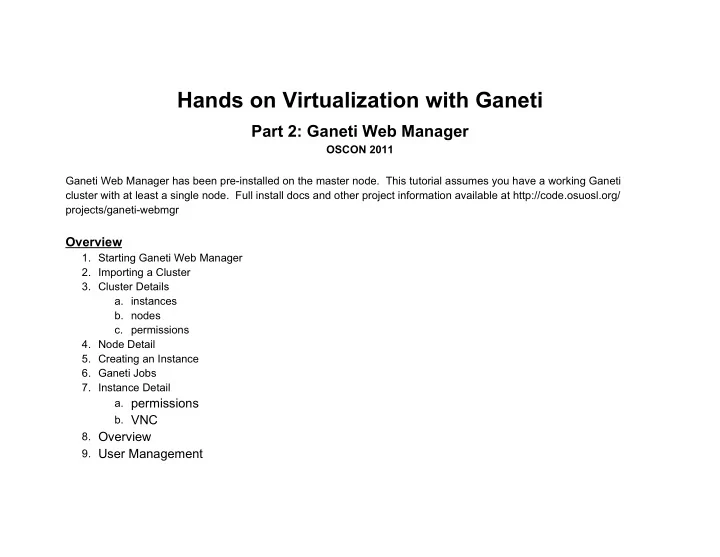
SLIDE 1 Hands on Virtualization with Ganeti
Part 2: Ganeti Web Manager
OSCON 2011 Ganeti Web Manager has been pre-installed on the master node. This tutorial assumes you have a working Ganeti cluster with at least a single node. Full install docs and other project information available at http://code.osuosl.org/ projects/ganeti-webmgr
Overview
- 1. Starting Ganeti Web Manager
- 2. Importing a Cluster
- 3. Cluster Details
- a. instances
- b. nodes
- c. permissions
- 4. Node Detail
- 5. Creating an Instance
- 6. Ganeti Jobs
- 7. Instance Detail
- a. permissions
- b. VNC
- 8. Overview
- 9. User Management
SLIDE 2 1) Start Django Development Server
1. cd ganeti_webmgr 2. source bin/activate 3. ./manage.py runserver 0.0.0.0:8000
2) Open http://localhost:8000 in your browser
default password for admin user and cluster user are: username: oscon password: oscon
SLIDE 3
3) Add A Cluster: Menu > Clusters > Add Cluster
SLIDE 4
4) Cluster Detail: Menu > Clusters > ganeti.example.org
SLIDE 5
4) Cluster Detail (nodes): Menu > Clusters > ganeti.example.org > Nodes tab 5) Grant “Create Virtual Machine” Permissions: Menu > Clusters > ganeti.example.org > Users
SLIDE 6
6) Node Detail: Menu > Clusters > Primary Node
SLIDE 7
7) Deploy a Virtual Machine: Menu > Create VM
SLIDE 8
8) Deploy a Virtual Machine: Menu > Create VM > Deploying (click create)
SLIDE 9
9) Virtual Machine Detail: Virtual Machines > Instance2.example.org (also shown after deployment)
SLIDE 10
10) Grant Permissions to your VM: Menu > Virtual Machines > Your VM > Users
SLIDE 11
SLIDE 12 11) Enable VNC Proxy
- 1. /etc/init.d/vncap restart
Note: There are a few networking issues within virtualbox:
- You must restart the proxy after every connection/disconnect for it to accept additional connections.
- VNC only works with Chrome, there is a bug preventing the virtualbox network from working with firefox.
The VNC Proxy is a gateway into your backend infrastructure. It allows secure connections, without user interaction.
SLIDE 13
12) VNC Console: Menu > Virtual Machines > instance2.example.org > Console
SLIDE 14
12) Overview Dashboard: Menu > Overview
SLIDE 15
13) User Detail: Menu > Users > oscon
SLIDE 16
14) User Permissions: Menu > Users > oscon > permissions
SLIDE 17
15) User Resources: Menu > Users > oscon > resources
SLIDE 18
16) User Action Log: Menu > Users > oscon > user actions