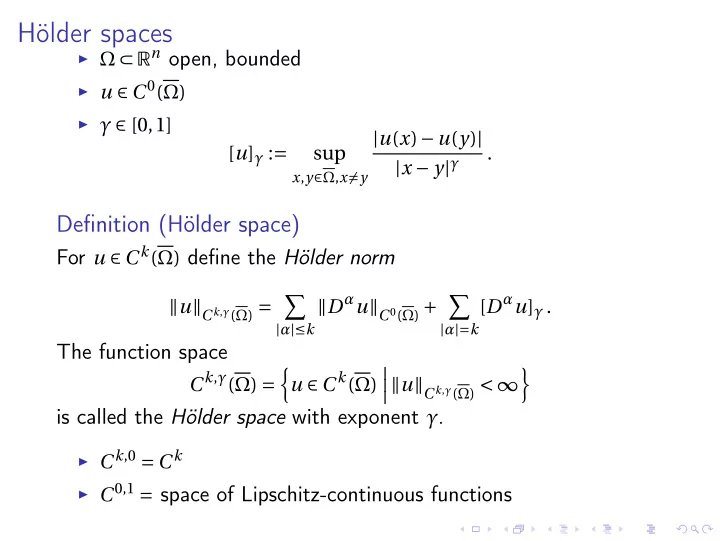
SLIDE 1 Hölder spaces
Ω ⊂ Rn open, bounded u ∈ C 0(Ω) γ ∈ [0,1]
[u]γ := sup
x,y∈Ω,x=y
|u(x)−u(y)| |x − y|γ .
Definition (Hölder space)
For u ∈ C k(Ω) define the Hölder norm
uC k,γ(Ω) =
DαuC 0(Ω) +
[Dαu]γ .
The function space
C k,γ(Ω) =
- u ∈ C k(Ω)
- uC k,γ(Ω) < ∞
- is called the Hölder space with exponent γ.
C k,0 = C k C 0,1 = space of Lipschitz-continuous functions
SLIDE 2
Theorem (Hölder space)
The Hölder space with the Hölder norm is a Banach space, i. e.
C k,γ(Ω) is a vector space, ·C k,γ(Ω) is a norm, any Cauchy sequence in the Hölder space converges.
Proof.
Homework!
SLIDE 3 Weak derivative
u,v ∈ L1 loc(Ω) α a multiindex C ∞ c (Ω) = infinitely smooth functions with compact support in Ω
Definition
v is called the αth weak derivative of u, Dαu = v ,
if (1)
uDαψdx = (−1)|α|
vψdx
for all test functions ψ ∈ C ∞
c (Ω).
Remark
(1)
= k times integration by parts
u smooth ⇒ v = Dαu is classical derivative
SLIDE 4 Weak derivative
Example (on Ω = (0,2))
1.
u(x) =
1 if 1<x<2
v(x) =
0 if 1<x<2
v = Du, since for any ψ ∈ C ∞
c (Ω)
2 uψ′ dx = ... = − 2 vψdx ,
2.
u(x) =
2 if 1<x<2
u does not have a weak derivative, since − 2 vψdx = ... = − 1 ψdx −ψ(1)
cannot be fulfilled for all ψ ∈ C ∞
c (Ω) by any v ∈ L1 loc(Ω)
SLIDE 5 Lebesgue spaces
Definition (Lebesgue space)
Let p ∈ [1,∞].
uLp(Ω) =
1/p (p < ∞) esssupΩ|u| (p = ∞)
The Lebesgue space with exponent p is
Lp(Ω) =
- u : Ω → R
- u measurable with uLp(Ω) < ∞
- .
Theorem (Lebesgue space)
Lp(Ω) is a Banach space.
SLIDE 6 Sobolve spaces
Definition (Sobolev space)
Let p ∈ [1,∞], k ∈ N0. The space
W k,p(Ω) =
loc(Ω)
- weak derivative Dαu ∈ Lp(Ω) for all |α| ≤ k
- with
uW k,p(Ω) =
1/p 1 ≤ p < ∞
p = ∞
is called a Sobolev space.
Theorem (Sobolev space)
W k,p(Ω) is a Banach space.
Remark
W 0,p(Ω) ≡ Lp(Ω) W k,p
(Ω) = closure of C ∞
c (Ω) in W k,p(Ω) Hk(Ω) ≡ W k,2(Ω) are Hilbert spaces (what is inner product?)
SLIDE 7 Properties of Lebesgue and Sobolev functions
Theorem (Hölder’s inequality)
p,p∗ ∈ [1,∞] with 1 p + 1 p∗ = 1 f ∈ Lp, g ∈ Lp∗
|f g|dx ≤ f Lp(Ω)gLp∗(Ω)
Theorem (Trace theorem)
Let Ω ⊂ Rn bounded, ∂Ω Lipschitz. There exists a continuous linear
- perator T : W 1,p(Ω) → Lp(∂Ω), the trace, with
(i) Tu = u|∂Ω if u ∈ W 1,p(Ω)∩C 0(Ω), (ii) TuLp(∂Ω) ≤ CuW 1,p(Ω), (iii) Tu = 0
⇔ u ∈ W 1,p (Ω).
Theorem (Poincaré’s inequality)
Ω ⊂ Rn bounded, open, connected, ∂Ω Lipschitz. ∃C = C(n,p,Ω) u −
∀u ∈ W 1,p(Ω) uLp(Ω) ≤ C∇uLp(Ω) ∀u ∈ W 1,p (Ω)
SLIDE 8
Embedding theorems
Theorem (Sobolev embedding)
Ω ⊂ Rn open, bounded, ∂Ω Lipschitz, m1,m2 ∈ N0, p1,p2 ∈ [1,∞). If m1 ≥ m2 and m1 − n
p1 ≥ m2 − n p2
then W m1,p1(Ω) ⊂ W m2,p2(Ω) and there is a constant C > 0 s. t.
uW m1,p1(Ω) ≤ CuW m2,p2(Ω) ∀u .
If the inequalities are strict, W m1,p1(Ω)
→ W m2,p2(Ω) compactly.
Theorem (Hölder embedding)
Ω ⊂ Rn open, bounded, ∂Ω Lipschitz, m,k ∈ N0, p ∈ [1,∞), α ∈ [0,1]. If m − n
p ≥ k +α and α = 0,1
then W m,p(Ω) ⊂ C k,α(Ω) and there is a constant C > 0 s. t.
uW m,p(Ω) ≤ CuC k,α(Ω) ∀u .
If m − n
p < k +α, W m,p(Ω)
→ C k,α(Ω) compactly.