Guzdial Research How do we support the use of programming as a - - PowerPoint PPT Presentation

guzdial research
SMART_READER_LITE
LIVE PREVIEW

Guzdial Research How do we support the use of programming as a - - PowerPoint PPT Presentation

Guzdial Research How do we support the use of programming as a medium for thought and communication? How do we improve success in programming (especially for people who arent computer scientists)? Past Research: Media Computation


slide-1
SLIDE 1

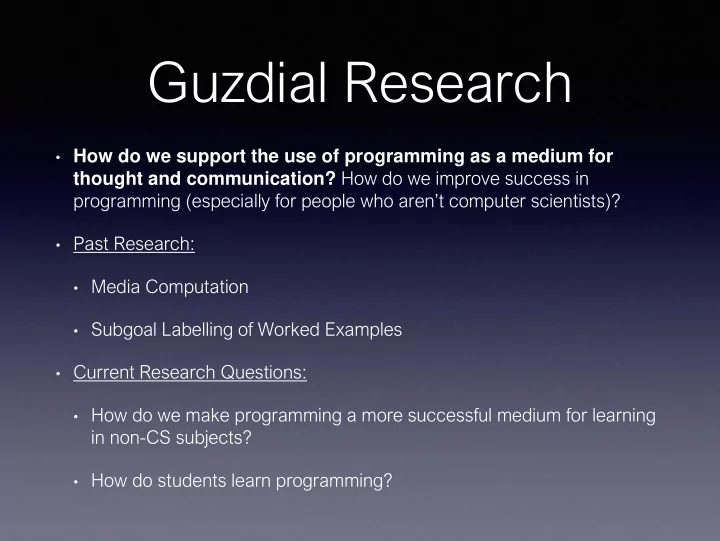
Guzdial Research

  • How do we support the use of programming as a medium for

thought and communication? How do we improve success in programming (especially for people who aren’t computer scientists)?

  • Past Research:
  • Media Computation
  • Subgoal Labelling of Worked Examples
  • Current Research Questions:
  • How do we make programming a more successful medium for learning

in non-CS subjects?

  • How do students learn programming?
slide-2
SLIDE 2

Papert, Logo; DiSessa, Boxer; Kay, Smalltalk

slide-3
SLIDE 3

Media Computation

  • Fall

ll 1999 999: All students at Georgia Tech must take a course in computer science.

  • Considered part of General Education, like mathematics,

social science, humanities…

  • 1999-2003: Only one course met the requirement.
  • Overall pass rate: About 78%
  • Around 50% for Liberal Arts, Architecture/Design, and

Business students

slide-4
SLIDE 4

Media Computation: Teaching in a Relevant Context

  • Presenting CS topics with

media projects and examples

  • Iteration as creating negative and

grayscale images

  • Indexing in a range as removing

redeye

  • Algorithms for blending both

images and sounds

  • Linked lists as song fragments

woven to make music

  • Information encodings as sound

visualizations

4

slide-5
SLIDE 5

Results: Media Computation

0,9 0,9 0,8 0,9 0,9 0,9 0,8 0,8 0,8 0,1 0,1 0,1 0,1 0,1 0,1 0,2 0,2 0,2 Total Fall03 Females Fall03 Males Fall03 Total Sp04 Females Sp04 Males Sp04 Total Fall04 Females Fall04 Males Fall04 WDF

Change in Success rates in CS1 “Media Computation” from Spring 2003 to Fall 2005 (Overall 85%) Architecture 46.7% 85.7% Biology 64.4% 90.4% Economics 54.5% 92.0% History 46.5% 67.6% Management 48.5% 87.8% Public Policy 47.9% 85.4%

Similar results replicated at multiple institutions

slide-6
SLIDE 6

Eccles (1983) model of achievement-related choices

slide-7
SLIDE 7
  • Students are often overwhelmed when programming.

“You’ve taught me so many details, I don’t know which ones to use.” (Clancy & Linn, 1990)

  • How do we convey how to think about the purpose for the

parts of the program? About why each part is there?

  • Richard Catrambone (1994) invented a way to label the

subgoals in examples provided to students.

  • Developed in statistics, chemistry, and physics
  • Never tested before in Computer Science

Part 2: Subgoal Labeling

slide-8
SLIDE 8

Example of Written Materials

Subgoa goal

  • Def

efine e Variab iables les from Built-in in

  • Click on "Built-In" and "Definition" and pull out a

def variable.

  • Click on the "variable" and replace it with

"fortuneList". This creates a variable called "fortuneList".

  • Click on "Lists" and drag out a call make a list
  • Click on "Text" and drag out a text text block

and drop it next to "item". Click on the rightmost "text" and replace it with your first fortune.

  • Handl

dle Even ents ts from My Blocks

  • Click on "My Blocks" and "Button1".
  • Drag out a when Button1.Click.

Non Non-subg ubgoal

  • al
  • Click on "Built-In" and "Definition" and

pull out a def variable.

  • Click on the "variable" and replace it with

"fortuneList". This creates a variable called "fortuneList".

  • Click on "Lists" and drag out a call make

a list

  • Click on "Text" and drag out a text text

block and drop it next to "item".

  • Click on the rightmost "text" and replace

it with your first fortune.

  • Click on "My Blocks" and "Button1".
  • Drag out a when Button1.Click.
slide-9
SLIDE 9

Original Video

slide-10
SLIDE 10

Video with Subgoals

slide-11
SLIDE 11

Results: Understanding

slide-12
SLIDE 12

Results: Retention

Significant results for transfer as well. Effect has been found with different populations (e.g., secondary teachers), and with text languages, too.

slide-13
SLIDE 13

Why do subgoal labels work?

  • Ashok Goel’s Str

tructure ucture-Beha Behavior vior-Function Function (SBF) F) model of design knowledge

  • St

Structure ructure is code

  • Fu

Functio nction is the purpose for the code, what goal it achieves.

  • Behav

ehavior ior is how the code dynamically achieves the goal

  • Behavior is hardest for students
  • Subgoal labels, across different programs,

connect S, B, and F.

slide-14
SLIDE 14

Current Research Questions

  • How do we make programming a successful

medium for learning in non-CS subjects?

  • Code has value as a learning medium
  • Targeting Pre-Calculus and Economics
  • How do students learn programming?
slide-15
SLIDE 15

Code is Different

Bruce Sherin

slide-16
SLIDE 16

Code is Temporal & Causal

slide-17
SLIDE 17

Teaching economics and systems-thinking. First experiences with economic systems

slide-18
SLIDE 18

Interleaving for Thinking about Systems

Play the Board Game Redesign the Board Game Rules Scale the Basic Board Game Scale the Redesigned Board Game Rules What do we want from an economic system?

Define what you mean by “win.” Can you come up with the perfect winning algorithm?

Put your algorithm in a game board

  • simulation. Does your algorithm work

the same over 1000’s of plays? What do we want from an economic system?

slide-19
SLIDE 19

Discrete Event Simulations, in Blocks Language

slide-20
SLIDE 20

Using Theory to Explain Learning Programming

  • Functional: Create analogies to learning mathematics.
  • Requires prior knowledge of mathematics and high self-efficacy for

mathematics

  • Plan-based: Teach students patterns of code (plans) that achieve something they

want to do, and when they learn enough plans, they will learn the abstractions of the syntax and semantics. Structure for function, abstracting to behavior.

  • Developing experiments to test the theory (a) for instructional design and (b) as

an explanatory tool for programs “in the wild.”

  • Teach the syntax and semantics of languages
  • Needs context (for motivation and function/goals) and

concrete worked examples to support later abstraction.

  • Constructionism: Little teaching, but let students play and learn

from rapid feedback.

  • Inefficient. Requires high self-efficacy.
slide-21
SLIDE 21
slide-22
SLIDE 22

Extra Slides

slide-23
SLIDE 23

70,98 59,55 73,63 65,03 65,56 64,81 70,98 59,55 73,63 29,02 40,45 26,37 34,87 34,44 35,04 29,02 40,45 26,37 Total Fall01 Females Fall01 Males Fall01 Total Sp02 Females Sp02 Males Sp02 Total Fall02 Females Fall02 Males Fall02 Pass WDF

Success Rates in CS1 from Fall 1999 to Spring 2002 (Overall: 78%) Architecture 46.7% Biology 64.4% Economics 53.5% History 46.5% Management 48.5% Public Policy 47.9%

slide-24
SLIDE 24

Experiment with App Inventor

  • Used subgoal labeling to teaching Android App Inventor

(a blocks-based programming environment) to new Computer Science Students.

  • Two groups of undergraduate students:
  • One group was shown a video for how to use the software to

build an App and given text listing the steps in the instruction.

  • Another group was given the video and the steps with

subgoal labels.

Lauren Margelieux, Mark Guzdial, and Richard Catrambone, ICER 2012

slide-25
SLIDE 25

Week 1:

  • Watch the video.
  • Take a test to demonstrate understanding.

Week 2:

  • Take a test to demonstrate retention.
  • Watch a new video.
  • Take a test to demonstrate understanding of second video.
  • Take a test where students must build a new app,

transferring knowledge.

Steps in Experiment

slide-26
SLIDE 26

Results: Define Variable Step in Transfer Task

0, 0,2 0,4 0,6 0,8 1,

Define Variable Subgoal Conventional

p < .001, f = .61