1 Supporting STEM Learning by Mark Guzdial* Georgia Institute of - - PDF document

1
SMART_READER_LITE
LIVE PREVIEW

1 Supporting STEM Learning by Mark Guzdial* Georgia Institute of - - PDF document

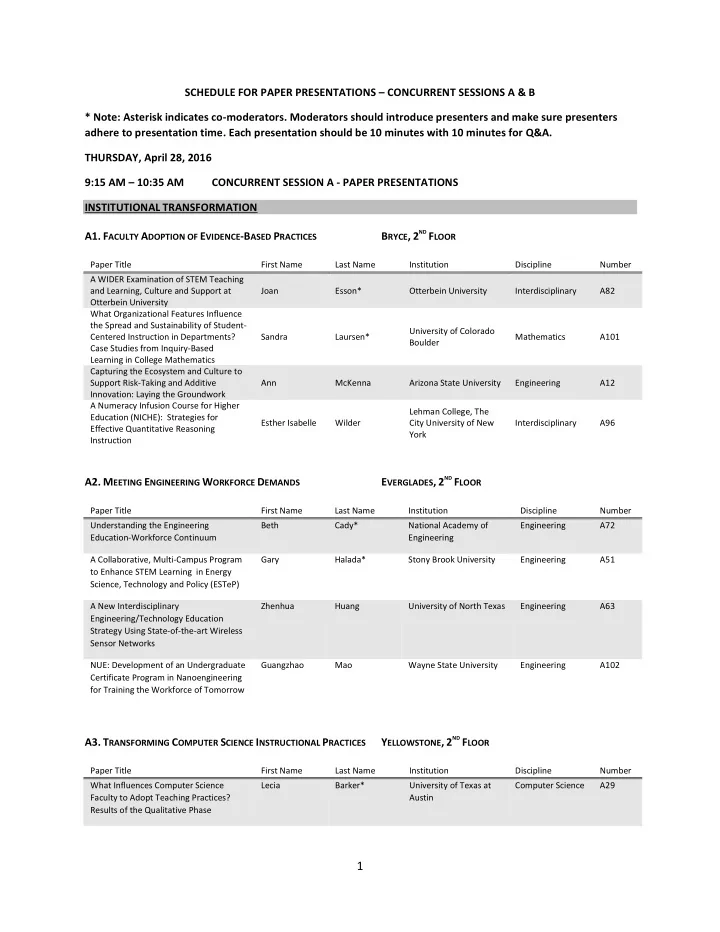
SCHEDULE FOR PAPER PRESENTATIONS CONCURRENT SESSIONS A & B * Note: Asterisk indicates co-moderators. Moderators should introduce presenters and make sure presenters adhere to presentation time. Each presentation should be 10 minutes with


slide-1
SLIDE 1

1

SCHEDULE FOR PAPER PRESENTATIONS – CONCURRENT SESSIONS A & B * Note: Asterisk indicates co-moderators. Moderators should introduce presenters and make sure presenters adhere to presentation time. Each presentation should be 10 minutes with 10 minutes for Q&A. THURSDAY, April 28, 2016 9:15 AM – 10:35 AM CONCURRENT SESSION A - PAPER PRESENTATIONS INSTITUTIONAL TRANSFORMATION

  • A1. FACULTY ADOPTION OF EVIDENCE-BASED PRACTICES

BRYCE, 2

ND FLOOR

Paper Title First Name Last Name Institution Discipline Number A WIDER Examination of STEM Teaching and Learning, Culture and Support at Otterbein University Joan Esson* Otterbein University Interdisciplinary A82 What Organizational Features Influence the Spread and Sustainability of Student- Centered Instruction in Departments? Case Studies from Inquiry-Based Learning in College Mathematics Sandra Laursen* University of Colorado Boulder Mathematics A101 Capturing the Ecosystem and Culture to Support Risk-Taking and Additive Innovation: Laying the Groundwork Ann McKenna Arizona State University Engineering A12 A Numeracy Infusion Course for Higher Education (NICHE): Strategies for Effective Quantitative Reasoning Instruction Esther Isabelle Wilder Lehman College, The City University of New York Interdisciplinary A96

  • A2. MEETING ENGINEERING WORKFORCE DEMANDS

EVERGLADES, 2

ND FLOOR

Paper Title First Name Last Name Institution Discipline Number Understanding the Engineering Education-Workforce Continuum Beth Cady* National Academy of Engineering Engineering A72 A Collaborative, Multi-Campus Program to Enhance STEM Learning in Energy Science, Technology and Policy (ESTeP) Gary Halada* Stony Brook University Engineering A51 A New Interdisciplinary Engineering/Technology Education Strategy Using State-of-the-art Wireless Sensor Networks Zhenhua Huang University of North Texas Engineering A63 NUE: Development of an Undergraduate Certificate Program in Nanoengineering for Training the Workforce of Tomorrow Guangzhao Mao Wayne State University Engineering A102

  • A3. TRANSFORMING COMPUTER SCIENCE INSTRUCTIONAL PRACTICES

YELLOWSTONE, 2

ND FLOOR

Paper Title First Name Last Name Institution Discipline Number What Influences Computer Science Faculty to Adopt Teaching Practices? Results of the Qualitative Phase Lecia Barker* University of Texas at Austin Computer Science A29

slide-2
SLIDE 2

2

Supporting STEM Learning by Redesigning the Textbook: Creating High-Completion CS Online Learning Using Educational Psychology Principles Mark Guzdial* Georgia Institute of Technology Computer Science A37 NSF TUES Type I: Process Oriented Guided Inquiry Learning (POGIL) in Computer Science (CS) Clifton Kussmaul Muhlenberg College Computer Science A39 An MOOC-based Professional Development Model for CS Principles Ralph Morelli Trinity College Computer Science A40

  • A4. COLLABORATIVE SOLUTIONS

SEQUOIA, 2

ND FLOOR

Paper Title First Name Last Name Institution Discipline Number Collaborative Education: Building a Skilled Software Verification and Validation User Community Sushil Acharya* Robert Morris University Computer Science A27 Crowdsourcing, Cyberlearning, and Coalitions for Empowering Small Universities to Renew Curricula, Update Courses, and Prepare Students’ Marketable Skills Hong Liu* Embry-Riddle Aeronautical University Interdisciplinary A88 Co-valuing Instructional Laboratory Course Offerings Gabriel Spalding Illinois Wesleyan University Physics A116

  • A5. ASSESSMENT OF INSTRUCTIONAL PRACTICES

YOSEMITE, 2

ND FLOOR

Paper Title First Name Last Name Institution Discipline Number Self-report of Instructional Climate and Practices: Two New Instruments Andrea Beach* Western Michigan University Interdisciplinary A78 Project SPROUT: Documenting and Investigating STEM Instruction Lynn Reimer* University of California, Irvine Interdisciplinary A72 Are Faculty Implementing RBIS At Your Campus? How Do You Know? Moira van Staaden Bowling Green State University & Harvard University Interdisciplinary A94 First Steps Toward Developing An Instructional Practices Guide For Undergraduate Mathematics Education Diana White University of Colorado Denver Mathematics A106

STUDENT LEARNING

  • A6. ASSESSING ENGINEERING STUDENT LEARNING

CAPITOL A, LOBBY LEVEL

Paper Title First Name Last Name Institution Discipline Number A Systems Approach to a Self-Report Measure of Interactive Student Engagement Jonathan Hilpert* Georgia Southern University Engineering A61

slide-3
SLIDE 3

3

Using Smartpens and Data Mining for Large-Scale Formative Assessment of Ordinary Learning Activities Thomas Stahovich* University of California, Riverside Engineering A75 SciLAF: Scientific-based Learning Assessment Framework for Student Knowledge Tracking Gabriel Terejanu University of South Carolina Computer Science A47 Automatic Sensing and Classification of Objects in an Engineering Laboratory Environment Conrad Tucker Penn State University Engineering A76

  • A7. STUDENT SUCCESS IN MATHEMATICS COURSES

CONGRESSIONAL B, LOBBY LEVEL

Paper Title First Name Last Name Institution Discipline Number Representations of Partial Derivatives Elizabeth Gire* Oregon State University Mathematics A102 Promoting Success In Early College Mathematics Through Graduate Teacher Training Gary Olson* University of Colorado Denver Mathematics A99 A National Investigation of Precalculus through Calculus 2 Chris Rasmussen San Diego State University Mathematics A98 Promoting Proof-Writing Through Video Case-Studies James Sandefur Georgetown University Mathematics A104

  • A8. INNOVATIVE METHODS FOR STUDENT ENGAGEMENT

CONGRESSIONAL C. LOBBY LEVEL

Paper Title First Name Last Name Institution Discipline Number The Impact of Organizing K-12 Outreach

  • n Undergraduate STEM Majors

Michael Ferrara* University of Colorado Denver Interdisciplinary A83 Research in Student Peer Review: A Cooperative Web-Services Approach Edward Gehringer* North Carolina State University Interdisciplinary A84 Probing the Inverted Classroom: A Controlled Study of Teaching and Learning Outcomes in Undergraduate Engineering and Mathematics Nancy Lape Harvey Mudd College Engineering A65 Students Reading Real Science: Primary Literature in the Classroom Melissa McCartney AAAS Interdisciplinary A90

  • A9. RESEARCH AND INQUIRY IN BIOLOGICAL SCIENCE CLASSROOMS,

CAPITOL B, LOBBY LEVEL

Paper Title First Name Last Name Institution Discipline Number ComGen-ARE: A Scalable Model for Empowering Faculty at Community Colleges to Bring Research into the Classroom Gita Bangera* Bellevue College Biological Sciences A2 CREST: Connecting Researchers, Educators and Students Margaret Franzen* Milwaukee School of Engineering Biological Sciences A7

slide-4
SLIDE 4

4

Guiding Education Through Novel Investigation (GENI): Facilitating and Assessing the Impact of Authentic Research in the Classroom Derek Wood Seattle Pacific University Biological Sciences A23

  • A10. PHYSICS BEYOND PHYSICS MAJORS

CONGRESSIONAL D, LOBBY LEVEL

Paper Title First Name Last Name Institution Discipline Number Development & Implementation of Physics of Medicine Curriculum Nancy Donaldson* Rockhurst University Physics A109 Mathematical Sense-Making: Targeting A Core Physics And Engineering Practice Andrew Elby* University of Maryland Physics A110 Inquiry into Radioactivity – Enabling Radiation Literacy Andy Johnson Black Hills State University Physics A112 Examining the design and implementation of a new IPLS course David Smith University of North Carolina at Chapel Hill Biological Sciences A13

LEARNING TECHNOLOGIES & CONTEXTS

  • A11. TOOLS FOR ASSESSING STUDENT LEARNING AND

INFORMING FACULTY DEVELOPMENT REGENCY D, BALLROOM LEVEL

Paper Title First Name Last Name Institution Discipline Number Assessing Faculty Professional Development in STEM Higher Education: Sustainability of Outcomes Diane Ebert-May* Michigan State University Biological Sciences A6 A Community of Enhanced Assessment Facilitates Reformed Teaching Paula Lemons* University of Georgia Biological Sciences A11 An Iterative Approach To Developing, Refining And Validating Machine-Scored Constructed Response Assessments Luanna Prevost University of South Florida Biological Sciences A18 Expanding a National Network for Automated Analysis of Constructed Response Assessments to Reveal Student Thinking in STEM Mark Urban-Lurain Michigan State University Biological Sciences A21

  • A12. INTERACTIVE COMPUTER SCIENCE COURSEWORK

GRAND TETON, 2

ND FLOOR

Paper Title First Name Last Name Institution Discipline Number Experiences and Reflections of using Parallel Design Patterns Tools in an Undergraduate Program Clayton Ferner* University of North Carolina Wilmington Computer Science A35 OpenDSA: Interactive eTextbooks for Computer Science Clifford Shaffer* Virginia Tech Computer Science A44

slide-5
SLIDE 5

5

New College--Level Interactive STEM Learning Material: Findings and Directions Frank Vahid

  • Univ. of California,

Riverside Computer Science A48 A Flexible Framework for Cyber Security Education RICHARD WEISS The Evergreen State College Computer Science A49

  • A13. HARNESSING TECHNOLOGY FOR

HANDS-ON ENGINEERING LEARNING

CONGRESSIONAL A, LOBBY LEVEL

Paper Title First Name Last Name Institution Discipline Number Hands-on Laboratory Experience using Virtual Reality 3D Simulations Pnina Ari-Gur* Western Michigan University Engineering A52 A Spiral Computer Engineering Lab Framework Pong Chu* Cleveland State University Computer Science A33 The Center for Mobile Hands-On STEM: Experiment Centric Pedagogy and Why It Should Be a Core Part of Every Engineering Student's Learning Experience Kenneth Connor Rensselaer Polytechnic Institute Engineering A58 Creating Low Cost Miniature Industrial Equipment and Accompanying Assessments for Innovative Instruction Bernard Van Wie Washington State University Engineering A77

BROADENING PARTICIPATION

  • A14. INCREASING THE POOL OF COMPUTER SCIENCE LEARNERS

THROUGH INTERDISCIPLINARY COMPUTING COURSES THORNTON B, 11

TH FLOOR

Paper Title First Name Last Name Institution Discipline Number Computing in Context Robert Beck* Villanova University Computer Science A30 Imagining Creative Hands-On Projects for Students in Computing in the Arts and STEM Incubator Programs Jennifer Burg* Wake Forest University Computer Science A31 Using Music to Enhance Learning Outcomes for Non-Majors in an Introductory Programming Course Tacksoo Im Georgia Gwinnett College Computer Science A36 Making: A Computing in the Arts Community Susan Reiser UNC Asheville Computer Science A42

  • A15. INCREASING THE POOL OF BIOLOGICAL SCIENCE MAJORS

THORNTON A, 11

TH FLOOR

Paper Title First Name Last Name Institution Discipline Number CSUSM/Palomar College STEM Partnership: Growing our Region’s STEM Talent Pool Charles De Leone* California State University San Marcos Biological Sciences A5

slide-6
SLIDE 6

6

Broadening Access to STEM Through A Hybrid Online 2+2 Program Jennifer Drew* University of Florida Biological Sciences A20 Scaling-up a comprehensive first-year experiential intervention program for first-generation, low-income STEM students at a large public research university Michael McKibben University of California, Riverside Biological Sciences A13

  • A16. RETAINING STEM STUDENTS IN DIVERSE SETTINGS

THORNTON C, 11

TH FLOOR

Paper Title First Name Last Name Institution Discipline Number Collaborative STEP: Bridges to STEM Careers Sadegh Davari* University of Houston - Clear Lake Computer Science A34 Toward a Deeper Understanding of First Generation Students’ Success in Computing Jane Stout* Computing Research Association Computer Science A46 Expanding STEM Talent Through Upward Transfer: Factors Influencing Transfer In STEM Fields Of Study From Two-Year To Four-Year Institutions Xueli Wang University of Wisconsin- Madison Research or Assessment A118 Who Succeeds Online? Using Student Characteristics to Predict Online Versus Face-to-Face Attrition Claire Wladis City University of New York Social / Behavioral Sciences A120 Representations of Partial Derivatives Elizabeth Gire Oregon State University Mathematics A102

THURSDAY, APRIL 28, 2016

10:50 AM – 12:20 PM CONCURRENT SESSION B - PAPER PRESENTATIONS

INSTITUTIONAL TRANSFORMATION

  • B1. PERSONNEL DEVELOPMENT IN ENGINEERING

EVERGLADES, 2

ND FLOOR

Paper Title First Name Last Name Institution Discipline Number Instructional Module Development System (IMODS): Building Faculty Expertise in Outcome-based Course Design Srividya Bansal* Arizona State University Engineering A54 Collaboratively Developing Research- Based Curricular Materials to Improve Conceptual Understanding in Engineering Education Shane Brown* Oregon State University Engineering A56 The Teaching Circle: Successfully Promoting Faculty Adoption of Evidence- Based Teaching Practices Cynthia Finelli University of Michigan Engineering A60

slide-7
SLIDE 7

7

Center for Infrastructure Transformation and Education (CIT-E): Prepare Students for the 21st Century Infrastructure Crisis Lauren McBurnett Arizona State University Engineering A67

  • B2. ALIGNING STEM COURSES WITH WORKFORCE NEEDS

SEQUOIA, 2

ND FLOOR

Paper Title First Name Last Name Institution Discipline Number Preparing Students for Business, Industry, and Government Careers Michael Dorff* Brigham Young University Interdisciplinary A79 Teaching and Learning in the Era of the Skills Gap: A Field Study of Higher Education-industry Dynamics in the State of Wisconsin During the Walker Administration Matthew Hora* University of Wisconsin- Madison Social / Behavioral Sciences A119 Progression of Student Abilities in Control of Variables in an Introductory Physics Lab Course Kathleen Koenig University of Cincinnati Physics A113 A Modular Assessment Framework for Professional Skills Using a Model of Domain Learning Approach Sadan Kulturel Penn State Berks Research or Assessment A117

  • B3. INCORPORATING RESEARCH INTO UNDERGRADUATE STUDIES

BRYCE, 2

ND FLOOR

Paper Title First Name Last Name Institution Discipline Number Dissemination of Microprocessor Courses through Classroom and Interactive Cyber-Enabled Technologies Steve Hsiung* Old Dominion University Engineering A62 Institutionalizing Undergraduate Research on a Grand Scale: Helping Systems and Consortia Comprehensively Adopt Undergraduate Research Mitchell Malachowski* University of San Diego Interdisciplinary A89 Managing the load and maximizing the gains for all: Project PLURIS (Purposeful Learning in Undergraduate Research and Independent Studies) Kathy Williams San Diego State University Interdisciplinary A97

  • B4. INSTITUTIONALIZING EVIDENCE-BASED PRACTICES

YOSEMITE, 2

ND FLOOR

Paper Title First Name Last Name Institution Discipline Number Translating Workshop Training Into Best Practices: Teaching With The CREATE Strategy Promotes Diverse Gains At Two- And Four-Year Colleges Sally Hoskins* City College of the City University of New York Biological Sciences A8 Transforming the Faculty Culture across the STEM disciplines Howard Jackson* University of Cincinnati Biological Sciences A9 Learning Assistant Alliance: Social Organizing Tools for Sharing Resources and Building Institutional Networks Valerie Otero University of Colorado Boulder Biological Sciences A16

slide-8
SLIDE 8

8

Catalyzing Institutional Transformation: An Integrated Model for Effective Practice Susan Shadle Boise State University Biological Sciences A19

  • B5. SUCCESSFUL PHYSICS TEACHING METHODS

YELLOWSTONE, 2

ND FLOOR

Paper Title First Name Last Name Institution Discipline Number Investigating Institutional Success At Overcoming Challenges In Algebra-based Studio Physics Jacquelyn Chini* University of Central Florida Physics A108 Enhancing Undergraduate STEM Education: Workshops and Learning Communities for Physics and Astronomy Faculty Robert Hilborn* American Association of Physics Teachers Physics A111 Active Learning Strategies for Algebra- based Introductory Physics Courses at UCF Talat Rahman Uinversity of Central Florida Physics A114 Research-based Assessment Resources to Improve Teaching in Physics Classrooms and Departments Eleanor Sayre Kansas State University Physics A115

STUDENT LEARNING

  • B6. CONNECTING STUDENTS TO STATISTICS

CONGRESSIONAL C, LOBBY LEVEL

Paper Title First Name Last Name Institution Discipline Number Connecting Introductory Students and Instructors to a Passion for Statistics through a Virtual, Project-Based Classroom Lisa Dierker* Wesleyan University Interdisciplinary A81 Fostering Active Learning in Statistics: Initial Findings about Graduate Teaching Assistants’ Training Needs Jennifer Kaplan* University of Georgia Mathematics A100 The HILT-LAS Project: High Impact, Little Time Activities that Address Lexical Ambiguity in Statistics Neal Rogness Grand Valley State University Mathematics A103 Broadening the Impact and Evaluating the Effectiveness of Simulation-based Curricula for Introductory Statistics Nathan Tintle Dordt College Mathematics A105

  • B7. ASSESSING AND IMPROVING

BIOLOGICAL SCIENCE STUDENT LEARNING CAPITOL B, LOBBY LEVEL

Paper Title First Name Last Name Institution Discipline Number Writing Matters: Increasing Undergraduate Cell Biology Literacy through Writing-to-Learn Activities Meena Balgopal* Colorado State University Biological Sciences A1

slide-9
SLIDE 9

9

Building Next-Generation STEM Assessments using Machine Learning Methodologies Ross Nehm* Stony Brook University Biological Sciences A15 Exploring Metacognition, Motivation, and Epistemic Beliefs as Mechanisms for Writing-to-Learn among Undergraduate Thesis Writers Leslie Schiff University of Minnesota Interdisciplinary A91 National Dissemination of the CAT Instrument: Lessons Learned and Implications Barry Stein Tennessee Technological University Interdisciplinary A93

  • B8. ENGINEERING EDUCATION CURRICULUM AND METHODS

CAPITOL A, LOBBY LEVEL

Paper Title First Name Last Name Institution Discipline Number Nanotechnology Solutions to Engineering Grand Challenges Edward Davis* Auburn University Engineering A59 Nanotechnology Fellows Program: An Interdisciplinary Practicum for Nanotechnology Undergraduate Education Saniya LeBlanc* The George Washington University Interdisciplinary A87 Building a Big Data Analytics Workforce in iSchools Jungwoo Ryoo Pennsylvania State University Computer Science A43 Impact of a Step-Based Tutoring System

  • n Student Learning and Motivation

Brian Skromme Arizona State University Engineering A74

  • B9. COMPUTER SCIENCE EDUCATION CURRICULUM AND METHODS

CONGRESSIONAL A, LOBBY LEVEL

Paper Title First Name Last Name Institution Discipline Number TAILS: Enhanced Learning Through Experiencing Artificial Intelligence as a Lab Science Stephanie E. August* Loyola Marymount University Computer Science A28 EIP: Engaging Laboratory Experiences for the Introduction to Programming Course Jose Ortiz-Ubarri* University of Puerto Rico Río Piedras Computer Science A41 Computational Creativity and Computer Science Education Leen-Kiat Soh University of Nebraska Computer Science A45 Creative Computation for CS1 and K9-12 Dianna Xu Bryn Mawr College Computer Science A50

LEARNING TECHNOLOGIES & CONTEXTS

  • B10. CHEMISTRY EDUCATION CONTEXTS

CONGRESSIONAL D, LOBBY LEVEL

Paper Title First Name Last Name Institution Discipline Number Chemistry, Life, the Universe and Everything: An Evidence-Based, Transformed General Chemistry Curriculum Melanie Cooper* Michigan State University Chemistry A24

slide-10
SLIDE 10

10

Enhancing Comparative Assessment in Chemistry with the QMAP System Thomas Holme* Iowa State University Chemistry A25 Bringing Useful Insights into Student Thinking to Course Design, Delivery, and Evaluation Using the BeSocratic Formative Assessment System Michael Klymkowsky University of Colorado Boulder Biological Sciences A4 Ionic: Transforming Education Through Collaborative Development Of Materials At The Frontiers Of Inorganic Chemistry Sheila Smith University of Michigan- Dearborn Chemistry A26

  • B11. DIGITAL TOOLS IN ENGINEERING EDUCATION

REGENCY D, BALLROOM LEVEL

Paper Title First Name Last Name Institution Discipline Number Engaging in Play: Creating a Community

  • f Practice to Support Game-Based

Implementations for Teaching Innovation and Entrepreneurship Cheryl Bodnar* Rowan University Engineering A55 The iCollaborate MSE Project - An Overview Kathleen Kitto* Western Washington University Engineering Mechanix Julie Linsey Georgia Tech Engineering A66 Enhancing Students’ Hydrology Learning Through Data and Modeling Driven Instruction Venkatesh Merwade Purdue University Engineering A69

  • B12. DIGITAL TOOLS FOR BIOLOGICAL SCIENCE LEARNING

CONGRESSIONAL B, LOBBY LEVEL

Paper Title First Name Last Name Institution Discipline Number Increasing STEM Persistence Of Minority Life Science Students By Bridging the Excitement Gap: A Preliminary Report Jeannie Barber-Choi* University of California, Los Angeles Biological Sciences A3 RNA-Seq for the Next Generation David Micklos* Cold Spring Harbor Laboratory Biological Sciences A14 Experimental Evolution in the Classroom: The Active LENS Project Robert Pennock Michigan State University Biological Sciences A17 ROOT: An Online In-Class Platform for Enriching Science Education Using Primary Sources John Walsh University of Southern California Biological Sciences A22

BROADENING PARTICIPATION

  • B13. INCREASING STEM RETENTION BY

IMPROVING SUCCESS IN CALCULUS

THORNTON C, 11

TH FLOOR

Paper Title First Name Last Name Institution Discipline Number Two-Tiered Summer Bridge Programming for At-Risk Engineering and Computer Science Students Caitlin Cairncross* University of Portland Computer Science A38

slide-11
SLIDE 11

11

Instructional Faculty Development and Student Success Janet Callahan* Boise State University Computer Science A32 Increasing Student Engagement and Success in First-year Calculus Jean McGivney- Burelle University of Hartford Mathematics A68 Research and Instructional Strategies for Engineering Retention Claudia Rawn University of Tennessee - Knoxville Engineering A71

  • B14. RECRUITING AND RETAINING A

DIVERSE STEM STUDENT POPULATION THORNTON B, 11

TH FLOOR

Paper Title First Name Last Name Institution Discipline Number STEM Recruitment: Convincing Outstanding Math-Potential-Admits To Succeed In STEM (COMPASS) Melissa Dagley* University of Central Florida Interdisciplinary A80 Preliminary Evaluation of STEM Retention and Introductory STEM Course Performance for Scots Science Scholars Angelia Gibson* Maryville College Interdisciplinary A92 The M-STEM Academies at the University of Michigan: An Integrated Approach to Increase the Number and Diversity of Undergraduates in STEM Disciplines Deborah Goldberg University of Michigan Interdisciplinary A85 Community for Achievement in Science, Academics, and Research: The CASAR Project Richard Kopec

  • St. Edward's University

Interdisciplinary A86

  • B15. BROADENING THE ENGINEERING STUDENT POPULATION

THORNTON A, 11

TH FLOOR

Paper Title First Name Last Name Institution Discipline Number Promoting a Culture of Inclusion in First- Year Engineering Courses Rebecca Atadero* Colorado State University Engineering A53 Increasing Diversity in Engineering through Healthcare Applications Grisselle Centeno* University of South Florida Engineering A57 Developing an Ecosystem for Student Success in Engineering and Computer Science Javier Kypuros The University of Texas Rio Grande Valley Engineering A64 Understanding Student Participation In A First-Year Calculus Online Support Forum Angela Minichiello Utah State University Engineering A70