Guidelines for Submission of Proposals for Changing Majors to the - - PDF document

guidelines for submission of proposals for changing
SMART_READER_LITE
LIVE PREVIEW

Guidelines for Submission of Proposals for Changing Majors to the - - PDF document

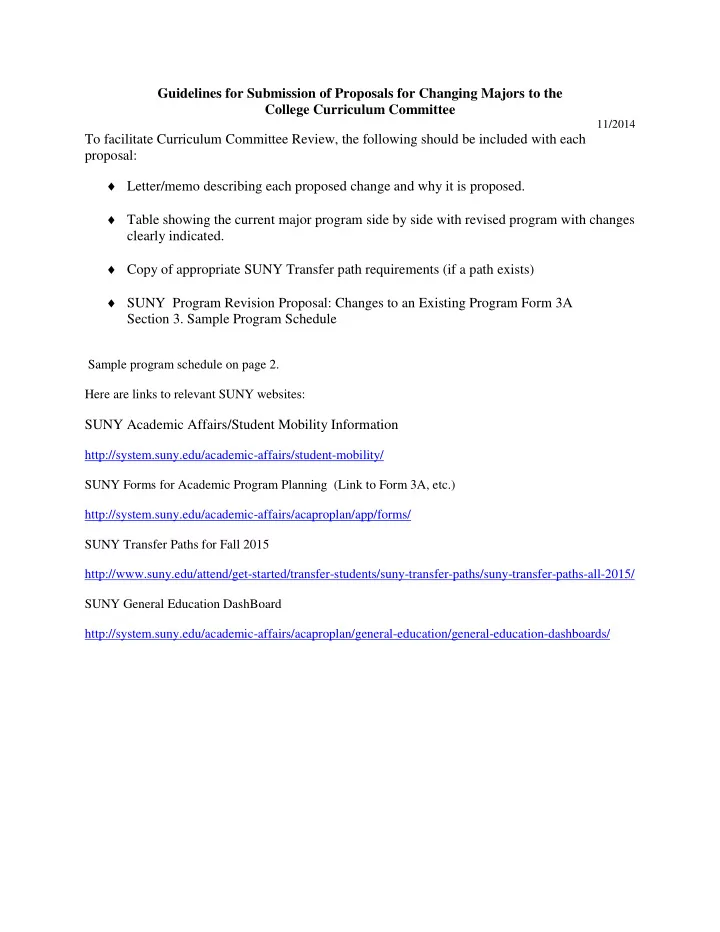
Guidelines for Submission of Proposals for Changing Majors to the College Curriculum Committee 11/2014 To facilitate Curriculum Committee Review, the following should be included with each proposal: Letter/memo describing each proposed


slide-1
SLIDE 1

Guidelines for Submission of Proposals for Changing Majors to the College Curriculum Committee

11/2014

To facilitate Curriculum Committee Review, the following should be included with each proposal:  Letter/memo describing each proposed change and why it is proposed.  Table showing the current major program side by side with revised program with changes clearly indicated.  Copy of appropriate SUNY Transfer path requirements (if a path exists)  SUNY Program Revision Proposal: Changes to an Existing Program Form 3A Section 3. Sample Program Schedule

Sample program schedule on page 2. Here are links to relevant SUNY websites:

SUNY Academic Affairs/Student Mobility Information

http://system.suny.edu/academic-affairs/student-mobility/ SUNY Forms for Academic Program Planning (Link to Form 3A, etc.) http://system.suny.edu/academic-affairs/acaproplan/app/forms/ SUNY Transfer Paths for Fall 2015 http://www.suny.edu/attend/get-started/transfer-students/suny-transfer-paths/suny-transfer-paths-all-2015/ SUNY General Education DashBoard http://system.suny.edu/academic-affairs/acaproplan/general-education/general-education-dashboards/

slide-2
SLIDE 2

Example: Adolescence Education: Earth Science Current Major Proposed Major EDUC 106 Issues in Education EDUC 106 Issues, Philosophy, Foundations of Ed. EDUC 201 Teaching & Diversity No change EDUC 206 Philosophy & Foundations Incorporated into revised EDUC 106 EDUC 201 Teaching & Diversity No change EPSY 229 Survey of Exceptional Children No change EPSY 275 Learning & Motivation No change EPSY 250 Adolescent Growth & Development No change EDUC 246 Dev. of Language & Adol.Literacy EDUC 246 Dev. of Language & Adol.Literacy CWE prereq. eliminated; Field Experience increased from 4 to to 6 hours EDUC 346 Teaching Reading in Content Area No change EDUC 213 Education Law Requirements No change SCED 392 Research/Theory/Practice MS/HS SCED 392 Research/Theory/Practice MS/HS Pre-req added: Candidate Status in Ed. Field Experience increased from 50 to 52 hrs SCED 396 Student Teaching in Sec. No change SCED 398 Seminar in MS/HS No change CHEM 111 General Chemistry I No change CHEM 112 General Chemistry II No change Math 105 or MATH 173 Calculus I MATH 173 Calculus I PHYS 103 General Physics I (non-calculus)

  • r 203 General Physics I

No change PHYS 104 General Physics II (non-calculus)

  • r 204 General Physics II

No change STAT 101 Introduction to Statistics No change Choose one of the following: GEOL 115 Science of Natural Disasters Credits of each changed from 3 to 4 credits GEOL 120 Introduction to Geology due to department course changes GEOL 150 Intro to Forensic Geology “ GEOL 182Water and Blue Planet “ OCEA 110 Introduction to Oceanography

  • mitted

Complete all METR 110 Intro to Meteorology Credits of each changed from 3 to 4 credits ESCI 215 Earth Materials due to department course changes GEOL 370 Geomorphology “ GEOL 220 Earth History and the Fossil Record “ ASTR 271 Stars and Galaxies No change BIOL, CHEM, ENVS, PHYS 100- 399 selection No change ESCI,GEOL,METR, WATR, OCEA,ASTR elective 200-300 level No change ESCI,GEOL,METR, WATR, OCEA,ASTR elective 300 level No change ESCI 315 Lab Techniques in Earth Science No change SCIN 312 Laboratory Techniques in Chemistry No change SCIN 315 Techniques in General Science No change SCIN 390 Interdisciplinary Science Capstone No change

slide-3
SLIDE 3

General Ed Attributes SUNY General Ed Attributes

General education not covered in content 12 – 18 credits GER not covered in content 12 credits Total Credits required 125-134 Total Credits required 122 -125 Adolescence Education: Earth Science Transfer Pathway Adolescence Education Pathway Geology Pathway Foundations of Education Adolescent Psychology Foreign Language (2 courses same language) Physical Geology (with lab) Historical Geology (with lab) Calculus I General Chemistry I (with lab) General Chemistry II (with lab) Recommended General Physics I (with lab) Introduction to Statistics

slide-4
SLIDE 4

SUNY Undergraduate Sample Program Schedule OPTION: You can paste an

  • f

this schedule AFTER this line, and delete the rest of this page.)

ProgramlTrack Title and Award:_Adolescence Education: Earth Sciecne

______________________

_

a) Indicate academic calendar type: [x ] Semester [] Quarter [ ] Trimester [ ] Other (describe): b) Label each term in sequence, consistent with the institution's academic calendar (e.g.,Falll, Spring 1, Fall 2) Name ofSUNY if one exists: _2 paths: _ Adolescence Education _and Geology See for details. c) d) Use the table to show how a typical student may progress through the program; copy/expand the table as needed. Complete all columns that apply to a course. -

112 General Chemistry I 4

4

4 4 4 4 4 4 4 4 4 I NS I 4 I 4

IPHYS 203 Pre- I I

STAT 101 Introduction to

I 3 I M I 3 I

3

req: MATH 173 completed/concu rrent

3

Pre-req GER(either AH,H,QW,WC,AR)

3 3

dependent upon choose other than what was selection used above

3 I NS

GERleither AH,H,QW,WC,AR) I 3

3

than what was

slide-5
SLIDE 5

EDUC 201 Teaching & Diversity EPSY 229 Survey of Exceptional ' Children

3

3-4

3 4

3

3

NS 3-4

4

NS

3

SS

I 3 I

4

3 4 3

IPre-req: SoS,

IGEOL 120 or

I

115 or 151 or 182 Pre-req: Candidate Status in Education Required; 8- or better to progress KEY Cr: credits GER: \L ' (Enter Category Abbreviation)

I I

EPSY 275 Psychological

I 3 I IASTR 271 Stars and Galaxies I 3

IESCI315 Laboratory

Techniques in Earth Science SCED 398 Seminar in Middle and High School Science

I 2

2 3

I 3

2 2 2 3

I IPre-req: SoS

Pre-req: SCED392 8- or better and student teaching eligibility and permission from the Office

  • f Education Advisement &

Field Experience.

Courses (Enter credits) New: new course (Enter X) ColPrerequisite(s): list co/prerequisite(s) for the noted courses Upper Division: Courses intended primarily for juniors and seniors SUNY GER Category Abbreviations (the first five listed in order oftheir frequency of being required by SUNY campuses): Basic Communication (BC), Math (M), Natural Sciences (NS), Social Science (SS), Humanities (H), American History (AH), The Arts (AR), Other World Civilizations (OW), Western Civilization (WC), Foreign Language (FL),

slide-6
SLIDE 6

Campus Category Course

Oneonta American History AHIS 240 American Colonial History Oneonta American History AHIS 254 Social & Intellectual History of U.S. I Oneonta American History AHIS 255 Social & Intellectual History of U.S. II Oneonta American History AHIS 263 African American History I Oneonta American History AHIS 264 African American History II Oneonta American History AHIS 267 U.S. Foreign Relations to 1914 Oneonta American History AHIS 282 The Indian in American History Oneonta American History AHIS 284 American Ethnic History Oneonta American History AHIS 285 History of the American Family Oneonta American History ALS 263 African American History I Oneonta American History ALS 264 African American History II Oneonta American History HIST 144 U.S. History I Oneonta American History HIST 145 U.S. History II Oneonta American History POLS 121 U.S. Government Oneonta Basic Communication AHIS 208 The City in American Culture (OS2) Oneonta Basic Communication ALS 100 Introduction to Africana-Latino Studies (WS2) Oneonta Basic Communication ALS 160 Urban Philosophical Dilemmas (OS2) Oneonta Basic Communication ALS 252 Latinos on the Move (WS2) Oneonta Basic Communication ALS 258 Latin American Political Theory (WS2) Oneonta Basic Communication ALS 259 Democracy and Race (WS2) Oneonta Basic Communication ALS 260 Philosophy of Protest (OS2) Oneonta Basic Communication ALS 261 Women of Mixed Racial Descent (WS2) Oneonta Basic Communication ALS 361 American Families in Poverty (WS2) Oneonta Basic Communication ALS 395 Senior Seminar in Africana-Latin Studies (WS2) Oneonta Basic Communication ALS/SOCL/POLS 293 Transforming Africa, Model SADC Simulation Oneonta Basic Communication ANTH 312 Exhibiting Cultures in Museums (WS2) Oneonta Basic Communication ANTH 325 Applied Anthropology (WS2) Oneonta Basic Communication ANTH 330 Paleoanthropology (WS2) Oneonta Basic Communication ANTH 333 Human Biological Variation (WS2) Oneonta Basic Communication ANTH 355 Field Methods in Anthropology (WS2) Oneonta Basic Communication ANTH 390 Issues in Anthropology (WS2) Oneonta Basic Communication BIOL 265 Evolution of Biology (WS2) Oneonta Basic Communication BIOL 317 Biological Literacy (WS2) Oneonta Basic Communication BIOL 356 Animal Behavior (WS2) Oneonta Basic Communication BUS 240 Writing for Business & the Professions (WS2) Oneonta Basic Communication COMM 100 Introduction to Speech Communication (OS2) Oneonta Basic Communication COMM 110 Public Speaking (OS2) Oneonta Basic Communication COMM 225 Argumentation (OS2) Oneonta Basic Communication COMM 227 Discussion (OS2) Oneonta Basic Communication COMP 100 Composition (BC2) Oneonta Basic Communication COMP 150 Introduction to Creative Writing (WS2) Oneonta Basic Communication COMP 200 Advanced Composition (WS2) Oneonta Basic Communication COMP 239 Technical and Professional Writing (WS2) Oneonta Basic Communication COMP 260 Poetry Workshop (WS2) Oneonta Basic Communication COMP 270 Fiction Workshop (WS2) Oneonta Basic Communication COMP 275 Creative Nonfiction Workshop (WS2) Oneonta Basic Communication COMP 290 Writing About Literature Oneonta Basic Communication ECON 390 Senior Seminar in Economics (WS2) Oneonta Basic Communication EDUC 106 Issues in Education (WS2) Oneonta Basic Communication EDUC 206 Philosophy & Foundations of Education (WS2) Oneonta Basic Communication EDUC 395A Student Teaching and Capstone (OS2) Oneonta Basic Communication EDUC 395B Student Teaching and Capstone (OS2) Oneonta Basic Communication ENED 396A Student Teaching Secondary English (OS2) Oneonta Basic Communication ENED 396B Student Teaching Secondary English (OS2) Oneonta Basic Communication ENVS 290 Waste Management (WS2) Oneonta Basic Communication ENVS 310 Environmental Oceanography (WS2) Oneonta Basic Communication FAMS 361 American Families in Poverty (WS2) Oneonta Basic Communication FASH 221 Apparel in Today’s Economy (WS2) Oneonta Basic Communication FCSE 392 Research Theory: Practice in Family & Consumer Science Education (OS2) Oneonta Basic Communication FCSE 396A Student Teaching in Family & Consumer Science Education (OS2) Oneonta Basic Communication FCSE 396B Student Teaching in Family & Consumer Science Education (OS2) Oneonta Basic Communication FLED 396A Student Teaching in Secondary Foreign Languages (OS2) Oneonta Basic Communication FLED 396B Student Teaching in Secondary Foreign Languages (OS2) Oneonta Basic Communication GEOG 100 Geography of the Far East (WS2) Oneonta Basic Communication GEOG 233 Urban Geography (WS2) Oneonta Basic Communication GEOG 260 Geography of Anglo-America (WS2) Oneonta Basic Communication GEOG 274 Geography of Asia (WS2) Oneonta Basic Communication GEOG 279 Geography of the Far East (WS2) Oneonta Basic Communication INTD 100 First Year Seminar (BC2) Oneonta Basic Communication LITR 285 Autobiography, Gender & Culture (WS2) Oneonta Basic Communication MCOM 210 Writing for the Newspaper (WS2) Oneonta Basic Communication MCOM 252 Writing for Radio, TV, & Film (WS2)

12/1/2014 P:\SUNY Transfer paths\SUNY INFO\SUNY Gen Ed Courses offered at Oneonta Page 1 of 6

slide-7
SLIDE 7

Campus Category Course

Oneonta Basic Communication MCOM 262 Reporting (WS2) Oneonta Basic Communication MCOM 301 Broadcast Journalism (WS2) Oneonta Basic Communication METR 212 Introduction to Climatology (WS2) Oneonta Basic Communication MGMT 354 Corporate Social Responsibility (WS2) Oneonta Basic Communication MTHE 396A Student Teaching in Secondary Math (OS2) Oneonta Basic Communication MUSC 388 Legal Issues of the Music Industry (WS2) Oneonta Basic Communication NUTR 340 Advanced Nutrition I (WS2) Oneonta Basic Communication OCEA 310 Environmental Oceanography (WS2) Oneonta Basic Communication PHIL 102 Ethics (WS2) Oneonta Basic Communication PHIL 103 Critical Thinking (WS2) Oneonta Basic Communication PHIL 160 Urban Philosophical Dilemmas (OS2) Oneonta Basic Communication PHIL 201 Theories of Knowledge (WS2) Oneonta Basic Communication PHIL 202 Metaphysics (WS2) Oneonta Basic Communication PHIL 206 Philosophy of Life and Death (WS2) Oneonta Basic Communication PHIL 211 Philosophy of Science (WS2) Oneonta Basic Communication PHIL 214 Philosophy of Religion (WS2) Oneonta Basic Communication PHIL 220 History of Philosophy I: Ancient Philosophical Thought (WS2) Oneonta Basic Communication PHIL 221 History of Philosophy II: Modern Philosophical Thought (WS2) Oneonta Basic Communication PHIL 223 Anarchism, Statism, Tradition and Revolution in the 19th Century (WS2) Oneonta Basic Communication PHIL 230 Environmental Ethics (OS2) Oneonta Basic Communication PHIL 231 Media Ethics (OS2) Oneonta Basic Communication PHIL 232 Philosophy of Law (OS2) Oneonta Basic Communication PHIL 258 Latin American Political Theory (WS2) Oneonta Basic Communication PHIL 259 Democracy and Race (WS2) Oneonta Basic Communication PHIL 260 Philosophy of Protest (OS2) Oneonta Basic Communication PHIL 380 Philosophy Conference (OS2) Oneonta Basic Communication PHIL 390 Senior Thesis (WS2) Oneonta Basic Communication PHYS 382 Advanced Physics Lab (WS2) Oneonta Basic Communication POLS 329 Public Policy Analysis (WS2) Oneonta Basic Communication POLS 368 Political Development: Problems of Nation Building (WS2) Oneonta Basic Communication POLS 382 International Organization and Law Oneonta Basic Communication POLS 398 Seminar in Political Science (WS2) Oneonta Basic Communication PROF 120 College Learning Strategies (WS2) Oneonta Basic Communication PSYC 220 Introduction to Psychological Research (WS2) Oneonta Basic Communication PSYC 222 Research Methods II Oneonta Basic Communication SCED 396A Student Teaching in Secondary Science (OS2) Oneonta Basic Communication SOCL 390 Senior Seminar in Sociology (WS2) Oneonta Basic Communication SSED 396A Student Teaching in Secondary Social Studies (OS2) Oneonta Basic Communication SSED 396B Student Teaching in Secondary Social Studies (OS2) Oneonta Basic Communication WMST 130 Gender, Power and Difference (WS2) Oneonta Basic Communication WMST 214 Archetypes of the Wild Worman (WS2) Oneonta Basic Communication WMST 261 Women of Mixed Racial Descent (WS2) Oneonta Basic Communication WMST 398 Seminar in Women's Studies (WS2) Oneonta Critical Thinking Infusion Oneonta Critical Thinking THTR 104 Survey of Dance in America Oneonta Foreign Language AGRK 101 Intro to Ancient Greek 1 Oneonta Foreign Language ARAB 101 Introductory Arabic I Oneonta Foreign Language ARAB 102 Introductory Arabic II Oneonta Foreign Language ASL 101 Intro-American Sign Language I Oneonta Foreign Language ASL 102 Intro-American Sign Language II Oneonta Foreign Language FREN 101 Introductory French I Oneonta Foreign Language FREN 102 Introductory French II Oneonta Foreign Language FREN 103 Intermediate French I Oneonta Foreign Language FREN 104 Intermediate French II Oneonta Foreign Language FREN 201 Advanced French I Oneonta Foreign Language FREN 202 Advanced French II Oneonta Foreign Language FREN 217 Contemporary France Oneonta Foreign Language GERM 101 Introductory German I Oneonta Foreign Language GERM 102 Introductory German II Oneonta Foreign Language GERM 103 Second Year German I Oneonta Foreign Language GERM 104 Second Year German II Oneonta Foreign Language HEBR 101 Introductory Hebrew I Oneonta Foreign Language HEBR 102 Introductory Hebrew II Oneonta Foreign Language ITAL 101 Introductory Italian I Oneonta Foreign Language ITAL 102 Introductory Italian II Oneonta Foreign Language ITAL 103 Second-Year Italian I Oneonta Foreign Language ITAL 104 Second-Year Italian II Oneonta Foreign Language ITAL 112 Elementary Italian Conversation Oneonta Foreign Language ITAL 201 Advanced Italian I Oneonta Foreign Language ITAL 202 Advanced Italian II Oneonta Foreign Language JAPN 101 Introductory Japanese 1 Oneonta Foreign Language LATN 102 Introductory Latin II

12/1/2014 P:\SUNY Transfer paths\SUNY INFO\SUNY Gen Ed Courses offered at Oneonta Page 2 of 6

slide-8
SLIDE 8

Campus Category Course

Oneonta Foreign Language RUSS 101 Introductory Russian I Oneonta Foreign Language SPAN 101 Introductory Spanish I Oneonta Foreign Language SPAN 102 Introductory Spanish II Oneonta Foreign Language SPAN 103 Second Year Spanish I Oneonta Foreign Language SPAN 104 Second Year Spanish II Oneonta Foreign Language SPAN 112 Elementary Spanish Conversation Oneonta Foreign Language SPAN 201 Review of Spanish Grammar Oneonta Foreign Language SPAN 202 Advanced Spanish Usage I Oneonta Foreign Language SPAN 203 Advanced Spanish Usage II Oneonta Humanities ALIT 200 American Literature I Oneonta Humanities ALIT 201 American Literature II Oneonta Humanities ALIT 207 Environmental Literature Oneonta Humanities ALIT 210 American Poetry Oneonta Humanities ALIT 215 19th Century American Novel Oneonta Humanities ALIT 216 Modern American Drama Oneonta Humanities ALIT 217 Contemporary American Fiction Oneonta Humanities ALIT 225 Modern American Drama Oneonta Humanities ALIT 226 Contemporary American Poetry Oneonta Humanities ALIT 234 Literature of the Jazz Age Oneonta Humanities ALIT 240 The American Renaissance Oneonta Humanities ALIT 241 Realism and Naturalism Oneonta Humanities ALIT 250 Black American Literature Oneonta Humanities ALIT 255 20th Century Irish-American Literature Oneonta Humanities ALIT 280 Jack London Oneonta Humanities ALIT 286 African American Women Writers Oneonta Humanities ALIT 351 Literature of the Harlem Renaissance Oneonta Humanities ALIT 369 Rachel Carson Oneonta Humanities ALIT 374 Hawthorne and Melville Oneonta Humanities ALS 160 Urban Philosophical Dilemmas (OS2) Oneonta Humanities ALS 211 Contemporary Black Political Thought Oneonta Humanities ALS 212 Music of the Caribbean Oneonta Humanities ALS 250 Black American Literature Oneonta Humanities ALS 259 Democracy and Race (WS2) Oneonta Humanities ALS 260 Philosophy of Protest (OS2) Oneonta Humanities ALS 286 African American Women Writers Oneonta Humanities ALS 351 Literature of the Harlem Renaissance Oneonta Humanities ANTH 115 Survey of World Religions Oneonta Humanities ANTH 120 Introduction to Linguistic Anthropology Oneonta Humanities ANTH 211 Religion, Magic & Myth Oneonta Humanities ANTH 212 Music of the Caribbean Oneonta Humanities ANTH 213 Comparative Religion Oneonta Humanities ANTH 217 Visual Anthropology Oneonta Humanities ELIT 200 English Literature: Beginnings to Early Renaissance Oneonta Humanities ELIT 201 English Literature: Renaissance to 18th Century Oneonta Humanities ELIT 202 English Literature: 18th Century to Present Oneonta Humanities ELIT 215 The English Novel Oneonta Humanities ELIT 243 Restoration & 18th Century Literature Oneonta Humanities ELIT 245 English Writers of the Romantic Age Oneonta Humanities ELIT 246 Victorian Literature Oneonta Humanities ELIT 247 20th Century English Writers Oneonta Humanities ELIT 270 Shakespeare I Oneonta Humanities ELIT 271 Shakespeare II Oneonta Humanities ELIT 272 17th Century English Literature Oneonta Humanities ELIT 273 Milton Oneonta Humanities FREN 208 Survey of French Literature I Oneonta Humanities FREN 209 Survey of French Literature II Oneonta Humanities INTD 115 Survey of World Religions Oneonta Humanities LING 150 Introductory Survey of Language Oneonta Humanities LING 201 Language and Society Oneonta Humanities LITR 100 Introduction to Literature Oneonta Humanities LITR 215 Contemporary Novel Oneonta Humanities LITR 220 Short Fiction Oneonta Humanities LITR 226 Modern Drama Oneonta Humanities LITR 244 Contemporary Literature Oneonta Humanities LITR 250 Approaches to Literature Oneonta Humanities LITR 283 Women in Literature Oneonta Humanities LITR 284 Nature & the Self in Literature Oneonta Humanities PHIL 101 Introduction to Philosophy Oneonta Humanities PHIL 102 Ethics Oneonta Humanities PHIL 103 Critical Thinking Oneonta Humanities PHIL 104 Philosophical Ideas in Imaginative Literature Oneonta Humanities PHIL 105 Business Ethics

12/1/2014 P:\SUNY Transfer paths\SUNY INFO\SUNY Gen Ed Courses offered at Oneonta Page 3 of 6

slide-9
SLIDE 9

Campus Category Course

Oneonta Humanities PHIL 107 Philosophies of Art Oneonta Humanities PHIL 115 Survey of World Religions Oneonta Humanities PHIL 160 Urban Philosophical Dilemmas (OS2) Oneonta Humanities PHIL 204 Literature & Philosophy of Alienation Oneonta Humanities PHIL 205 Phil & Psychology of Yoga Oneonta Humanities PHIL 210 Symbolic Logic Oneonta Humanities PHIL 230 Environmental Ethics Oneonta Humanities PHIL 231 Media Ethics Oneonta Humanities PHIL 235 Existentialism Oneonta Humanities PHIL 240 American Philosophy Oneonta Humanities PHIL 259 Democracy and Race (WS2) Oneonta Humanities PHIL 260 Philosophy of Protest (OS2) Oneonta Humanities POLS 211 Contemporary Black Political Thought Oneonta Humanities RELG 115 Survey of World Religions Oneonta Humanities RELG 212 Introduction to Judaism Oneonta Humanities SPAN 208 Introduction to Spanish Literature Oneonta Humanities WLIT 215 Great World Novels Oneonta Humanities WLIT 225 The Greek Dramatists Oneonta Humanities WLIT 227 Sex and Gender in Greek Literature Oneonta Humanities WLIT 235 Comedy & Satire in Greece & Rome Oneonta Humanities WLIT 260 The Bible as Literature I Oneonta Humanities WLIT 280 The Catholic Imagination Oneonta Information Management Infusion Oneonta Mathematics MATH 101 Mathematics for Liberal Arts Oneonta Mathematics MATH 105 Elementary Functions Oneonta Mathematics MATH 109 Basic Concepts of Elementary Math II Oneonta Mathematics MATH 173 Calculus I Oneonta Mathematics STAT101 Introduction to Statistics Oneonta Natural Sciences ANTH 101 Human Origins Oneonta Natural Sciences ANTH 130 Introduction to Biological Anthropology Oneonta Natural Sciences ASTR 108 Descriptive Astronomy Oneonta Natural Sciences ASTR 110 Introductory Astronomy Oneonta Natural Sciences ASTR 112 Search for Extraterrestrial Intelligence Oneonta Natural Sciences ASTR 115 Big Bang: Creation & Evolution of Universe Oneonta Natural Sciences BIOL 100 General Biology I Oneonta Natural Sciences BIOL 101 Plant Biology Oneonta Natural Sciences BIOL 123 Introduction to Evolution Oneonta Natural Sciences BIOL 180 General Biology I Oneonta Natural Sciences CHEM 100 Chemistry in Everyday Life Oneonta Natural Sciences CHEM 101 Introductory Chemistry: Organic Oneonta Natural Sciences CHEM 102 Introductory General Chemistry Oneonta Natural Sciences CHEM 103 The Chemistry of Nature Oneonta Natural Sciences CHEM 111 General Chemistry I Oneonta Natural Sciences ENVS 101 Intro to Environmental Science & Issues I Oneonta Natural Sciences ENVS 110 Environmental Sustainability Oneonta Natural Sciences ESCI 100 Introduction to the Earth Oneonta Natural Sciences ESCI 200 Investigations in Earth & Planetary Science Oneonta Natural Sciences GEOL 102 Sustaining Water Oneonta Natural Sciences GEOL 115 Science and Natural Disasters Oneonta Natural Sciences GEOL 120 Introduction to Geology Oneonta Natural Sciences GEOL 150 Introduction to Forensic Geology Oneonta Natural Sciences GEOL 182 Water and the Blue Planet Oneonta Natural Sciences GEOL 227 Global Tectonics Oneonta Natural Sciences METR 110 Introduction to Meteorology Oneonta Natural Sciences METR 180 Lightning & Thunderstorms Oneonta Natural Sciences NUTR 140 Nutrition Oneonta Natural Sciences NUTR 142 Nutrition in Everyday Life Oneonta Natural Sciences OCEA 110 Introduction to Oceanography Oneonta Natural Sciences PHYS 100 Introductory Physics Oneonta Natural Sciences PHYS 101 Modern Physical Science Oneonta Natural Sciences PHYS 103 General Physics (non-calculus) Oneonta Natural Sciences PHYS 108 Energy and Society Oneonta Natural Sciences PHYS 109 Lasers, Rockets & Space Ships Oneonta Natural Sciences PHYS 112 The Physics of Sports Oneonta Natural Sciences PHYS 113 The Physics of Sound Oneonta Natural Sciences PHYS 140 Light and Color Oneonta Natural Sciences PHYS 203 General Physics I Oneonta Other World Civilizations ALS 104 Introduction to African History Oneonta Other World Civilizations ALS 202 Peoples & Cultures of Africa Oneonta Other World Civilizations ALS 203 Peoples & Cultures of the Caribbean Oneonta Other World Civilizations ALS 206 Latino Drama: Teatro Campesino to Telenovelas Oneonta Other World Civilizations ALS 207 Black Drama

12/1/2014 P:\SUNY Transfer paths\SUNY INFO\SUNY Gen Ed Courses offered at Oneonta Page 4 of 6

slide-10
SLIDE 10

Campus Category Course

Oneonta Other World Civilizations ALS 215 History of Modern Middle East & North Africa Oneonta Other World Civilizations ALS 219 Africa Since 1800 Oneonta Other World Civilizations ALS 251 Pan Africanism Oneonta Other World Civilizations ALS 252 Latinos on the Move (WS2) Oneonta Other World Civilizations ALS 257 Modern Black Literature Oneonta Other World Civilizations ALS 258 Latin American Political Theory (WS2) Oneonta Other World Civilizations ALS 261 Women of Mixed Racial Descent (WS2) Oneonta Other World Civilizations ALS 262 Topics in Racism Oneonta Other World Civilizations ALS 265 Government & Politics of Africa Oneonta Other World Civilizations ALS 270 Postcolonial Literature & Culture: Africa Oneonta Other World Civilizations ALS 271 Colonial Latin America Oneonta Other World Civilizations ALS 272 Modern Latin America Oneonta Other World Civilizations ALS 273 Race, Gender, Class and Culture Oneonta Other World Civilizations ALS 274 Women in Africa & the Middle East Oneonta Other World Civilizations ALS 276 History of Slavery Oneonta Other World Civilizations ALS 278 African Atlantic: Popular Culture Oneonta Other World Civilizations ALS 292 The City in African History Oneonta Other World Civilizations ALS/SOCL/POLS 293 Transforming Africa, Model SADC Simulation Oneonta Other World Civilizations ANTH 105 World Cultures Oneonta Other World Civilizations ANTH 145 Prehistoric World Cultures Oneonta Other World Civilizations ANTH 201 The North American Indian Oneonta Other World Civilizations ANTH 202 Peoples & Cultures of Africa Oneonta Other World Civilizations ANTH 203 Peoples & Cultures of the Caribbean Oneonta Other World Civilizations ANTH 208 Mesoamerica Past & Present Oneonta Other World Civilizations ANTH 228 Globalization & Culture Oneonta Other World Civilizations ANTH 229 Critique of Civilization Oneonta Other World Civilizations ANTH 252 The Incas andTheir Ancestors Oneonta Other World Civilizations GEOG 274 Geography of Asia Oneonta Other World Civilizations GEOG 277 Geography of Southeast Asia Oneonta Other World Civilizations GEOG 279 Geography of the Far East Oneonta Other World Civilizations HIST 104 Introduction to African History Oneonta Other World Civilizations HIST 120 The Making of the Modern World Oneonta Other World Civilizations HIST 289 Spanish Conquistadores Oneonta Other World Civilizations HIST 292 The City in African History Oneonta Other World Civilizations HIST 293 History of Modern Central Asia Oneonta Other World Civilizations PHIL 250 Hinduism, Buddhism, & Taoism Oneonta Other World Civilizations PHIL 251 Mysticism & Med in Indian & Chinese Tradition Oneonta Other World Civilizations PHIL 258 Latin American Political Theory (WS2) Oneonta Other World Civilizations POLS 171 Comparative and International Politics Oneonta Other World Civilizations POLS 251 China, Japan & Korea Politics Oneonta Other World Civilizations POLS 265 Government & Politics of Africa Oneonta Other World Civilizations WHIS 215 History of Modern Middle East & North Africa Oneonta Other World Civilizations WHIS 219 Africa since 1800 Oneonta Other World Civilizations WHIS 251 Modern Japan Oneonta Other World Civilizations WHIS 252 Modern China Oneonta Other World Civilizations WHIS 253 History of Asia to 1500 Oneonta Other World Civilizations WHIS 270 Latin America Before Columbus: People and Histories Oneonta Other World Civilizations WHIS 271 Colonial Latin America Oneonta Other World Civilizations WHIS 272 Modern Latin America Oneonta Other World Civilizations WHIS 274 Women in Africa & the Mid East Oneonta Other World Civilizations WHIS 275 History of Southern Africa Oneonta Other World Civilizations WHIS 276 History of Slavery Oneonta Other World Civilizations WHIS 281 The Islamic World to 1800 Oneonta Other World Civilizations WLIT 201 World Literature II: Renaissance to 18th Century Oneonta Other World Civilizations WLIT 202 World Literature III: 18th Century to Present Oneonta Other World Civilizations WLIT 241 Literatures of the Middle East Oneonta Other World Civilizations WLIT 242 Muslim Women Writers Oneonta Other World Civilizations WLIT 257 Modern Black Literature Oneonta Other World Civilizations WLIT 271 Postcolonial Literature and Culture: The Americas Oneonta Other World Civilizations WLIT 281 The Chinese Novel Oneonta Other World Civilizations WMST 261 Women of Mixed Racial Descent Oneonta Other World Civilizations WMST 274 Gender and Power in Africa Oneonta Social Sciences AHIS 267 U.S. Foreign Relations to 1914 Oneonta Social Sciences ALS 262 Topics in Racism Oneonta Social Sciences ANTH 100 Introduction to Cultural Anthropology Oneonta Social Sciences ANTH 140 Introduction to Archaeology Oneonta Social Sciences ANTH 210 Anthropological Folklore Oneonta Social Sciences ANTH 214 Culture and Personality Oneonta Social Sciences ANTH 216 Anthropology of the Future Oneonta Social Sciences ANTH 219 Anthropology of Death Oneonta Social Sciences ANTH 227 Cultural Identities Oneonta Social Sciences ANTH 234 Human Origins

12/1/2014 P:\SUNY Transfer paths\SUNY INFO\SUNY Gen Ed Courses offered at Oneonta Page 5 of 6

slide-11
SLIDE 11

Campus Category Course

Oneonta Social Sciences ANTH 238 Anthropology of Reproduction Oneonta Social Sciences ECON 110 Principles of Economics Oneonta Social Sciences ECON 111 Principles of Microeconomics Oneonta Social Sciences EPSY 229 Survey of Exceptional Children Oneonta Social Sciences EPSY 250 Adolescent Growth & Development Oneonta Social Sciences FAMS 160 The Family in Perspective Oneonta Social Sciences FAMS 205 Marriage & Family Living Oneonta Social Sciences FOOD 133 Community Food & Nutrition Oneonta Social Sciences GEOG 100 Geography of the Far East (WS2) Oneonta Social Sciences GEOG 210 Economic Geography Oneonta Social Sciences GEOG 225 Population Geography Oneonta Social Sciences GEOG 230 Cultural Geography Oneonta Social Sciences GEOG 233 Urban Geography (WS2) Oneonta Social Sciences GEOG 238 Geography of Developing Regions Oneonta Social Sciences GEOG 260 Geography of Anglo-America (WS2) Oneonta Social Sciences GEOG 266 Geography of Latin America Oneonta Social Sciences GEOG 270 Geography of Europe Oneonta Social Sciences LCST 201 LCS: An Interdisciplinary Introduction Oneonta Social Sciences POLS 235 Environmental Politices & Policy Oneonta Social Sciences POLS 329 Public Policy Analysis (WS2) Oneonta Social Sciences PSYC 100 Introductory Psychology Oneonta Social Sciences SOCL 100 Introduction to Sociology Oneonta Social Sciences SOCL 110 Social Problems Oneonta Social Sciences SOCL 209 Social Research Methods Oneonta Social Sciences SOCL 220 Sociology of Modern Life Oneonta Social Sciences SOCL 229 Islamic Faith and Society Oneonta Social Sciences SOCL 305 Comparative Criminal Justice Oneonta The Arts ARTH 109 Survey of the Visual Arts I Oneonta The Arts ARTH 110 Survey of the Visual Arts II Oneonta The Arts ARTH 200 The Language of the Visual Arts Oneonta The Arts ARTH 221 History of Photography Oneonta The Arts ARTS 130 Introduction to 3-D Design Oneonta The Arts ARTS 140 Two-Dimensional Design Oneonta The Arts ARTS 141 Drawing I Oneonta The Arts ARTS 210 Basic Photography I Oneonta The Arts ARTS 237 Ceramics Oneonta The Arts MCOM 281 The Art of the Motion Picture Oneonta The Arts MCOM 283 The Development of Film Oneonta The Arts MCOM 284 Great Films of Great Directors Oneonta The Arts MCOM 285 Film Genres Oneonta The Arts MUSC 106 Learning about Music Oneonta The Arts MUSC 121 Jazz Oneonta The Arts MUSC 126 The American Musical Theatre Oneonta The Arts MUSC 192 Audio Arts Production I Oneonta The Arts MUSC 223 History of Rock Music Oneonta The Arts MUSC 247 Survey of Music Theory I Oneonta The Arts MUSC 249 Music Theory I Oneonta The Arts THTR 100 Theater Appreciation Oneonta The Arts THTR 104 Survey of Dance in America Oneonta The Arts THTR 111 Acting I Oneonta The Arts THTR 126 The American Musical Theatre Oneonta The Arts THTR 215 Improvisational Theater Oneonta The Arts THTR 240 Creative Dramatics Oneonta The Arts THTR 245 Children's Theatre Oneonta The Arts THTR 271 Theater History I Oneonta Western Civilization HIST 100 Western Civilization to 1600 Oneonta Western Civilization HIST 101 Modern Western Civilization Oneonta Western Civilization HIST 200 Greece: Achilles to Alexander Oneonta Western Civilization HIST 214 Europe from Napoleon to WWI Oneonta Western Civilization MUSC 100 Music for Listeners Oneonta Western Civilization PHIL 212 Social & Political Philosophy Oneonta Western Civilization WLIT 212 The Western Tradition: Survey of Greek & Roman Literature Oneonta Western Civilization WLIT 250 Continental Literature in Translation Oneonta Western Civilization WLIT 261 The Bible as Literature II: New Testament & Early Christian Writers

12/1/2014 P:\SUNY Transfer paths\SUNY INFO\SUNY Gen Ed Courses offered at Oneonta Page 6 of 6

slide-12
SLIDE 12

Seamless Transfer Policy Frequently Asked Questions

The following list of responses to frequently asked questions regarding seamless transfer policy implementation are intended to be informational only, and is not an official SUNY policy

  • document. Official SUNY policies regarding seamless transfer can be viewed and downloaded at

the Student Mobility Page. General Education Has SUNY-GER changed with the latest resolution?

  • No. As with previous policy, SUNY-GER consists of:

At least 30 credits of approved SUNY-GER courses with a minimum of 7 of 10 areas: Mathematics (required) Basic Communication (required) Natural Science (strongly encouraged) Social Science (strongly encouraged) Humanities (strongly encouraged) American History Western Civilization Other World Civilizations The Arts Foreign Language Completion of 2 competencies: Critical Thinking Information Management What degrees need to require SUNY-GER? SUNY-GER must be completed in the first 60 credits of AA, AS and bachelor‟s degrees. How do local gen ed (a.k.a. „local graduation requirements‟) apply to transfer students? Campuses can require additional or different local graduation requirements so long as they do not exceed the credit caps for programs and do not require transfer students to exceed the total number of credits to graduation required of native students in the same program. Can transfer path courses be approved for SUNY-GER?

  • Yes. In fact, many transfer path courses are already approved for gen ed.

Where can I find a list of approved SUNY-GER courses? http://bireporting.suny.edu/analytics/saw.dll?Dashboard

slide-13
SLIDE 13

Is double dipping allowed (using the same course to satisfy multiple categories)? System policy on double dipping defers to local campus policies at both sending and receiving campuses, as long as local policies do not require the transfer student to exceed the number of credits to graduation that are required of students who began their college education at the same institution. What is the grading policy for transfer of gen ed courses? A passing grade counts as successful completion for the SUNY-GER category. A grade of C

  • r better guarantees transfer credit. Campus discretion can be used about whether a course

grade satisfies graduation requirements outside SUNY-GER (e.g. in the major), as long as native and transfer students are treated the same. Pass/Fail may be accepted, but are not guaranteed by policy. Transfer Path Courses (courses in the major) What is a transfer path course (aka mobility course)? SUNY Transfer Paths are Core lower division coursework (foundational major and associated cognate courses) to achieve junior status after two years of full-time study. Cognate courses are taken outside the discipline or department, yet relate directly to the student‟s field of study (e.g., mathematics for natural science majors). SUNY faculty disciplinary committees of 2-year and 4-year faculty identified core courses in each discipline and created generic descriptions for each course. Nearly 900 faculty were involved in the latest round of Transfer Path discussions. Transfer Paths have been created, covering over 95% of all transfer students within SUNY. Where are the Transfer Path courses located? The Student Mobility dashboard (campus view) Public view: Core Course Finder What is the process for adding, deleting, or changing Transfer Path courses? Email requests to the Student Mobility Project Coordinator. Reviewers in the Office of Academic Programs & Planning will review the courses. Upon approval, you will be notified via email and the courses will be posted to the Student Mobility Dashboard. Are Transfer Path courses guaranteed to transfer, and what is the grading policy? Approved SUNY Transfer Path courses are guaranteed to transfer as courses in the major or required cognates (not just as electives) at all SUNY campuses if completed with the grade of C or better. Transfer campuses can choose to accept a passing grade lower than C. If a program requires a grade higher than C of native students, this standard can apply to transfer students as well. Pass/Fail courses may be accepted at the discretion of the campus,

slide-14
SLIDE 14

but transfer is not guaranteed. If a Transfer Path course is equivalent to or replaces a prerequisite course at the incoming campus that course shall fulfill the local prerequisite and the student can move into the higher level course at the receiving campus. What is the plan for review and redesign for the transfer paths? The Office of the Provost, in collaboration with the Faculty Governance, will develop a cycle

  • f review for the SUNY Transfer Paths. Disciplinary committees of 2-year and 4-year faculty

will review the Transfer Paths and recommend possible changes. The Transfer Paths are expected to evolve over time and will be maintained online at the Provost website. What if a Transfer Path does not exist for a program? Do campuses have to create them?

  • No. Campuses should ensure that students complete a sufficient number of courses in their

area of interest to achieve true junior status after two years of full-time study or the

  • equivalent. However, any SUNY campus may submit requests to the Student Mobility

Project Coordinator for the consideration of a new Transfer Path. The SUNY Provost, in consultation with the Faculty Council of Community Colleges and the University Faculty Senate, will convene a faculty disciplinary committee to consider and recommend to the SUNY Provost the appropriate SUNY Transfer Path courses. Programs Does every program have to be re-registered by SUNY and SED?

  • No. Only changes resulting in a cumulative change of one-third or more of the minimum

credits required for the award since last program registration; adding or deleting tracks or concentrations; and any change involving licensure-related courses. Note: Substitutions of courses only count once (e.g. substituting a three credit course for another three credit course = a three credit change). Do the transfer guarantees have to be honored if they conflict with residency requirements?

  • Yes. In order to protect students from excessive credits, the SUNY Board of Trustee

Seamless Transfer Resolution regarding the guaranteed transfer of SUNY-GER and Transfer Path courses must be honored. How can residency requirement conflicts be resolved? The policy does not dictate one particular method. Options include campus waivers for individual students, adjustments in minimum credit requirements, or working with the sending campus to facilitate reverse transfer.

slide-15
SLIDE 15

Can individual components of programs receive waivers?

  • Yes. With compelling justification, programs can receive waivers for all requirements, or

each component individually (SUNY-GER, courses in the major, credit caps). What are the credit caps? Associate programs are capped at 64 credits. Baccalaureate programs are capped at 126 credits. Are all associate degree programs and baccalaureate degree programs covered by the credit caps?

  • Yes. Resolved clause # 7 of the SUNY Board of Trustees Resolution on Seamless Transfer

Requirements states: “Associate degree programs shall generally require no more than 64 credits that can normally be completed within two years of full-time study or the equivalent, and bachelor‟s degree programs shall require no more than 126 credits that can normally be completed within four years of full-time study or the equivalent, unless there is a compelling justification.” Therefore, all associate and baccalaureate degrees fall under the credit caps, unless they receive waivers. Do Liberal Arts and Sciences and General Studies programs leading to an AA or AS degree have to require Transfer Paths?

  • Yes. Students should be required to complete at least one Transfer Path in these programs. In

cases where there is no SUNY Transfer Path in the disciplinary area of interest, students should complete a sufficient number of courses in their area of interest to achieve true junior status after two years of full-time study or the equivalent. Waivers What is the current status of the waiver request process? Successful waivers are submitted judiciously, with completed and accurate curriculum charts alongside detailed compelling justifications. Campuses can respond to a request for redesign in one of several ways: Provide the waiver committee with more information to bolster their case as designed; Redesign the program to come into compliance with the policy; Make changes to the program and based on those changes request another waiver; or, If the campus is unable to come to an agreement with the waiver review committee, they can appeal to the Provost. What is the process for a waiver request? Waiver Review Flowchart

slide-16
SLIDE 16

Are there examples of things that would be viewed favorably as a reason for approving a waiver request? The waiver review committee reviews each individual request on its own merits so it's very difficult to make generalizations. It may be helpful to know that the committee did develop a set of guiding principles that represent things they consider as part of every review. SUNY Board of Trustee policies Local campus policies are subject to Board policies (§ 351-355, 6303) New York State regulations: Regulations of the Commissioner of Education (§ 50-52) Education Law regarding the Licensed Professions Rules of the Board of Regents (Parts 3.47-3.50) External standards Accreditation standards Standards within the discipline Similar programs within New York State Similar programs nationally Advisory boards or other in-field external constituencies Additional considerations Human life and safety (e.g. CPR courses) Financial aid impact Alignment with SUNY strategic goals http://system.suny.edu/academic-affairs/student-mobility/seamless-transfer-policy-faqs/

SUNY Contact:

Daniel Knox Director of Student Mobility SUNY System Administration One University Plaza Albany, NY 12246 Phone: 518-320-1155/518-320-1155 Daniel.Knox@suny.edu

slide-17
SLIDE 17

Further Questions and Answers: Do both competencies (Critical Thinking and Information Management) need to be completed during the first four semesters? The entire SUNY GER needs to be completed during the first two years. How does one indicate those Competencies have been satisfied on the Program Revision form or the SUNY Undergraduate Sample Program Schedule? I don‟t know that we have thought about the competencies on the form. I‟d add a note to indicate that the competencies are addressed within the time frame. Is there a specific SUNY form that should be filled out to indicate satisfaction of the Competencies requirement? Not sure what you mean here. The GETA (General Education Transcript Addendum) which a student receives when transferring should address this, but I haven‟t seen one in quite some time, so, not sure. How do we know which courses in the SUNY-GER list of approved courses satisfy the Competencies? You can check the gen ed dashboards for this. Both categories are listed as choices in the drop down menu. http://system.suny.edu/academic- affairs/acaproplan/general-education/general-education-dashboards/ Can ONE course be used to satisfy BOTH Competencies? Yes. Can a single course satisfy both competencies (with campus permission) if that same course is not on the SUNY-GER list of courses that fulfill the 10 Knowledge and Skills areas? It should be approved for both categories, and any other knowledge and skill areas which may apply. Since the competencies can be "infused" rather than fulfilled via a specific course, how do programs or campuses indicate or prove that the Competencies have been completed? You should map your curriculum to indicate where and when students can

  • btain these competencies. Infusion doesn‟t necessarily need to mean each

course has them. It may mean each program does. Can any combination of courses and credits satisfy the 7-10-30 requirement of approved Gen. Ed courses? If a 4-credit chemistry course satisfied the Natural Science requirement and a 4-credit Music performance course satisfied the Arts requirement, could a student take another 4-credit course of some sort to add up to 12 credits that would be part of the 30 credits so long as the

slide-18
SLIDE 18

student successfully completed courses in seven of the ten Gen. Ed areas. Yes absolutely. Similarly, if a student takes three 2-credit courses that are listed in the Gen. Ed. Course list, those three 2-credit courses would be part of the 30 credit requirement. Yes. Would System Admin. approve a 2 credit course for Gen. Ed. Credit? Yes, we have on several occasions. The MTP states that it‟s content rather than credits which fulfills a silo. If, for example, a performing arts course were approved on a local campus for 2 credits, could the student on that campus take two of those performing arts classes to make up 4 credits that would be part of the 30 required credits (in seven categories)? Yes. From: Deborah L. Moeckel, Ph.D.
 Assistant Provost for Assessment and Community College Education
 The State University of New York 
 State University Plaza Albany, New York 12246 


slide-19
SLIDE 19

Vol.13, No. 3 Date: June 13, 2013 From: Office of the Executive Vice Chancellor and Provost Subject: Policy and Guidance: Seamless Transfer Requirements To: Presidents, State-Operated Campuses Presidents, Community Colleges Statutory College Contacts This memorandum provides guidance on implementing the State University of New York Board

  • f Trustees’ Resolution 2012-089, Seamless Transfer Requirements, adopted on December 17,
  • 2012. The resolution supports the education pipeline goals—including student mobility and

degree completion—in The Power of SUNY: Strategic Plan 2010 and Beyond. This memorandum builds upon previous Memoranda to Presidents regarding student mobility and transfer and general education (Vol. 11, No. 1; Vol. 10, No. 1; Vol. 3, No. 5; Vol. 3, No 1; Vol. 99, No. 3; Vol. 90, No. 13; Vol. 80, No. 3; Vol. 73, No. 45) available at: http://www.suny.edu/provost/mtp/index.cfm. It was developed in consultation with Presidents and Chief Academic Officers in all sectors of the University as well as faculty governance leaders, the Undergraduate Committee of the University Faculty Senate, the Academic Affairs Committee of the Faculty Council of Community Colleges and the Student Mobility Steering Committee. Questions about this memorandum may be directed to the Office of the Provost at: program.review@sysadm.suny.edu. Attachment Copy: Chief Academic Officers, All Campuses President, University Faculty Senate President, Faculty Council of Community Colleges President, Student Assembly President, SUNY Registrars Association Student Mobility Steering Committee

slide-20
SLIDE 20

MTP 13(3) Seamless Transfer Requirements Guidance on SUNY Board of Trustee Policy, Resolution 2012-089 Seamless Transfer Requirements Seamless transfer has been a central theme in SUNY’s policies and the strategic and master plans of the Board of Trustees for more than four decades, dating back to the early 1970s. Its centrality reflects the fact that virtually all State University campuses with undergraduate programs serve as both sending and receiving institutions for transfer students. The goal of seamless transfer is to enable students to complete their intended program of study on time, without unnecessary cost and/or duplication of effort. In support of the State University’s continuing commitment to the highest academic standards and student success, this Memorandum builds on previous policy and guidance related to general education and transfer, and on common student learning outcomes in SUNY General Education Requirement (SUNY- GER) courses identified by SUNY faculty, as well as Transfer Paths for dozens of undergraduate majors created by associate and baccalaureate faculty. The Memorandum is divided into five main sections: Curriculum Design; Curriculum Delivery; Transfer Guarantee and Appeals; Information for Current and Prospective Students, Faculty and Administrators; and Leadership and Renewal.

  • I. Curriculum Design

Key to achieving seamless transfer is designing curricula to ensure that, within the first two years of full-time study, students in an Associate in Arts (A.A.), Associate in Science (A.S.) or bachelor’s degree program can complete the SUNY General Education Requirement and a sufficient number of courses in the major and associated cognate courses to achieve true junior status.

  • A. SUNY General Education Requirement (SUNY-GER)

The SUNY-GER is the 30-credit requirement for SUNY baccalaureate, A.A. and A.S. degree recipients, which supports academic excellence as well as student choice, mobility and degree attainment by expecting students to demonstrate achievement of SUNY-wide learning outcomes. (See http://www.suny.edu/provost/generaleducation/GenEdGuideApp.cfm).

  • i. Thirty credits in a minimum of 7 of 10 SUNY-GER areas are required for all students in

programs leading to A.A., A.S. and baccalaureate degrees.

  • ii. The SUNY-GER areas of Mathematics and Basic Communication are required. In addition,

Natural Science, Social Science, and the Humanities are strongly encouraged, as these areas are required in nearly all bachelor’s degree general education programs, giving students who complete them the maximum flexibility for transfer options.

  • iii. Campuses shall design each new curriculum leading to an A.A., A.S., and bachelor’s degree

to enable students to complete seven of ten SUNY-GER areas (including mathematics and basic communication), two competency areas, and 30 credits of SUNY-GER courses within the first two years of full-time study of the program (or 60 credits, whichever is greater).

  • iv. Campuses shall review existing programs leading to an A.A., A.S. and bachelor’s degree, to

determine whether the SUNY-GER can be completed during the first two years of study or equivalent, and revise programs accordingly.

  • v. If multiple courses within a general education area are required in a program, it is helpful to

align those courses with likely receiving institutions’ local requirements, where possible. 2

slide-21
SLIDE 21

MTP 13(3) Seamless Transfer Requirements

  • vi. Local general education requirements beyond the SUNY-GER shall not require a transfer

student to exceed the number of credits to graduation required of native students in the same program.

  • vii. If a SUNY sending institution certifies that a student has completed the SUNY-GER, then the

receiving institution must accept that requirement as being met.

  • viii. If a SUNY sending institution certifies that a student has completed a SUNY-GER area, then

the receiving institution must accept that requirement as being met. If the transfer student has completed SUNY-GER areas that are different from the SUNY-GER areas required by the receiving institution, the receiving institution may require the transfer student to fulfill the additional general education areas as long as it does not require the transfer student to exceed the number of credits to graduation that are required of students who began their college education at the same institution.

  • ix. To support maximum flexibility for students, campuses are encouraged to seek approval

through the SUNY Provost’s Office for all potential SUNY-GER courses, including Transfer Path courses that meet the learning outcomes for SUNY-GER areas (see: http://www.suny.edu/provost/generaleducation/GenEdGuideApp.cfm).

  • B. Foundational Courses and SUNY Transfer Paths

Foundational courses enable lower-division students to establish a solid disciplinary base upon which to take upper-division courses with true junior status. SUNY Transfer Paths are discipline- specific lists of prototype major and cognate courses and descriptions developed by SUNY faculty to identify the foundational courses in a discipline that are typically taken during the first two years of full-time study, and that have been matched with actual courses offered by SUNY

  • campuses. They closely resemble lower-division courses required at other colleges and

universities, both public and private. (For additional background on SUNY Transfer Paths, see: http://www.suny.edu/provost/academic_affairs/studentmobility.cfm.) i. Campuses shall work with the SUNY Provost’s Office to maintain a current and complete list

  • f undergraduate courses that are approved as SUNY Transfer Path courses. Campuses

should submit proposed additions and deletions to Office of the Provost for review. All approved courses will be posted in a web-accessible database (see http://www.suny.edu/provost/academic_affairs/studentmobility.cfm). ii. Campuses shall design each new curriculum leading to an A.A., A.S., and bachelor’s degree to include a sufficient number of foundational major courses, as well as associated cognate courses, within the first two years of full-time study in the program (or 60 credits, whichever is greater), to enable a bachelor’s degree to be completed in two additional years of full-time

  • study. Transfer Path courses should be used when applicable.

iii. Campuses shall review existing programs with Transfer Paths that lead to an A.A., A.S. and bachelor’s degree to determine whether they currently include a sufficient number of Transfer Path courses within the first two years of full-time study in the program (or 60 credits, whichever is greater), to enable a bachelor’s degree to be completed in two additional years

  • f full-time study. Through local shared governance processes, campuses should revise their

programs accordingly to ensure true junior status after the completion of the first two years of full-time study in the program (or 60 credits, whichever is greater). iv. The SUNY Provost’s Office, in consultation with the Student Mobility Committee, will develop a cycle for reviewing the SUNY Transfer Paths. If it is determined that a SUNY Transfer Path may need revision, the SUNY Provost, in consultation with the Faculty Council

  • f Community Colleges and the University Faculty Senate, will convene a faculty

3

slide-22
SLIDE 22

MTP 13(3) Seamless Transfer Requirements disciplinary committee composed of both two-year and four-year faculty to consider and recommend to the SUNY Provost possible changes to the transfer path. v. Any SUNY campus may submit a request to the SUNY Provost’s Office for the consideration

  • f a new Transfer Path. The SUNY Provost, in consultation with the Faculty Council of

Community Colleges and the University Faculty Senate, will convene a faculty disciplinary committee to consider and recommend to the SUNY Provost the appropriate SUNY Transfer Path courses. vi. If a SUNY Transfer Path does not exist for a program leading to the A.A., A.S. or baccalaureate degree, campuses should ensure that students complete a sufficient number of foundational courses, both major and cognates, to achieve true junior status after two years of full-time study or the equivalent. Campuses submitting new A.A. and A.S. program proposals for SUNY Provost’s Office review will continue to be expected to show course equivalencies to parallel programs at two receiving SUNY campuses. vii. If a campus does not offer a particular course(s) in a Transfer Path, students should be afforded the opportunity to take the course(s) at another SUNY campus, either through online delivery or on campus instruction. Cross-registration policies and procedures are described in Memorandum to Presidents (Vol. 13, No. 1), Policy and Guidance: Cross Registration of Full-Time Students (see http://www.suny.edu/provost/mtp/files/mtp13-1.pdf ). viii. Proposed new programs that require SUNY Transfer Path courses which are not currently

  • ffered by a campus will need to demonstrate that students will have access to these courses

at another campus, through cross-registration, either through online delivery or on campus

  • instruction. In some cases, joint registration with another campus (or campuses) may be

needed. ix. Liberal Arts and Sciences and General Studies programs leading to the A.A. or A.S. degree should require students to complete at least one Transfer Path set of courses that enables them to be true juniors after two years of study, or the equivalent. In cases where there is no SUNY Transfer Path in the disciplinary area of interest, students should complete a sufficient number of foundational courses, both major and cognates, to achieve true junior status after two years of full-time study or the equivalent. x. Students in Liberal Arts programs expressing an interest in a specific discipline should be advised to follow the SUNY Transfer Path courses in that discipline within the program. xi. If the advisement in Liberal Arts and General Studies programs leading to the A.A. or A.S. becomes formalized as a set of courses (e.g., through worksheets or degree audit software), then that set of courses should be registered as a track through revision of the currently registered program, which permits the college to advertise the track in the Liberal Arts

  • program. If the college wishes to advertise the set of courses as a program, it must register

them as a separate program. xii. Campuses receiving transfer students should consider a student to have completed a parallel program if the student’s transcript includes the successful completion of the Transfer Path courses in the discipline, regardless of the name of the curriculum the student completed.

  • C. Program Credit Requirements

New York State regulations [8NYCRR sections 52.2(c)(7) and 52.2(c)(8)] require associate degree programs to be normally capable of completion within two years of full-time study or the equivalent, with a minimum of 60 credits; and bachelor’s degree programs to be normally capable

  • f completion within four years of full-time study or the equivalent, with a minimum of 120
  • credits. SUNY policy limits program requirements to generally no more than 64 credits for

associate degrees and 126 credits for bachelor’s degrees. 4

slide-23
SLIDE 23

MTP 13(3) Seamless Transfer Requirements

  • i. Consistent with SUNY policy, campuses shall review existing and proposed programs to

determine whether the curricular requirements exceed SUNY credit limits, and revise the programs accordingly.

  • a. For associate degree programs, the total required credits shall not exceed 64 credits, except

in cases where the campus makes a compelling case for doing so, which is then approved by the SUNY Provost.

  • b. For baccalaureate degree programs, the total required credits shall not exceed 126 credits,

except in cases where the campus makes a compelling case for doing so, which is then approved by the SUNY Provost.

  • ii. While A.A.S. degree programs are intended to prepare graduates for immediate employment

rather than transfer, in fact many SUNY A.A.S. graduates in disciplinary areas such as nursing, business and criminal justice do pursue baccalaureate degrees in parallel disciplinary areas. To facilitate seamless transfer, campuses should consider:

  • a. Revising the existing curriculum as an A.A. or A.S. program, incorporating the necessary

coursework (Transfer Path and SUNY-GER courses) to ensure true junior status; or

  • b. Creating parallel degree options that include an option for direct entry into the workforce

(A.A.S.) alongside a transfer preparation program (A.A. or A.S.).

  • iii. For a limited number of programs, a waiver of SUNY’s credit limits and program requirements

(including general education and Transfer Path courses) may be necessary. In such instances, campuses shall submit requests for consideration of a waiver to the SUNY Provost at program.review@sysadm.suny.edu. The written request must include both a sample program schedule and a compelling justification for the waiver (e.g., to meet professional licensure requirements, accreditation standards, and/or industry expectations). In all cases, campuses must demonstrate that programs can be completed in the standard number of years. Any waiver

  • f program requirements and/or credit limits must be approved by the SUNY Provost.
  • iv. In collaboration with campuses, the Office of the Provost will conduct a comprehensive review
  • f programs in disciplines, such as engineering and nursing, where waivers may be necessary

and unavoidable. This review will include similar programs at peer campuses within SUNY and nationally. Campuses will not be expected to individually perform these reviews.

  • II. Curriculum Delivery

Key to achieving seamless transfer is ensuring that students have access to courses, consistent with the faculty designed curricula, to enable them to complete the degree on time and transfer successfully.

  • A. Course Scheduling to Support Transfer and Degree Completion
  • i. Campuses shall ensure course availability to support degree attainment and seamless transfer,

consistent with faculty designed curricular requirements and student need. Course availability may be facilitated through cross-registration and/or the cross-listing of courses with other campuses and delivered either through online or on campus instruction.

  • ii. Campuses should publish the frequency of course offerings in their catalog (e.g., “this course

is offered every fall and spring”), so that students know the availability of required courses for their full program of study and can plan accordingly.

  • B. Declaration of Major

Successful advising and transfer depend upon students clarifying their educational goals as early as possible. 5

slide-24
SLIDE 24

MTP 13(3) Seamless Transfer Requirements

  • i. For associate degree programs, students should be expected to matriculate into a registered

program of study on or before earning 30 credits.

  • ii. For baccalaureate degree programs, students should be expected to declare a major on or

before earning 60 credits.

  • C. Residency Requirements
  • i. Campuses are asked to review their residency requirements and align them with SUNY’s

commitment to seamless transfer and timely degree attainment, as well as updating them with a consideration of online education, cross-registration and cross-listing courses.

  • ii. The SUNY Board of Trustee Seamless Transfer Resolution regarding the guaranteed transfer
  • f SUNY-GER and Transfer Path courses is SUNY policy and must be followed, and

supersedes local campus policies.

  • iii. Alignment between SUNY and local policies may be achieved in a variety of ways. For

example, a reduction of the minimum number of credits or an acceptance of SUNY-GER courses and/or SUNY Transfer Path courses as satisfying residency requirements may reconcile the policies.

  • iv. If the integrity of the degree is brought into question because too few courses will be taught

by a receiving campus, reverse transfer might be an option, with the student receiving the degree from the institution where the largest number of relevant credits was earned. The Office of the Provost will work with SUNY campuses to facilitate reverse transfer, as appropriate.

  • D. Inter-institutional Collaboration – Enhanced Access to Courses and Programs
  • i. The State University Provost shall develop methods—such as the SUNY Learning Network’s

Online Course Finder— to provide students at campuses that do not offer all Transfer Path courses information about and access to those courses at other SUNY campuses so that the students can complete lower-division requirements for seamless transfer.

  • ii. Campuses should adopt local policies and procedures to implement the SUNY Cross-

Registration policy.

  • III. Transfer Guarantee and Appeals

Under the provisions of the Seamless Transfer Resolution, consistent with longstanding SUNY policy, students who complete a SUNY A.A. or A.S. degrees have guaranteed transfer to a SUNY four-year campus, with true junior status in a parallel baccalaureate program.

  • A. Guaranteed Admissions

The goal of the SUNY Transfer Guarantee is to provide the applicant an opportunity to continue full-time study at a four-year institution when transferring from a SUNY two-year college with an A.A. or an A.S. degree.

  • i. Students who earn an A.A. or A.S. degree shall be guaranteed admission in a parallel

program at a SUNY baccalaureate campus. Transfer students are obligated to meet only those admissions requirements—to institutions or to particular programs—that also apply to continuing and returning students, and to meet application submission deadlines.

  • ii. A.A. and A.S. graduates, accepted in parallel programs at SUNY baccalaureate campuses,

who have completed the appropriate Transfer Path courses and SUNY-GER, will be afforded true junior standing and be given the opportunity to complete the requirements for a bachelor’s degree within four additional semesters of full-time study or the equivalent. 6

slide-25
SLIDE 25

MTP 13(3) Seamless Transfer Requirements

  • iii. Students with an A.A. or A.S. degree in Liberal Arts, General Studies, Independent Studies,
  • r other such programs who have completed a Transfer Path curriculum and the SUNY-GER

will be guaranteed admission and junior status at a SUNY baccalaureate campus in a parallel program.

  • iv. If a student completes more than one Transfer Path, the admission and junior status guarantee

applies to each Transfer Path, allowing the student maximum flexibility to find the most suitable transfer program.

  • v. Through Strategic Enrollment Management, SUNY will address any capacity issues related

to the SUNY Transfer Guarantee, and campuses will have opportunities to seek additional resources for program development in high-need disciplines that lack capacity to meet transfer student demand.

  • vi. SUNY System shall strengthen its admissions, recruitment efforts, and procedures to promote

student mobility, including referring transfer students to campuses with capacity.

  • B. Transfer of SUNY General Education Courses

Each SUNY campus will grant credit to transfer students for successfully completing SUNY-GER courses.

  • i. Consistent with prior policy, a passing grade counts as successful completion for the SUNY-

GER area at any campus; transfer of credit is guaranteed if a course is successfully completed with a grade of C or above. Each campus has discretion about whether a particular course grade satisfies graduation requirements outside SUNY-GER, provided that the campus treats native and transfer students the same.

  • ii. Pass/Fail courses may be accepted at the discretion of the campus but transfer is not

guaranteed.

  • C. Transfer of Courses in the Major

Consistent with prior policy, approved SUNY Transfer Path courses are guaranteed to transfer as courses in the major or required cognates (not just as electives) at all SUNY campuses if completed with the grade of C or better.

  • i. Campuses can choose to accept a passing grade lower than C.
  • ii. If a program requires a grade higher than C of native students, this standard can apply to

transfer students as well.

  • iii. Pass/Fail courses may be accepted at the discretion of the campus but transfer is not

guaranteed.

  • iv. If a Transfer Path course is equivalent to or replaces a prerequisite course at the incoming

campus that course shall fulfill the local prerequisite and the student can move into the higher level course at the receiving campus.

  • D. Appeals Processes

Student Appeals

  • i. Under SUNY policy, all students who have been accepted or are currently enrolled at SUNY

campuses and who do not agree with a campus decision regarding acceptance or placement of credit earned elsewhere in SUNY are allowed to appeal. Appeals must start at the campus level, and may proceed to the system level if necessary.

  • ii. Information and instructions regarding campus and system appeals processes should be posted
  • n campus websites in an easily accessible and understandable manner. Contact information

7

slide-26
SLIDE 26

MTP 13(3) Seamless Transfer Requirements should be made available, and the following link should also be posted on the campus website: http://www.suny.edu/provost/academic_affairs/studenttransferappeal.cfm.

  • iii. If students do not agree with their local campus decision regarding the appeal, or have not

received a campus response in 15 business days, the student may appeal to the SUNY Provost (see: http://www.suny.edu/provost/academic_affairs/studenttransferappeal.cfm). Campus Appeals

  • i. A receiving campus may appeal having to accept a SUNY-GER or Transfer Path course from a

sending campus (see http://www.suny.edu/provost/academic_affairs/studentmobility.cfm).

  • ii. A sending campus may appeal a decision by a receiving campus not to accept a SUNY-GER or

Transfer Path course or a course in an articulation agreement.

  • iii. After receiving an appeal request, the SUNY Provost's Office will attempt to have the

campuses arrive at a mutually acceptable outcome. If this is not achieved, the appeal will be referred to the Student Mobility Steering Committee.

  • IV. Information for Current and Prospective Students, Faculty and Administrators

Clear, complete, accurate, timely and easily accessible information is essential for supporting completion and success for all students, including students seeking seamless transfer. The New York State Commissioner’s Regulations require the publication—in the college catalog or bulletin—of program descriptions that include prerequisites and requirements for completion.

  • A. Campus Role

Campuses should ensure that clear, complete, accurate and timely information in the following areas is easily accessible in catalogs, websites, program planning tools and/or other sources:

  • i. Program requirements, including expected student learning outcomes and sample schedules

for program completion that include sequencing and availability of all courses, particularly major and cognate courses, with an indication of Transfer Path and/or articulation agreement courses, when applicable.

  • a. For A.A., A.S., and bachelor’s degree programs, the general education requirement,

including SUNY-GER and any local requirements; courses that students may use to satisfy SUNY-GER, and their availability and transferability; any specific general education requirements for particular majors; campus policies on grades in general education courses for native and transfer students; and the effective date for SUNY-GER policies.

  • b. Student advisement and registration policies and schedules, and their implications for

transfer students.

  • c. Requirements about when students are expected to declare a major or program and their

intended degree.

  • d. Expected course schedules (e.g., “offered every fall and spring” or “offered fall only”).
  • e. Detailed term course/section schedules (with days and times) for as many future terms as

possible, to promote planning for timely degree completion.

  • f. Campus residency requirements and any implications for transfer students.
  • g. Each student’s progress toward the intended degree, using degree planning and audit

tools.

  • h. SUNY policy, including the seamless transfer guarantee and its implications for students.

i. Transfer opportunities at other SUNY campuses, and articulation agreements. 8

slide-27
SLIDE 27

MTP 13(3) Seamless Transfer Requirements j. Campus contact information for questions about transfer and information on the transfer appeals process, including local and system-level appeals.

  • B. SUNY System Role

SUNY System will do its part to coordinate information across campuses to support student completion and success, including seamless transfer.

  • i. SUNY System shall maintain an easily accessible website with clear, complete, accurate and

current information for campuses about seamless transfer, also known as student mobility (see http://www.suny.edu/provost/academic_affairs/studentmobility.cfm) The website will include information about SUNY’s Transfer guarantee, the SUNY General Education Requirement, SUNY Transfer Paths, transfer course equivalencies, SUNY cross-registration policy, and the SUNY transfer appeal process for institutions and students.

  • ii. SUNY shall continue to coordinate and support information resources and tools that help

campuses design and update their curricula, including the SUNY Degree Planning and Audit system, the SIRIS term/course file, academic program dashboards, and transfer student tracking.

  • iii. SUNY System will continue to coordinate efforts to make courses available so that both

native and transfer students can complete degree plans in a timely way, using such means as the SUNY Degree Planning and Audit tool, the SUNY Learning Network’s Online Course Finder, the SUNY cross-registration policy, and others.

  • iv. SUNY System’s strategic enrollment management effort shall support seamless transfer by

tracking useful indicators for transfer advisors, enrollment officers, faculty and others, which may include transfer applications and acceptances; transfer enrollment patterns; institutional and program capacity for meeting transfer student demand; and transfer student outcomes, including retention and graduation rates for the system, each campus, and selected majors.

  • V. Leadership and Renewal
  • A. Review and Implementation Timeline

Students will be best served by timely and efficient implementation of SUNY’s Seamless Transfer Requirements policy. In consultation with faculty governance, campus Chief Academic Officers should develop a plan for implementing the provisions of this Memorandum to Presidents that corresponds with the following timeline.

  • i. Effective January 2013, all proposals for new or revised academic programs must follow the

SUNY Board of Trustees Resolution regarding Seamless Transfer Requirements, as explained in the implementation guidelines in this Memorandum.

  • ii. For currently registered programs, the implementation timeline is divided into three phases:
  • a. Phase I - Initial Review and Waiver Requests (completed by January 31, 2014)
  • Campus reviews all programs for compliance with Seamless Transfer Requirements

policy and submits an initial Program Status Inventory to the SUNY Provost. (Note: System Administration will assist campuses with preloading the Program Status Inventory for faculty review during summer, 2013.)

  • Campus submits all waiver requests for SUNY Provost’s consideration.
  • b. Phase II - Minor Revisions (effective for students entering in Fall, 2014)
  • For programs that need only minor revision to comply with SUNY’s Seamless

Transfer requirements (such as deleting or specifying a free elective, specifying a 9

slide-28
SLIDE 28

MTP 13(3) Seamless Transfer Requirements general education category or adding a Transfer Path Course), campus follows its local governance procedures for changing curricula.

  • For programs that can meet Seamless Transfer Requirements if courses in the

curricula receive SUNY approval as SUNY GER and/or Transfer Path courses, campus completes the appropriate SUNY course approval processes.

  • Campus submits updated Program Status Inventory by October 15, 2014.
  • c. Phase III - Major Revisions (effective for students entering in Fall, 2015)
  • For programs requiring major revision that must be approved by SUNY and re-

registered by SED (such as cumulative change of one-third or more of the minimum credits required for the award since last program registration; adding or deleting tracks or concentrations; and any change involving licensure-related courses), campus submits formal proposals to the SUNY Provost by December 1, 2014.

  • Campus submits final Program Status Inventory by October 15, 2015.
  • iii. The Office of the Provost staff will work with the SUNY Chief Academic Officers to track

campus progress on each implementation phase of Seamless Transfer Requirements.

  • iv. Students who began a program before the effective date of program revisions must be allowed

to graduate under the program’s previous requirements. However, if it is beneficial to the student, the student should be allowed to graduate under the revised program requirements.

  • B. Monitoring and Assessment
  • i. The Chief Academic Officer at each campus will be responsible for ensuring local compliance

with Seamless Transfer Requirements.

  • ii. System Administration will continue to develop monitoring capabilities to gauge the

effectiveness of Seamless Transfer policy across SUNY, including whether campuses are honoring transfer guarantees for SUNY-GER and Transfer Path courses, using current and future data sources such as degree planning and audit system reports and data warehouse information submitted through SIRIS.

  • iii. In collaboration with the Student Mobility Steering Committee, the Office of the Provost will

develop an assessment plan to gauge the progress of implementation, compliance with seamless transfer requirements, and impact on student outcomes across the System. The assessment plan will be completed no later than May 31, 2014. 10

slide-29
SLIDE 29

MTP 13(3) Seamless Transfer Requirements Appendix: Background Information Salient Provisions of Trustees Resolution 2012-089, Seamless Transfer Requirements

  • i. Each curriculum leading to an A.A., A.S., and bachelor’s degree shall enable students to complete

seven of ten SUNY General Education Requirement academic areas (including mathematics and basic communication), two competency areas, and 30 credits of SUNY General Education courses within the first two years of full-time study of the program (or 60 credits, whichever is greater), unless a program-level waiver applies.

  • ii. When a campus or curriculum has lower-division, locally defined general education requirements that

exceed the SUNY General Education Requirement, it shall ensure that those local requirements do not prevent a student from completing an undergraduate degree within the program’s usual credit requirement.

  • iii. Consistent with prior policy, each incoming transfer student shall have fulfilled a SUNY General

Education area, as distinguished from the particular course, if the original SUNY campus deemed it fulfilled.

  • iv. The student shall receive credit for a SUNY General Education Requirement course that applies to the

major if successfully completed with a grade of C or above.

  • v. Consistent with prior policy, each curriculum with a transfer path shall guarantee credit to incoming

transfer students for successfully completed transfer path courses in the academic discipline, as well as associated cognate courses, where successfully completed is defined as a minimum grade of C, or higher if the campus has a higher standard for its students who start as freshmen. This provision does not preclude a campus from accepting a lower grade if it so chooses.

  • vi. Each undergraduate curriculum with a transfer path shall require students to complete the number of

major courses in the path that will achieve true junior status, as well as associated cognate courses, within the first two years of full-time study in the program. If a transfer path has not yet been established, A.A., A.S., and bachelor’s degree programs should ensure that students will have completed sufficient foundational courses to be true juniors after two years of full-time study and, wherever appropriate, a transfer path should be developed.

  • vii. Associate degree programs shall generally require no more than 64 credits that can normally be

completed within two years of full-time study or the equivalent, and bachelor’s degree programs shall require no more than 126 credits that can normally be completed within four years of full-time study

  • r the equivalent, unless there is a compelling justification.
  • viii. In accordance with SUNY Transfer Guarantee policy, students with an A.A. or A.S. degree having

successfully completed the SUNY General Education requirements and the transfer path courses specified for a bachelor’s degree shall be guaranteed admission to a four-year campus offering that program, under the same conditions as students who enrolled at the campus as freshmen, consistent with Strategic Enrollment Planning goals, for needs and capacity in each discipline.

  • ix. The State University Provost shall develop methods to provide students at campuses that do not offer

all transfer path courses access to those courses at other SUNY campuses so that the students can complete lower-division requirements for seamless transfer.

  • x. Campuses shall clearly identify and publish program-specific admissions requirements, degree

requirements, transfer policies, and transfer appeal mechanisms for their students, faculty and staff. System administration will maintain policies, appeal information and campus contact information on its website. 11

slide-30
SLIDE 30

MTP 13(3) Seamless Transfer Requirements Glossary of Terms General Education. A variety of high-quality courses in an undergraduate curriculum that provide students with a set of non-specialized, coherent and focused educational experiences aimed at enabling students to acquire broad knowledge and skills that are useful and important for all educated persons regardless of their jobs or professions. (Source: Trustees Resolution 2010-006) SUNY General Education Requirement (SUNY-GER). The 30-credit requirement for SUNY baccalaureate, A.A. and A.S. degree recipients, which supports academic excellence as well as student choice, mobility and degree attainment by expecting students to demonstrate achievement of SUNY-wide learning outcomes in seven of ten knowledge areas (and two required competency areas, Critical Thinking and Information Management), as follows: Basic Communication (required) Mathematics (required) Natural Sciences Social Sciences Humanities American History Western Civilization Other World Civilizations The Arts Foreign Language Consult the following guidelines for General Education learning outcomes and course approval: http://www.suny.edu/provost/generaleducation/GenEdGuideApp.cfm. Liberal Arts and Sciences (LAS). The New York State Education Department requires a minimum number of credits in liberal arts and sciences courses in each registered undergraduate degree program, as shown in Table 1. In most cases, SUNY-GER courses may be counted as liberal arts and sciences courses.

Table 1. Minimum Amount of Liberal Arts Content Required for Each Undergraduate Degree Degree Minimum Proportion

  • f Content

Minimum Number of Credits Associate in Arts (A.A.)

3/4

45 Associate in Science (A.S.)

1/2

30 Associate in Applied Science (A.A.S.)

1/3

20 Bachelor of Arts (B.A.)

3/4

90 Bachelor of Science (B.S.)

1/2

60 All other undergraduate baccalaureate degrees (B.B.A., B.E., B.F.A., B.P.S., B.Tech., etc.)

1/4

30 SOURCE: http://www.highered.nysed.gov/ocue/lrp/liberalarts.htm

Residency Requirement. A policy that specifies the minimum number of credits that a student must take at the institution where the student is matriculated and the degree will be awarded. Student Mobility Steering Committee. The Student Mobility Steering Committee is a SUNY shared- governance standing committee that reports to the SUNY Provost, the Faculty Council of Community Colleges, and the University Faculty Senate. The Student Mobility Steering Committee makes recommendations to the SUNY Provost on all matters concerning the ability of students to transfer from

  • ne campus to another within SUNY as prescribed by SUNY Board of Trustee Policy. For details on

membership and responsibilities, see: http://www.suny.edu/provost/academic_affairs/steeringcommittee.cfm. 12

slide-31
SLIDE 31

MTP 13(3) Seamless Transfer Requirements SUNY Transfer Paths. The SUNY Transfer Paths consist of the foundational courses (courses in the major plus cognate courses) within academic disciplines that are commonly taken in the first two years of study, leading to true junior status. The Transfer Path courses were developed via SUNY faculty disciplinary committees for the most popular transfer disciplines. Cognate Courses. Cognate courses are taken outside the discipline or department, yet relate directly to the student’s field of study (e.g., mathematics for natural science majors). 13

slide-32
SLIDE 32

MTP 13(3) Seamless Transfer Requirements Resources for Campuses General Education – Resources for Campuses http://www.suny.edu/provost/generaleducation/GenED.cfm Student Mobility Page –Information and Resources for Campuses and Students http://www.suny.edu/provost/academic_affairs/studentmobility.cfm Student Mobility Dashboard – Contains a searchable database of all approved Transfer Path courses. http://www.suny.edu/provost/academic_affairs/SUNYBID.cfm References Trustee Resolution 2012-XX, Seamless Transfer Requirements. http://www.suny.edu/Board_of_Trustees/webcastdocs/Tab%2018%20-%20Seamless%20Transfer%20- %20Revised.pdf Memorandum to Presidents (Vol. 13, No. 1), Policy and Guidance: Cross Registration of Full-Time Students, January 14, 2013. http://www.suny.edu/provost/mtp/files/mtp13-1.pdf Memorandum to Presidents (Vol. 10 No. 1), Policy and Guidance: State University General Education Requirement, May 28, 2010. http://www.suny.edu/provost/generaleducation/MemoToPres2010_01.cfm Trustees Resolution 2010-006, Amendments to General Education Requirement, January 19, 2010. http://www.suny.edu/provost/generaleducation/TrusteesResolution2010_006.cfm Trustees Resolution 2009-138, Reaffirmation and Strengthening of the State University Board of Trustee Policy on Student Mobility (Transfer and Articulation), November 17, 2009. http://www.suny.edu/provost/transfer/BOTpolicies.cfm Memorandum to Presidents (Vol. 87, No. 9), Transfer and Articulation Policy, August 24, 1987. http://www.suny.edu/provost/MTP/mtp87-9.pdf University Faculty Senate Resolution 150-03-1, Joint Committee on Transfer and Articulation Resolution, October 18, 2008. http://www.suny.edu/facultysenate/plenmtg150.cfm#150-3 Memorandum to Presidents (Vol. 3 No. 5), Policy Review and Update: The State University General Education Requirement and Transfer, July 22, 2003. http://www.suny.edu/provost/MTP/mtp03-5.pdf Additional Relevant Board Policies Trustees Resolution 2010-039, Streamlining the State University Board of Trustees Policy on Assessment Trustees Resolution 2009-138, Reaffirmation and Strengthening of the State University Board of Trustee Policy on Student Mobility (Transfer and Articulation) Trustees Resolution 90-241, State University General Education Requirement Trustees Resolution 90-196, Reaffirmation and Extension of the State University Board of Trustees’ Transfer Policy Trustees Resolution 72-302 Transfer Guarantee Program Guidelines 14