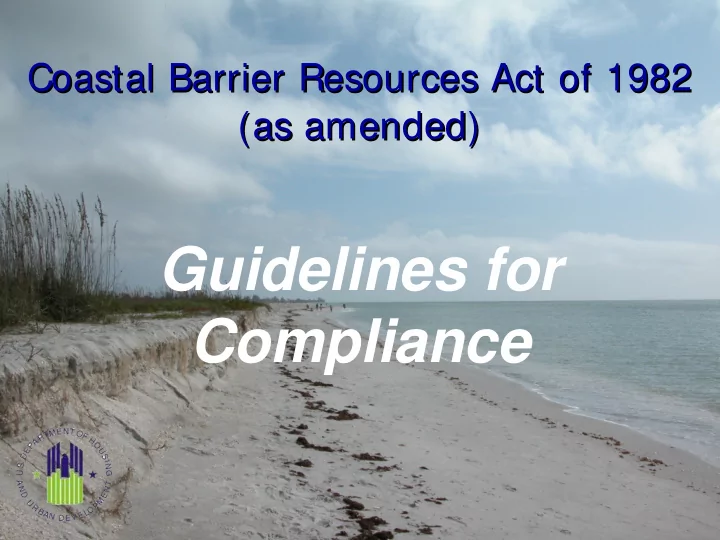
Guidelines for Compliance Guidance Purpose Guidance Purpose To I - - PowerPoint PPT Presentation

guidelines for compliance guidance purpose guidance
SMART_READER_LITE
LIVE PREVIEW

Guidelines for Compliance Guidance Purpose Guidance Purpose To I - - PowerPoint PPT Presentation

Coastal Barrier Resources Act of 1982 Coastal Barrier Resources Act of 1982 (as amended) (as amended) Guidelines for Compliance Guidance Purpose Guidance Purpose To I nstruct Environmental Professionals, Appraisers, Mortgage I nsurance


slide-1
SLIDE 1

Coastal Barrier Resources Act of 1982 Coastal Barrier Resources Act of 1982 (as amended) (as amended)

Guidelines for Compliance

slide-2
SLIDE 2

Guidance Purpose Guidance Purpose

To I nstruct Environmental Professionals, Appraisers, Mortgage I nsurance Professionals, and Responsible Entities

  • n the Restrictions, Prohibitions, and

I mportance of Compliance with the Coastal Barrier Resources Act

(Public Law 97-348 (96 Stat. 1653; 16 U.S.C. 3501 et seq.))

slide-3
SLIDE 3

Training Objectives Training Objectives

At the conclusion of this training, you will:

  • Understand the goal of the Coastal Barrier

Resources Act;

  • Know which states have units within the

Coastal Barrier Resources System (CBRS);

  • Know the restrictions to federal

assistance in the CBRS;

  • Know where to go for additional

information; and

  • Know how to apply the Act.
slide-4
SLIDE 4

What are Coastal Barriers? What are Coastal Barriers?

  • A succession of long, narrow islands,

spits, and bay barriers generally located parallel to the mainland coast.

  • Areas within the Coastal Barrier

Resources System are mapped and described as CBRS ‘Units’

slide-5
SLIDE 5

Why is Development on Coastal Why is Development on Coastal Barriers a Problem? Barriers a Problem?

  • Shifting Land Forms
  • Public Safety and Ecological Determinants

including:

– Flood Hazards, – Hurricane Winds, – Land Degradation and Erosion, – Property Damage, – Loss of Environmentally Sensitive Ecosystems, – I nterference with Natural Processes, and – I ncreases in Storm Damage to Coastal Areas

slide-6
SLIDE 6

CBRS Units CBRS Units

Puerto Rico and Virgin Islands The CBRS currently includes 585 system units.

slide-7
SLIDE 7

CBRA Restrictions CBRA Restrictions

  • The Act restricts federal financial assistance

within the John H. Chafee Coastal Barrier Resources System (CBRS).

  • Financial assistance is defined as:

– Loans, – Grants, – Guaranties, – I nsurance (I ncluding Flood and Mortgage), – Payments, – Rebates, – Subsidies, – or Any Other Form of Direct or I ndirect

Assistance.

slide-8
SLIDE 8

CBRA Prohibitions CBRA Prohibitions

  • All federal agencies must abide by the Act’s

prohibitions against providing federal financial assistance.

  • The Act does not prohibit development in CBRS

units by owners willing to develop their properties WI THOUT the benefit of federal financial assistance.

  • Local and State Strictures will often apply

regardless of whether the CBRA does.

slide-9
SLIDE 9

Specifically Prohibited Specifically Prohibited Federal Assistance Federal Assistance

Some Examples of Federally-aided Activities Prohibited by the Statute include: Construction or Purchase of

  • Any project to prevent erosion or
  • therwise stabilize any inlet, shoreline,
  • r inshore area (with certain

exceptions).

– Structures – Appurtenances – Facilities – Related

I nfrastructure

–Airports –Boat Landing Facilities –Bridges or causeways

slide-10
SLIDE 10

Coastal Barrier Resources System Coastal Barrier Resources System and National Flood Insurance and National Flood Insurance

An overwhelming number of properties in CBRS units are in floodplains.

  • Under the Act, prohibitions against

providing federal flood insurance coverage for new properties within the CBRS became effective October 1,1983.

  • I f an existing insured structure is

substantially improved or damaged, the federal flood insurance policy will not be renewed.

slide-11
SLIDE 11

Does the Coastal Barrier Does the Coastal Barrier Resources Act Affect You? Resources Act Affect You?

I f your project is in the Coastal Barrier Resources System and:

  • I ncludes Subsidies for road construction or other

coastal engineering projects or,

  • I s a previously grandfathered, existing insured

structure substantially improved or damaged, (the federal flood insurance policy will not be renewed)

  • r,
  • I s pursuing loan guarantees or mortgage insurance
  • r,
  • I s an eligible activity under the Community

Development Block Grant program such as housing construction, economic development, rental assistance or subsidies, etc. Then YES!

slide-12
SLIDE 12

How Can You Find Out if Your How Can You Find Out if Your Proposed Action is Located in a Proposed Action is Located in a Coastal Barrier Unit? Coastal Barrier Unit?

Check Coastal Barrier Resources System Maps Available Online at:

http:/ / www.fws.gov/ habitatconservation/ coastal_barrier.htm OR Contact U.S. Fish and Wildlife Service Ecological Services Field Offices

slide-13
SLIDE 13

Where are CBRS Units Located? Where are CBRS Units Located?

I f your project is in one of the following states

  • r territories,

consult the CBRS Unit Maps to see if your site is within the boundary of a CBRS Unit.

ALABAMA NEW JERSEY CONNECTICUT NEW YORK DELAWARE NORTH CAROLINA FLORIDA OHIO GEORGIA PUERTO RICO LOUISIANA RHODE ISLAND MAINE SOUTH CAROLINA MARYLAND TEXAS MASSACHUSETTS U.S. VIRGIN ISLANDS MICHIGAN VIRGINIA MISSISSIPPI WISCONSIN MINNESOTA

slide-14
SLIDE 14

What do What do the Maps the Maps Look Like? Look Like?

slide-15
SLIDE 15

What do the Units Look Like? What do the Units Look Like?

CBRS Units are Labeled and Bordered by a Heavy Line

slide-16
SLIDE 16

Where Can You Get More Where Can You Get More Information? Information?

Check the Coastal Barrier Resources Act Website at:

http:/ / www.fws.gov/ habitatconservation/ coastal_barrier.htm

slide-17
SLIDE 17

Other Contacts? Other Contacts?

HUD Environmental Staff: http:/ / www.hud.gov/ offices/ cpd/ environment/ contact/ local contacts/ Eric Axelrod, Senior Environmental Officer, Office of Housing

Phone: 202.402.2275 Email: eric.axelrod@hud.gov

James Potter, Community Planner, Environmental Planning Division

Phone: 202.402.4610 Email: james.m.potter@hud.gov

U.S. Fish and Wildlife Service: Katie Niemi Coastal Barriers Coordinator

Phone: 703.358.2161 Email: Katie_Niemi@fws.gov

Environmental Planning Division, Office of Environment and Energy US Department of Housing and Urban Development—February 2008