GSAS-II: WHAT DOES IT DO? WHAT IS NEW? WHAT IS COMING AND WHAT IS - - PDF document

gsas ii what does it do what is new what is coming and
SMART_READER_LITE
LIVE PREVIEW

GSAS-II: WHAT DOES IT DO? WHAT IS NEW? WHAT IS COMING AND WHAT IS - - PDF document

5/17/17 GSAS-II: WHAT DOES IT DO? WHAT IS NEW? WHAT IS COMING AND WHAT IS NOT. drhgfdjhngngfmhgmghmghjmghfmf ROBERT B. VON DREELE BRIAN H. TOBY FOR DIFFRACTION ANALYSIS, GSAS & EXPGUI Wide Range of Fields Web of Science Category %


slide-1
SLIDE 1

5/17/17 1

GSAS-II: WHAT DOES IT DO? WHAT IS NEW? WHAT IS COMING AND WHAT IS NOT.

drhgfdjhngngfmhgmghmghjmghfmf

ROBERT B. VON DREELE BRIAN H. TOBY

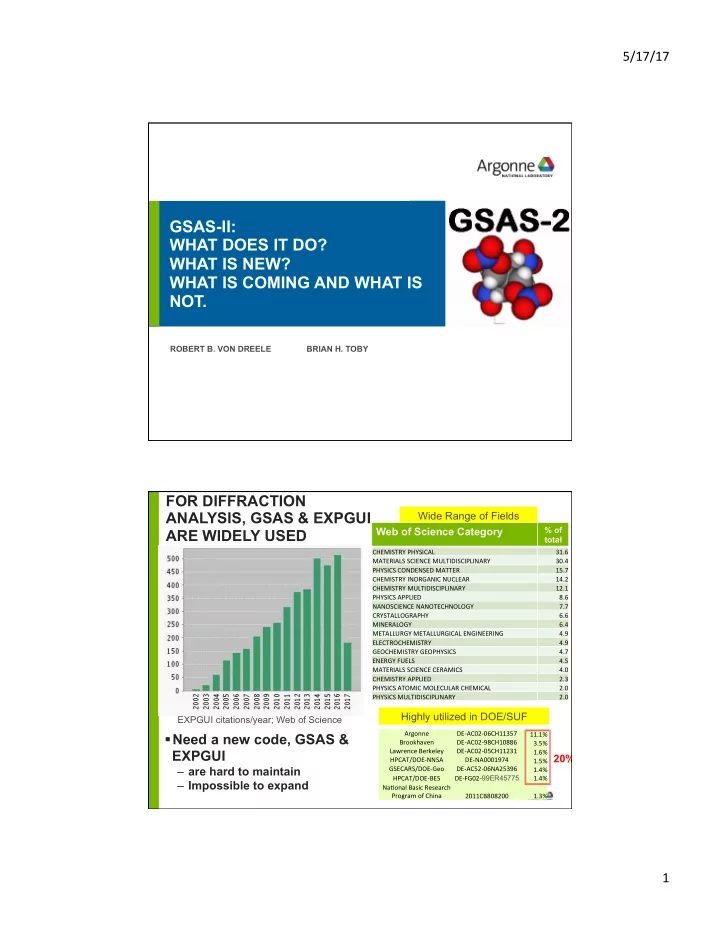
FOR DIFFRACTION ANALYSIS, GSAS & EXPGUI ARE WIDELY USED

Need a new code, GSAS & EXPGUI

– are hard to maintain – Impossible to expand

Highly utilized in DOE/SUF Wide Range of Fields 20% Web of Science Category

% of total

CHEMISTRY PHYSICAL 31.6 MATERIALS SCIENCE MULTIDISCIPLINARY 30.4 PHYSICS CONDENSED MATTER 15.7 CHEMISTRY INORGANIC NUCLEAR 14.2 CHEMISTRY MULTIDISCIPLINARY 12.1 PHYSICS APPLIED 8.6 NANOSCIENCE NANOTECHNOLOGY 7.7 CRYSTALLOGRAPHY 6.6 MINERALOGY 6.4 METALLURGY METALLURGICAL ENGINEERING 4.9 ELECTROCHEMISTRY 4.9 GEOCHEMISTRY GEOPHYSICS 4.7 ENERGY FUELS 4.5 MATERIALS SCIENCE CERAMICS 4.0 CHEMISTRY APPLIED 2.3 PHYSICS ATOMIC MOLECULAR CHEMICAL 2.0 PHYSICS MULTIDISCIPLINARY 2.0 Argonne DE-AC02-06CH11357 11.1% Brookhaven DE-AC02-98CH10886 3.5% Lawrence Berkeley DE-AC02-05CH11231 1.6% HPCAT/DOE-NNSA DE-NA0001974 1.5% GSECARS/DOE-Geo DE-AC52-06NA25396 1.4% HPCAT/DOE-BES DE-FG02-99ER45775 1.4% NaPonal Basic Research Program of China 2011CB808200 1.3%

EXPGUI citations/year; Web of Science

slide-2
SLIDE 2

5/17/17 2

GSAS-II: A MODERN ANALYSIS PACKAGE FOR ALL ASPECTS OF CRYSTALLOGRAPHY

GSAS-II is intended to replace GSAS & EXPGUI with a new, modern, extensible, and open-source crystallographic analysis Support all aspects of diffraction data analysis (from raw data to publication), including capabilities not in GSAS/EXPGUI Facile processing of large numbers of similar datasets Written with modern code (Python) Incorporates extensive visualization Use parameters that “make sense” Designed around GUI Design goal: Novice friendly, but expert efficient

B.H. Toby and R.B. Von Dreele, "GSAS-II: The Genesis of a Modern Open-Source All-Purpose Crystallography Software Package". Journal of Applied Crystallography. 46: p. 544-9 (2013).

GSAS-II reads powder diffraction images from all appropriate APS beamlines, as well as the Curiosity Rover on Mars!

FOR MORE INFO

See GSAS-II “home page” https://subversion.xray.aps.anl.gov/trac/pyGSAS. Includes Installation instructions Tutorials Developer notes (~200 pages) Mailing list Project tracking info (N.B. not all tools are in use)

4

slide-3
SLIDE 3

5/17/17 3

WHAT DOES GSAS-II DO?

Calibrate and integrate area detector data Crystallographic fitting of single crystal and powder data (lab, synchrotron, TOF and CW neutron) – Allows any number of data sets and phases Powder data: – Fit arbitrary peaks – Autoindexing – Structure solution (charge flipping & Monte Carlo) – Stacking fault simulations – Size/µStrain fitting (optionally anisotropic w/visualization) Sequential fitting (fit a single model to 10n data sets) – Parametric fitting Applied stress fitting (from raw images)

5

WHATS NEW?

Stacking fault simulations Single crystal twinning 3+1 supersymmetry: fits for incommensurate modulated structures PDF determination from powder data Streamed automated integration and PDF computation Commensurate neutron magnetic scattering (color space groups) Heterogeneous sequential fits Simplified installation process Absolute detector calibration from series of images with known relative placement Small angle scattering (x-rays, CW?)

6

slide-4
SLIDE 4

5/17/17 4

WHAT IS BEING WORKED ON

Bug fixes (always!) Scripting capability (API) for GSAS-II; implemented on as as-needed basis (starting with 11-BM calibration) Reflectometry fitting Generation of CW instrumental parameters from fundamental parameters Refinement of stacking fault parameters

7

THINGS WE PLAN TO WORK ON

Technical manual (Book: the math behind GSAS-II) Sequential fits with groups of histograms/refinement Sequential fit restraints Testing (& fixes) for wxPython 4.0 and Python 3.x More tutorials Override size/placement of windows via config. options Maybe: Multiple core implementation Combined PDF/Rietveld fitting Maximum Entropy Fourier maps

8

slide-5
SLIDE 5

5/17/17 5

DESIRED, BUT NOT WITHIN (NON-) FUNDING SCOPE

Incommensurate magnetic scattering Generation of special site constraints for supersymmetry groups Fundamental parameters-generated peak profiles Full API implementation

Need a long-range plan that brings new “talent” into computational crystallography

9

TOPICS FOR FUTURE MEETINGS

June 12: Reflectometry fitting in GSAS-II July 10: Sequential/Parametric fitting August 14: Metadata handling (image import) – is day before DOE review a problem? September 11:

(updated with meeting comments)

10

slide-6
SLIDE 6

5/17/17 6

USER FEEDBACK

Other development topics: GISAXS modeling? Start with side discussion with Joe Strzalka Expand multi-image secondary fit for more versatile fitting: side discussion with Steven Weigand How to handle spatial aberrations in area detectors? (Sector 1 need) Other discussion topics How to encourage code sharing (importers, etc.) Search-Match inside GSAS-II?

(from comments at meeting)

11