
SLIDE 1
Budget Debate Presentation 2013
- Hon. Phillip Paulwell, MP
Minister of Science, Technology, Energy and Mining April 24, 2013
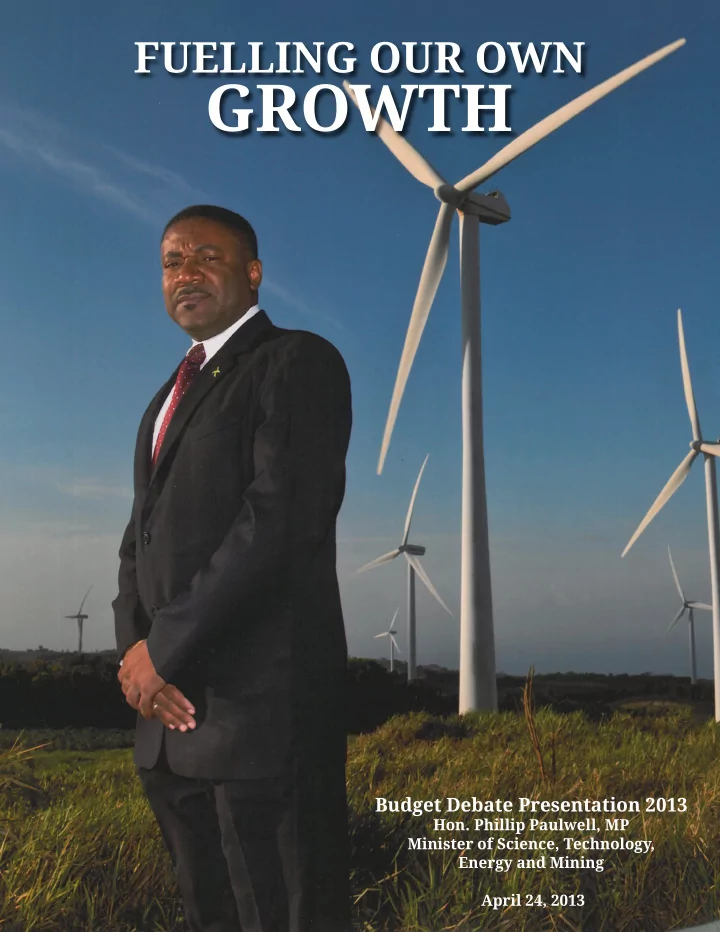
GROWTH Budget Debate Presentation 2013 Hon. Phillip Paulwell, MP - - PDF document
FUELLING OUR OWN GROWTH Budget Debate Presentation 2013 Hon. Phillip Paulwell, MP Minister of Science, Technology, Energy and Mining April 24, 2013 Ministry of Science, Technology, Energy and Mining Budget Presentation 2013-2014 Fuelling
Budget Debate Presentation 2013
Minister of Science, Technology, Energy and Mining April 24, 2013
Ministry of Science, Technology, Energy and Mining Budget Presentation 2013-2014
Presented by
Minister
Wednesday, April 24, 2013
Fuelling Our Own Growth
Table of Contents
INTRODUCTION..............................................................................................1 ENERGY...............................................................................................................2
State of Energy in Jamaica..................................................................................................3 Energy Effjciency and Conservation.................................................................................3 Renewable Energy................................................................................................................5 Incentives, Policy and Regulatory Framework...............................................................7 Wheeling.................................................................................................................................8 The Rural Electrifjcation Programme...............................................................................8 Jamaica’s Energy Infrastructure.........................................................................................9 360 MW Bid.........................................................................................................................10 Petcom, Fuel, Petrojam Ethanol.......................................................................................11 Chavez, PetroCaribe and Venezuela..............................................................................13
MINING.............................................................................................................14
UC Rusal Update.................................................................................................................15 CAP Update..........................................................................................................................17 Noranda.................................................................................................................................18 REE, Limestone and other Minerals...............................................................................18
SCIENCE, TECHNOLOGY AND INNOVATION...................................20
Minister’s Innovation Awards ........................................................................................20 Government Laboratories and the Scientifjc Research Council...............................22
INFORMATION & COMMUNICATION TECHNOLOGIES..............23
E-Government and GovNet..............................................................................................23 The Universal Service Fund............................................................................................25 E-Learning and the Schools’ Tablet Computer Programme......................................26 700 MHz Auction and MTR Reduction..........................................................................28
CONCLUSION.................................................................................................30
Appendix 1: Accomplishments.....................................................................................................I Appendix 2: MSTEM Agencies..................................................................................................XI
Fuelling Our Own Growth INTRODUCTION
INTRODUCTION
2013/2014 Budget Debate, truly a critical point for
people. Over the past 15 months, as we negotiated this new crucial IMF Extended Fund Agreement from the ru- ins of the failed Stand-by Agreement, we have had to face many harsh realities, but none so clear as the fact that without economic growth and development, we face the real possibility of being back at square one. All Jamaicans must be determined that this should not happen. But, Mr. Speaker, while we recognize the importance of an IMF agreement, this Administration is under no illusion that IMF agreements alone are the solution to our problems – they only give us a breathing space for us to get our act together. We know that it is only the hard work and dedication of the Jamaican people to achieve the development of our country that will result in lasting change. When my Prime Minister, the Most Honourable Portia Simpson Miller gave me the respon- sibility to lead the Ministry of Science, Technology, Energy and Mining, I decided that for my Ministry to be most effective, my primary goal as the Minister would be to help find avenues to fuel growth in our economy. Let us be very clear, growth is only sustainable when it brings tangible and long-term benefits to a broad spectrum of the Jamaican society. To do less than that is to fail those in the middle and working classes who look for leadership that will give them more than a push start. And so this afternoon Mr. Speaker, I will focus on those areas of the Ministry of Science, Tech- nology, Energy and Mining (MSTEM) which fuel and support growth and development, which will form the main pillars for the modernization of the Jamaican economy and which together represent vast opportunities for all Jamaicans.
Fuelling Our Own Growth ENERGY
ENERGY
Energy is a small word that has many different meanings to different people. To the business community, energy is the engine that makes the wheels turn efficiently. To the consumer ener- gy means the dreaded light bill. Due to the high cost of energy in Jamaica, the little man and woman have been feeling the pinch to the point where for some householders, the monthly light bill is more than the rent, for some it is more than the mortgage and in some cases – it is more than the grocery bill. The small business owner has to choose between laying off staff or paying for electricity. As Minister, it is my objective to find a way to bring long-term relief to the business community, and just as importantly – for the young couple who live in Portmore, the family in Discovery Bay, the returning resident in Mandeville, or the old lady who lives in one room in the heart of Jones Town. For too long, our people have had to sacrifice their electricity service so that they can send their children to school or buy their medical supplies. The high cost of energy is Jamaica’s chief impediment to growth and job creation, and until and unless we find ways to reduce our energy costs and our dependence on imported oil, there will be little prospect of economic growth for our nation. In our search for solutions to this energy problem, the National Energy Policy (NEP) has guid- ed the work being done by MSTEM. The policy, Jamaica’s first long-term energy plan, was ap- proved by this Parliament in November 2010 with bi-partisan support. In the policy, Jamaica’s vision for energy is outlined as: “a modern, efficient, diversified and environmentally sustainable energy sector”. The policy has seven ultimate outcomes which include: the provision of more affordable ener- gy supplies to Jamaican consumers, an improved competitive base for the country, as well as sustainable growth and development of the nation. The policy supports Vision 2030, Jamaica’s National Development Plan which has the broad
Last year Jamaica spent
million
GDP
Fuelling Our Own Growth ENERGY
national strategic objective to “provide a secure and sustainable energy supply for our country,” including diversifying the energy supply and promoting energy efficiency and conservation. Since assuming office over a year ago, energy has been my main focus, and particularly, how to get the cost of electricity down from approximately $0.42 US per KWh – one of the highest rates in the world – to a rate that allows our businesses to compete internationally, and our citizens a more affordable energy bill. Indeed Mr. Speaker, the issue of energy affordability was a key part of the mandate secured by this Administration in the 2011 General Election, and so it is an imperative to deal with all the related issues to enhance the possibility of sustainable economic development. State of Energy in Jamaica Energy consumption in Jamaica is inefficient, expensive and so un- sustainable, it has been at the centre of Jamaica’s economic blight.
rather is the case in all areas of our energy consumption. In 2012, Jamaica spent $222 billion on the importation of crude and refined petroleum products. That is some 15.5 per cent of GDP which compares to an international standard of between two and nine per cent for nations larger and smaller than us.
We not only realize this in the Ministry, but we have been doing something about it. Our approach has been to tackle this through focusing on conservation and renewables, the legislative and regulatory framework, and in- vestment in our energy infrastructure. Energy Effjciency and Conservation
fuel, indeed a strategic national resource. Energy efficiency and conservation is a national resource because it has the potential to achieve
Fuelling Our Own Growth ENERGY
real and sizeable savings, with the amount of savings deter- mined completely by our own
consider energy efficiency and conservation as an economic growth sector, with ever-ex- panding opportunities for new investment and for new busi- nesses.
tion understands the opportu- nities presented by pursuing energy efficiency and conservation strategies and practices, and we have made it a priority to lead the country in principle as well as in practice. Last year, the Government in partnership with the Inter-American Development Bank (IDB) be- gan a $2 billion programme to transform the efficiency of public sector buildings. I am pleased to report today that the preliminary results of this programme prove that energy efficiency and conservation makes sense. The programme seeks to replace aged and inefficient equipment; to retrofit infrastructural de- ficiencies and to instigate behavioural change that promotes efficiency and conservation. It is a travesty that in a country with an economic situation as challenging as ours, the Government spends some $14 billion annually on electricity. We selected the Office of the Prime Minister as the flagship location, to demonstrate to every single Jamaican, the public sector, the private sector and the public at large, that the leadership
We began with basic retrofits: the application of window film to reduce the amount of light and heat from the sun, and the application of cool roof technology, again to reduce heat. Those activities have had a direct impact on the demand for air conditioning, and already we have begun to realise savings. The analysis of the JPS bills from Jamaica House has shown a 10 per cent reduction in consumption, and that is just with the minor work completed.
Applying cool roof to the Office of the Prime Minister
Fuelling Our Own Growth ENERGY
This reduced consumption sets the stage for the next phase of the programme, which is the upgrading and retrofitting of the lighting and air conditioning. The programme, even in its preliminary phases, proves the potential of energy efficiency and conservation as a growth sector for the economy. As this programme progresses, it presents
ness, including the installation of cool roofs and window film, the retrofitting of inefficient air conditioning systems, lighting and so on. The Government has structured the programme to encourage participation by local MSMEs. We have taken a policy decision that the contracts will be within reach of small contractors, and there is a 10 per cent advantage for Jamaican-owned companies. We expect and encourage Jamaican companies to bid on projects.
means of kick starting the growth process in an emerging industry. We want Jamaican compa- nies bidding for and winning the contracts, not just so that we can get our people to work, but also so that we can build lasting human resource capacity. Generally, Mr. Speaker, there is a lucrative business opportunity in providing services to lower the high cost of energy, particularly electricity. There are opportunities for banks and other financial institutions to provide financing, for engineers, for traders and equipment suppliers. Already, this GOJ/IDB project has provided employment and skills training for labourers in this emerging industry and we project that as the programme expands, these numbers will continue to rise. Much of the gains we need to make from energy efficiency depend on us changing long held bad habits, so Cabinet has approved a Behaviour Change and Operational Code of Conduct for public sector officials and facilities. Specifically, we have adopted the International Standard of 25 degrees Celsius (78 degrees F) for all Government buildings. Renewable Energy
the “fuel of the future”. As we chart our own path to growth we must begin right now, where we are, with what we
Fuelling Our Own Growth ENERGY
have, and we have available to us sun, wind, water and waste.
sources into our fuel mix. Our goal, as I have consistently stated is to have by 2030, 20 per cent
Last year, the Government began a targeted series of policy shifts to enable and encourage in- vestment in renewable energy projects. First, we removed a proviso that gave the Petroleum Corporation of Jamaica (PCJ) the exclusive right to develop all renewable energy projects in
115 MW of energy generated from renewable sources. Those bids will be opened in June. Again, this is an opportunity for local investors to get in- volved, and provide some or all of that generating capacity. When that 115MW is installed, Jamai- ca will have some 12.5 per cent of our electricity capacity generated from re- newables – bringing us to almost 50 per cent of our goal of 30 per cent by 2030. That 115 MW of renewable energy will also provide some 400,000 mega watt hours (MWh) of electricity per year, and will save Jamaica the equivalent of
per year amounting to $55 million USD annually. An important policy step as a com- panion to our quest for renewables was the introduction, last year, of Net Billing, which allows self-generators
to sell their excess capacity to JPS. To date, I have granted over 50 net billing licenses.
Fuelling Our Own Growth ENERGY
As with any new policy, there were teething pains. For example, we found that many photo voltaic (PV) system designs submitted with applications for net billing licenses were not up to the standard required by the Electric Lighting Act. We have since mandated the Government Electrical Inspectorate (GEI) to work with applicants in bringing their installations up to par. Within the last twelve months a total of 15 PV systems and one wind system have been certi- fied by the GEI, while another 14 will be inspected this week. The increase in residential solar installations has also created an urgent demand for trained electrical inspectors. To alleviate this shortage, Mr. Speaker, I will be meeting with the HEART Trust/NTA to discuss a training programme for inspectors so that we can effectively handle the number of applications for renewable energy systems. Jamaicans have been very enthusiastic about self-generation and about changing their rela- tionship with JPS. There has been tremendous excitement and appetite for net billing from private citizens and companies, small and large. As I speak, one major agricultural company – Jamaica Broilers – is working to deploy solar energy among its contract farmers: this is re- newable energy in action, increasing our productivity, creating jobs and cutting costs. Incentives, Policy and Regulatory framework
energy markets in Jamaica is signalled by continuing policy and legislative review. But we cannot escape the reality that in the meanwhile, the cost of renewable energy remains high, particularly for small businesses and households. One measure we implemented required Jamaica to petition the Council for Trade and Econom- ic Development (COTED) for the suspension of the Common External Tariff (CET) on a number
those exemptions were originally granted after hard negotiations, when I previously served as energy Minister. Unfortunately, they were allowed to expire under the JLP administration. That exemption has now been granted, and today 14 additional energy efficiency and renewable energy items can be imported into Jamaica duty free.
hensive list of items, including wind turbines, solar cells, panels and tubes, solar water pump- ing systems, occupancy sensors, PV batteries, LEDs, inverters and many more.
Fuelling Our Own Growth ENERGY
Wheeling
robust and realize efficiencies, is Electric Power Wheeling. “Wheeling” is the use of the JPS grid to transmit power from a self-generating entity in one location to itself in another for a fee. This is a benefit to those businesses who generate their own electricity, because it means that if that company has excess generating capacity in one location, wheeling allows it to use that excess in another of its locations. The OUR has indicated that the rate will vary between $50 US to $175 US per MW-km per month, and that the final rate will be determined after public consultation. I disagree with the OUR’s methodology of charging a rate for the capacity and for including dis- tance as a factor in the formula. I also disagree with the rate being denominated in US dollars, which is a disincentive for local industry. I will be writing to the OUR to formalise my position. I intend to start granting licenses for wheeling in July 2013. The Rural Electrifjcation Programme There is a saying that if it ain’t broke, don’t fix it. How about if we try to make it better? I would like to make mention of a tremendously successful Government entity, the Rural Electrification Programme (REP). The REP was founded in 1975, with a mandate to extend the national electricity grid into re- mote areas of the island. Since its inception, the REP has wired the homes of some 80,000 cus- tomers of the JPS, bringing Jamaica’s electrification rate to 98 per cent. Of the two per cent of the island that remains outside of the national grid, many are in remote areas more than three kilometres from the grid, and extending the grid to them would be economically unfeasible.
those still without electricity, but with the advances in renewable energy technologies, and the parallel reduction in the cost of these solutions, 100 per cent electrification is achievable. As we draw closer to the milestone, this Administration has decided to rebrand the REP, and to give it a new mission. The REP will be transformed into an agency to be named “Jamaica Ener- gy Solutions Ltd.”. JESL will be responsible for three main activities:
Fuelling Our Own Growth ENERGY
metres from the grid;
necessary because as we know, electricity theft cannot be solved merely with tough policing;
a continuation of work began by PCJ and will ensure that Jamaica maintains the gains achieved under the GOJ/IDB Public Sector Energy Efficiency and Conservation Pro- gramme. JESL will also provide project management services for the design and implementation of energy solutions for major housing initiatives by agencies of the state, espe- cially where low-income earners are the targeted popula- tion for those housing solutions. Briefly on the new agency’s role in reducing electricity theft: this is a problem that affects both JPS and the Government, as shareholders in JPS. In fact, all Jamaicans should care about this issue, since theft represents most of the 17 ½ per cent we as consumers eventually pay for losses. The agency, in partnership with the Social Development Commission (SDC), the Planning In- stitute of Jamaica (PIOJ) will work with JPS at a multi-faceted set of interventions aimed at combating theft. Jamaica’s Energy Infrastructure
capacity of JPS, the type of fuel used in most of the plants as well as the cost of breakdowns. The 22 plants owned by the company have an average age of over 32 years, with well over half being higher than the average age. We know them all Mr. Speaker: the Hunt’s Bay B6, Old Harbour #1, #2, #3 and #4 are all in that category. Those plants contribute 292 MW of the 883 MW of installed capacity in Jamaica. These plants are all older than the average age of the system, and need to be retired. Mr. Speak- er, it is time for a major injection of new capacity that will reduce the current cost of electricity from $0.42 US per KWh.
Fuelling Our Own Growth ENERGY
360 MW Bid After several stops and starts, today I can speak with certainty that a positive change is about to come to the supply of electricity in Jamaica.
There have been too many delays, and we can no longer live with these high electricity prices. You will recall that in 2010, the OUR went to tender for 480 MW of generating capacity. The JPS was the sole bidder, and was awarded the right to construct a 360 MW Combined Cycle plant. This award contemplated that the Government would be responsible for securing the supply
Last October, this Government, having completed the bidding rounds for infrastructure and the supply of gas, ended its role in the LNG Project and turned the responsibility for the supply
for the plant. JPS was given a January 30, 2013 deadline to provide the OUR with project information such as the details of their gas supplier, and a renewed bid security. On February 1, 2013, the OUR informed the JPS and its shareholders that the RFP process in relation to the 360 MW project was at an end. Thereafter, the OUR agreed to accept unsolicited proposals from JPS and other companies.
turnaround from 2010, when there was a sole bidder, signifying confidence in this Administra- tion, its policies and regulatory framework. The OUR has engaged the services of international consultants Mott McDonald in evaluating the proposals, and considered a number of factors including:
According to the evaluation report, of the 14 projects submitted, four were rejected because the information was incomplete. Ten were screened for detailed technical and comparative economic analysis. Of those ten, the OUR determined that the following entities, in this order,
Fuelling Our Own Growth MINING
had proposals worth pursuing by negotiations:
bour and a 122.4 MW project proposed for Caymanas
both proposed for Old Harbour
barge All three propose the use of natural gas. Subsequent to the OUR receiving and assessing those proposals, the Government has since received another unsolicited proposal from a Hong Kong company, proposing to build a LNG receiving terminal, power plant and to supply LNG from its own gas fields. The company has proposed a combined cycle gas-fired 360 MW power plant adjacent to the LNG hub terminal. Based on the fact that this company owns its LNG and the attractive price quoted, Cabinet has taken a decision that this proposal should also be considered along with the three, and it will be referred to the OUR for assessment. In relation to the proposals, the OUR will now seek the support of the National Contracts Com- mission (NCC) to pursue active negotiations with all four, and present a recommendation to the Government in 30 days.
monitoring, evaluation and enforcement, similar to those it has over the telecommunications
Petcom, Fuel, Petrojam Ethanol
sector, and one of the major decisions of Cabinet is for the divestment of the Petroleum Com- pany of Jamaica (Petcom). We are currently having a valuation of the company’s assets done and we will announce more as information becomes available. Cabinet has established an enterprise team for the privati- sation.
Fuelling Our Own Growth MINING
Petcom has been a strategic asset in the petroleum marketing sector in Jamaica, and we hope that it will remain a strong player in the mar-
tors to participate in the ownership
we have heard the appeals of mo- torists and fuel retailers for the in- troduction of low-sulphur diesel. Petrojam has now completed the appropriate infrastructure work to accommodate this fuel, and since last month has been conducting consultations with industry
phur diesel will be available at Jamaican retail stations. Two Petcom stations, Petcom Dunrobin in St. Andrew and Portmore Parkway Petcom in St. Catherine have been prepared for the arrival of this fuel and will immediately begin selling it to the motoring public when it becomes available. We expect other marketing companies to be ready shortly. Mr. Speaker, not only will offering this cleaner option to the diesel we use now be better for the vehicles that run on it, it will also be better for the environment. We are again leading the Caribbean as we did with the phasing out of leaded fuel and the re- placement of MTBE as an additive with ethanol. Regarding ethanol production, I am pleased to announce that after an extended shutdown of three years between November 2009 and December 2012, operation of the dehydration plant at Petrojam Ethanol (PEL) has been restarted. Last December, PEL entered a toll processing agreement with Lansing Ethanol Services, under which ethanol processed at the PEL dehy- dration plant serves to supply the local market for gasoline blending, in addition to supplying volumes for export to the USA and other countries. It is expected that the profits for this year will amount to $109 million.
Fuelling Our Own Growth MINING
Chavez, PetroCaribe and Venezuela My final point on energy relates to Venezuela and the PetroCaribe Agreement. As we know, President Hugo Chavez passed away earlier this year, and we continue to mourn his death in solidarity with the people of Venezuela. We are, however, confident that the legacy of this great leader, who had a vision of unity and cooperation for peoples of the South will be continued by his successor, President Nicolas Maduro, whom we wish well.
Fuelling Our Own Growth MINING
MINING
Our soil is a rich basin of minerals that when
mined, can create several linkages to create wealth and hundreds of new jobs. No longer can we be casual in searching for new miner- als that lie below the earth’s surface. The bauxite/alumina sector is very important to us as a nation, not only for the revenue that it can bring, but also in light of the fact that so many Jamaican communities and workers depend on the industry for their survival.
world consumption was 47.3 million tonnes or some 460 thousand tonnes less. This continues to increase the enormous overhang in stockpiles, which stood at 12.2 million tonnes at year-
Nevertheless, Mr. Speaker, the long-term outlook for aluminium remains good. Alcoa, for ex- ample, expects to more than triple its sales of aluminium sheet to automakers by 2015 as they reduce car weight by substituting it for steel in car bodies. The outcome, in respect of the fiscal year just completed Mr. Speaker, is that total bauxite ex- ported – that is, crude bauxite exported and the bauxite equivalent of Alumina exported – was 9.4 million tonnes; down 7.4 per cent from the previous fiscal period. Alumina exports were 1.8 million tonnes, representing a 6.5 per cent decline while exported bauxite of 4.7 million tonnes was 4.8 per cent less than the preceding fiscal period. On the revenue side, Mr. Speaker, the total value of the bauxite and alumina exported was $672 million US, which was down by 6.8 per cent. Approximately $245 million US was retained in the country, down 21 per cent. As a consequence of the relatively poor overall performance,
from the bauxite levy falling by 22 per cent to below US$13.1 million although royalties saw an increase to US$5.3 million. Despite the harsh climate for the industry, this Administration does not believe the local baux-
Fuelling Our Own Growth MINING
ite/alumina industry’s best days are behind us. Over the past year, we have spared no effort in resuscitating the sector, because we have seen first hand the prosperity our communities enjoy when the industry is thriving, and the struggles they go through when the industry declines. UC Rusal Update With respect to UC Rusal, majority owners in the WINDALCO Joint Venture and the 100 per cent owner of the Alpart Refinery at Nain, agreement has been reached on a number of mat- ters. Parliament will recall that alumina refining at the WINDALCO plant at Kirkvine, Manchester and at Alpart ceased in 2009. Both operations have remained closed since. The Ewarton re- finery was briefly closed in 2009, and re-opened in July 2010. Last July, when news of the impending closing of Ewarton reached the Government, we had to act swiftly and decisively. A Ewarton closure would mean that three of Jamaica’s four refineries would be mothballed, put- ting over 600 people out of work, destroying the economy of the area as well as the livelihoods
In October, the Government and UC Rusal came to agreement, not just to keep the Ewarton re- finery operational, but also on matters affecting the long-term viability of our bauxite/alumina
(L-R) Igor Dorofeev, Country Manager, UC Rusal, signs the Bauxite Levy Waiver Agreement with the Hon. Phillip Paulwell and Linton Walters, Chair- man of the Jamaica Bauxite Institute on October 1, 2012
Fuelling Our Own Growth MINING
that waiver set to end this September. For their part, UC Rusal committed:
cent capacity or 300,000 metric tons per annum;
Ewarton, construction of which would employ 800 persons;
return to full production; and
eries at Alpart and Kirkvine and to make all three refineries “base locations” by 2015.
Rusal is taking the necessary steps to uphold their side of the agree-
ing 50,000 metric tons of alumina per month;
employment for another 117 persons;
Ewarton, and with a local bank for financing, with those negotiations scheduled for completion in June. In terms of the re-opening Kirkvine and Alpart, the negotiations continue. In relation to Alpart, UC Rusal has presented a plan for an energy solution as well as a timeline for its re-opening. They have decided to proceed with a natural gas solution, and have entered an agreement with the PACE Group for infrastructure and with British Petroleum (BP) for the supply of the gas, which will be delivered as compressed natural gas (CNG). That refinery, Mr. Speaker, is now expected to resume production in the first quarter of 2016, following the completion of the new energy infrastructure. However, they have indicated that while they are forging ahead with the implementation of their energy solutions, if there is
Ewarton today is operating at
producing
tonnes/mth employing
workers
Fuelling Our Own Growth MINING
DALCO Joint Venture, the Government and UC Rusal have now reached agreement on the pur- chase price. Cabinet has approved the purchase price, and it is expected that the UC Rusal Board of Directors will ratify this next week. CAP Update
which is vested in Clarendon Alumina Partners (CAP), the Government has decided not to di- vest those shares at this time. On assuming office in January 2012, we found that contrary to what we were led to believe, the negotiations for the sale of CAP to Glencore was nowhere near complete. A communica- tion from Glencore to the former Government’s negotiating team just before the 2011 General Elections, indicated this position, including a number of conditions-precedent which had not been met. This Government assembled a new negotiating team to pursue and settle new arrangements. Cabinet this week received and accepted their report. We are now awaiting approval from Al- coa and Glencore, which we expect by month-end.
ate time. What I can say now is that the most difficult arrangement with Glencore, which had a fixed price component, ended in December 2012. In terms of CAP’s position in the Joint Venture, the team found that although production was still being done on behalf of both CAP and Alcoa, no meetings of the Executive Committee had taken place for nearly a year. This meant that Alcoa was left to run the plant without any over- sight or direction by this important Committee. This Administration immediately set that situation right by resuming Executive Committee meetings, and we have held them regularly since. It is expected that when the agreement is effected, CAP will continue operating, supplying Glencore at significantly increased alumina prices linked to the London Metal Exchange.
Fuelling Our Own Growth MINING
Noranda
Noranda Jamaica Limited will be increasing its investment in Jamaica. This investment in- volves the expansion of its Port Rhodes facili- ties in Discovery Bay to allow larger ships and to enable a quicker turn-around. In addition, the company will be making a sig- nificant investment in the rail infrastructure between its mines and the port. The total value of this investment is some $2 billion JM. We are currently in negotiations with Noranda for the establishment of a refinery.
agreements for the export of raw bauxite. While all existing agreements will be honoured, no new agreement will be considered unless it is accompanied by a commitment to build a refin- ery with specific timelines for implementation. While it is true that the bauxite levy has done immense good for the country, too long have we allowed the wealth of future generations to literally be exported out, while we watch others become enriched from the higher-value products made from our raw material. REE, Limestone and other Minerals
the bauxite/alumina era in Jamaica. It is more like we are about to start a new chapter. The pilot project now underway, to investigate the commercial potential of extracting rare earth elements from the “red mud” residue of bauxite production, shows that even in what we
Nippon Light Metal, and the Jamaica Bauxite Institute (JBI) is proceeding apace: equipment for the laboratory has landed in Jamaica, and the construction of the pilot project plant at the JBI in Hope Gardens is near completion. As we know, if commercialization is indeed realized, Jamaica stands to gain significant reve-
Fuelling Our Own Growth MINING
process, providing an invaluable opportunity for knowledge transfer. And in relation to other minerals, eight Special Exclusive Prospecting Licences have been granted to companies to conduct exploration for base and precious metals. These include min- erals such as gold, silver, copper, lead, and zinc. The base and precious mineral prospects are distributed across various regions of St. Catherine, Clarendon, St. Andrew and St. Thomas. Exploration activities include the analysis of rock and soil samples to confirm the presence of these minerals and also to determine the available reserves. Even though we continue to pursue all our options, we also know that Jamaica is literally sit- ting on great wealth. Much of our island is made of limestone, and there is demand for all grades of this mineral. Limestone has many applications and uses, and world prices are attrac-
approximately $10 USD per tonne, rising to highs of $300 USD per tonne for pharmaceutical grade limestone, which is used in aspirin, antacid and other pills. The Mines and Geology Division (MGD) has identified over 50 billion tonnes of high-grade limestone reserves across the island. Having conducted these evaluations, the Government is now actively seeking to attract investors to develop this commodity through secondary pro- cessing and value added industries. Again, this is an opportunity for Jamaican businesses to pursue growth opportunities.
(L-R) Hon. Phillip Paulwell, Most Hon. Portia Simpson Miller, Japanese Ambassador Yasuo Takase, JBI Executive Director, Parris Lyew Ayee and Nip- pon Light Metal Representative break ground at the site of the REE pilot plant, February 4, 2013
Fuelling Our Own Growth SCIENCE, TECHNOLOGY AND INNOVATION
SCIENCE, TECHNOLOGY AND INNOVATION
Again, Mr. Speaker, I would like to reiterate
this Administration’s commitment to the idea that if we are serious about growth, we will have to use our ingenuity to turn ideas into products and services of commercial value. Our economic growth prospects are highly de- pendent on our ability to apply science, tech- nology and innovation (STI) to the development process. The Government recognizes that innovation is taking place in all sectors of our society and its diverse economic activities, including services, energy, food and agriculture, mining, manufac- turing, pharmaceuticals and neutraceuticals, sports and music. We also recognise that to drive economic growth and wealth creation we as Government must deliberately introduce policies and programmes to nurture a culture of creativity and stimu- late innovation through the application of science and technology. Minister’s Innovation Awards
innovation and creates necessary synergies. Last year, I revived the Minister’s Innovation Awards, a national competition to identify and recognize innovative Jamaicans and help them, in a structured and focused way, to commercialise their innovations. When I first started that competition in 2005, it was scheduled to be held biennially, but has
entries, a 300 percent increase over the highest number of entries the competition had attract- ed previously. We were able to award, through our main sponsor, the Petro Caribe Development Fund, over $7 million in prizes, including a $2 million top prize, and six sectional cash prizes. Last years’
Fuelling Our Own Growth SCIENCE, TECHNOLOGY AND INNOVATION
awards also saw the introduction of the JPS Youth Innovator Award, a $1 million cash prize for the top innovator under the age of 18 years.
high-quality innovations tailored to the Jamaican experience, and the fact that entries came from Jamaicans from all walks of life. The winning entry, a novel treatment for high blood pressure and diabetes submitted by the Natural Products Institute of the UWI Mona, was created using indigenous substances, while the winning youth entry, from the Sunderland Primary School Inventors’ Club, presented an
Another interesting fact about the entries was that over half of them were ICT-related, proving again that with access to technology and the Internet, Jamaicans can be just as innovative as people anywhere in the world. This year, we have expanded the Awards to a full yearlong programme of activities that is de- signed not just to engage and inspire our innovators, but also to prepare them for the world of business. Again, I encourage local businesses to invest more in research and development (R&D) and to support local innovation. Our innovators need venture capital, they need markets for their products, and they need overall investment.
(L-R) Kelly Tomblin, CEO of JPS and Hon. Phillip Paulwell present the inaugural JPS Youth Innovator Award to students and teachers of the Sunder- land Primary School at the Minister’s Innovation Awards November 7, 2012. At far right is Innovation Committee Chairman, Prof. Errol Morrison.
Fuelling Our Own Growth SCIENCE, TECHNOLOGY AND INNOVATION
Government Laboratories and the Scientifjc Research Council
tion Roadmap to guide Jamaica’s STI development. In respect of the implementation of the STI Roadmap, this year MSTEM will embark on a programme to rationalize all Government labo- ratories in and around the Hope Gardens Complex with a view to optimizing the use of space, equipment and personnel, and minimizing other overheads. These laboratories located at the following institutions will all be assessed: Jamaica Bauxite In- stitute, Mines and Geology Division, Government Chemist, Rural Physical Planning Unit, Veter- inary Diagnostic Laboratory, Environmental Health Laboratory, Food Storage and Prevention
Council.
nating scientific research and facilitating a “bridge” between ideas, R&D and commercializa- tion of inventions, the SRC has been promoting and installing environmentally friendly and cost effective treatment systems for domestic, municipal, farm and processing wastewater. The SRC constructs and retails its patented Biodigester Septic Tank (BSTTM), primarily for the
Sludge Blanket (UASB) Reactor for agro-industrial and industrial waste. Cabinet has approved the sum of $420 million JM for the SRC to rehabilitate existing treat- ment systems at six health facilities and to implement new systems at eight facilities over an 18-month period starting in June this year. This will employ over 130 people, and at least five
Fuelling Our Own Growth INFORMATION AND COMMUNICATION TECHNOLOGIES
INFORMATION AND COMMUNICATION TECHNOLOGIES
Mr Speaker, establishing macro-economic stability, exercising fiscal disci-
pline, and ensuring market efficiencies continue to be the fundamentals of economic development, but in today’s global digital economy these mea- sures, while necessary, are no longer enough to ensure sustainable growth and advance the long-term aspirations of our citizens. Information and communication technology (ICT)-enabled innovations can and must become one of the dominant vehicles for creating wealth, particularly as we struggle increasingly with growing demands and dwin- dling resources. Notwithstanding the high levels of Foreign Direct Investment in ICT infra- structure over the past decade, Mr Speaker, and the remarkable progress we have made in establishing a telecommunications infrastructure that is superior to that of many other developing countries and, indeed, on par with some developed countries, Jamaica has struggled to create sustainable and scalable indigenous technological innovations. These innovations are necessary to gain a secure foothold in the emerging digital economy and meaningfully confront the perennial challenges we face in critical areas such as agricul- ture, healthcare and education, and the manufacturing and service enterprises, not to mention facilitating the effectiveness of the delivery of government services. In order to correct these deficiencies, we must expand the ICT sector and position it to be a core enabler of the reversal of our fortunes, a fulcrum for the transformation of the Jamaican
innovations and also endow other productive sectors with the capability to maximize their contribution to our development goals. E-Government and GovNet
ment.
Since
July 2012
are down
%
Fuelling Our Own Growth INFORMATION AND COMMUNICATION TECHNOLOGIES
Some of you are old enough to remember the manual typewriter, others will have used the Gestetner stencil machine, then came the computer – and fax and more recently the Internet. All this technological advancement has meant the use of less paper for communication and
still want to do things the old fashioned way. As technology Minister, I have a deep personal interest in moving government offices from paper to the digital age. How will we do this? Time has come for us to make a quantum leap in the use of computer technology to create a digital umbilical linkage between all government
The innovative application of technology, Mr. Speaker, will allow us to transform the way Gov- ernment organizes itself, operates, collaborates and delivers services in a way that focuses on the needs of citizens, businesses and other stakeholders. After many years of talking about E-Government, or the use of ICTs to improve the service delivery, its implementation is long
The transition to E-Government is now underway in earnest. At the end of next month we will complete the winding up the Central Information Technology Office (CITO), the agency
re-positioning of Fiscal Services Ltd., the body previously responsible for the digital revenue functions of the Government. CITO will become a policy unit within MSTEM, while Fiscal will be rebranded E-Government Jamaica Ltd., empowered to provide general ICT services to the entire public sector. There will also be a Chief Information Officer contracted to the Ministry with responsibility for providing overarching technology vision and leadership in the development and implementa- tion of GoJ’s ICT strategies and corporate programmes. Perhaps the most critical project the new entity will be charged with implementing is the cre- ation of the common Government Wide Area Network (GovNet). At the moment there are vast gaps in technology capacity throughout the Government, with some ministries, agencies and departments (MDAs) suffering from major deficiencies and others being quite the opposite. Indeed, the increasing trend of our citizens’ use of ICTs, in particular social media, in their daily lives means that we as Government are expected to keep pace with public demands. GovNet will allow the seamless transfer of information between Government MDAs and other
Fuelling Our Own Growth INFORMATION AND COMMUNICATION TECHNOLOGIES
public sector and strengthen the capacity of public institutions to deliver efficient and effective public goods and services. Over time the mechanism will provide a suite of on-line services to the public, increasing the ease of doing business with Government. The creation of E-Gov and GovNet, will Mr. Speaker, be the single most transformative policy shift for our civil service since Independence. E-Gov, will allow for instance, a farmer in St Eliz- abeth who wants to export carrots, to complete all the applications for permits and licenses
to leave his farm or his community. It will allow our police officers to target and track crime more effectively, it will allow our citizens to pay their taxes on time, and will generally allow for a more efficient interaction between Government and the people we serve. The Universal Service Fund Today I would like to advise this Honourable House that since inception the USF has collected nearly $10 billion from the Universal Service Levy. We continue to use the fund as originally devised: to bring access to all our people. The USF last year commissioned 35 Community Access Points (CAPs) into service, bringing the number to 118 CAPs operating throughout all 14 parishes. These facilities bring well-needed access to computers and broad- band Internet to communities – some poor, some urban, some rural – but all open to the general public. Across the island, the USF has partnered with community-based
and supervised the establishment
stances provisions for broadband Internet.
Kingston.
Fuelling Our Own Growth INFORMATION AND COMMUNICATION TECHNOLOGIES
As we establish CAPs, we have been keeping track of usage statistics, which will help us mea- sure definitively where we are along the road to ubiquitous, broadband Internet access for all Jamaicans, wherever in the country they may be. Significantly, the USF has not restricted itself to establishing CAPs, but has also been called upon to take on projects to upgrade existing technology and expand the accessibility of Inter- net services. The USF currently has nine such projects underway. These projects, when complete, will provide improved opportunities for higher academic stud- ies, and improve the crime fighting efficiencies and the administrative capacity of the Jamaica Constabulary Force by providing the Force with connectivity to the island-wide broadband
nectivity to the island’s main hospitals, health centres, and administrative offices, while work will begin on a project with the National Library of Jamaica to digitize and make a portion of its content web-accessible. E-Learning and the Schools’ Tablet Computer Programme This year, we completed the e-Learning High Schools Project, financed by the USF, which sought to establish computer labs and encourage e-learning in our high schools. The original project delivered to over 200 Jamaican high schools a fully outfitted computer lab with an average of 25 workstations per lab, and broadband Internet access for all. What that project clearly demonstrated is that the use of ICTs in the teaching-learning process helps school administrators to be more accurate and efficient, and gives our teachers and stu- dents through the Internet, access to an infinite repository of information. We have also come to realize, however, that while installing computer labs in high schools allowed for greater numbers of students to take up Information Technology at the CSEC level, the truth is that in a school of 1000 plus students, 25 computers allows about 30 minutes of access per student per week, not enough to have our students build the level of competence with the technology to compete internationally. Fortuitously, the cost and size of computers have been declining steadily, while their capabil- ities are increasing, making it possible to envision, design and implement e-learning projects that can truly impact the education of every single Jamaican student. With the benefit of the lessons learned in the execution of the original E-Learning Project, plus advances in technolo-
Fuelling Our Own Growth INFORMATION AND COMMUNICATION TECHNOLOGIES
gy, it is now possible for a country like Jamaica to effectively bridge the digital divide; both between all social classes in the student population and between Jamai- can students and students every- where else in the world.
academic year this September, a team comprising representatives
cation (MOE), the E-Learning Ja- maica Company and the Universal Service Fund (USF) will pilot a project that I am confident will fundamentally change the way we approach education in Jamaica. We will begin E-Learning II, with the Schools Tablet Computer Programme. Under that pro- gramme, every single student and teacher at 30 schools – five Early Childhood Institutions (“basic” schools), 10 primary schools, five junior high schools and 10 high schools – across the country will be given a tablet computer free of cost, amounting to 20,000 tablets. These tablets will be Wi-Fi and 3G enabled, and will come pre-loaded with approved age-ap- propriate games and apps, MOE prescribed texts and all the software required for students up to Grade 12 to complete their School Based Assessments. Notably, the devices will have security features that allow them to be tracked if stolen, and to block access to content that is harmful to children. The 30 schools selected to participate in the pilot are among those that have been assessed and found to be under performing academically by the MOE. Each school will be made into a wire- less hotspot, offering free access to broadband Internet for students and the wider community. The joint team is currently designing the project’s key performance indicators and other criti- cal factors, and the Minister of Education will give further details in his sectoral presentation. This year long pilot project will provide essential data we need to expand the tablet programme throughout the entire education system. In the rollout of the full programme, there will be a nominal charge for the devices. This charge
Fuelling Our Own Growth INFORMATION AND COMMUNICATION TECHNOLOGIES
will be waived for students enrolled on the PATH programme, and for disabled students. All the evidence – scientific, anecdotal and otherwise – says definitively that the younger peo- ple are exposed to technology is the more easily and quickly they will acquire the skills to be- come proficient in its use. We also know that access to technology is a proven equalizer. Once you have a device and access to the Internet, it no longer matters what neighbourhood you come from, or whether your parents have money. Technology allows us to break down the old traditional barriers to accessing learning resourc- es, and this Administration is going to pilot the removal of all those barriers, to allow every Jamaican child an equal shot at achieving his or her goals. 700 MHz Auction and MTR Reduction
licenses for spectrum in the 700 MHz band, which as I have already explained, is the “beach- front property” of spectrum.
new telecommunications entity to our shores. For a new entity, the landscape is made even more attractive by a provision in the Telecoms Amendment Act, which allows for infrastruc- ture sharing. A new telecoms player can therefore enter the sector without the burden of the costs of infrastructure and facilities such as cell sites and towers, landing stations and cables. I have instructed the Spectrum Management Authority to manage the auction process, and they have issued an Information Memorandum, which they have been marketing internation- ally, and the bid period will run until June 22. As we deal with the 700 MHz opportunities, we also note that the mobile spectrum licenses, which were awarded in phase 1 of the liberalized telecoms policy in 1999, are due for renewal
that they can continue their programme of investment and improved service delivery for the people of Jamaica.
Fuelling Our Own Growth INFORMATION AND COMMUNICATION TECHNOLOGIES
rates for mobile calls. This was the direct result of the Act conferring on the Office of Utilities Regulation (the OUR) the express power to set interconnection charges and an interim price cap for retail rates for telecoms services. Parliament will recall that on passage of that legislation, weeks before the OUR’s new mobile termination rate (MTR) took effect call rates began to fall. Today, Mr. Speaker, I am pleased to announce that the OUR will again reduce the MTR, and that very soon consumers will begin to enjoy even further reduce mobile rates. Recently, in my capacity as President of the Caribbean Telecommunications Union to eliminate mobile roaming charges within the Caribbean and to institute special packages for intra-re- gional calls. I have had successful discussions with both LIME and Digicel, and they will be making announcements on their Caribbean rates and policies soon.
Fuelling Our Own Growth CONCLUSION
CONCLUSION
tunity to be serving in this Cabinet at this critical and exciting time, and my Cabinet colleagues for the generous support they continue to afford me. Mr. Speaker, I thank also my Minister of State Julian Robinson, the Permanent Secretary, the staff of MSTEM and those who serve in the agencies, whether as board members or staff. I thank also most sincerely the people of East Kingston and Port Royal for their unwavering and fulsome support. This Saturday I start my annual Face-To-Face community meetings across the constituency, and the times and locations of these meetings is available at the Constituency
We are in an exciting time where we can truly make a difference to our people in their quest for a better life in the land of their birth. This better life will come through growth of our economy by the application of appropriate strategies, policies, and technologies, many of which will be introduced and supported by MSTEM. It is for this reason, Mr. Speaker, that when we finish this debate inside the Parliament, I intend to hit the road, going into our towns and communities across Jamaica, to bring them on board, to associate them with our plans and our objectives, not merely as announcements, but as work on the ground, by all of us, together. I consider our meetings with citizens across the country to be of extreme importance at this time, because as we try to get the macro-economic programme right for financial stability, so we must provide the opportunities for our people to participate in the programmes for growth and development. My presentation involves every single Jamaican: at the school level, the community level, small business level, medium sized business and large Jamaican enterprises. There are opportunities for everyone, if we will only seize those opportunities and embrace them to the fullest extent. Science, Technology, Energy and Mining are not just theoretical constructs to engender more talk and policy papers. If we exploit them to their maximum potential, then they will bear liv- ing testimony to the words of our first National Hero – Marcus Mosiah Garvey who said “Liber- ate the minds of men and ultimately you will liberate the bodies of men”.
Fuelling Our Own Growth CONCLUSION
I want to close by saying we must start to fuel growth and challenge ourselves to not only un- derstand but master all aspects of Science, Technology, Energy and Mining. We must always remain aware of our strength as a people, cognizant that we have the intellect and the power to make Jamaica a nucleus of innovation and enterprise in the Caribbean and the wider world. Jamaicans must believe in ourselves as world-class people – not just as athletes like Usain Bolt and Shelly-Ann Fraser, or like Merlene Ottey and Herb McKenley before them. We have made an international imprint with musicians like Bob Marley, and Jimmy Cliff, while today, Shaggy and Tarrus Riley continue to keep our flag flying high. I say, let us believe in ourselves by fuelling the growth we need to be the next generation of scientists and technology experts to conquer the world stage. Today I call on all who live and work in this country to:
Join with us to fuel growth that will see additional energy supply at more affordable prices to allow our business sector to compete against imports and improve exports. Join with us to fuel growth that every man, woman and child can be assured of a reliable electric- ity service that is affordable.
Join with us to fuel growth that will push Jamaica fully into the digital age with its tremendous
Join with us to fuel growth so as a country we can allow every child to have their own tablet to lessen the cost of buying textbooks and keeping them in touch with the rest of the world. Join with us to fuel growth in the ICT sector where tremendous investment opportunities exist for home-based companies to carve their own niche on the world stage. Join with us to fuel growth while we exploit our bauxite and limestone resources while search- ing for gold, silver, zinc and rare earth elements, just to name a few. Join with us to fuel growth by harnessing the power of the sun, wind and water to sustainbly produce electricity. Join with us to fuel growth as we find new ways to conserve the energy we use daily Join with us as we fuel groeth by allocating new spectrum bandwidth to enable universal ac- cess, and once again locate Jamaica at the pinnacle of the technology revolution.
Fuelling Our Own Growth CONCLUSION
Join with us to fuel growth by encouraging our youth to push scientific boundaries that test their innovative prowess. Join with us to fuel growth by fostering innovation in educational institutions like Northern Caribbean University whose students’ creativity in computer technology caused them to be recognized among the best in the world. Join with us to fuel growth by keeping the Scientific Research Council a world-class institution to help create new products for use at home and abroad. Join with us to fuel growth among our people by remembering the words of Marcus Garvey who said: “There is no force like success and that is why the individual makes every effort to sur- round himself throughout life with the evidence of it – and as of the individual, so should it be the nation. Men and women who are in earnest are not afraid of the consequences”. Members of this Honourable House, let us move ahead with all of Jamaica to fuel growth by maximizing all that can be delivered by exploiting the obvious benefits that abound in the fields of Science, Technology, Energy and Mining.
The Government is leading. Let us grow together. May God bless you all, and may God bless Jamaica, Land We Love. I thank you.
Fuelling Our Own Growth Appendix 1: Accomplishments
Appendix 1: Accomplishments
The Ministry of Science, Technology, Energy and Mining (MSTEM) was created from a merger
Science portfolio, which includes the Scientific Research Council (SRC) and the National Com- mission on Science and Technology (NCST). The Electoral Commission of Jamaica (ECJ) is also an agency of the Ministry. Under the leadership of the Hon. Minister Phillip Paulwell, the following were some of the Ministry’s major achievements during the calendar year 2012. SCIENCE AND TECHNOLOGY Completed the Science, Technology and Innovation (STI) Roadmap In 2012 MSTEM completed the STI Strategic Roadmap Final Report and submitted a Cabinet Submission for the implementation of a Science, Technology and Innovation (STI) Strategic Roadmap. The STI Roadmap seeks to: (1) rationalise the STI Sector with the aim of accelerated product development and effective commercialisation; and (2) design a system for the general support of research development and innovation. It is anticipated that the rationalization of the sector will take 2-3 years beginning in 2013 with a series of national priority agenda setting workshops and consultations and the imme- diate review and update of the Science, Technology and Innovation Policy. Revived and expanded the Minister’s Innovation Awards In 2012, Hon. Philip Paulwell reintroduced the Minister’s Innovation Awards to identify, rec-
nating from individuals and institutions of Jamaica. The competition and ceremony are aimed at nurturing a culture of creativity and stimulat- ing or catalysing innovation through application of science and technology to drive economic
Fuelling Our Own Growth Appendix 1: Accomplishments
growth and wealth creation, which can then be tapped to support the Government’s Science, Technology and Innovation (STI) policy. In the 2012 competition, over 177 entries, a 300% increase over the last staging, were sub- mitted and evaluated by a panel of 10 judges. On November 8, 2012, at a black tie event, over $7million in cash and prizes were awarded to successful Jamaican innovators, including a $2 million cash prize for the top winner, a team from the Natural Products Institute of the UWI Mona, and, for the first time a $1 million “Youth Innovator Award” to the most promising in- novator(s) under the age of 30 years old, which was won by the Sunderland Primary School’s Inventors Club. Winners also received intellectual property and patenting support from the Jamaica Intellectual Property Office (JIPO). Keynote Speaker at the event, which was streamed live on Facebook and on the MSTEM web- site, was Prof. Bert Fraser Reid, a distinguished Jamaican-born chemist and Nobel prize nom- inee. INFORMATION AND COMMUNICATIONS TECHNOLOGY Promulgated and passed the Telecommunications (Amendment) Act 2012 The passage of the Telecommunications (Amendment) Act 2012 brought a raft of changes to Jamaica’s telecommunications landscape, the most significant being the provision authorizing the Office of Utilities Regulation (OUR) to set the mobile termination rate. This brought an in- stant reduction in voice call rates, in some instances by as much as 30 per cent. The Act also established the Universal Service Fund (USF), which will be responsible for, among
the Fund; and monitoring the implementation of projects financed by the Fund. Before the passage of the Act, the Universal Service Levy (USL) could only be utilized for very limited purposes, such as the promotion of Internet access throughout the island in schools, public libraries and post offices. With the passage of the Act, the USF will now be able to in- crease access to high capacity networks and the dissemination of ICT services in under-served areas of Jamaica, support ICT programmes that specifically target vulnerable groups, includ- ing low-income households, the elderly, the youth and disabled persons; and provide access points and multifunction tele-centres. In addition, the USF is now explicitly empowered to fund connectivity services and support the provision of critical infrastructure to educational
Fuelling Our Own Growth Appendix 1: Accomplishments
institutions throughout Jamaica. The Act empowers the OUR to mandate telecoms licensees to share telecommunications infra- structure and facilities, such as cell sites and towers, landing stations, and cables. This reduces barriers to entry for a new telecoms player, as it now means that a new player need not expend resources to construct infrastructure, but can instead enter the market with relative ease and in a shorter time frame. Finally, the legislation empowers the Minister to impose number por- tability, the ability of a consumer to retain his or her telephone number after switching service providers. In 2013, MSTEM will continue to prepare the legislative framework for number portability and will create and empower a single regulator for the telecoms and broadcast sectors. Ended the Cable and Wireless (LIME) monopoly on provision of telecommunications services to the Montego Bay Free Zone Until June 2012, Jamaica Digiport International Limited (JDI), a wholly-owned subsidiary of telecommunications provider LIME Jamaica, held two licenses: the Free Zone Carrier License 2000 and the Free Zone Trade Service Provider License 2000. Those licenses gave JDI the right to be the exclusive provider of telecommunications services to the Montego Bay Free Zone, as well as to own and operate licensed facilities in any free zone. The licenses were originally due to expire in March 2015, but the Government reached an agreement with LIME Jamaica to relinquish both, thereby opening the Montego Bay Free Zone to other providers. The termination of JDI’s exclusive license is anticipated to be a catalyst for expansion in business at the free zone, as service providers, previously unable to compete, will now compete for business from existing and new operators. Launched over 30 Community Access Points The Universal Service Fund, formerly the Universal Access Fund, was established to enable more Jamaicans to have access to Information Communication Technology (ICT). In addition to supporting the initiatives of the E-learning Company of Jamaica, in 2012 the USF facilitated the outfitting of 35 Community Access Points (CAPs) with computers and Internet connectivi- ty, including the 100th facility at De La Vega City in Spanish Town. CAPs are located islandwide,
Fuelling Our Own Growth Appendix 1: Accomplishments
in schools, community centres, post offices, libraries, churches and other areas, making tech- nology accessible to the public. Construction work on the island-wide broadband network accelerated during the year, result- ing in the connection of 118 of the 278 institutions during the period. All 278 plus an addi- tional 53 institutions are expected to be connected and commissioned to service in 2013, with additional institutions, namely, hospitals, health centres, and administrative offices also being connected to the island-wide broadband network. Completion of the e-Learning Jamaica High School Project This project is being implemented in 203 educational institutions - 166 public high schools, 10 teachers colleges, 6 special schools for the physical and mentally disabled, 5 community col- leges and 16 independent high schools, in collaboration with the Ministry of Education (MOE). The project will be completed during this fiscal year, with the completion of
examinations (teachers and students instructional materials, video lectures, test ques- tions, educational software for low performing schools)
livery of the final audio-visuals to the schools (interactive whiteboards)
standardized diagnostics tests in grades 7&9 in all schools
and use of equipment in the high schools
ensure the sustainability of the project and the provision of hardware, software and teacher training to 227 centres in the MOE’s Alternative Secondary School Programme (ASTEP). The period will also be used to transfer the assets to the MOE through a Deed of Gift, to com- plete documentation and hand over the relevant components to the MOE for institutionaliza- tion, and to assist the MOE with instituting a comprehensive maintenance and replacement strategy.
Fuelling Our Own Growth Appendix 1: Accomplishments
ENERGY Established the Jamaica Energy Council The establishment of Jamaica Energy Council (JEC) in April, 2012 was a high priority activity towards ensuring that matters to do with Jamaica’s energy situation are dealt with at the high- est standards of consultation, collaboration and agreement in decision making. Chaired by the Hon. Phillip Paulwell, as Minister with responsibility for Energy, other key members of the JEC include the Opposition Spokesman on Energy, representatives of govern- ment ministries, private sector groups, academia, chambers of commerce and civil society. The first meeting was held on April 20, 2012 and meetings have been held monthly since. Completed the LNG Project Bids, reformulated the GOJ’s role To signal continuity and stability in the approach to energy matters, the Government contin- ued the Liquefied Natural Gas (LNG) Project it inherited from the previous administration, as well as its leadership by the LNG Steering Committee, whose membership also largely re- mained unchanged. By September, when all the bids in relation to the infrastructure and the LNG supply had been evaluated and considered by the LNG Steering Committee, the data indicated that the price would be prohibitive for the intended off-takers. Given the result of the bidding process, the Government determined it had taken the matter as far as it could go, and that the electricity and alumina producers, with much more flexibility in the procurement of fuel supplies, and could use their international leverage to get the best possible prices. The winners of the bid to construct and operate the new 360 MW gas-fired plant in Old Harbour, St Catherine gave a commitment to source their own fuel and to commis- sion the new plant into operation on schedule in 2015. The Government then modified its role in the LNG Project to bring it in line with the country’s National Energy Policy, by removing itself from the process of fuel source selection and in- stead focusing on creating the legislative and regulatory framework, which will be established and promulgated in 2013. The proposed budget for the entire project as designed by the previous administration in 2011 was $5.4 million USD, of which, $2.8 million USD was spent. With the termination of the work of the LNG Steering Committee, there will be no need to access the remaining funds, sav-
Fuelling Our Own Growth Appendix 1: Accomplishments
ing the country some $2.6 million USD. Rescinded the Petroleum Corporation of Jamaica (Extension of Functions) Order This order gave the PCJ the exclusive right to develop renewable energy in Jamaica, and meant that all potential renewable energy investors were required to partner with, or at the very least, seek the approval of PCJ before pursuing projects. The removal of the exclusivity now means that the renewable energy market in Jamaica is fully liberalized and open to competi- tion. Initiated a Request for Proposals process for the supply of 115 MW of Electricity Generation Capacity from Renewable Energy Once the government rescinded the Petroleum Corporation of Jamaica (Extension of Func- tions) Order, which gave the PCJ the exclusive right to develop renewable energy projects in Ja- maica, the renewable energy market in Jamaica was effectively fully liberalized, and the Office
renewable energy capacity. In 2012, the OUR issued a Request for Proposals for the supply of 115 MW of electricity gen- eration capacity from renewable sources of energy. That 115MW will provide some 400,000 mega watt hours (MWh) of electricity per year, and will save Jamaica the equivalent of over 700,000 barrels of imported oil per year amounting to $55 million USD annually. The request for renewable electrical energy and/or capacity from renewable sources is in keeping with the Government of Jamaica’s (GOJ) target for 20 percent of the electricity sup- plied to the grid coming from renewable energy sources by 2015, while the RFP process seeks to strike a balance between encouraging investment and reducing electricity prices to con- sumers. Introduced Net Billing In May, the Hon Phillip Paulwell signed and handed over 11 licenses for Net Billing. This marked the start of distributed generation in Jamaica, as small independent RE investors can now generate electricity and sell their excess to JPS via the national grid. Net Billing is an at- tractive energy management solution not only for homeowners, but also for small business
Fuelling Our Own Growth Appendix 1: Accomplishments
All Jamaicans connected to the grid are eligible to participate, and can do so, guided by the Standard Offer Contract, which lays out step-by-step instructions on how to start the applica- tion process. Launched the Public Sector Energy Efficiency and Conservation Programme (UNDP) MSTEM in partnership with the United Nations Development Programme (UNDP) conducted a total of three Energy Efficiency and Conservation public sector workshops in 2012 for Min- istries/ /Departments/Agencies (MDA). The first workshop was held in Montego Bay in May 2012, the second was held in Mandeville in August 2012 and the third in Kingston in Novem- ber 2012. To date, close to 200 public sector officials have been trained in energy management under this programme. Opened the OLADE sub-regional Office In August, Hon Minister Phillip Paulwell opened the sub-regional office of the Latin American Energy Organization (OLADE). Located at the PCJ Resource Centre in Kingston, this sub-regional office will serve nine Carib- bean nations (Barbados, Cuba, Grenada, Guyana, Haiti, Jamaica, Trinidad & Tobago, Dominican Republic and Suriname) with the aim of supporting compliance in order to channel resources, exchanging information and experiences in statistical management and to foster integration, protection, conservation, and energy security of the sub-region resources. In hosting this facility, Jamaica’s leadership role in the Caribbean will be enhanced significant- ly; MSTEM and its agencies’ technical and institutional capacities will be boosted tremendous- ly as a result of greater access to OLADE’s technical experts and it will go a far way in improv- ing Jamaica’s ability to influence the kinds of projects undertaken by OLADE. Launched the UN Sustainable Energy for All (SE4ALL) Initiative In 2012 the United Nations Secretary General declared 2012 as the “International Year of Sus- tainable Energy For All” (SE4ALL) and identified three main objectives: universal access, en- ergy efficiency and increasing the mix of renewable energy technology. These objectives align
Fuelling Our Own Growth Appendix 1: Accomplishments
perfectly with this administration’s plan for revolutionizing the local energy sector to one that provides a stable and predictable supply of energy in a way that is environmentally safe and can be accessed by all members of the population. The panel discussions at the Jamaica Launch of the SE4ALL Initiative in July 2012, presented the existing regulatory framework (MSTEM and the OUR), the potential barriers to SE4ALL (public discussion), global initiatives such as SIDS DOCK to support Jamaica in SE4ALL, case studies from existing PPPs (Wigton), private sector perspectives (Jamaica Broilers), and in- vestment opportunities (DBJ). Minister of State Julian Robinson served as the keynote speaker and officially launched the ini- tiative on behalf of the Government of Jamaica. The International guest speaker at the launch was Ambassador Crispin Gregoire, Director for the Caribbean Programme, UNDP Headquar- ters New York. Implementation of the Inter-American Development Bank/Government of Jamaica (IDB/ GOJ) Public Sector Energy Efficiency and Conservation Programme (EECP) The Public Sector Energy Efficiency and Conservation Programme (EECP), which is being im- plemented in partnership with the Inter-American Development Bank (IDB), had defined a US$90 million investment project. The benefits expected to accrue from the full implementa- tion of the complete US$90 million programme include: GOJ consumption cost savings of 30%, Electricity peak demand reduction and electricity savings of 115 million kWh/per year; a re- duced oil import bill with the attendant foreign exchange savings; and a reduction in Green- house gas emissions of 75,000 tonnes of carbon dioxide per year. In 2012, the MSTEM started the implementation of the first phase, valued at US$20 million
envelope and publication of the general procurement notice and Publication of bids for building envelope retrofit at ten (10) locations including the Office of the Prime Minister, Development Bank of Jamaica, National Housing Trust, the Jamaica Informa- tion Service and Central Sorting Office
Fuelling Our Own Growth Appendix 1: Accomplishments
which were approved by Cabinet for implementation
tation
The main areas of focus for 2013 are investments in physical retrofits to achieve immediate savings; particularly installation of solar control film and application of cool roof solution as well as air-conditioning and lighting retrofits. Electrified 15 rural communities through the Rural Electrification Programme (REP) In 2012, the Rural Electrification Programme initiated and completed line extension, street- light installation and house wiring in 15 rural communities across the parishes of St Elizabeth, Westmoreland, St Thomas, St Andrew and Manchester. This investment of $28 million brings electricity to some 180 homes, and brings the level of electrification in Jamaica to about 97.5%. The remaining 2.5% of Jamaicans still without electricity represents some 20,000 people in 2,500 communities islandwide. Having largely fulfilled its mandate, in 2013 the REP will complete a strategic review of its op- erations, to focus on the promulgation of renewable energy solutions. Removed CET and GCT from Energy Efficiency and Conservation & Renewable Energy items On June 1, 2012, the Government applied GCT exemptions to a list of 31 energy saving devices for renewable energy and energy efficiency. Later in the year, Cabinet approved an amendment to the Customs Act to reflect CET exemptions that had previously been granted by CARICOM’s Council of Trade and Economic Development (COTED) for a period of five years from January 1, 2013 to December 31, 2017. That exemption was granted, and today fourteen additional energy efficiency and renewable energy items can be imported into Jamaica duty free. Among the items to be exempt from CET are:
Fuelling Our Own Growth Appendix 1: Accomplishments
MINING Successfully negotiated and executed the Bauxite Levy Concession Agreement In October, MSTEM and UC Rusal, the majority owners of WINDALCO, executed a Bauxite Levy Concession Agreement, which averted the closure of the Ewarton Works alumina refinery in St Catherine. The period of concession is one year, from October 1, 2012 to September 30, 2013, and WINDALCO agreed that during the period of levy concession, employment levels at the Ewarton refinery will be maintained at the current level of 600 local jobs; that the level
tons per annum, which is half the total capacity of the plant. UC Rusal also gave a written commitment that the Ewarton refinery will become a base loca- tion as of 2015, and that it would invest $100 million USD in a coal-fired electricity generating
by 2015 and will employ 800 persons in the construction phase. Full production of alumina at Ewarton will resume once construction of the coal fired energy plant is complete. With respect to the other two UC Rusal plants, the WINDALCO plant at Kirkvine and the Alpart plant at Nain, negotiations continue. Negotiated agreement for the used of Alpart mined-out bauxite lands The closure of the Alpart Alumina Refinery at Nain in St Elizabeth and the cessation of major bauxite mining activities on lands owned by UC Rusal has had a major and negative effect
farmers and other interests, MSTEM successfully negotiated with UC Rusal an agreement to lease parcels of mined-out land to small farmers at peppercorn rates, and to create an irriga- tion solution from one of the bauxite pits.
Fuelling Our Own Growth Appendix 2: MSTEM Agencies
Appendix 2: MSTEM Agencies Subjects, Departments and Agencies of the MINISTRY OF SCIENCE, TECHNOLOGY, ENERGY AND MINING 36 Trafalgar Road, Kingston 10 www.mstem.gov.jm (876) 929 -8990 MINISTER: Hon. Phillip Paulwell, M.P. MINISTER OF STATE: Hon. Julian Robinson, M.P. PERMANENT SECRETARY: Mrs. Hillary Alexander, J.P. SUBJECTS SCIENCE AND TECHNOLOGY Research and Development Science and Technology INFORMATION AND COMMUNICATION TECHNOLOGY Information and Communication Technology (ICT) Telecommunications ENERGY Building Inspection Development of Energy Resources Energy Policy Gas and Oil Exploration Light and Power Petroleum Haulage, Storage and Distribution Petroleum Refinery
Fuelling Our Own Growth Appendix 2: MSTEM Agencies
Rural Electrification MINING Bauxite and Alumina Bauxite Community Development Projects Mining Quarries Non-Bauxite Minerals PARLIAMENTARY AFFAIRS* Business of the House of Representatives Electoral Matters (Electoral Commission of Jamaica) * Assigned to the Minister of Science, Technology, Energy and Mining in his capacity as Lead- er of the House DEPARTMENTS SCIENCE AND TECHNOLOGY E-Learning Company International Centre for Environmental and Nuclear Sciences (ICENS) National Council on Science and Technology (NCST) (Chaired by the Prime Minister) Scientif- ic Research Council (SRC) INFORMATION AND COMMUNICATION TECHNOLOGY Central Information and Technology Office (CITO) Post and Telecommunications Department/Postal Corporation of Jamaica Spectrum Management Authority (SMA) Universal Access Fund Company Limited (UAF)
Fuelling Our Own Growth Appendix 2: MSTEM Agencies
ENERGY Board of Examiners Electricity Division Petrojam Ethanol Company Limited (PEL) Petrojam Limited Petroleum Company of Jamaica (PETCOM) Petroleum Corporation of Jamaica (PCJ) Rural Electrification Programme (REP) Wigton Wind Farm Limited MINING Bauxite and Alumina Trading Company (BATCO) Clarendon Alumina Production Limited (CAP) Earthquake Unit Jamaica Bauxite Institute (JBI) Jamaica Bauxite Mining (JBM) Mines and Geology Division