
SLIDE 1
Developing a growth mindset in ourselves and
- ur teams
Charlie Warshawski
growth mindset in ourselves and our teams Charlie Warshawski - - PowerPoint PPT Presentation
Developing a growth mindset in ourselves and our teams Charlie Warshawski Think of as many different uses for. A chair A cup www.loveyourcoaching.com Understand Mindset motivation theory Outcomes Understand associated theories
Charlie Warshawski
www.loveyourcoaching.com
talent, mistakes, rewards
as leaders, colleagues, learners
www.loveyourcoaching.com
How hard is it to change an attribute?
Rank in order from 1-10 which you would find hardest to change (10 – hardest!)
www.loveyourcoaching.com
Mindset theory
www.loveyourcoaching.com
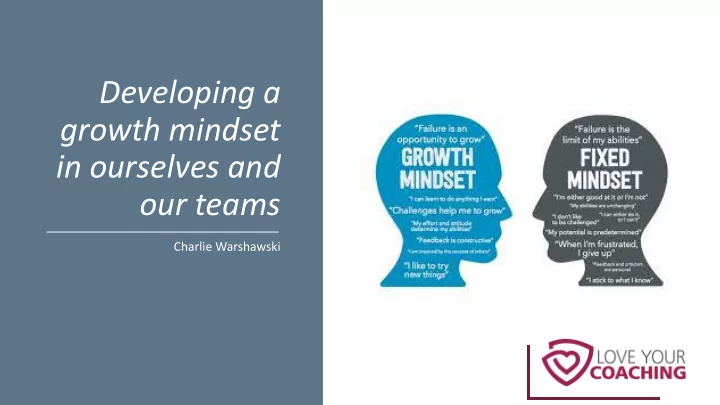
Definition
Fixed Mindset Basic qualities are fixed traits and can’t be changed. Talent is the key to success. Failure = annihilation Growth Mindset All qualities can be improved with effort. Effort and resilience are the key to success. Failure = learning
Mindset mandala
www.loveyourcoaching.com
Motivation is often more important than your initial ability in determining whether you succeed in the long run. Many high achievers were often fairly ordinary people who became extraordinarily motivated. By motivation, I mean not only the desire to achieve but also the love of learning, the love of challenge, and the ability to thrive on obstacles Carol Dweck, Self Theories
www.loveyourcoaching.com
www.loveyourcoaching.com
FMS: tuned in for praise and ability related feedback GMS: tuned in for new learning
make a great effort to continue doing a task that was difficult?
www.loveyourcoaching.com
www.loveyourcoaching.com
Talent vs effort
www.loveyourcoaching.com
Nature x Nurture x Opportunity x Predisposition x Effort and persistence = The cumulative steps to success
Limiting our potential
www.loveyourcoaching.com
www.loveyourcoaching.com
Praising intelligence or fixed characteristics show to have NO impact
Noticing and acknowledging genuine effort, psychosocial skills and aspects that we have control on do have an impact
Source: Carol Dweck, Self Theories
www.loveyourcoaching.com
Reward or not
Students given a task – cube puzzle – to solver Time 1 – no reward introduced Time 2 - $1 for every puzzle solved Time 3 – no reward introduced Time 3 – solved fewer puzzles than Time 1
www.loveyourcoaching.com
end)
mindset in others
mindset in us
mindset in ourselves
charlie@loveyourcoaching.com
www.loveyourcoaching.com
exposure to feedback
growth mindset challenge
www.loveyourcoaching.com
Dweck TED talk: www.ted.com/talks/carol_dweck_the_power_of_believing_that_you_c an_improve Mindset, Carol Dweck Bounce, Matthew Syed Learned optimism, Martin Seligman Drive, Daniel Pink Outliers, Malcolm Gladwell
www.loveyourcoaching.com
skiing
International Ski Federation
www.loveyourcoaching.com