
SLIDE 1
GROWTH AND OPPORTUNITY
Irish Residential Properties REIT plc | Semi-Annual Report 30 June 2014
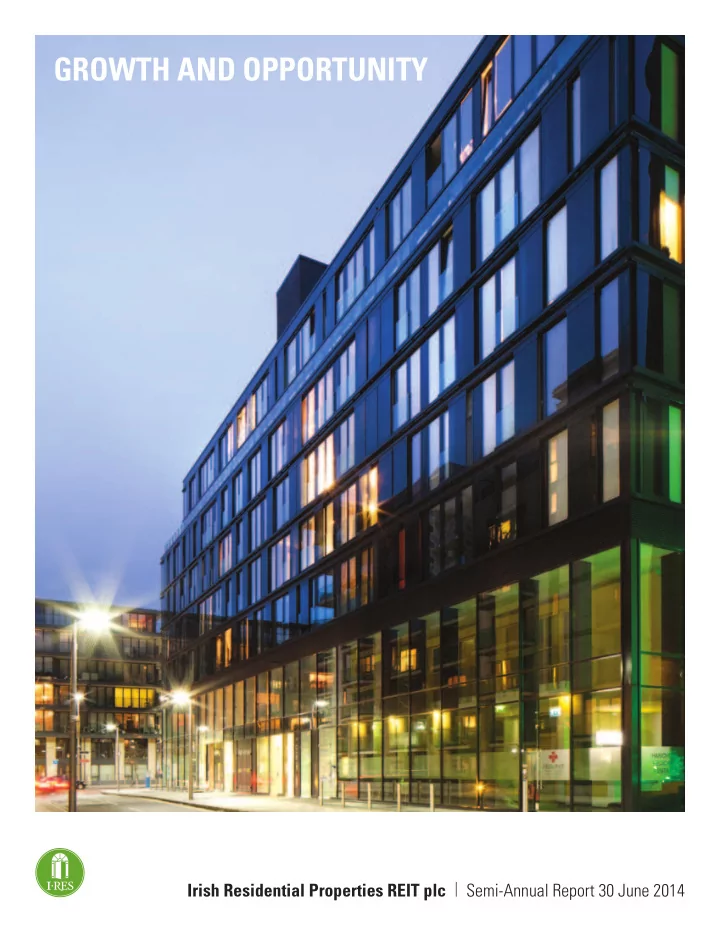
GROWTH AND OPPORTUNITY Irish Residential Properties REIT plc | - - PDF document
GROWTH AND OPPORTUNITY Irish Residential Properties REIT plc | Semi-Annual Report 30 June 2014 PROFILE Irish Residential Properties REIT plc (I-RES) is a growth-oriented real estate investment trust focused on building a portfolio of
Irish Residential Properties REIT plc | Semi-Annual Report 30 June 2014
Irish Residential Properties REIT plc (“I-RES”) is a growth-oriented real estate investment trust focused on building a portfolio of multi-unit residential real estate and strategically located commercial property located in major urban centres across Ireland for the purpose of generating rental income.
flows through investing primarily in multi-unit residential properties in Ireland;
affordable, mid-tier and luxury accommodation sectors;
acquisition opportunities in the greater Dublin area and other major urban areas in Ireland;
value through active and efficient asset and property management; and
growing cash distributions.
10 September 2013
agreement with CAPREIT , Canada’s leading multi- unit residential rental REIT , on 11 April 2014
in September 2013
luxury property, on 18 July 2014
and achieve its investment goals
properties in the greater Dublin area consisting
exchanged imminently
to strengthen our acquisition pipeline
For the period 2 July 2013 to 30 June 2014
Number of Suites 357 Occupancy 99.4% Average Monthly Rent € 1,070 Operating Revenues (000s) € 3,499 Net Operating Income (“NOI”) (000s) € 2,625 NOI Margin 75.0% Cash and Cash Equivalents (000s) € 142,520 Closing Share Price € 1.01 Net Asset Value per Share € 0.982 Investment Property Value (000s) € 53,750
2
Irish Residential Properties REIT plc Semi-Annual Report 30 June 2014
Our goal is for I-RES to become one of the leading consolidators
and improving fundamentals in the Irish apartment market.
On behalf of your Board of Directors, I am very pleased to present the first Irish Residential Properties REIT plc (“I-RES” or the “REIT”) report to shareholders for the period 2 July 2013 to 30 June 2014. It has been a very active and successful time since the REIT’s Initial Public Offering in April 2014 and we look for growth and progress to continue going forward. We are also pleased with the contribution of our designated investment advisor and prop- erty manager, a subsidiary of Canadian Apartment Properties Real Estate Investment Trust (“CAPREIT”). They have brought a wealth of professional property and asset man- agement experience to I-RES, already generating a significant improvement in our operating and financial results. We remain confident the continued application of their tested and proven programmes will result in solid growth and increased cash flows in the years ahead. From a governance perspective, as Chairman I believe the significant capital market, accounting, real estate and general business knowledge represented in the I-RES Board
holders remain paramount. It is a very strong and independent Board, and I look forward to working with them over the long term. Looking ahead, we believe I-RES presents a very compelling investment opportunity. Our goal is for I-RES to become one of the leading consolidators of multi-unit residential rental properties in Ireland, capitalising on the strong and improving fundamentals in the Irish apartment market. We are confident there is significant potential for I-RES to grow its property portfolio for the benefit of its shareholders. As the I-RES portfolio increases in size and scale, we are confident this external growth will be augmented by organic growth in cash flows through the implementation of our property manager’s proven property and asset management programmes. We look forward to keeping you apprised of our progress. Colm Ó Nualláin Chairman
Irish Residential Properties REIT plc Semi-Annual Report 30 June 2014
3 The Marker Residences, Docklands is a prestigious 84-suite luxury property well located in South Docklands and adjacent to Grand Canal Square, the iconic Bord Gais Energy Theatre, and numerous high-profile office developments. Residents have access to the exercise and spa facilities, including a gym and large exercise pool, of the adjacent award-winning five-star Marker Hotel. Camac Crescent, Inchicore is a modern 90-suite luxury property located in an established residential neighbourhood near Dublin City Centre, beside Europe’s largest inner-city pub- lic park and close to numerous amenities and major employers. Residents enjoy the property’s landscaped courtyard garden and its large dual-aspect open-concept suites with large balconies.
4
Irish Residential Properties REIT plc Semi-Annual Report 30 June 2014
Following the completion of I-RES’s initial public offering in April 2014, we have been very busy enhancing property operations and adding to our asset base. We are pleased with the REIT’s performance to date and look forward to further growth going forward.
Our initial portfolio of four properties, consisting of 338 apart- ment suites and related commercial units in the greater Dublin area, was acquired in September 2013, when I-RES was a wholly owned subsidiary of Canadian Apartment Properties Real Estate Investment Trust, a subsidiary of which is our investment advisor and property manager. The initial portfolio was appraised at the time of the initial public offering in April for €46.5 million and was appraised as at 30 June 2014 for €51.5 million. At the time of the acquisition of the initial portfolio, occupancy
rent of €900 per suite. As at 30 June 2014, portfolio apart- ment occupancy was 99.4% and the average monthly rent was €1,070 per suite. Operating margins have also increased sig- nificantly, clearly showing the effectiveness of our property manager’s professional management programmes. We look for this to continue to be applied to our expanded portfolio going forward, to the great benefit of our shareholders. In June 2014, we acquired a small, fully leased property, consisting of 19 apartments and one commercial unit, for €2.1 million (excluding costs of acquisition) located in prox- imity to an existing property and therefore requiring little additional management expense. In July 2014, we strengthened our portfolio by acquiring The Marker Residences, a prestigious luxury property located in South Docklands adjacent to Grand Canal Square, for €50.1 million (excluding costs of acquisition). This 84-suite luxury residential and ancillary commercial building, with access to the amenities of the adjoining Marker Hotel, will, we believe, be a prime asset for many years to come, particularly as the South Docklands redevelopment continues. We also believe there is an opportunity for significant rental growth. We are particularly pleased to have been selected as pre- ferred bidder, with contracts to be exchanged imminently to acquire four properties in the greater Dublin area, consisting
for €211.3 million (excluding costs of acquisition). This out- standing portfolio was acquired through a process run by the National Asset Management Agency and the acquisition is anticipated to close in October 2014. We believe there are significant opportunities to enhance net operating income from these properties. Most significantly, the addition of this portfolio will bring our total apartment units owned to 1,202, providing a real plat- form for CAPREIT , our property manager, to leverage their proven professional management strategies and bring their Canadian expertise to the Irish market. There is no question that market competition in Ireland has caused a compression in capitalisation rates for all invest- ment property sectors from those that applied at the time of
have significantly outperformed our budgets from the time of acquisition of the initial portfolio. We anticipate rising levels
increases take effect. Moreover, I-RES is looking at other
can be held for ultimate sale as the Irish banking sector and economy continue to improve, which we anticipate will add to shareholder returns.
Operating margins have also increased significantly, clearly showing the effectiveness of our property manager’s professional management programmes.
Irish Residential Properties REIT plc Semi-Annual Report 30 June 2014
5 Grande Central, Sandyford is a 63-suite apartment complex located in one of Dublin’s prime suburban neighbourhoods, home to many prestigious corporate
connections to the City
scaped courtyard and fully-furnished suites with modern kitchens and double-glazed windows. I-RES benefits from significant shortages in rental accom- modations and an improving commercial property market in
rental accommodations will continue for at least several years before levelling off to more typical rates of annual growth. But we do not intend to stop here. There remain significant
add value through active management. This bodes well for future growth and value enhancement to the benefit of our shareholders. The Laurels, T allaght contains 19 large suites and
Tallaght neighbourhood, about 12 kilometres southwest
shopping complex and the Tallaght Institute of Technology, the property is well serviced by transit and close to major highways and railways. In closing, it has been a busy and highly successful period since
recent acquisition we will have invested all of the funds raised and drawn on our credit facility, and we look optimistically to the future for I-RES and our shareholders. David Ehrlich Chief Executive Officer
6
Irish Residential Properties REIT plc Semi-Annual Report 30 June 2014
I-RES’s investment advisor and property manager is I-RES Fund Management Ltd, a wholly owned subsidiary of CAPREIT , one of Canada’s largest residential rental landlords, with an extensive and proven track record of growth, performance and delivering value to investors. From an initial portfolio of 2,900 apartment suites at the time of its initial public offering in May 1997 , CAPREIT has grown to where it now owns interests in 41,216 residential units, well diversified by property type and geographically across virtually all major Canadian urban markets. With over 900 engaged and skilled employees in seven offices across the country, CAPREIT brings extensive and proven operating skills to I-RES. In 2013, CAPREIT was very proud to be named one of Canada’s Top Fifty Employers.
Our business model is quite simple. First, strategic and ac- cretive acquisitions diversify and expand the size and scale
cient energy management initiatives, sophisticated purchas- ing programmes and state-of-the-art sales and marketing strategies, CAPREIT’s portfolio has consistently generated nearly full occupancies, steady increases in average monthly rents and reduced operating costs. This proven, professional business model is now being applied to the growing I-RES property portfolio. Our focus is also on ensuring the highest levels of resident
ing properties, resulting in an ability to maximise occupancies with steady increases in monthly rents. Whether through resi dent newsletters, in-property celebrations and special events, engaging with local communities, or fast and effi- cient response to resident requests and concerns, we aim to be the “Landlord of Choice” in all of our markets. CAPREIT has a long track record and legacy of commitment to investing in its properties. Over the past five years, more than $500 million has been invested throughout CAPREIT’s portfolio in new energy-efficient heating systems, state-of- the-art safety and security systems, building infrastructure, parking garages, landscaping, lobbies and common areas. Not
serve to enrich the lives of residents. We believe a similar commitment to investing in the I-RES portfolio will generate the same benefits for I-RES’s shareholders and its residents. Importantly, with the completion of I-RES’s initial public
fully aligning its interests with those of all I-RES share-
CAPREIT’s commitment to I-RES’s growth and success over the long term. Thomas Schwartz President and CEO Canadian Apartment Properties REIT
Through efficient energy management initiatives, sophisticated purchasing programmes and state-of-the-art sales and marketing strategies, CAPREIT’s portfolio has consistently generated nearly full occupancies, steady increases in average monthly rents and reduced operating costs.
Irish Residential Properties REIT plc Semi-Annual Report 30 June 2014
7 Priorsgate, Tallaght is a 102-suite apartment complex situated in the heart of a well-established residential and commercial area, close to major transit lines and highways as well as retail locations, a major hospital and university. It features a landscaped courtyard and fully-furnished suites with all modern amenities. King’s Court, Dublin City Centre is a modern 83-suite apartment complex located in the heart of Dublin just north of the River Liffey and close to the famous Henry Street shopping area, the Temple Bar cultural centre, Smithfield Square and Phoenix Park. The property includes a landscaped communal garden and fully furnished suites with modern kitchens and large balconies.
Building Y ear T
Property City Class Built Date Acquired Suites
King’s Court, North King Street Dublin City Centre Luxury 2006 10 September 2013 83 Grande Central, Rockbrook Sandyford Luxury 2007 10 September 2013 63 Priorsgate, Greenhills Road Tallaght Luxury 2007 10 September 2013 102 Camac Crescent Inchicore Luxury 2008 10 September 2013 90 The Laurels, Main Street Tallaght Mid-tier 2007 27 June 2014 19 The Marker Residences Docklands Luxury 2012 18 July 2014 84
PROPERTY PORTFOLIO
8
Irish Residential Properties REIT plc Semi-Annual Report 30 June 2014
commercial space. In 1997 , Mr Schwartz founded CAPREIT , Canada’s first apartment real estate investment trust. Mr Schwartz is currently President and Chief Executive Officer of CAPREIT and has supervised CAPREIT’s growth from 2,900 residential units to over 41,200, with an estimated total asset value of approximately C$5.5 billion as at 31 December 2013. Mr Schwartz is active in industry and government affairs and is currently on the Board of Trustees of CAPREIT; the Board
Housing REIT; the Board of Directors of REALpac; and the Board of Directors of the Mount Sinai Hospital Foundation. Mr Schwartz is also a member of the Schulich School of Business Advisory Council – Program in Real Estate and Infrastructure. David Ehrlich Executive Director David Ehrlich is Chief Executive Officer of I-RES. Mr Ehrlich graduated from Dalhousie Law School in 1977 and has been a member of the Nova Scotia Barristers Society since 1979 (and a continuing member of the Law Society of Upper Canada since 1986). For over 10 years, until 31 December 2013, Mr Ehrlich was a senior partner at Stikeman Elliott LLP , a leading Canadian business law firm with
Canada as well as New York, London and Sydney. During his years practising as a lawyer, Mr Ehrlich acted for a number
investment trusts, investment banks, life insurance companies, banks, pension funds, devel-
managers and governmental
focused his practice on the public real estate markets and was involved in creating the real estate investment trust industry in Canada from its inception, including the formation of CAPREIT . Mr Ehrlich has been involved in all significant aspects
financing and capital market activities and has worked closely with all of its senior manage-
. Declan Moylan Non-Executive Director Declan Moylan is a solicitor admitted in Ireland, with over 40 years’ experience in business law practice, and in practice
2008, Mr Moylan served as managing partner of Mason Hayes & Curran, and subse- quently as chairman of Mason Hayes & Curran from 2008 until his retirement from that position in 2013. Mr Moylan is currently
the Law Society of England and Wales, the International Bar Association and the Irish Centre for European Law. Mr Moylan is a director of several Irish companies and is a member
Educational Trust. Aidan O’Hogan Non-Executive Director Mr O’Hogan is a fellow of the Society of Chartered Surveyors Ireland and past president of the Irish Association of Valuers
retired as chairman of Savills Ireland after 40 years as a real estate professional. Mr O’Hogan is currently chairman of Property Industry Ireland. Mr O’Hogan was previously managing direc- tor and chairman of Hamilton Osborne King, with almost 20 years’ experience there. Colm Ó Nualláin Non-Executive Chairman Colm Ó Nualláin is recently retired after more than 20 years as Finance Director of Grafton Group plc, a leading builders merchant group quoted on the London Stock Exchange. Mr Ó Nualláin is a qualified Chartered Accountant with international experience and has previously held senior financial positions in a number of public and semi-state companies. Thomas Schwartz Non-Executive Director Thomas Schwartz, with over 35 years of real estate experience, will be a director of the Investment Manager upon (and subject to) its approval as an AIFM by the Central Bank of
a Chartered Accountant in 1975 and went on to pursue a career in real estate development. Mr Schwartz founded Intraurban Projects to specialise in the development of new housing projects in mature communities. Intraurban built and developed
all market segments and through York Heritage Properties has participated in the development, construction and management
Irish Residential Properties REIT plc Semi-Annual Report 30 June 2014
9
portfolios in Western Canada and Northern Ontario, as well as leadership roles at Greenwin Property Management and Tridel, where he managed various property portfolios in the Greater Toronto Area. Mr Kenney is the vice-chairman of the Federation of Rental-Housing Providers of Ontario and was a founding director of the Greater Toronto Apartment Association from 1998 to 2009. Mr Kenney holds a bachelor of economics degree from Carleton University. Scott Cryer Chief Financial Officer
Scott Cryer joined CAPREIT in 2009 and is currently Chief Financial Officer. Mr Cryer most recently held the position of Vice President, Financial Reporting. Prior to joining CAPREIT , Mr Cryer had an 11-year career with increasing responsibility in the Real Estate Assurance and Advisory practice of Deloitte & Touche LLP . Mr Cryer received his Chartered Accountant designation in 2000 and holds a bachelor of economics degree from the University of Western Ontario. Maria Amaral Chief Accounting Officer
Maria Amaral joined CAPREIT in 1997 and has over 25 years of experience in real estate related accounting roles. In addition to the Accounting department, Ms Amaral also oversees the Information Technology and Business Process Improvement
appointment as Chief Account- ing Officer, Ms Amaral held senior positions at CAPREIT , including Senior Vice President
Prior to joining CAPREIT , Ms Amaral held a number of roles as accounting manager and chief accountant at real estate investment, development and management companies in
Management Accountant. Corinne Pruzanski General Counsel and Corporate Secretary of CAPREIT Corinne Pruzanski joined CAPREIT as General Counsel and Corporate Secretary in 2011, with responsibility for all legal and governance matters relating to CAPREIT , including CAPREIT’s acquisitions, dispositions, financing arrangements and compliance with laws. Prior to joining CAPREIT , Ms Pruzanski was a partner at the law firm Stikeman Elliott LLP , which she joined as an associate in 2004 after working as a lawyer in New York for seven years. Ms Pruzanski was admitted to the Bar in Ontario in 1996 and in New York in 1997 , and holds a bachelor of law degree from the University of British Columbia and a bachelor of arts degree from York University. Thomas Schwartz President and Chief Executive Officer of CAPREIT See Board of Directors’ profiles for further details. Mark Kenney Chief Operating Officer
With over 24 years of experi- ence in the multi-unit residential rental property sector and as Chief Operating Officer of CAPREIT , Mark Kenney is actively involved in creating and implementing company policy, directing the property manage- ment team, overseeing marketing, procurement and energy initiatives, and perform- ing operational due diligence
to joining CAPREIT in 1998, Mr Kenney held a senior position at Realstar Management Partnership, overseeing
10
Irish Residential Properties REIT plc Semi-Annual Report 30 June 2014
The Directors have considered the principal risks and un- certainties that I-RES is exposed to and that may impact performance in the remaining six months of its first financial year, which are summarised as follows: Property manager and investment advisor: I-RES is sig- nificantly dependent upon the performance of the property manager and investment advisor and there can be no assur- ance that those parties will be successful in achieving I-RES’s investment objectives. Property and asset management agreement: there is no guarantee that the property and asset management agree- ment will be renewed, and there is no guarantee that a suitably qualified successor could be found or could be engaged on comparable terms. Occupier demand: there is unoccupied space within I-RES’s portfolio which the property manager and investment advisor is tasked with leasing. There is a risk that, due to a lack of
to lease. T enant default: with continued uncertainty in certain sectors
is a risk that tenants may default on payments, thereby im- pacting I-RES’s income and capital performance. Availability of bank finance: following the failure of the Irish banking system, in recent years there has been a limited num- ber of banks providing financing against property in Ireland. General economic conditions: I-RES’s investments are con- centrated in Ireland. Although there are clear signs of a general economic recovery in Ireland, this recovery is uncertain and there can be no assurance that forecasts of GDP growth will be realised. Ability to deploy the remaining IPO proceeds: there is strong competition for desirable properties and tenants in Ireland at present, which may constrain I-RES in its deploy- ment of its remaining IPO proceeds or proceeds of any future equity issuance. To date, I-RES has been successful in deploying capital through on and off market transactions. Interest rate volatility: if I-RES incurs floating rate debt, it may be exposed to risks associated with movements in interest rates. Regulatory risk: there is a risk that I-RES may be required to secure authorisation as a regulated AIF by the Central Bank
tinue its business and would then have to be liquidated. There is a risk that the investment manager may fail to comply with various policies and procedures addressing areas such as, inter alia, risk management, liquidity management, conflicts of interest, valuations, compliance, internal audit and remunera- tion, and that I-RES may fail to comply with ongoing capital, reporting and transparency obligations.
Irish Residential Properties REIT plc Semi-Annual Report 30 June 2014
11
The Directors confirm to the best of their knowledge that the condensed interim financial statements have been prepared in accordance with IAS 34, “Interim Financial Reporting” as adopted by the European Union. In accordance with that standard, the Directors have prepared a complete set of condensed interim financial statements in accordance with International Financial Reporting Standards (“IFRS”) as adopted by the European Union, which are effective for financial periods beginning after 2 July 2013, and the interim management report herein includes a fair review of the information required by Disclosure and Transparency Rules of the Central Bank of Ireland, namely:
,beinganindicationofimportanteventsthat have occurred during the period from incorporation on 2 July 2013 to 30 June 2014 and their impact on the interim financial statements, and a description of the principal risks and uncertainties for the remaining six months of the financial year; and
,beingrelatedpartytransactionsthathave taken place during the period from incorporation on 2 July 2013 to 30 June 2014 and that have materially affected the financial position or performance of the entity during the period. Signed on behalf of the Board Colm Ó Nualláin Thomas Schwartz Director Director
12
Irish Residential Properties REIT plc Semi-Annual Report 30 June 2014
Report on the condensed interim financial statements
Our conclusion We have reviewed the condensed interim financial statements, defined below, in the half-yearly financial report of Irish Residential Properties REIT plc for the period ended 30 June 2014. Based on
believe that the condensed interim financial statements are not prepared, in all material respects, in accordance with International Accounting Standard 34 as adopted by the European Union and theTransparency(Directive2004/109/EC)Regulations2007and the Transparency Rules of the Central Bank of Ireland. This conclusion is to be read in the context of what we say in the remainder of this report. What we have reviewed The condensed interim financial statements, which are prepared by Irish Residential Properties REIT plc, comprise:
for the period then ended; and
statements. As disclosed in note 2, the financial reporting framework that has been applied in the preparation of the financial statements of the group is applicable law and International Financial Reporting Stan- dards (IFRSs) as adopted by the European Union. The condensed interim financial statements included in the half-yearly financial report have been prepared in accordance with International Accounting Standard 34, ‘Interim Financial Reporting’, as adopted by the European Union and the Transparency (Directive 2004/109/EC)Regulations2007andthe TransparencyRulesofthe Central Bank of Ireland. What a review of condensed interim financial statements involves We conducted our review in accordance with International Standard
Financial Information Performed by the Independent Auditor of the Entity’ issued by the Auditing Practices Board for use in the United Kingdom and Ireland. A review of interim financial informa- tion consists of making enquiries, primarily of persons responsible for financial and accounting matters, and applying analytical and
A review is substantially less in scope than an audit conducted in accordance with International Standards on Auditing (UK and Ireland) and, consequently, does not enable us to obtain assurance that we would become aware of all significant matters that might be identi- fied in an audit. Accordingly, we do not express an audit opinion. We have read the other information contained in the half-yearly financial report and considered whether it contains any apparent misstatements or material inconsistencies with the information in the condensed interim financial statements.
Responsibilities for the condensed interim financial statements and the review
Our responsibilities and those of the directors The half-yearly financial report, including the condensed interim financial statements, is the responsibility of, and has been ap- proved by, the directors. The directors are responsible for preparing the half-yearly financial report in accordance with the Transparency (Directive2004/109/EC)Regulations2007andtheTransparency Rules of the Central Bank of Ireland. Our responsibility is to express to the company a conclusion on the condensed interim financial statements in the half-yearly finan- cial report based on our review. This report, including the conclusion, has been prepared for and only for the company for the purpose of complyingwiththe Transparency(Directive2004/109/EC)Regulations 2007 and the Transparency Rules of the Central Bank of Ireland and for no other purpose. We do not, in giving this conclusion, accept or assume responsibility for any other purpose or to any other person to whom this report is shown or into whose hands it may come save where expressly agreed by our prior consent in writing. PricewaterhouseCoopers Chartered Accountants Dublin 28 August 2014
to Irish Residential Properties REIT plc
CONDENSED INTERIM FINANCIAL STATEMENTS FOR THE PERIOD 2 JULY 2013 TO 30 JUNE 2014
(unaudited) 12
Irish Residential Properties REIT plc Semi-Annual Report 30 June 2014
Irish Residential Properties REIT plc Semi-Annual Report 30 June 2014
13
CONDENSED INTERIM STATEMENT OF FINANCIAL POSITION
(Unaudited — € thousands)
As at 30 June 2014 Note
Assets Non-Current Assets Investment properties 5 € 53,750 Property, plant and equipment 6 21 53,771 Current Assets Other current assets 6 5,487 Cash and cash equivalents 142,520 148,007 T
€ 201,778 Liabilities Current Liabilities Accounts payable and accrued liabilities € 2,976 Security deposits 368 T
€ 3,344 Shareholders’ Equity Share capital € 20,387 Share premium 172,000 Retained earnings 6,047 T
€ 198,434 T
€ 201,778
See accompanying notes to the condensed interim financial statements. Irish Residential Properties REIT plc Semi-Annual Report 30 June 2014
13
14
Irish Residential Properties REIT plc Semi-Annual Report 30 June 2014
CONDENSED INTERIM STATEMENT OF INCOME AND COMPREHENSIVE INCOME
(Unaudited — € thousands)
For the period 2 July 2013 to 30 June 2014 Note
Operating Revenues Revenue from investment properties € 3,499 Operating Expenses Realty taxes 84 Property operating costs 790 874 Net Rental Income 2,625 General and administrative expenses 8 1,300 Fairvalue(gain)/lossoninvestmentproperties 5 (7,249) Operating Income 8,574 Interest on intercompany loan 1,464 Other income (19) Profit Before T axes 7,129 Current income tax expense 11 922 Profit for the Period € 6,207 Attributable to Shareholders € 6,207 Basic Earnings per Share 16 € 0.149 Dilutive Earnings per Share 16 € 0.149 All of the profit for the period arises from continuing operations.
See accompanying notes to the condensed interim financial statements.
14
Irish Residential Properties REIT plc Semi-Annual Report 30 June 2014
Irish Residential Properties REIT plc Semi-Annual Report 30 June 2014
15
CONDENSED INTERIM STATEMENT OF CHANGES IN SHAREHOLDERS’ EQUITY
(Unaudited — € thousands)
Share Share Retained Capital Premium Earnings Other T
Note
Shareholders’ Equity at 2 July 2013 € – € – € – € – € – Share Capital New Shares issued for Cash 9 20,040 172,000 – – 192,040 New Shares issued (1) 9 160 – (160) – – Long-Term Incentive Plan 8 – – – 187 187 20,200 172,000 (160) 187 192,227 Retained Earnings Profit for the period – – 6,207 – 6,207 – – 6,207 – 6,207 Shareholders’ Equity at 30 June 2014 € 20,200 € 172,000 € 6,047 € 187 € 198,434
(1) Capitalisation of undistributable reserves. Refer to note 9 for further details. See accompanying notes to the condensed interim financial statements. Irish Residential Properties REIT plc Semi-Annual Report 30 June 2014
15
16
Irish Residential Properties REIT plc Semi-Annual Report 30 June 2014
CONDENSED INTERIM STATEMENT OF CASH FLOWS
(Unaudited — € thousands)
For the period 2 July 2013 to 30 June 2014 Note
Cash Flows From Operating Activities Operating Activities Profit before taxes € 7,129 Items related to operating activities not affecting cash: Fair value adjustment – investment properties (7,249) Amortisation of property, plant and equipment 1 Share-based compensation expense (187) Taxes paid (922) (1,228) Operating income items related to financing and investing activities 1,445 Changes in non-cash operating assets and liabilities 13 (1,768) Net Cash Used In Operating Activities (1,551) Cash Flows From Investing Activities Acquisition of investment properties (46,345) Investment property enhancement expenditure (156) Purchase of property, plant and equipment (23) Investment income received 19 Net Cash Used In Investing Activities (46,505) Cash Flows From Financing Activities Intercompany loan advanced 45,000 Mortgages repaid on maturity (45,000) Interest paid on intercompany loan (1,464) Net proceeds on issuance of Shares 192,040 Net Cash Generated From Financing Activities 190,576 Changes in Cash and Cash Equivalents During the Period 142,520 Cash and Cash Equivalents, Beginning of the Period – Cash and Cash Equivalents, End of the Period € 142,520
See accompanying notes to the condensed interim financial statements.
16
Irish Residential Properties REIT plc Semi-Annual Report 30 June 2014
Irish Residential Properties REIT plc Semi-Annual Report 30 June 2014
17
Irish Residential Properties REIT plc (“I-RES”) was incor- porated on 2 July 2013 as Shoreglade Limited (also formerly known as CAPREIT Ireland Limited). On 16 April 2014, I-RES
ing segment of the Official List of the Irish Stock Exchange for trading on the regulated market for listed securities of the Irish Stock Exchange. Its registered office is Kings Court, Unit 4, 48-59 North King Street, Smithfield, Dublin 7 . Shares
symbol “IRES” . I-RES owns interests in multi-unit residential rental apartment properties located in and near major urban centres in Dublin,
from real estate located in Ireland where it is also domiciled. On 10 September 2013, I-RES purchased its first investment in- terests in investment properties (see note 4 for further details). I-RES was previously a wholly owned subsidiary of Cana- dian Apartment Properties Real Estate Investment Trust (“CAP REIT”), a real estate investment trust owning interests in multi-unit residential rental apartment properties located across Canada. On 16 April 2014, CAPREIT’s interest in I-RES was diluted to 20.8% through the issuance of Ordinary Shares
a) Basis of preparation These condensed interim financial statements, which were approved by I-RES’s Board of Directors on 28 August 2014, have been prepared in accordance with International Account- ing Standard (“IAS”) 34, “Interim Financial Reporting” (“IAS 34”) as issued by the International Accounting Standards Board (“IASB”) and as adopted by the European Union (“EU”). The condensed interim financial statements are prepared on a going concern basis and in accordance with International Financial Reporting Standards (“IFRS”) as adopted by the European Union, which are effective for accounting periods beginning after 2 July 2013. The condensed interim financial statements have been presented in euro, which is I-RES’s functional currency.
NOTES TO CONDENSED INTERIM FINANCIAL STATEMENTS
30 June 2014 (Unaudited — € thousands, except Share and per Share amounts) The financial statements cover the period from incorporation
There are no comparatives as this is the first period of operation. These financial statements do not constitute Statutory Accounts and accordingly they do not include all the disclosures that would be included in Statutory Accounts. The Statutory Accounts will be prepared for the period ending 31 December 2014. I-RES has not early adopted any forthcoming IASB standards. Note 2t) sets out details of such upcoming standards. Going concern I-RES meets its day to day working capital requirements through its cash and deposit balances. I-RES’s plans indicate that it should have adequate resources to continue in opera- tional existence for the foreseeable future. Accordingly, the Directors consider it appropriate that the company adopts the going concern basis in the preparation of the condensed interim financial statements. b) Investment properties I-RES considers its income properties to be investment prop- erties under IAS 40, Investment Property (“IAS 40”), and has chosen the fair value model to account for its investment properties in the financial statements. Fair value represents the amount at which the properties could be exchanged between a knowledgeable and willing buyer and a knowl- edgeable and willing seller in an arm’s-length transaction at the date of valuation. Investment properties comprise investment interests held in land and buildings (including integral equipment) held for the purpose of producing rental income, capital appreciation,
a highest and best use basis, but do not include any portfolio premium that may be associated with the economies of scale
All investment properties are recorded at their fair value at their respective acquisition dates and are subsequently stated at fair value at each statement of financial position date, with any gain or loss arising from a change in fair value recognised within operating income in the statement of income and com- prehensive income for the period.
18
Irish Residential Properties REIT plc Semi-Annual Report 30 June 2014
The fair value of investment properties is determined by a qualified external appraiser. Management undertakes a review
lying assumptions, such as cash flows and capitalisation rates. These assumptions may be modified based on market information
properties are adjusted. See notes 3 and 5 for a detailed discussion of the significant assumptions, estimates and valuation methods used. c) Property asset acquisition Identifiable assets acquired and liabilities assumed in an asset acquisition are measured initially at their fair values at the acquisition date. Acquisition-related transaction costs are capitalised to the property. d) Property, plant and equipment Property, plant and equipment are stated at historical cost less accumulated depreciation and mainly comprise infor mation technology hardware. These items are amortised on a straight-line basis over their estimated useful lives ranging from three to five years. e) T enant inducements Incentives such as cash, rent-free periods and move-in allowances may be provided to lessees to enter into a lease. The incen- tives are written off on a straight-line basis over the term of the lease as a reduction of rental revenue. f) Financial instruments Financial assets and financial liabilities Financial assets and financial liabilities are initially recognised at fair value and are subsequently accounted for based on their classification, as described below. Their classification depends on the purpose for which the financial instruments were acquired
Classification of financial instruments The following summarises the classification and measurement I-RES has elected to apply to each of its significant categories
Type Classification Measurement
Financial assets Cash and cash equivalents Cash and cash equivalents Amortised cost Other receivables Loans and receivables Amortised cost Financial liabilities Accounts payable and accrued liabilities Other liabilities Amortised cost Fair value through profit or loss (“FVTPL ”) Financial instruments in this category are recognised initially and subsequently at fair value. Gains and losses arising from changes in fair value are presented within net income in the statement of income and comprehensive income in the period in which they arise. Financial assets and liabilities at FVTPL are classified as current, except for the portion expected to be realised or paid beyond 12 months of the statement of financial position date, which is classified as non-current. Derivatives are also categorised as FVTPL unless designated as hedges. Notes to Condensed Interim Financial Statements 30 June 2014 (Unaudited – € thousands, except Share and per Share amounts)
Irish Residential Properties REIT plc Semi-Annual Report 30 June 2014
19 Cash and cash equivalents Cash and cash equivalents include cash and short term invest- ments with an original maturity of three months or less, as well as restricted cash held by I-RES, and are accounted for at amortised cost. Interest earned or accrued on these financial assets is included in other income. Loans and receivables Such receivables arise when I-RES provides services to a third party, such as a tenant, and are included in current assets, except for those with maturities more than 12 months after the statement of financial position date, which are classified as non-current assets. Loans and receivables are included in
accounted for at amortised cost. Other liabilities Such financial liabilities are recorded at amortised cost and include all liabilities other than derivatives or liabilities, which are designated to be accounted for at fair value. Transaction costs Transaction costs related to financial assets classified as FVTPL are expensed as incurred. Transaction costs related to loans and receivables and other liabilities are included in the initial fair value of such financial assets and liabilities. Trans- action costs relating to available-for-sale financial assets are included in the cost of the asset on initial recognition. Determination of fair value The fair value of a financial instrument on initial recognition is generally the transaction price, which is the fair value of the consideration given or received. Subsequent to initial recog- nition, the fair value of financial instruments is remeasured based on relevant market data. I-RES classifies the fair value for each class of financial instrument based on the fair value hierarchy in accordance with IFRS 7 , Financial Instruments: Disclosures (“IFRS 7”). The fair value hierarchy distinguishes between market value data obtained from independent sources and I-RES’s own assumptions about market value. See note 10 for a detailed discussion of valuation methods used for financial instruments with prices quoted in an active market and instruments valued using observable data. Notes to Condensed Interim Financial Statements 30 June 2014 (Unaudited – € thousands, except Share and per Share amounts) j) Intercompany loan An intercompany loan was recognised at amortised cost using the effective interest rate method. Under the effective inter- est rate method, any transaction fees, costs and discounts directly related to the intercompany loan were recognised within interest and other financing costs in the statement of income and comprehensive income over the expected term
in full on 16 April 2014. k) Revenue recognition I-RES recognises rental revenue using the straight-line meth-
from all leases is accounted for on a straight-line basis over the term of the related leases. The difference between the rental revenue recognised and the amounts contractually due under the lease agreements is accrued as rent receivable. l) Interest on intercompany loan This amount includes interest and other financing costs on the intercompany loan payable, which is expensed at the stated interest rate specified per the terms of the intercompany loan agreement between I-RES and CAPREIT. The inter- company loan agreement ended when I-RES repaid in full on 16 April 2014. m) Operating segments I-RES operates and is managed as one business segment, being property investment, with all investment properties located in Ireland. Operating segments are reported in a man- ner consistent with the internal reporting provided to the chief operating decision maker, who has been identified as the I-RES Board of Directors. n) Foreign currency transactions Transactions in foreign currencies are translated to I-RES’s functional currency at exchange rates at the dates of the
in foreign currencies at the reporting date are translated to the functional currency at the exchange rate at that date.
20
Irish Residential Properties REIT plc Semi-Annual Report 30 June 2014
Cash and cash equivalents consist of cash on hand, balances with banks and investments in money market instruments with an original term to maturity of 90 days or less at acqui-
the use of cash or cash equivalents are excluded from the statement of cash flows and are disclosed separately in the notes to the financial statements. p) Income taxes Irish Residential Properties REIT plc elected for REIT status with effect from 1 April 2014. As a result, from this date I-RES does not pay Irish corporation tax on the profits and gains from its qualifying rental business in Ireland provided it meets certain conditions. For the period 2 July 2013 to 31 March 2014, I-RES is liable for corporation tax on any profits and gains which would have arisen prior to and upon election to REIT status. Going forward, corporation tax is still payable in the normal way in respect of income and gains from any residual busi- ness (generally including any property trading business) not included in the property rental business. I-RES would also be liable to pay other taxes such as VAT, stamp duty land tax, stamp duty, local property tax and payroll taxes in the normal way. The tax expense comprises current and deferred tax. The current income tax charge is calculated on the basis of the tax laws enacted or substantively enacted at the statement
positions taken in tax returns with respect to situations in which applicable tax regulation is subject to interpretation. It establishes provisions where appropriate on the basis of amounts expected to be paid to the tax authorities. Notes to Condensed Interim Financial Statements 30 June 2014 (Unaudited – € thousands, except Share and per Share amounts) Deferred income tax is recognised on temporary differences arising between the tax bases of assets and liabilities and their carrying amounts in the statement of financial posi-
laws) that have been enacted or substantively enacted by the period end date and are expected to apply when the related deferred income tax asset is realised or the deferred income tax liability is settled. Deferred income tax assets are recognised only to the extent that it is probable that future taxable profit will be available against which the temporary differences can be utilised. q) Equity and share issue costs The equity of I-RES consists of ordinary shares issued. Shares issued are recorded at the date of issuance. Direct issue costs in respect of the issue of shares are accounted for as a deduc- tion from equity. Direct issue costs include costs of preparing the prospectus, accounting, tax and legal expenses, under- writing fees and valuation fees in respect of the shares and
r) Net asset value (“NAV”) The IFRS NAV is calculated as the value of I-RES’s assets less the value of its liabilities measured in accordance with IFRS. EPRA NAV is calculated in accordance with the European Public Real Estate Association (“EPRA ”) Best Practice Rec-
issued in January 2014. s) Share-based payments I-RES has determined that the options issued to senior exec- utives qualify as an “equity settled share-based payment trans action” as per IFRS 2. This implies the fair value of the
the vesting term with a corresponding increase in equity. The fair value has been measured using the Black-Scholes model.
Irish Residential Properties REIT plc Semi-Annual Report 30 June 2014
21 t) Future accounting changes As at 28 August 2014, a number of new standards, amendments to standards and interpretations are effective for future fiscal periods and have not been applied in preparing these financial statements. I-RES has not yet fully determined the impact of these amendments on its future financial reporting but does not expect them to have a material impact.
Standards, Amendments and Interpretations Effective Date (1)
IAS 27 – Separate Financial Statements 1 January 2014 IAS 28 – Investments in Associates and Joint Ventures 1 January 2014 IAS 32 (Amendment) – Offsetting Financial Assets and Liabilities 1 January 2014 IAS 36 – Recoverable Amount Disclosures for Non-Financial Assets 1 January 2014 IFRS 10 – Consolidated Financial Statements 1 January 2014 IFRS 11 – Joint Arrangements 1 January 2014 IFRS 12 – Disclosure of Interests in Other Entities 1 January 2014 Amendments to IFRS 10, IFRS 11 and IAS 27 – Investment Entities 1 January 2014
(1) The effective date is that applying to the EU endorsed IFRS if later than the IASB effective date and relates to periods beginning on or after this date.
The preparation of the financial statements in accordance with IFRS requires the use of estimates, assumptions and judge- ments that in some cases relate to matters that are inherently uncertain, and which affect the amounts reported in the financial statements and accompanying notes. Areas of such estimation include, but are not limited to: valuation of investment proper- ties, remeasurement at fair value of financial instruments, valuation of accounts receivable, capitalisation of costs, accounting accruals, the amortisation of certain assets, and accounting for deferred income taxes. Changes to estimates and assumptions may affect the reported amounts of assets and liabilities and the disclosure of contingent assets and liabilities at the date of the financial statements and the reported amounts of revenues and expenses during the reporting period. Actual results could also differ from those estimates under different assumptions and conditions. The valuation estimate of investment properties is deemed to be more significant, due to subjectivity and the potential risk of causing a material adjustment within the next financial year to the carrying amounts of assets and liabilities. See note 5 for a detailed discussion of valuation methods and the significant assumptions and estimates used. Notes to Condensed Interim Financial Statements 30 June 2014 (Unaudited – € thousands, except Share and per Share amounts)
22
Irish Residential Properties REIT plc Semi-Annual Report 30 June 2014
Notes to Condensed Interim Financial Statements 30 June 2014 (Unaudited – € thousands, except Share and per Share amounts)
Valuation basis Investment properties are carried at fair value, which is the amount at which the individual properties could be sold between willing parties in an arm’s-length transaction, based
the same location, considering the highest and best use of the asset, with any gain or loss arising from a change in fair value recognised in the statement of income and compre- hensive income for the period. Valuations do not take into account any potential portfolio premium, or transaction costs generally necessary to complete such transactions. The fair values of all of I-RES’s investment properties are deter- mined by a qualified external appraiser. The qualified external appraiser holds a recognised relevant professional qualifica- tion and has recent experience in the location and category of the respective property. Capitalisation rates employed by the appraiser are based on recently closed transactions for similar
flows of an investment property change significantly semi- annually, the fair value of the investment property would be re-assessed by the external appraiser and the fair value adjusted accordingly. Valuations are prepared on a bi-annual basis at each interim reporting date. Fair values for investment properties are classified as Level 3 in the fair value hierarchy, as disclosed in note 10. I-RES verifies all major inputs (as detailed above) to the valuation and reviews the results with the external appraiser for all independent valuations.
I-RES has completed the following investment property acquisitions since 2 July 2013, which have contributed to the operating results effective from the acquisition date:
For the period 2 July 2013 to 30 June 2014 T
T erm to Suite Acquisition Interest Maturity Count Region Costs Funding Rate (Y ears)
27 June 2014 19 Dublin, Ireland € 2,172 € – (1) – (1) – (1) 10 September 2013 338 Dublin, Ireland € 44,173 € – (2) – (2) – (2) 357 € 46,345 € –
(1) The acquisition was funded from equity proceeds raised on 16 April 2014. (2) The acquisition was funded from an intercompany loan payable to CAPREIT at a stated interest rate of 5.3% per annum. The loan was payable
16 April 2014.
Discussion of the valuation process, the valuation method-
between I-RES and the qualified external appraiser. Changes in Level 3 fair values are analysed at each reporting
can use current prices in an active market for a similar property in the same location and condition. I-RES has concluded there is insufficient market evidence on which to base investment property valuations using this approach, and has therefore determined that using the Direct Income Capitalisation (“DC”) method is more appropriate. I-RES utilises the DC method. Under this method, capitalisa- tion rates are applied to a stabilised net operating income (“NOI”) representing market-based NOI assumptions (prop- erty revenue less property operating expenses adjusted for market based assumptions such as long-term vacancy rates, management fees, R&M costs, and general and administration costs). The most significant assumption is the capitalisation rate for each specific property. The capitalisation rate is based on the actual location, size and quality of the property and taking into account any available market data at the valuation date. Generally, an increase in stabilised NOI will result in an increase to the fair value of an investment
a decrease to the fair value of an investment property. The capitalisation rate magnifies the effect of a change in stabilised NOI, with a lower capitalisation rate resulting in a greater effect on the fair value of investment properties than a higher capitalisation rate.
Irish Residential Properties REIT plc Semi-Annual Report 30 June 2014
23 Notes to Condensed Interim Financial Statements 30 June 2014 (Unaudited – € thousands, except Share and per Share amounts) A summary of the market assumptions, ranges, and fair value as at 30 June 2014 is presented below:
As at 30 June 2014 Weighted T ype of Interest Fair Value Rate T ype Max Min Average
Investment properties € 53,750 Capitalisation rate 7.06% 5.66% 6.12% Reconciliation of carrying amounts of investment properties
For the period 2 July 2013 to 30 June 2014
Balance at inception € – Additions: Acquisitions 46,345 Property capital investments 156 Unrealised fair value adjustments 7,249 Balance at the end of the period € 53,750 The carrying value of €53,750 for the investment properties at 30 June 2014 was based on an external valuation carried out as at that date. The valuations were prepared in accordance with The RICS Valuation – Professional Standards 2012 (Red Book).
As at 30 June 2014
Property, Plant and Equipment Property, plant and equipment (1) € 22 Accumulated amortisation of property, plant and equipment (1) T
€ 21 Other Current Assets Prepaid expenses € 285 Deposits and other receivables 5,202 T
€ 5,487
(1) Consists of head office and information technology hardware and software.
7 . Intercompany Loan
On 16 April 2014, I-RES repaid an intercompany loan payable to CAPREIT , a related party, aggregating to €45,000 with a stated interest rate of 5.3% per annum. The intercompany loan was payable on demand, but in any event, no later than 29 August 2014, with interest on such amount at the stated interest rate.
Options are issuable pursuant to I-RES’s Share-based com- pensation plan, namely, the Long Term Incentive Plan (“Plan”). Options were granted on 16 April 2014 by I-RES to senior executives of CAPREIT (the Investment Manager of I-RES) and David Ehrlich, CEO of I-RES. The Plan will have a maximum life
the date of grant. The Plan limit cannot exceed 10% of I-RES’s issued Ordinary Share capital (adjusted for share issuance and cancellation) during the 10 year period prior to that date. As at 30 June 2014, the maximum number of options issuable under the Plan is 20,200,000 awards. The maximum number
plans as at 30 June 2014 is 3,120,000 awards. The fair value of options has been determined as at the grant date using the Black-Scholes model. The assumptions utilised to arrive at the estimated fair value for the outstanding grants at the respective periods is shown below. The expected volatility is based on historic market volatility
Government bonds with a term consistent with the assumed
LTIP
As at 30 June 2014
Number of Shares 17,080,000 Award grant price € 1.0 Risk free rate (%) 1.2 Distribution yield (%) 5.0 Expected years 7.0 Volatility (%) 20.3 Award option value € 0.08
24
Irish Residential Properties REIT plc Semi-Annual Report 30 June 2014
CAPREIT’s initial investment in I-RES’s share capital (prior to the dilution of its beneficial interest) was €40 at a par value
Ordinary Shares to CAPREIT , as consideration in lieu of net assets received on dilution of CAPREIT’s beneficial interest in I-RES by 79.2%. On 11 April 2014, undistributable reserves in the amount of €1,600 were capitalised and applied in paying in full 1,600,000 new Ordinary Shares as to €0.10 par value and €0.90 premium, which Ordinary Shares were issued by way of capitalised issue to CAPREIT . On 1 April 2014, I-RES was converted to a public limited company. On 13 March 2014, I-RES authorised share capital of €100,000 divided into 1,000,000,000 Ordinary Shares of €0.10 each. On 16 April 2014, I-RES issued 200,000,000 Ordinary Shares pursuant to the Initial Public Offering for €1.00 each including a share premium of €0.90 per share. All equity shares outstanding are fully paid and are voting shares. Equity shares represent a Shareholder’s proportionate undivided beneficial interest in I-RES. No equity share has any preference or priority over another. No Shareholder has or is deemed to have any right of ownership in any of the assets of I-RES. Each Share confers the right to cast one vote at any meeting of Shareholders and to participate pro rata in any distributions by I-RES and, in the event of termination of I-RES, in the net assets of I-RES remaining after satisfaction of all liabilities. Shares will be issued in registered form and are transferable. The number of issued and outstanding Ordinary Shares is as follows:
For the period 2 July 2013 to 30 June 2014
Issued or granted during the period in connection with the following: CAPREIT’s initial ownership 400,000 Shares issued to CAPREIT prior to Initial Public Offering 1,600,000 Initial Public Offering (a) 200,000,000 Shares outstanding, end of the period 202,000,000 a) New Shares issued
Price Gross T ransaction Net Shares Per Share Proceeds Costs Proceeds Issued
April 2014 (the “Initial Public Offering”) Bought-Deal (16 April 2014) € 1.00 € 200,000 € 8,000 € 192,000 200,000,000 Total € 200,000 € 8,000 € 192,000 200,000,000
a) Fair value of financial instruments and investment properties I-RES classifies and discloses the fair value for each class of financial instrument based on the fair value hierarchy in accordance with IFRS 13. The fair value hierarchy distinguishes between market value data obtained from independent sources and IRES’s
Level 1 – Inputs based on quoted prices in active markets for identical assets or liabilities; Level 2 – Inputs based on factors other than quoted prices included in Level 1 and may include quoted prices for similar assets and liabilities in active markets, as well as inputs that are observable for the asset or liability (other than quoted prices), such as interest rates and yield curves that are observable at commonly quoted intervals; and Level 3 – Inputs which are unobservable for the asset or liability, and are typically based on I-RES’s own assumptions, as there is little, if any, related market activity. Notes to Condensed Interim Financial Statements 30 June 2014 (Unaudited – € thousands, except Share and per Share amounts)
Irish Residential Properties REIT plc Semi-Annual Report 30 June 2014
25 Notes to Condensed Interim Financial Statements 30 June 2014 (Unaudited – € thousands, except Share and per Share amounts) I-RES’s assessment of the significance of a particular input to the fair value measurement in its entirety requires judgement, and considers factors specific to the asset or liability. The following table presents I-RES’s estimates of the fair value on a recurring basis based on information available as at 30 June 2014, and aggregated by the level in the fair value hierarchy within which those measurements fall. These estimates are not necessarily indicative of the amounts I-RES could ultimately realise.
Level 1 Level 2 Level 3 Quoted prices in active markets for Significant other Significant identical assets and liabilities
unobservable inputs T
Recurring Measurements Assets Investment Properties € – € – € 53,750 (1) € 53,750
(1) Fair values for investment properties are calculated using the direct income capitalisation method, which results in these measurements being classified as Level 3 in the fair value hierarchy. See note 5 for detailed information on the valuation methodologies and fair value reconciliation.
b) Risk management The main risks arising from I-RES’s financial instruments are interest rate, liquidity and credit risks. I-RES’s approach to manag- ing these risks is summarised as follows: Market risk Market risk is the risk that the fair value or cash flows of a financial instrument will fluctuate due to changes in market prices. Market risk reflects interest rate risk, currency risk and other price risks. I-RES’s financial assets currently comprise short term bank deposits and trade receivables. The short term bank deposits are used to invest cash while awaiting suitable investment properties for investment. These are denominated in euros. Therefore, exposure to market risk in relation to these is limited to interest rate risk. I-RES’s exposure to interest rates is limited to the exposure of €142,520 of earnings from uninvested funds at the period end. Liquidity risk Liquidity risk is the risk that I-RES may encounter difficulties in accessing capital markets and refinancing its financial obliga- tions as they come due.
2014 2015–2016 2017–2018 2019 onward
Other liabilities € 2,976 € – € – € – Security deposits 368 – – – € 3,344 € – € – € – Credit risk Credit risk is the risk that: (i) counterparties to contractual financial obligations will default; and (ii) the possibility that I-RES’s tenants may experience financial difficulty and be unable to meet their rental obligations. I-RES monitors its risk exposure regarding obligations with counterparties through the regular assessment of counter- parties’ credit positions and will not be exposed to the credit- worthiness or solvency of any one counterparty. I-RES mitigates the risk of credit loss with respect to tenants by evaluating the creditworthiness of new tenants, obtain- ing security deposits wherever permitted by legislation, and geographically diversifying its portfolio. I-RES monitors its collection experience on a monthly basis and ensures that a stringent policy is adopted to provide for all past due amounts. All residential accounts receivable balances exceeding 30 days are written off to bad debt expense and recognised in the statement of income and comprehensive
sive income. Accordingly, no allowance for doubtful accounts is established.
26
Irish Residential Properties REIT plc Semi-Annual Report 30 June 2014
Cash and cash equivalents are held with major Irish and Euro- pean institutions. The Board has established a cash manage- ment policy for these funds, which it monitors regularly. This policy has investment thresholds, with a maximum limit of 20% of the overall gross assets, with individual institutions to avoid concentration of risk with any one counterparty. I-RES has also engaged the services of a Depository to ensure the security of the cash assets.
11. T axation
I-RES was incorporated on 2 July 2013 and was liable for cor- porate taxes up to 31 March 2014, following which it elected for REIT status. For the period 2 July 2013 to 31 March 2014, I-RES paid corporate taxes of €922. As at 30 June 2014, there are no outstanding tax obligations, as detailed below. I-RES elected for REIT status with effect from 1 April 2014. As a result, from this date I-RES does not pay Irish corporation tax on the profits and gains from its qualifying rental business in Ireland provided it meets certain conditions. Instead, distributions to shareholders in respect of the prop- erty rental business are treated for Irish tax purposes as income in the hands of shareholders. Corporation tax is still payable in the normal way in respect of income and gains from any residual business (generally including any property trading business) not included in the property rental business. I-RES is also liable to pay other taxes such as VAT , stamp duty land tax, stamp duty, local property tax and payroll taxes in the normal way. Within the Irish REIT regime, for corporation tax purposes the property rental business is treated as a separate business to the residual business. A loss incurred by the property rental busi- ness cannot be set off against profits of the residual business. An Irish REIT is required to distribute to its shareholders (by way of dividend), on or before the filing date for its tax return for the accounting period in question, at least 85% of the property income of the property rental business arising in each accounting period. Failure to meet this requirement will result in a tax charge calculated by reference to the extent of the shortfall in the dividend paid. A dividend paid by an Irish REIT from its property rental busi- ness is referred to as a property income distribution or PID. Any normal dividend paid from the residual business by the Irish REIT is referred to as a Non-PID dividend. The Directors confirm that I-RES has remained in compliance with the Irish REIT rules and regulations up to and including the date of this report.
There were no dividends declared or paid by I-RES during the period and there are no dividends proposed by the Direc- tors in respect of this reporting period. Under the Irish REIT Regime, subject to having sufficient distributable reserves, I-RES will be required to distribute to shareholders at least 85% of the property income of its property rental business for each accounting period, with the first dividend, provided it has sufficient distributable reserves, being payable in 2015.
Changes in non-cash and other operating assets and liabilities
For the period 2 July 2013 to 30 June 2014
Prepaid expenses € (285) Other receivables (148) Deposits (5,054) Accounts payable and other liabilities 3,163 Deferred income taxes payable – Security deposits 368 € (3,687) Issuance of Shares
For the period 1 April 2014 to 30 June 2014
Issuance of Shares € 200,040 Issuance costs (8,000) Net proceeds € 192,040 Notes to Condensed Interim Financial Statements 30 June 2014 (Unaudited – € thousands, except Share and per Share amounts)
Irish Residential Properties REIT plc Semi-Annual Report 30 June 2014
27
CAPREIT has a 20.8% beneficial interest in I-RES and has determined that it has significant influence over I-RES. The beneficial interest is held through a qualified alternative in- vestment fund, Irish Residential Properties Fund. In addition, effective 11 April 2014, CAPREIT’s wholly owned subsidiary, I-RES Fund Management Limited, entered into an external management agreement to perform certain property and asset management services for I-RES. Included in general and administrative expenses is €341 from asset management and property management fees. As per the agreement, I-RES pays 3.0% per annum of its gross rental income as property management fees and 0.5% per annum of its net asset value as asset management fees. David Ehrlich is the CEO and a Director of the I-RES Board. He is also a trustee of CAPREIT . Thomas Schwartz is a Director (non-executive) of the I-RES Board. He is also the president and CEO of CAPREIT and each of its subsidiaries. Officers and key management of CAPREIT were granted options of I-RES. In addition, Mr Ehrlich will be entitled to participate in the Long Term Incentive Plan and under his employment contract, he is entitled to be granted options in respect of 3% of all equity raised by I-RES. Mr Ehrlich and Mr Schwartz were granted 6,060,000 and 2,020,000 options, respectively, pursuant to I-RES’s Long Term Incentive Plan. The only executive member of key management of I-RES’s Board is David Ehrlich; all other members are non-executive
€221. He was appointed as the CEO of I-RES on 16 April 2014 and was previously the CEO of CAPREIT Ireland Limited. The total expense, which is comprised of remuneration of the Directors, is €42 for the period, excluding the executive Director of I-RES. They were appointed as Directors of I-RES
Priorsgate Estate Management Company Ltd (“Priorsgate“) is deemed to be a related party by virtue of significant influence over operations. Priorsgate is responsible for the management of the Priorsgate Development. During the period I-RES incurred expenses of €123 for service fees payable to Priorsgate for the management of the Priorsgate
Rockbrook Grande Central Management Company Ltd (“Rockbrook”) is deemed to be a related party by virtue of sig- nificant influence over operations. Rockbrook is responsible for the management of the Grande Central Development. During the period I-RES incurred expenses of €119 for service fees payable to Rockbrook for the management of Grande Central
I-RES is contingently liable with respect to litigation and claims that arise in the ordinary course of business. Matters relating to litigation and claims are generally covered by insurance, or have been provided for in general and administrative expenses where appropriate.
Earnings per share amounts are calculated by dividing profit for the reporting period attributable to ordinary equity holders
For the period 2 July 2013 to 30 June 2014
Profit attributable to equity holders of I-RES € 6,207 Basic weighted average number of shares 41,481 Dilutive weighted average number of shares 41,716 Basic Earnings per Share € 0.149 Dilutive Earnings per Share € 0.149 Notes to Condensed Interim Financial Statements 30 June 2014 (Unaudited – € thousands, except Share and per Share amounts)
28
Irish Residential Properties REIT plc Semi-Annual Report 30 June 2014
EPRA Earnings represents the earnings from the core oper- ational activities (recurring items for I-RES). It is intended to provide an indicator of the underlying performance of the property portfolio and therefore excludes all components not relevant to the underlying and recurring performance of the portfolio, including any revaluation results and results from the sale of properties. EPRA Earnings per share amounts are calculated by dividing EPRA Earnings for the reporting period attributable to ordinary equity holders of I-RES by the weighted average number of Ordinary Shares outstanding during the reporting period.
For the period 2 July 2013 to 30 June 2014
Earnings per IFRS income statement € 6,207 Adjustments to calculate EPRA Earnings, exclude: Changes in fair value of investment properties (7,249) Tax on profits or losses on disposals 922 EPRA Loss € (120) Basic weighted average number of shares 41,681 Dilutive weighted average number of shares 41,716 EPRA Loss per Share € (0.003) EPRA Dilutive Loss per Share € (0.003)
17 . Net Asset Value per Share
The European Public Real Estate Association (“EPRA ”) issued Best Practices Recommendations most recently in August 2011 and additional guidance in January 2013, which gives guidelines for performance matters. The EPRA NAV measures highlight the fair value of net assets
net marked-to-market to the value of financial instruments used for hedging purposes and where a company has the intention to keep the hedge position until the end of the contractual duration, and deferred tax in respect of any difference between the fair value and the book value of the investment properties.
As at 30 June 2014
Net assets € 198,434 EPRA net assets € 198,434 Number of shares outstanding 202,000,000 Dilutive number of shares outstanding 202,169,109 Basic NAV Net Asset Value per Share € 0.982 ERPA Net Asset Value per Share € 0.982 Dilutive NAV Net Asset Value per Share € 0.982 ERPA Net Asset Value per Share € 0.982
On 18 July 2014, I-RES acquired the prestigious Marker Residences, located in the Grand Canal Dock area of Dub- lin 2, from Brehon Capital Partners and Midwest Holding. The property consists of 84 fully occupied luxury apartment suites completed to a very high standard and approximately 1,200 square metres of commercial space, all of which will be fully leased on closing. The purchase price of approximately €50,103 (excluding transaction costs) was funded by I-RES’s cash on hand. On 15 August 2014, I-RES entered into a two year €130,000 credit facility arranged by Barclays Ireland PLC, secured against I-RES’s assets and bearing interest at the EURIBOR rate plus 2.5% per annum. In addition, there was a one-time arrangement fee of €820 incurred on the credit facility. In August 2014, I-RES was selected as a preferred bidder to acquire four properties in the greater Dublin area consist- ing of 761 apartment suites and ancillary commercial space for approximately €211,250. Contracts are expected to be exchanged imminently. The purchase will be funded by I-RES’s cash on hand and the €130,000 credit facility.
These condensed interim financial statements were approved by the Board on 28 August 2014. Notes to Condensed Interim Financial Statements 30 June 2014 (Unaudited – € thousands, except Share and per Share amounts)
Head Office Kings Court 48-59 North King Street Unit 4 Smithfield, Dublin 7 Tel: +353 (0)1 518 0300 website: www.iresreit.ie Officers David Ehrlich Chief Executive Officer Colm Ó Nualláin Chairman Investor Information Analysts, Unitholders and
should visit I-RES’s website at www.iresreit.ie or contact: David Ehrlich Chief Executive Officer Tel: +1 416 861-3031 Fax: +1 416 861-9209 E-mail: investors@iresreit.ie Registrar and Transfer Agent Computershare Investor Services (Ireland) Limited Heron House Corrig Road Sandyford Industrial Estate Dublin 18, Ireland Tel: +353 (0)1 447 5566 Auditor PricewaterhouseCoopers Legal Counsel MHC Corporate Services Limited Stock Exchange Listing Shares of I-RES are listed
under the trading symbol “IRES. ”
An investor conference call will be hosted by I-RES at 8.30 am B.S.T . on Friday, 29 August 2014. The telephone numberstoaccesstheconferencecallareIreland/UK TollFree00800-6578-9898,otherInternational416340-2216 and North America Toll Free 866 223-7781. A slide presentation will be available to accompany management’s comments during the conference call. To view the slides, access the I-RES website at www.iresreit.ie, click on “Investor Relations” and follow the link on the page. Please log on at least 15 minutes before the call commences. The telephone numbers to listen to the call after it is completed (Instant Replay) are Europe Toll Free 800-3366-3052 and North America Toll Free 800 408-3053. The Passcode for the Instant Replay is 6830718#. The Instant Replay will be available until midnight, 5 September 2014.