Growing Tomatoes in the Home Garden Larry Williams UF/IFAS - - PDF document

growing tomatoes in the home garden
SMART_READER_LITE
LIVE PREVIEW

Growing Tomatoes in the Home Garden Larry Williams UF/IFAS - - PDF document

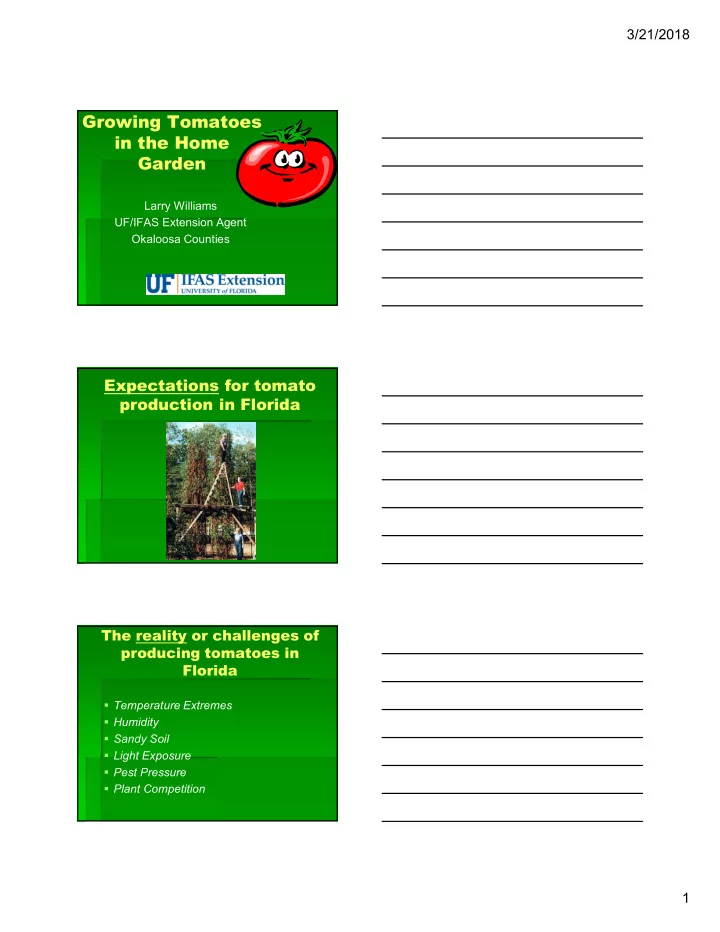
3/21/2018 Growing Tomatoes in the Home Garden Larry Williams UF/IFAS Extension Agent Okaloosa Counties Expectations for tomato production in Florida The reality or challenges of producing tomatoes in Florida Temperature Extremes


slide-1
SLIDE 1

3/21/2018 1

Growing Tomatoes in the Home Garden

Larry Williams UF/IFAS Extension Agent Okaloosa Counties

Expectations for tomato production in Florida

The reality or challenges of producing tomatoes in Florida

  • Temperature Extremes
  • Humidity
  • Sandy Soil
  • Light Exposure
  • Pest Pressure
  • Plant Competition
slide-2
SLIDE 2

3/21/2018 2

Solanaceae Family

  • Tomato (Meso american)
  • Pepper (Meso american)
  • Eggplant (Asian)
  • Potato (Andean)
  • Tobacco (Meso american)
  • Petunia
  • Nightshade: eastern & bitter black

Family includes:

Plant Growth Habits

  • Determinate
  • Flower clusters produced with only one or

two leaves (nodes) between them

  • After several clusters shoot will terminate in

an inflorescence (flower cluster)

  • Tend to be smaller plants that are suited for

caging or sprawling

  • Fruit tends to ripen all at once

Plant Growth Habits

  • Indeterminate
  • Three to four leaves are produced between flower

clusters

  • Shoot does not terminate in flower cluster
  • Since plants continue to elongate they are larger

and tend to get viney if not pruned

  • Suited for staking and caging
  • Fruit ripen throughout the growing season
  • ISI Indeterminate Short Internode varieties with

the controlled growth habit of a “determinate” with the unlimited production potential of an “indeterminate”

slide-3
SLIDE 3

3/21/2018 3

Plant Growth Habits

Determinate Indeterminate

Determinate Growth Habits Indeterminate Growth Habits

slide-4
SLIDE 4

3/21/2018 4

Flowers

  • Individual flowers

borne in clusters of 4-8 flowers

  • Largely self-

fertilized and primarily wind pollinated

Pollination

  • Are self-pollinated (agitation)
  • Anthers start releasing pollen mid-

morning (10 am – 2 pm)

  • Rainy conditions or late dew

persistence can cause pollination problems

Fertilization (eggs)

  • Pollen germinates to form a tube

that grows to ovule (egg)

  • Fertilization must take place within

24 hours of pollination

  • Low (< 50) or high (> 70) night

temperatures can slow down pollen tube growth and prevent fertilization

slide-5
SLIDE 5

3/21/2018 5

Growing Tomatoes

  • Site Selection
  • Cultivar Selection
  • Recommended Varieties
  • Cultural practices
  • Planting
  • Irrigation
  • Mulching
  • Staking & caging
  • Fertility
  • Diseases, Insects & Abiotic Disorders

Site Selection

  • Near house & water source
  • Open to good air movement
  • Full sun (> 5-6 hours/day)
  • Away from competing tree roots
  • Well-drained soils
  • Soil pH 5.8 - 6.3

Trees Compete!

Roots can extend up to three times the dripline of the tree.

Some trees have deep roots close to the trunk, but most tree roots are concentrated in the upper foot of soil.

slide-6
SLIDE 6

3/21/2018 6

Cultivar Selection

Considerations:

  • Disease Resistance
  • r Tolerance
  • Personal Preference

(Size, Color…)

  • Hybrid vs. Heirloom
  • Determinate vs.

Indeterminate Tomato Varieties Resistant to Bacterial Wilt & Tomato Spotted Wilt Virus Tomato Spotted Wilt Virus Resistant

  • BHN 602, Seigers, Seedway
  • Top Gun, Seigers, Seedway
  • Amelia (TSW & root knot nematode resistant)
  • Crista (TSW & root knot nematode resistant)
  • Quincy, Seminis dealers
  • Bella Rosa - Rupp Seed Company, 1-800-700-1199
  • Fletcher, also nematode resistant, Seedway
  • Mountain Glory

Bacterial Wilt Resistant

  • Neptune (Seeds are probably no longer available)
  • Florida 7514 – One parent is Neptune. – Rupp Seed Company, 1-800-700-1199
  • BHN 669 - Rupp Seed Company, 1-800-700-1199
  • BHN 446 – May not be available.
  • BHN 466 – May not be available.
slide-7
SLIDE 7

3/21/2018 7

Heirlooms

  • Family: seeds that have been

passed down for several generations through a family

  • Commercial: open-pollinated

varieties introduced before 1940

  • Created: crossing two known

parents and dehybridizing the resulting seeds for how ever many years/generations it takes to eliminate the undesirable characteristics

  • Mystery: varieties that are a

product of natural cross-pollination

  • f other heirloom varieties

Heirloom

  • More lobed and

undulated fruit

  • Open pollinated
  • More prone to

diseases, fruit cracking

  • 75 to 110 day

(Brandywine 100day)

  • Aunt Ginny,

Boondocks, Prudens Purple, Striped German, Old German, Amish Paste, Mr. Stripey

www.heirloomtomatoes.bizland.com

Plant Selection

  • Variety
  • Quality
  • Age (5 to 6 Weeks)
  • Size (5 to 7 Inches)
  • Pest Free (No Spots!)
  • Color (Dark Green)
  • Roots (Fibrous & White)

*Avoid old, oversized plants!

slide-8
SLIDE 8

3/21/2018 8

Cultural Practices

Planting:

Cultural Practices

Planting:

Mulching Watching for Pests

Cultural Practices

Watering the Garden:

slide-9
SLIDE 9

3/21/2018 9

Irrigation Considerations

  • Water early in day.
  • Young plants need 1” water per

week -- apply water frequently.

  • Mature plants need 2” water per

week - apply infrequently.

Cultural Practices

Mulching:

  • Retains soil

moisture

  • Reduces weeds
  • Moderates soil

temperatures

  • Less fruit disease

(no contact with soil)

Benefits of Mulch:

Cultural Practices

Staking and Pruning:

  • Staking
  • Trellising
  • On Fence
  • Cages

Note: Disinfect recycled stakes/cages.

slide-10
SLIDE 10

3/21/2018 10

Cultural Practices

Fertilizing Tomatoes:

Fertilizer Amounts

Fertilizing Tomatoes

Soil Type N-P-K Ratio Amount Amount banded per broadcasted per 10ft row 100 sq ft Sand, marl 6-6-6 5 oz 2-3 lbs

  • r clay

Organic 0-12-20 2 oz 1-2 lbs (muck or peat)

slide-11
SLIDE 11

3/21/2018 11 Sufficiency Ranges for Petiole Sap Testing for Tomatoes

Fresh Petiole Sap Concentration In Parts Per Million

Tomato Plant Stage Nitrate Nitrogen NO3-N Potassium (K) First Buds 1,000 - 1,200 3,500 - 4,000 First Open Flowers 600 - 800 3,500 - 4,000 Fruits one inch diameter 400 - 600 3,000 - 3,500 Fruits two inch diameter 400 - 600 3,000 - 3,500 First Harvest 300 - 400 2,500 - 3,000 Second Harvest 200 - 400 2,000 – 2,500

* As plants mature and fruit, the demand for nitrogen decreases. Excessive nitrogen can reduce fruit set and development. Results of Excessive Nitrogen!!! Big, Green, Ugly Plant with Few to No Fruit

Common Diseases

Tomato Spotted Wilt Virus Leaf & Fruit Symptoms Bacterial Wilt Symptom & Sign

slide-12
SLIDE 12

3/21/2018 12

slide-13
SLIDE 13

3/21/2018 13

Highly Magnified Thrips

Resistant Varieties (all use

Sw-5 gene, seeing up to 5 – 10 %)

  • Amelia
  • Talladega
  • Bella Rosa
  • Quincy
  • BHN 444
  • BHN 640
  • BHN 602
  • Crista

Metalized Mulch

Also called silver, aluminized, or highly UV-reflective mulch

slide-14
SLIDE 14

3/21/2018 14

Common Diseases

Fusarium Wilt Symptoms Early Blight Leaf & Stem Symptoms

Common Diseases

Bacterial Spot

  • n Leaf & Fruit

Phoma Fruit Rot Symptom

  • n Leaf & Fruit

Tomato Arthropods

slide-15
SLIDE 15

3/21/2018 15

Pest Control Arsenal

Copper-based Fungicide

Stink Bug & Leaffooted Bug

slide-16
SLIDE 16

3/21/2018 16

Trap Crops

Root-Knot Nematode

Nematodes Nematodes

Management

  • Crop rotation
  • Resistant

varieties

  • Organic matter
  • Cover crops
  • Soil solarization
slide-17
SLIDE 17

3/21/2018 17

Common Abiotic Disorders

  • Blossom Drop
  • Deformed Fruit
  • Blossom-End Rot
  • Sunscald
  • Herbicide Injury

Tomato Blossom Drop Deformed Fruit

slide-18
SLIDE 18

3/21/2018 18

Calcium Deficiency/ “Blossom-End Rot” Sunscald Herbicide Injury

slide-19
SLIDE 19

3/21/2018 19

Thanks! -- Questions? Additional Information Available at:

  • http://edis.ifas.ufl.edu
  • http://solutionsforyourlife.ufl.edu
  • http://ftsg.ifas.ufl.edu
  • Your local UF/IFAS Extension Office

Credits

  • Dan Mullins, UF/IFAS Extension Agent, Santa Rosa County
  • Larry Williams, UF/IFAS Extension Agent, Okaloosa County
  • Gerald Edmondson, UF/IFAS Extension Director, Okaloosa County
  • Dr. Steve Olson, UF/IFAS Extension Vegetable Crops Specialist
  • Linette Jerkins, Office Supervisor, Okaloosa County Extension
  • Kevin Schoessow, University of Wisconsin Extension Agent, Burnett,

Sawyer & Washburn Counties

Special thanks to the above for providing information and images for this presentation.