Growing Tomatoes Found the right spot for your garden Had a - - PowerPoint PPT Presentation

growing tomatoes
SMART_READER_LITE
LIVE PREVIEW

Growing Tomatoes Found the right spot for your garden Had a - - PowerPoint PPT Presentation

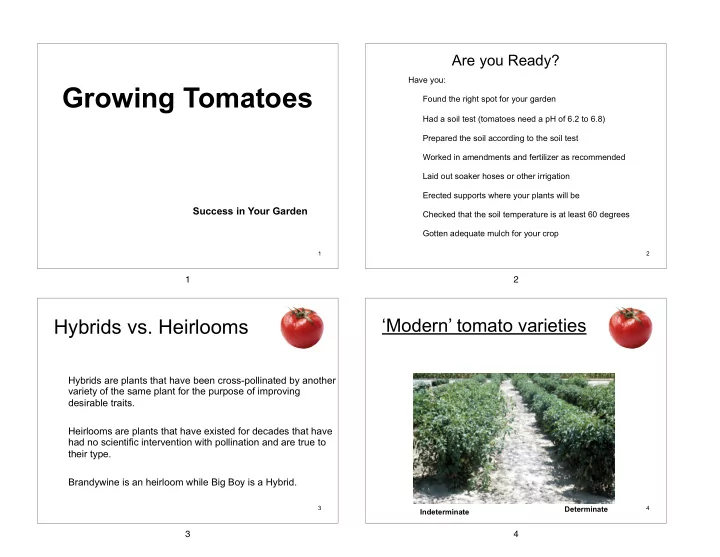
Are you Ready? Have you: Growing Tomatoes Found the right spot for your garden Had a soil test (tomatoes need a pH of 6.2 to 6.8) Prepared the soil according to the soil test Worked in amendments and fertilizer as


slide-1
SLIDE 1

Success in Your Garden

Growing Tomatoes

1

1

Are you Ready?

Have you:

  • Found the right spot for your garden
  • Had a soil test (tomatoes need a pH of 6.2 to 6.8)
  • Prepared the soil according to the soil test
  • Worked in amendments and fertilizer as recommended
  • Laid out soaker hoses or other irrigation
  • Erected supports where your plants will be
  • Checked that the soil temperature is at least 60 degrees
  • Gotten adequate mulch for your crop

2

2

Hybrids vs. Heirlooms

  • Hybrids are plants that have been cross-pollinated by another

variety of the same plant for the purpose of improving desirable traits.

  • Heirlooms are plants that have existed for decades that have

had no scientific intervention with pollination and are true to their type.

  • Brandywine is an heirloom while Big Boy is a Hybrid.

3

3

‘Modern’ tomato varieties

Indeterminate Determinate

4

4

slide-2
SLIDE 2

‘Modern’ tomato varieties

  • Hybrids
  • Semi-determinate (‘determinate’) vine
  • Multiple disease resistance
  • VFFFNTSWV (TotallyTomatoes

catalog shows resistance symbols)

  • Compact (patio) plants

5

5

Advantages of Compact Vine

  • Adapted to raised bed culture
  • Short cages or ‘stake-weave’
  • More stable in wind
  • Use less water and fertilizer
  • Closer spacing means more

plants per row

  • Yields comparable to large vined

types

6

6

Disadvantages of Compact Vines

  • Limited varieties
  • Often are determinate
  • All the crop ripens early in the season
  • Need other varieties for continued summer and

fall production

7

7

Grape/Cherry Type Tomatoes

  • Juliet (indeterminate)
  • Mountain Belle (determinate)
  • Sun Gold (indeterminate)
  • Suncherry (indeterminate)
  • Supersweet 100 (indeterminate)
  • Tumbling Tom (determinate)
  • Sweet Olive (determinate)
  • SunSugar (indeterminate)

8

8

slide-3
SLIDE 3

Standard Slicers

  • JetStar
  • Beefy Boy (indeterminate, short

internodes)

  • Jetsetter
  • Celebrity
  • Super Fantastic
  • Beefsteak
  • Better Boy

9

9

Heirloom Varieties

  • Cherokee Purple
  • Big Rainbow
  • Mortgage Lifter
  • Brandywine
  • Mr. Stripey
  • Arkansas Traveler
  • Pineapple

10

10

Growing Tomatoes

11

11

Don’t start too early in the season.

Stillwater can have a freeze even after the “Frost Free date - April 15.” Freezes can occur in May...but they are rare. Wait until the Soil temperature is a consistent 60oF to plant.

Below 60 degrees soil temperature, plant roots don’t develop properly so plants don’t absorb nutrients properly. Plants may survive but don’t ‘thrive.’

12

12

slide-4
SLIDE 4

How to Take the Soil Temperature

  • Take at a depth of 2 to 2.5 in between 10 and 11

am

–Note the OK Mesonet station in Stillwater reports a 4” bare soil –temperature - can use to monitor. https://www.mesonet.org/index.php/agriculture/monitor

  • Should be at least 60° for several days in a row

13

***double check the weather forecast to ensure a late season cold snap is not on the horizon.

13

What Happens if You
 Plant Too Early

  • Plants don’t grow
  • May get phosphorus deficiency

14

14

Planting Earlier

  • Use Walls-of-Water and Plastic Mulch

15

15

Transplanting

  • Use transplant solution (root stimulator)
  • One cup solution per plant

16

16

slide-5
SLIDE 5

Basic Information

  • Full sun
  • How many: 3 – 5 plants per person
  • Spacing: 2 to 4 feet between plants
  • Mulch when soil warms
  • Irrigation: Use drip irrigation or soaker

hoses

  • Training (sprawling, cages, stake & weave)

17

17

Drip Irrigation

  • Water doesn’t evaporate as quickly
  • Foliage doesn’t get wet; less disease

18

18

Mulching

  • Wait until soil warms
  • Straw or hay are most commonly used materials
  • Cottonseed hulls can also work well.

19

19

Training: Cages

  • Quick to set up
  • Tend to blow over, need room to store

20

20

slide-6
SLIDE 6

Cages: What to Use?

  • Can buy cages; often too wimpy
  • Try concrete reinforcing wire

21

21

Training: Stake & Weave

  • Takes more time
  • Requires pruning

22

22

Diseases, Growth and Fruiting Problems in Tomatoes

Viruses, fungi and environmental deficiencies can affect tomatoes.

  • Healthy plants that are fed and watered regularly, have

adequate room to grow, and are not exposed to environmental factors that are not normal can produce good fruits.

  • Preventative measures taken by the gardener can

lessen problems with plants and the crop.

  • When a problem arises, prompt action can save the
  • crop. Ignorance is not bliss!

23

23

Blossom drop from excessive summer heat.

Daytime 95 F, Night 75 F Excessive N; Hot, dry winds make problem worse A genetic trait- usually referred to as the Hot Set or Heat Set gene allows tomatoes to set under heat conditions. Many new varieties now are being developed with the Hot Set gene incorporated.

24

24

slide-7
SLIDE 7

Blossom-End Rot on Tomatoes

25

25

Blossom-End Rot on Tomatoes

  • Caused by calcium deficiency in fruit
  • Usually not a lack of calcium in the soil
  • Tops outgrow the roots during cool spring

weather

  • Weather turns hot and roots can’t keep up
  • Fruit bypassed; leaves have priority for water

and nutrients

  • Situation corrects itself in a couple of weeks

26

26

Blossom-End Rot: Recommendations

  • Avoid damaging the root system
  • Do a good job of watering
  • Mulching can help
  • Adding calcium to the soil or spraying

calcium on the plants usually does not work. Most soils in this area have adequate amounts of calcium.

27

27

The Top 10 Reasons Your Tomatoes Fail Part 1

Planting too early. Soil must be at least 60 degrees for a week or more. Soil pH is not correct. Must be between 6.2 and 6.8 for tomatoes. Too much nitrogen causes plants to get huge with no blossoms. Improper support for the tomato vines. Improper watering. Soil should be kept evenly moist. Overhead watering should be avoided.

28

28

slide-8
SLIDE 8

The Top 10 Reasons Your Tomatoes Fail Part 2

Weed competition. Weeds love all the tomato nutrients and will thrive while your tomatoes languish. Failure to control diseases. Provide adequate air circulation and check your plants daily for signs of disease. Promptly check with the Extension Office on how to deal with the problem. Failure to control insects. Insects eating your plants such as tomato hornworms or spider mites need immediate physical or chemical or biological controls. Poor soil drainage. Do not drown your tomatoes. Lack of calcium available for the plants causing blossom end rot.

29

29

OK State Fact Sheets

30

Growing Tomatoes in the Home Garden - http://

pods.dasnr.okstate.edu/docushare/dsweb/Get/ Document-1392/HLA-6012web.pdf

Common Diseases of Tomatoes - http://

pods.dasnr.okstate.edu/docushare/dsweb/Get/ Document-1323/EPP-7625web.pdf

We gratefully acknowledge the contributions of Chuck Marr, Horticulturist at Kansas State University for information and many of the slides in this presentation.

30

Tomato MD app

31

American Phytopathological Society http://www.apsnet.org/

apsstore/shopapspress/Pages/apps.aspx

  • Diagnostic key of tomato diseases based on

symptoms

  • An index of more than 35 common diseases,

insects, and mites that affect tomato plants

  • Covers causes and sources, symptoms,

management strategies, other plants that may serve as host to the pest, and more useful information

  • $2.99

31