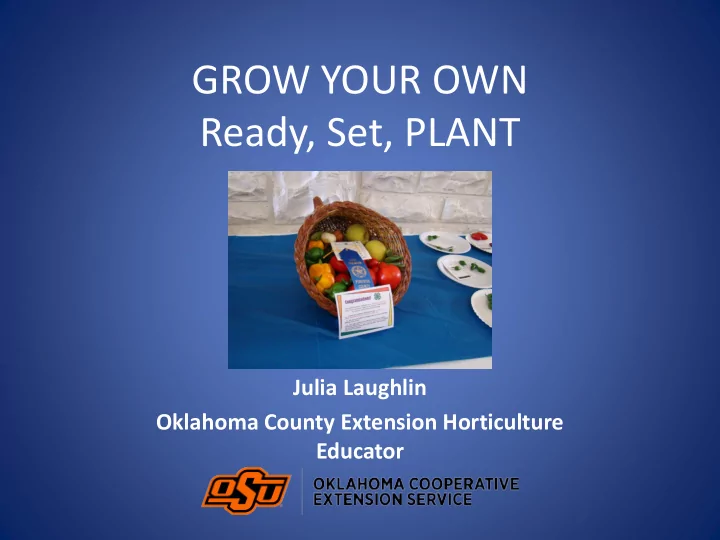
SLIDE 1 GROW YOUR OWN Ready, Set, PLANT
Julia Laughlin Oklahoma County Extension Horticulture Educator
SLIDE 2
Direct Seeding vs Transplants in the Garden
SLIDE 3 Warm season crops like hot temps and generally cannot take temps below freezing. Cool season crops like cooler temps and can take temps down to low 20’s or below in some cases… LAST FREEZE IN OK COUNTY?? About TAX DAY FIRST FREEZE IN FALL? Very near or after Halloween
SLIDE 4 Succession (Successive) Planting
Direct planting every 2 weeks during the season, works for many crops to increase harvest!
- Cool-season crops – like greens, radishes etc.
– Spring planting: February – March – Fall planting: July – October
- Warm-season crops – like green beans and
squash
– Summer planting: April – May – Fall planting: July – August
SLIDE 5 Keys to Successful Direct Sowing
- Don’t sow too deep, most seed cover 2-3
times their size.
- Keep them moist, but do not DROWN!
- Thin seedlings to correct spacing
– You can add washed thinnings of greens to your salad!
SLIDE 6
Using string line to mark rows will help you plant straight rows
SLIDE 7 Starting Transplants
– Small pots, newspaper pots, black plastic trays, peat pellets, peat pots, soil blocks, paper rolls, etc.
- Moisten potting soil thoroughly
– There are specialty “seedling mixes” that work great
- Place seed on soil and cover lightly with soil
– No deeper than 3x diameter – Lettuce seeds need light
– 12-16 hours of daylight is ideal – 70 degrees F
SLIDE 8 Starting Transplants, cont.
Please see my hand-out on this!
- If using clear plastic lids, remove them after
seed germinates
- Supplemental light should be placed 3-4”
above seed/plants
- Harden-off before planting outside
Limit water & fertilizer 3-5 days outdoors works well
SLIDE 9 When to Seed for Transplants
- Weeks before recommended transplanting
date:
- Cole crops – 4-6 weeks
- Onions – 10-12 weeks
- Lettuce – 4-6 weeks
- Peppers – 8-10 weeks
- Tomato & Eggplant – 6-8 weeks
- Melons & Cucumbers – 4 weeks
- Flowers – read label
SLIDE 10 Harden-off Seedlings
Even if you can move transplants outside for a couple of mild days it helps. If transplants get stressed at planting time it often kills them or sets them way back. Try placing the plants where they get protection for direct afternoon sun and hard winds. You may need to move inside at night or cover with a row cover or frost blanket.
www.rhs.org.uk
SLIDE 11 Saving Seed
Many gardeners like to save seeds from their own gardens, to plant again next year and to share with
- friends. Seed saving is a fun hobby and a useful art.
Depending on the species, seed saving is relatively easy (beans, tomatoes) or it may require considerable planning and care (squash, peppers).
SLIDE 12
Saving Seed – cont.
It is not recommended to save seed from a vegetable or flower that is an F1 hybrid since seeds from hybrid cultivars will produce a mixture of plant types, most of which will be inferior to the parent. The best possible success with F1 hybrids is to buy new seed each year of cultivar wanted. .
SLIDE 13
What is an heirloom variety: An open-pollinated variety having some considerable ancestry and history of use.
SLIDE 14
SLIDE 15 Seed Storage
Ideal seed storage temperatures should be between 40 to 50o . Most seed should be kept where the relative humidity does not go over 20-35%. You can freeze seed but MUST be airtight to prevent freezer burn! If seed becomes moist, regardless of temperature, it loses its ability to germinate over a period of
- time. At low temperatures, seed can be more
moist and still germinate well after a short storage period.
SLIDE 16 Germination Testing
A month or so before the seed is to be used, you can determine the percentage of seed which have the capacity to grow. The easiest way to do this is to moisten two or three layers of paper
- towels. Place 10 seeds on the towels and roll
them up. Do not roll tightly. A loose roll will provide more oxygen and give a better test. Place the rolls in a plastic bag. Keep in a warm place such as kitchen counter or on top of the water heater.
SLIDE 17
Germination Testing, cont.
Some seed germinates in a matter of several days, therefore, check the rolls every two or three days. In most cases, the seed should germinate in 10 to 14 days. If it has not, or if you get less than 50%, it might be best to discard the seed and buy fresh seed for the coming garden season.
SLIDE 18
Season Extension
By protecting plants form the elements we can grow later and start earlier or grow year-round. In the simplest form, it is a cloche. Greenhouses have heat and sometimes cooling systems and are the ideal season extension!
SLIDE 19 Spun bound Row Covers
- Also used as insect barrier! You could use
plastic but can smash crops. Anchor for winds!
SLIDE 20
Low Tunnels and High Tunnels
SLIDE 21
Cold Frames and Hot Beds
SLIDE 22
COOL SEASON VEGGIES FOR SPRING, FALL AND WINTER (WITH SEASON EXTENSION)
SLIDE 23 Beets, Radishes, Turnips, Carrots and Peas
- Direct sow Feb. 15 to April 15 in 2 week successions
and for fall mid-August.
- Follow seed packet directions for spacing, but
generally 2-4 inches.
- Detroit Dark Red beets, Cherry Belle radish and
Rainbow chard
SLIDE 24 GREENS: Leaf Lettuces, Collards, Kale, Chard, Turnips
- All direct sown from SEED except head lettuces
- Leaf lettuces are sown on 2-4 inch centers
- Give kale, chard, collards about 1 foot.
- Turnips you can grow varieties just for greens (like
ALLTOP) or just use the greens from your turnip crop. Either way space about 4 inches.
- Chard often goes all winter and through the next
summer! It will be your only green that works in summer heat.
SLIDE 25 Cole Crops and Head Lettuces
- Plant transplants in March without frost protection. For fall
plant mid-late August to mid September.
- Fall planting is best for brassicas but I always plant cabbage and
broccoli in spring too
- Space 12” for head lettuce and 14-18 for brassicas
- Add fertilizer when planting
- Try Packman broccoli, Snowball cauliflower, Red Head cabbage
and Butter crunch lettuce
- Cabbage worm will show up!
- WATCH OUT FOR BUNNIES!! Have to fence them out!
SLIDE 26
Snowball cauliflower
SLIDE 27
Buttercrunch Head Lettuce
SLIDE 28 Onions
- Purchase to plant in late February or early March
- Get the plants for large onions, the bulbs for small green
- nions
- At this time also pick-up your potatoes
- Space plants 4-6” to allow for maximum size or closer with the
intention of eating them green!
- Fertilize with Nitrogen Fertilizer (I like blood meal)
– 1 cup every 20 foot of row every 2-3 w (The more leafs, the more rings, the more rings, the larger the
SLIDE 29 Potatoes
– Purchase 2-3 weeks before planting and cut up to “callus” and be sure each piece ahs an “eye” TO “HILL” simply open a “trench” 4-6 inches deep
- Just barely cover the potatoes with soil
- Cover the potato plants weekly as they emerge
- Plants will set potatoes in the clipping and you will
never have to “dig” potatoes again
- Harvest when they start to bloom and fall over. Take
new potatoes and then hill the plant back up!
SLIDE 30 Callusing potatoes
- Make sure you leave an eye in each
piece
- Let pieces cure for about 10 days
SLIDE 31 Garlic
- Plant from cloves the end of September
to mid-October
- Space 4 inches apart
- Harvest next June!
SLIDE 32
WARM SEASON VEGGIES
SLIDE 33 Tomatoes, Peppers, Eggplant (the nightshades)
- All transplanted after April 15
- Space tomatoes 2 feet apart but peppers and
eggplants about 18 inches
- Tomatoes have to be staked or caged!
- Your hot peppers can make your sweet peppers hot!
- Watch out for Spider mites, hornworms and stink
bugs!
- Also eggplants get flea beetles
- Try Black Beauty eggplant and California Wonder
pepper
SLIDE 34 Favorite Tomato Varieties
- Early Girl
- Celebrity
- Sweet 100 (cherry)
- Sungold (cherry)
- Black Krims (Heirloom)
- Cherokee Purple (Heirloom)
SLIDE 35 Okra
- LOVES warm weather
- Plant in early May
- Space about 1 foot
- Soak seed overnight
- Try Clemson Spineless or Annie Oakley
- Harvest small at 3-4 inches
- No real pests although deer love it
- May need a ladder to harvest at the end of summer!
SLIDE 36 Beans and Southern peas
- Easy to grow and don’t need much fertilizer
- Start planting after April 15 for summer gardens and
August and early September for fall
- Direct sow and space 2-4 inches and plant succession
- f green beans!
- Pole beans need trellising but bush beans don’t
- Try Kentucky Wonder green bean and Pink Eye Purple
Hull cowpea
SLIDE 37 Cucurbits
- Squash, Cucumbers, Watermelons, Cantaloupe and
Pumpkins
- Can plant in hills
- Consider rowing upright/trellising
- Summer squash we eat when it is immature, winter
squash we eat when rind is hard
- Summer squash and melons can go on 2 foot centers
but winter squash and pumpkins need about 4-6 foot spacing
- Watch out for cucumber beetles and squash bugs!
- Try Black zucchini, strightneck squash. Black
Diamond watermelon. Waltham butternut and Acorn winter squash and Hales best jumbo cantaloupe
SLIDE 38 Sweet Corn
- HEAVY feeders you will have to fertilize with nitrogen
- Warmer soil temperatures needed so sow in April
- Plant 2 seeds every foot and then thin to one sealing
- Only 1 type can be grown at a time or stagger
plantings by 12 days
- “SuperSweet” varieties probably best
- Try “Silver Queen” or “Candy Corn”
- Watch out for corn ear worm – use mineral oil at silk
fall
- Must test ears for correct harvest!
SLIDE 39 Sweet Potatoes
- Plant from “slips” in early June
- Easy to grow – but keep weeds out early
- Be sure to harvest before frost or freeze in October
- Try Jewel or Beauregard
SLIDE 40 Asparagus and other Perennial Vegetables
- Asparagus varieties include Mary & Martha Washington (the
- ld standard bearers), UC 157 F1, Jersey Giant, Jersey Knight
- Plant in March-early April from transplants
- Since they are perennial, aged manure underneath is a good
idea.
- Wed control is a must! Look out for asparagus beetles
- Do not harvest asparagus the first year and then lightly the
second year. After that harvest for 8-10 weeks.
SLIDE 41
WE HAVE A SITUATION!
SLIDE 42 Integrated Pest Management
Pests can be insects, diseases and weeds!
- Garden establishment
- Plant maintenance
- Pest avoidance
- Monitoring
SLIDE 43 Good Cultural Practices for Pest Control
- Crop Rotation
- Choose Resistant Varieties
- Sanitation
- Barriers/Row Covers for Insects
- Mechanical – Vacuuming/Flaming
- Cultivation/Tillage/Mulching
- Crop and Variety Selection
- Crop Timing
- Crop Diversification/Companion Planting/Trap Cropping
- Recognize and Encourage Beneficials
SLIDE 44 A Word About Crop Rotation
- Tomatoes, tomatillos, peppers,
potatoes, and eggplant are all in the same family (nightshades)
- Cucumber, squash, watermelon, and
cantaloupe are in the same family (cucurbits)
- Rotate crops yearly, outside of plant
families, to avoid soil-borne insect and disease problems
SLIDE 45 Pests and Disease
– Handpick if you can – Firm stream of water for aphids and spider mites – Horticultural oils and soaps
– Increase airflow – Remove leaves or prune out when you can – Keep water at soil level and off leaves – Remove and replace sick plants, if early enough in the season
– Not caused by insect or disease – Environmental
SLIDE 46 Environmental Problems
- Drought
- TOO Much water - irrigation or RAIN
- HEAT
- Wind
- Hail
- Varmints
SLIDE 47 Abiotic Problems Catfacing
pollination
temperature at pollination time
SLIDE 48 Abiotic Problems Blossom End Rot
the fruit
- Plant is growing too fast
and calcium is going into foliage and not the fruit
- Get calcium to plant
- Fluctuations in available
water increase so mulcning helps!
and cucurbits
SLIDE 49
- Most insect and disease pests are going to be “host
specific,” in other words, know your crop, know your
- enemies. Some insects are not very picky, like
grasshoppers and powdery mildew, and can devastate many different crops. Count on your Extension Educator, fact sheets and other references to help you ID your problem and plan your management strategies.
SLIDE 50 Dealing with Insect Pests
- Look for and encourage beneficials
- Know your enemy and the alternative and natural strategies
- Control could be as simple as a spray of water, a mineral, soap
- r oil based spray, biological agent, crop timing, crop rotation
- r another improvement of cultural technique (improved
drainage, companion planting etc.)
- Allow a natural microclimate ecosystem to establish
SLIDE 51
Insect Pests – THE WORST
SLIDE 52 General Pest Problems Grasshoppers
- Very very hard to control
- Heavy populations some years due to successful egg
laying
- Organic and traditional farmers use baits and
“Grasshopper spores”
SLIDE 53 General Pest Problems Grubs and Cutworms
- Soil inhabiting
- Cutworm comes up to feed
- Grub will feed on roots
- Winter cultivation kills both
SLIDE 54 General Pest Problems Spider Mite
- Goldening speckling of the
upper surface of the leaf
- SOMETIMES webbing
- Hot weather lovers
- Soap and oil solutions
– 3Tbs dishwashing soap – 3 Tbs vegetable oil / one gallon water
SLIDE 55 General Pest Problems Aphids
- Aesexual
- Cool weather lovers
- Piercing/sucking mouthparts
- Create “honeydew” which fosters “sooty mold”
- Hard spray of water, soap solution or any insecticide!
SLIDE 56
Aphid/Ant Mutualism
SLIDE 57
Beneficials Ladybird beetle, eggs and larvae
SLIDE 58
Beneficials Black and Yellow Garden Spider
SLIDE 59
Beneficials Wheel Bugs/Assassin Bugs
SLIDE 60
Beneficials Adult Lacewing, larvae and eggs
SLIDE 61
If you build it they will come…
SLIDE 62 Disease Control Strategies
- Understand disease triangle: host, pest, environment
- Be aware that many insects “vector” plant diseases
- Choose resistant varieties when possible
- Practice sanitation
- Use planned crop rotation on annual crops
- Use of best cultural techniques for the crop (proper
fertilization, staking for good air movement etc.)
- If using a natural fungicides or bactericides, know the correct
timing for best control
SLIDE 63
SLIDE 64 Disease Management
mtvernon.wsu.edu Kim Rebek
Sanitation
SLIDE 65 “Organic” Pesticides
- Botanical Pesticides – Neem, Pyrethrum
- Microbial Pesticides – Bacillus thuringiensis (B.t.)
Beuveria, Spinosad
- Mineral/Soap/Oil Pesticides – Sulfur, Copper,
Potassium Bicarbanate, Insecticidal soap, Horticultural oils
- NOTE: These products can still be toxic to
humans and Beneficials!
SLIDE 66 Weed Control Strategies
- MULCH MULCH MULCH MULCH MULCH!!!! Using OM!
- Try to choose land that is not already infested with a difficult weed
population
- Eliminate the weed species before planting if at all possible
- Weed barriers such as thick mulches, landscape fabric, cover crops and
plasticulture can be used
- Consider cultivation equipment options
- Design plantings to allow for cultivation, if possible, and NEVER let them
go to seed!
- Consider “Flaming” if your are going “Organic”
SLIDE 67 Weed Control Strategies
- MULCH MULCH MULCH MULCH MULCH!!!! Using Organic Matter if you
can!
- CULTVATE! Consider cultivation equipment options..hoes, knives etc.
- Try to choose land that is not already infested with a difficult weed
population
- Eliminate the weed species before planting if at all possible
- Weed barriers such as thick mulches, landscape fabric, cover crops and
plasticulture can be used
- Design plantings to allow for cultivation, if possible, and NEVER let them
go to seed!
SLIDE 68 Benefits of MULCHING
- Organic mulches, like compost, add small
amount of organic matter over time
– Controls weeds – Increases moisture – Decrease runoff and erosion – Regulates soil temperature
SLIDE 69 Weed Management
Organic Mulches
www.ipmthailand.org i22.photobucket.com www.wildernessnursery.com
SLIDE 70 Weed Management
Inorganic Mulches
www.wildernessnursery.com www.hightunnels.org
Newspaper Plastic
SLIDE 71 SAVE THE FLAVOR
- Harvest at the right time for peak quality and
then store correctly and preserve quickly.
- Check out the Extension information on
canning, freezing and drying produce
SLIDE 72 Harvest Practices for Nightshade Crops
- Eggplant based on glossy skin prior to:
– Skin getting tough – Seeds maturing
- Pepper based on size primarily
– Color for some markets
- Tomato based on fruit color
– Breaker stage at least – Full red color for local sales
SLIDE 73
Take tomatoes at the BREAKER stage
SLIDE 74 Harvesting Cucumbers and Squash
- Cucumber & summer Squash – desired size of
fruits
- Winter Squash, Pumpkin - rind hardening & loss
- f shine
SLIDE 75 Cantaloupe harvest at half slip!
SLIDE 76 Watermelon harvest
- Thump it?
- Yellow belly?
- Dried tendril closest to the fruit
SLIDE 77 Harvesting Beans
www.hort.cornell.edu www.hort.purdue.edu
Snap beans: Do not let pods overfill & harvest young pods regularly
SLIDE 78 Harvest Practices Okra, Corn & Potatoes
- Okra - size 2-3.5” long, free of fiber & tender
- Potato - size, specific gravity, skin set
–Reduce irrigation, kill vines 2-3 wks prior to harvest
- Sweet corn - kernels should be pale yellow &
plump with some small kernels at the end
- Sweet potato - harvest prior to freeze
–Usually, the bigger the better
SLIDE 79 Onion Harvest
- Do you need to step on the tops?
- No, they will go over on their own
– Bulbing is initiated by day length
- Dig 7-10 days after tops go over
– Store in dry shady area
SLIDE 80 Harvesting Spinach and other Greens
– Pinch-off outer leaves – Keep 50% intact for further growth – Chard may produce up to 2 years!
www.hort.purdue.edu
SLIDE 81 Harvesting Lettuce
Head and Romaine: Harvest at appropriate size, cut at crown Loose leaf types: Cut outer leaves one-by-one, leaving inner leaves to mature
SLIDE 82 Harvest Cabbage
www.yaguinalights.org
Twist heads to harvest
are the size
SLIDE 83
Fall is actually one of the best gardening seasons in Oklahoma!
Most gardeners are tired at the end of summer and forget about it…but it is really a good time to grow veggies!
SLIDE 84
For more information…
Oklahoma Cooperative Extension Fact Sheets at: http://osufacts.okstate.edu