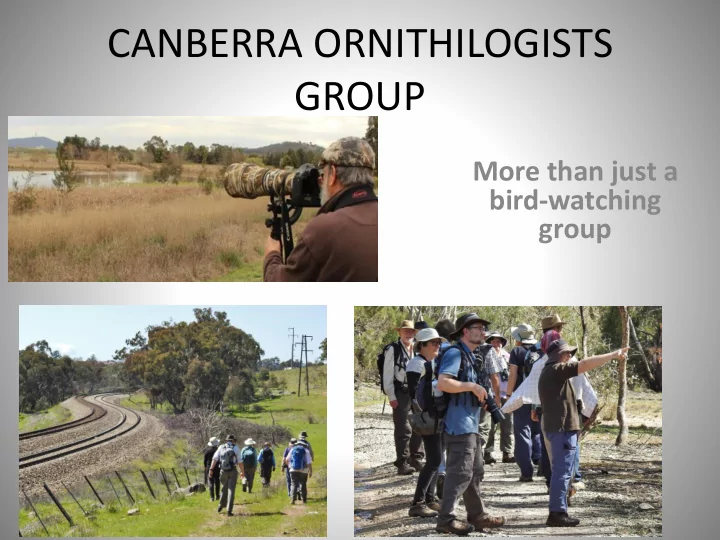
GROUP More than just a bird-watching group COG what is it? - - PowerPoint PPT Presentation
CANBERRA ORNITHILOGISTS GROUP More than just a bird-watching group COG what is it? Dedicated to the conservation of birds and their habitat 50 years old 30 years of data on birds Contributes to environmentally sensitive
COG – what is it?
- Dedicated to the
conservation of birds and their habitat
- 50 years old
- 30 years of data on birds
- Contributes to
environmentally sensitive and sustainable development in the ACT
- Works with a range of
partners and the community
White-winged Choughs
How do we do this?
Data Collection – surveying and monitoring
- Database informs future
planning to conserve and maintain ACT birds in the landscape
- Surveying and monitoring
data collected over 30 years
Typical Grassy Woodland Species – White -eared Honeyeater, Leaden Flycatcher , Rufous Whistler
Data Collection – surveying and monitoring
- Includes:
- 21 years of woodlands
survey
- 35 years of Garden Bird
Survey
- 10 plus years of
waterbird surveys in Jerrabomberra Wetlands in the ACT and Lakes George and Bathurst
Jerrabomberra Wetlands Nature Reserve
Partnerships
COG works with a number
- f partners:
- ANU
- Woodlands and
Wetlands Trust
- ACT Conservation
Council
- CIMAG
- ACT Government
- Greening Australia
Bush-stone Curlew Jerrabomberra Wetlands Nature Reserve
Research
- A range of research
activities supported
- Canberra Bird
Conservation Fund
- Supports ANU and
Canberra University PhD students doing research work on birds
- 14 projects to date
Survey at Jerrabomberra Wetlands
Citizen Science
- Citizen science - Gang-
gang Year of the Bird project
- engaged community in
reporting sightings of Gang-gangs over 12 months
- Analysis of data to
provide a much better picture of conservation needs of Gang-gangs
Gang-gang Cockatoo
WHAT HAVE BEEN OUR SUCCESSES?
Conservation Role
- Strong conservation stance about the natural
landscape in the ACT
- COG has influenced decision-making by ACT
Government agencies in urban development
- Data assisted with conservation of the
endangered Yellow Box/Redgum grassy woodland ecological ecosystem
Case Study - Mulligans Flat
- Data gathered since the
80s
- Grazed leasehold
earmarked for urban development
- Baseline data
highlighted ecological value and importance
- f the large area of
Yellow Box/Redgum grassy woodland
New Suburb of Casey
Case Study - Mulligans Flat
- Mulligans Flat was declared a
reserve in 1995 due to the survey and monitoring work by and lobbying of government by COG and other groups
- Now one of the largest and
most important Yellow Box/Redgum grassy woodland areas under public protection
- Site of a large scale woodlands
research and restoration experiment with the re- introduction of locally extinct species
Mulligans Flat Woodland Sanctuary
Case Study - Throsby
- COG data contributed
to government decision to include area of the proposed new suburb
- f Throsby in
Goorooyaroo Nature Reserve
- Superb Parrot surveys
contributed significantly to outcome
Goorooyarroo Nature Reserve
Case Study - Throsby
- Reduces the
development footprint in Throsby
- Will help protect
Superb Parrot breeding trees
- Superb Parrots only
EPBC Act 1999 listed species regularly visiting Canberra
Superb Parrot
Listing of Threatened Species
- Data contributed to listing of
several bird species under ACT legislation
- Species threatened include
- Scarlet Robin, Brown
Treecreeper, Hooded Robin
Scarlet Robin Brown Treecreeper Hooded Robin
Where to from Here
- Helping to preserve the
“Bush Capital”
- Contribute to build the
bird knowledge base
- Maintain ongoing
research
- Continue survey work in
Greening Australia’s K2C program
Gang-gang Cockatoo feeding young
Where to from Here
- Continue work with the
Woodlands and Wetlands Trust on the re- introduction of the Bush- stone Curlew
- Develop further citizen
science activities such as more Bird of the Year projects
- Continue to raise
community awareness about the importance of birds in the landscape
Grey Cuckoo-shrike feeding young