Group C Vito Guardi Joseph Ferrari Vlad Kopman Introduction - - PowerPoint PPT Presentation

group c vito guardi joseph ferrari vlad kopman
SMART_READER_LITE
LIVE PREVIEW

Group C Vito Guardi Joseph Ferrari Vlad Kopman Introduction - - PowerPoint PPT Presentation

Group C Vito Guardi Joseph Ferrari Vlad Kopman Introduction Specifications Limitations AGV System How It Works Safety Features Error Checking MATLAB Interface Cost Analysis Acknowledgements Future Tasks


slide-1
SLIDE 1

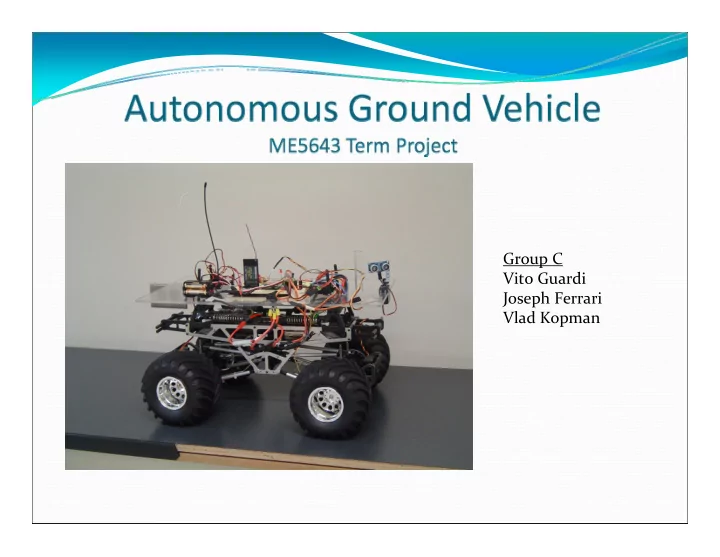
Group C Vito Guardi Joseph Ferrari Vlad Kopman
slide-2
SLIDE 2
  • Introduction
  • Specifications
  • Limitations
  • AGV System
  • How It Works
  • Safety Features
  • Error Checking
  • MATLAB Interface
  • Cost Analysis
  • Acknowledgements
  • Future Tasks
slide-3
SLIDE 3

Objectives

  • Search a given area for a target
  • Find a target using sensors
  • Stop moving when a target is found
  • Report the targets GPS coordinate back to the base
  • Calculate the Distance and Bearing to the target

from the base

  • Point turret on base at target

Possible Uses

  • Real‐Time protection of a temporary battalion rest

camp

  • Autonomous patrol of areas adjacent to a

stationary turret installation

slide-4
SLIDE 4
  • Maximum Speed………………….15 mph
  • Minimum Turning radius…….5 feet
  • Runtime………………………………20 minutes
  • GPS accuracy……………………….16.5 ft
  • GPS refresh rate…………………..1 second
  • 912 MHz RF modem range…..800ft
  • Target detection range………….1 to 4 ft
  • Maximum searching radius….25ft
  • Processing power………………….1 Parallax Propeller

microcontroller – approx 8BS2’s

slide-5
SLIDE 5

The AGV should never be run with out the supervision of a trained

  • perator

It is up to the operator to ensure that the 75.550MHz and 912MHz frequencies are not being used by other devices, as it will cause harmful interference in the operation of the AGV The operator should also hold the manual override transmitter while the AGV is in any mode of operation Due to the added weight of the circuitry on the AGV it is top heavy and while excessive maneuvering is possible at high speeds it runs the risk of flipping the AGV over

slide-6
SLIDE 6
  • Package Type = 40‐pin DIP
  • Processors (cogs) = Eight
  • Architecture = 32‐bits
  • System Clock Speed = DC to 80 MHz
  • Power Requirements 3.3 volts DC
  • Global RAM/ROM = 64 K bytes; 32 K RAM

/ 32 K ROM

  • Cog RAM = 512 x 32 bits each
  • I/O Pins = 32 (simultaneously addressable

by all eight cogs)

  • Current Source/Sink per I/O = 50 mA
  • Running tasks in multiple cogs allow the propeller to effectively do

multiple tasks at the same time

  • Cogs can indirectly communicate with each other via access to a

common global memory / hub

  • Eliminates the need for multiple microcontrollers
slide-7
SLIDE 7

Platform

Tamiya TXT – 1 Chasse Features

  • Four Wheel Drive
  • Durable Construction
  • Twin 500 size motors
  • Servo saver prevents damage

to steering servo

  • Off‐road suspension
  • Thermal and current overload

protection Disadvantages

  • Old mechanical speed

controller gives only crude inaccurate control of speed

  • Inadequate turning radius
slide-8
SLIDE 8

Electronic Speed Controllers

  • Two Viper Marine 15 ESCs
  • High current (15Amp cont.)
  • Precision control of motor

speed

  • Forward and Reverse
  • Built in safety features

Four Wheel Steering

  • Two high torque servos
  • Greatly reduced turning

radius High Capacitance Batteries

  • 4.2 AHr 7.2V Batteries
  • Increased runtime by several

minutes

slide-9
SLIDE 9

Wireless Transceiver Propeller and support circuitry GPS Receiver Viper Marine 15 ESC

slide-10
SLIDE 10

Opto‐Reflective Switch Ultra‐Sonic (PING) Sensor Opto‐Reflective switch used in conjunction with an ADC to make an optical encoder Uses an IR Photo transistor and an IR LED which prevents sensitivity to ambient light

slide-11
SLIDE 11

Potentiometer Wireless Transceiver

  • Comm. Port For MATLAB Interface
slide-12
SLIDE 12
slide-13
SLIDE 13
slide-14
SLIDE 14
slide-15
SLIDE 15

Level 1 Safety Features ‐ Active

  • At any moment the operator can chose to take the AGV out of autonomous
  • peration and take control of the robots main functions

Level 2 Safety Features – Passive

  • If the operator takes the AGV out of the rage of the manual override

transmitter it will automatically cut the throttle

  • If the Propeller Microcontroller fails and control signals are no longer sent

to the ESC, the Viper Marine 15’s internal fail safe activates cutting the throttle Manual Override Switch Programmable Fail‐Safe Unit

slide-16
SLIDE 16

When sending critical 32 bit data through an 8 bit radio modem error checking is a necessity

  • 32 bit data is first broken down into

4 segments of 8 bit data

  • Each segment is sent with a unique

identifier character before it

  • One segment is received at a time

and the order of the data received is confirmed using the identifier character

  • If one of the 4 segment is missing all
  • f the data is rejected
slide-17
SLIDE 17
  • Distance and bearing calculations are too complex for the propeller
  • Propeller is interfaced with MATLAB through simulink
  • Create serial object
  • Communicate with propeller through COM port
  • Incorporate error checking to ensure both MATLAB and propeller are synced
  • Ensure erroneous data is not sent between MATLAB and propeller
  • Simulink creates a user interface for displaying data
  • Matlab creates GPS coordinates of different search patterns
  • To be used in future work
slide-18
SLIDE 18
  • Distance and bearing calculations are too complex for the propeller
  • Propeller only can work with 7 significant figures
  • Shortest distance is the great‐circle distance between two points on the earth
  • Bearing is the direction (degrees east of north) between two points
  • Calculated using ATAN2 function
  • Bearing changes along a great‐circle, so we can:
  • Constantly update bearing
  • Follow a rhumb line (line of constant bearing, but not shortest distance)
  • Assume constant bearing over short (< 100ft) distances our solution
slide-19
SLIDE 19
slide-20
SLIDE 20

Part Cost Per Unit Units Total Cost ONFA Fail Safe $26.99 1 $26.99 Viper Marine 15 ESC $50.00 2 $100.00 Futaba 3Ch Remote $109.99 1 $109.99 7.2V 4.2 Ahr Battery $39.99 1 $39.99 9.6V .9Ahr Battery $34.99 1 $34.99 Propeller Microcontroller $12.95 2 $25.90 5V 1A Voltage Regulator $1.95 2 $3.90 3.3V .5A Voltage Regulator $1.95 2 $3.90 Various Capacitors $3.00 1 $3.00 Various Resistors $3.00 1 $3.00 Tamiya TXT‐1 Kit $369.99 1 $369.99 8 Bit Analog to Digital Converter $6.00 1 $6.00 Opto‐Reflective Switch $15.00 1 $15.00 Wire $10.00 1 $10.00 Solder $10.00 1 $10.00 Plexiglass $30.00 1 $30.00 Parallax Wireless Tranciever $49.95 2 $99.90 Parallax GPS Reciever $89.95 1 $89.95 6 Inch Breadboards $15.00 2 $30.00 Parallax Ultrasonic Ping Sensor $29.95 1 $29.95 Standard Servo $12.95 1 $12.95 High Torque Servo $32.99 2 $65.98 Reed Relays $2.99 2 $5.98 H Bridge $7.00 1 $7.00 Misalaneous Hardware $20.00 1 $20.00 Total $1,154.36

slide-21
SLIDE 21
  • Interface a digital compass with the AGV so that it knows its heading
  • Follow the heading calculated by MATLAB
  • Follow a series of waypoints that create a search pattern
  • Create a more sophisticated target recognition system
  • Obtain a more accurate GPS location of target
  • Integrate a digital compass into the base station
  • Improve accuracy
  • Remove need for calibration or orientation
  • Increase scope of project
  • Multiple AGVs
  • Multiple turrets
slide-22
SLIDE 22
  • Sang‐Hoon (Nathan) Lee
  • Parallax Propeller Object

Exchange

  • http://obex.parallax.com/P

arallax

  • Propeller Web Forum
  • http://forums.parallax.com

/forums/default.aspx?f=25