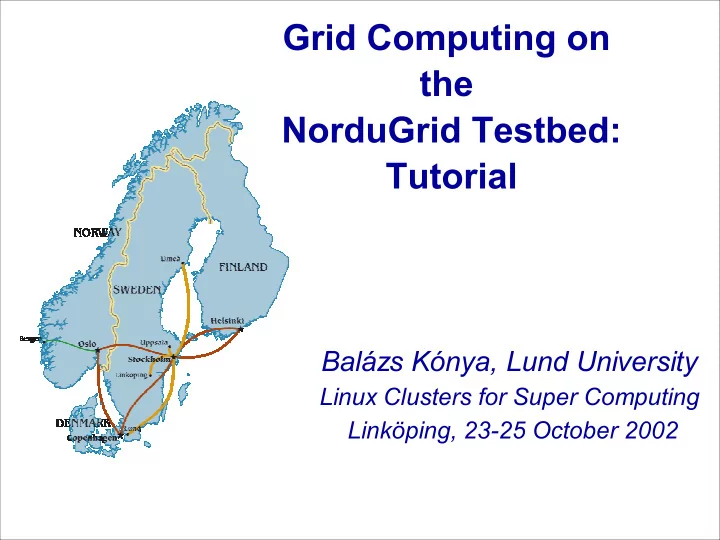
Grid Computing on the NorduGrid Testbed: Tutorial Balzs Knya, - - PowerPoint PPT Presentation

grid computing on the nordugrid testbed tutorial
SMART_READER_LITE
LIVE PREVIEW

Grid Computing on the NorduGrid Testbed: Tutorial Balzs Knya, - - PowerPoint PPT Presentation

Grid Computing on the NorduGrid Testbed: Tutorial Balzs Knya, Lund University Linux Clusters for Super Computing Linkping, 23-25 October 2002 outline 15:15-16:00 Introduction to Gridcomputing 16:00-16:15 Installation coffee break


slide-1
SLIDE 1

Grid Computing on the NorduGrid Testbed: Tutorial

Balázs Kónya, Lund University

Linux Clusters for Super Computing Linköping, 23-25 October 2002

slide-2
SLIDE 2

NorduGrid Tutorial, LCSC 2002 2

  • utline

15:15-16:00 Introduction to Gridcomputing 16:00-16:15 Installation coffee break 16:15-16:30 Logging into the Grid: dealing with certificates 16:30-17:00 NorduGrid Testbed overview: architecture, Grid services 17:00-17:50 Living on the NorduGrid

  • verview of a Grid session

what is on the Grid?: resource discovery (MDS) the “Hello Grid” job

slide-3
SLIDE 3

NorduGrid Tutorial, LCSC 2002 3

  • utline cont.

the command line UI & Broker: ng commands formulating a Grid job request: the eXtended Resource Specification Language (XRSL) exercises data access on the Grid: the notion of replicas 17:50-18:00 Summary, Future Plans

for the impatient:) www.nordugrid.org/documents/ngclient-install.html

slide-4
SLIDE 4

NorduGrid Tutorial, LCSC 2002 4

NorduGrid Tutorial

Introduction to Grid Computing

slide-5
SLIDE 5

NorduGrid Tutorial, LCSC 2002 5

What is the Grid?

Grid is a technology to share and seamlessly access resources of the world: computing cycles datasets, software, special instruments the Holy Grail of distributed computing Middleware: a bag of software which implements Grid Standards & protocols World Wide Web access to information World Wide Grid access to computing capacity and ...

slide-6
SLIDE 6

NorduGrid Tutorial, LCSC 2002 6

What is the Grid?

The future infrastructure of computing and data management The Computational Power Grid a very ambitious attempt to create a new utility, next to the already existing water, heating, electricity, ... the present hype in IT

source: IBM

slide-7
SLIDE 7

NorduGrid Tutorial, LCSC 2002 7

History

Grand Scientific Challenges of the 80's

parallel computation high performance & high throughput computing

Early ”Testbeds” in the USA connected supercomputing centers at the late 90's Ian Foster, Carl Kesselman, July, 1998: Blueprint for a new Computing Infrastructure

slide-8
SLIDE 8

NorduGrid Tutorial, LCSC 2002 8

History cont.

The Computational Grid <-> Power Grid analogy was suggested The birth of the ”ancient” middleware solutions

Globus, Legion, Condor, NWS, SRB, NetSolve, AppLes,Unicore “demonstration quality Testbeds: Gusto” no real users loose of interest in Grids

2000+: The Grid revives and gets “Global”

The High Energy Physics community picks up the nearly forgotten Grid idea The appearance of the Global Grid Forum de facto standard middleware: Globus

the “Grid phenomena” or hype is started

Grid Projects are launched everywhere, governments & research agencies rush to support Grid project

slide-9
SLIDE 9

NorduGrid Tutorial, LCSC 2002 9

History cont.

Huge commercial interest: startup companies & the Big Names try to sell the Grid

IBM wants to Grid-enable the company’s entire product portfolio commercial Grid software (IBM, Platform Computing, SUN) commercial support, consulting, training seriuos research projects (mainly biology) among the customers

last Global Grid Forum meeting in Edinburgh July, 2002:

  • ver 850 participants

Key speakers involved: IBM, Nec, Hewlet Packard, Microsoft, SUN

Daily Grid magazines: www.thegridreport.com, www.gridtoday.com,

www.gridcomputingplanet.com

Everything is called Grid, the word “Grid” is inflated to a marketing term the divergence of Grid Toolkits and solutions

slide-10
SLIDE 10

NorduGrid Tutorial, LCSC 2002 10

European projects Grid Computing Today

slide-11
SLIDE 11

NorduGrid Tutorial, LCSC 2002 11

Current EU founded projects

DATAGRID GRIDSTART GRIA DAMIEN GRIP EUROGRID DATATAG GRIDLAB CROSSGRID AVO EGSO

FLOWGRID OPENMOLGRID GRACE COG MOSES GEMSS BIOGRID SELENE MAMMOGRID

slide-12
SLIDE 12

NorduGrid Tutorial, LCSC 2002 12

EU FP6

slide-13
SLIDE 13

NorduGrid Tutorial, LCSC 2002 13

USA projects

DISCOM SinRG APGrid IPG …

slide-14
SLIDE 14

NorduGrid Tutorial, LCSC 2002 14

TeraGrid

53 million from the NSF 13.6 teraflops of Linux clusters 450 terabytes of data storage 4 sites 40 Gbits/sec (later 50-80) network connections Globus based Grid toolkits Visualisation environment

slide-15
SLIDE 15

NorduGrid Tutorial, LCSC 2002 15

TeraGrid

HPSS HPSS 574p IA-32 Chiba City 128p Origin HR Display & VR Facilities Myrinet Myrinet 1176p IBM SP Blue Horizon Sun E10K 1500p Origin UniTree 1024p IA-32 320p IA-64 HPSS 256p HP X-Class 128p HP V2500 92p IA-32

NCSA: Compute-Intensive ANL: Visualization Caltech: Data collection and analysis applications SDSC: Data-oriented computing

slide-16
SLIDE 16

NorduGrid Tutorial, LCSC 2002 16

Asia Pacific Projects

Japan: AIST GTRC China: SDG Korean Grid Thailand:ThaiGrid Australia: GRIDSLab

slide-17
SLIDE 17

NorduGrid Tutorial, LCSC 2002 17

Grid in the NEWS

slide-18
SLIDE 18

NorduGrid Tutorial, LCSC 2002 18

Grid in the NEWS

slide-19
SLIDE 19

NorduGrid Tutorial, LCSC 2002 19

Vision...

Cohen Communication Group:

  • Grid computing will be the driving force behind the 150%

annual internet traffic expansion in 2005

  • in contrast to the 60% predicted growth rate accounted mainly

for video streaming and video file transfer forecasted by McKinsey - JP Morgan

IBM:

  • Grid is the next utility in the line of the water, drainage, gas

and electricity systems

  • people will pay their “computing bills”
slide-20
SLIDE 20

NorduGrid Tutorial, LCSC 2002 20

Oversold?

The promise of the Grid has been not oversold but the difficulty of developing the necessary Grid infrastructure has been underestimated

Ian Foster:

People used to overestimate the short term impact of change but underestimate the long- term effect

slide-21
SLIDE 21

NorduGrid Tutorial, LCSC 2002 21

what is behind?

Powerful PCs are everywhere Clusters are commodity Network & Storage & Computing exponentials:

  • Networking speed grows

faster than computing power

  • Even data storage
  • utperforms the CPUs

source: Scientific American, Jan 2001

slide-22
SLIDE 22

NorduGrid Tutorial, LCSC 2002 22

The physicist's real challenge:

slide-23
SLIDE 23

NorduGrid Tutorial, LCSC 2002 23

there are already ...

Walmart Inventory Control

Satellite technology used to track every item Bar code information sent to remote data Inventory adjusted in real time to avoid shortages and predict demand Data management, prediction, real-time, wide-area synchronization

SETI@HOME

3.8M users in 226 countries 1200 CPU years/day 1.7 ZETAflop over last 3 years (10^21) 38 TF sustained performance (Japanese Earth Simulator is 40 TF peak) Highly heterogeneous: >77 different processor types

slide-24
SLIDE 24

NorduGrid Tutorial, LCSC 2002 24

... distributed applications

Everquest

45 communal “world servers” (26 high-end PCs per server) supporting 430,000 players Real-time interaction, individualized database management, back channel communication between players

Napster, Gnutella, Kazaa, etc...

file sharing ask the music industry :)

Google

database, search engine more than 150 million searches per day, 2 billion indexed pages, more than 10.000 linux servers

slide-25
SLIDE 25

NorduGrid Tutorial, LCSC 2002 25

there should be a Grid ...

Existing real world examples demonstrate that it is technically, commercially, and economically viable to deploy robust, large-scale distributed applications The Grid will extend those distributed applications should accelerate the progress of distributed applications will use common interfaces will be based upon well-defined protocols & standards will offer scalable Grid services for applications

slide-26
SLIDE 26

NorduGrid Tutorial, LCSC 2002 26

where we are now?

lots of theoretical papers

The anatomy of the Grid:Enabling Scalable virtual organizations, I.Foster et.al. The Physiology of the Grid: An Open Grid Services Architecture for Distributed System Integration, I.Foster,C.Kesselman, et. al. The patology of the Grids, ???

non-existing (very few) TestBeds:

they are incompatible, Difficult to get access to them very expensive to maintain

non existing standards (GGF has not produced anything yet) “de facto standard” middleware is rather limited in functionality diverging solutions huge amount of (overlapping) projects we are living in the Grid hype era

slide-27
SLIDE 27

NorduGrid Tutorial, LCSC 2002 27

not even (hardly) addressed:

political issues heterogeneity Grid-based authorization Grid schedulling Program development environments Debugging, compiling, performance tuning Fault tolerance Modeling of dynamic, unpredictable environments Grid market economy (allocation, accounting, cost models)

slide-28
SLIDE 28

NorduGrid Tutorial, LCSC 2002 28

Definition

Ian Foster (www.gridtoday.com/02/0722/100136.html): coordinates resources that are not subject to a centralized control using standard, open, general-purpose protocols and interfaces delivers nontrivial qualities of service Rajkumar Buyya: A type of parallel and distributed system that enables the sharing, selection, & aggregation of resources distributed in administrative domains depending on their availability, capability, performance, cost, and users quality of service requirements.

slide-29
SLIDE 29

NorduGrid Tutorial, LCSC 2002 29

Simple Model of the Grid

Resource & Job Management Data Management Information System

+ security

slide-30
SLIDE 30

NorduGrid Tutorial, LCSC 2002 30

another model (basic elements)

Security Resource Allocation & Scheduling Data locality Network Management System Management Resource Discovery Uniform Access Computational Economy

Application Development Tools

source:Rajkumar Buyya

slide-31
SLIDE 31

NorduGrid Tutorial, LCSC 2002 31

The layers of the Grid:

Grid Applications

science,engineering,commercial apps, web portals

Grid Programming environment

languages,interfaces,libraries,compilers, griddifying tools

User level Middleware

resource management and scheduling services

Low level Middleware

job submission, storage access, info service,accounting

Security Infrastructure

single log-on, authentication, authorization, secure communication

Grid Fabric

clusters, networks, batch systems, devices, databases

slide-32
SLIDE 32

NorduGrid Tutorial, LCSC 2002 32

TeraGrid model of the Grid

  • Linux Operating

Environment

  • Basic and Core Globus

Services

GSI (Grid Security Infrastructure) GSI-enabled SSH and GSIFTP GRAM (Grid Resource Allocation & Management) GridFTP Information Service Distributed accounting MPICH-G2 Science Portals

Advanced and Data Services

Replica Management Tools GRAM-2 (GRAM extensions) CAS (Community Authorization Service) Condor-G (as brokering “super scheduler”) SDSC SRB (Storage Resource Broker) APST user middleware, etc.

slide-33
SLIDE 33

NorduGrid Tutorial, LCSC 2002 33

The NorduGrid Architecture

slide-34
SLIDE 34

NorduGrid Tutorial, LCSC 2002 34

Grid & Supercomputers

The present day Supercomputers are the PC clusters Grid will provide a uniform access to all the resources The Supercomputing centers will be the power plants of the Grid

The Grid

Cray T3E PC cluster Sun E10000

slide-35
SLIDE 35

NorduGrid Tutorial, LCSC 2002 35

clusters,P2P,Grid

Cluster:

single administrative domain centralised resource management, full controll over resources suitable for strongly-coupled applications limited capacity

Grid:

a layers on top of clusters, bunch of services on top of clusters “borrows” resources from clusters, capacity will be able to be reserved multiple administrative domains

Peer-to-Peer

millions of uncoordinated, unorganized desktops (screensavers) parallel application pools capacity varies and mostly unpredictable

slide-36
SLIDE 36

NorduGrid Tutorial, LCSC 2002 36

Applications

Applications are key to the success of Grid Application developers will only pick up the Grid IF:

Grid services will have a well-defined interface Grid infrastructure some day be as natural part of the picture as the OS

We are still very far from “throwing any application onto the Grid” Considerable porting effort in “Griddifications” of problems

slide-37
SLIDE 37

NorduGrid Tutorial, LCSC 2002 37

targeted application areas

Bioinformatics Drug Design Data Mining Protein Structure Astrophysics Meteorology Earth Observation VLSI Design Network Simulation Fluid Dynamics Molecular Dynamics Civil Engineering Financial Risk Analysis Computer Graphics Genetics BioInformatics

slide-38
SLIDE 38

NorduGrid Tutorial, LCSC 2002 38

“best” applications for the Grid

Decoupled applications (minimal communication) embarrassingly parallel apps, parameter sweeps Staged/linked applications (complete part A then do part B) Includes remote instrument applications (get input from instrument at site A, compute/analyze data at site B) Access to resources (mainly data) get “something” from/do “something” at site A dataGrids data & controlled/shared acces to date is the critical issue of the future

slide-39
SLIDE 39

NorduGrid Tutorial, LCSC 2002 39

“Data is the killer app”

SRB-G Matrix D2K I2T Magda

Your Tool/Service Here

DataCutter SAM Spitfire

there are many simillar but incompatible solutions :

slide-40
SLIDE 40

Alessandro Volta in Paris in 1801 inside French National Institute shows the battery while in the presence of Napoleon I

Fresco by N. Cianfanelli (1841) (Zoological Section "La Specula" of National History Museum of Florence University)

source: Rajkumar Buyya

slide-41
SLIDE 41

NorduGrid Tutorial, LCSC 2002 41

….and in the future, I imagine a worldwide Power (Electrical) Grid …...

What ?!?!

This is a mad man… Oh, mon Dieu !

source: Rajkumar Buyya

slide-42
SLIDE 42

NorduGrid Tutorial, LCSC 2002 42

acknowledgement

while I was preparing for this introductory Grid talk I “borrowed” slides, ideas, pictures from general Grid-talks. I would like to thank all the authors of those talks. Especially to Rajkumar Buyya & Fran Berman*

*GGF5 Plenary Keynote: TeraGrid "State of the Grid 2002"