SLIDE 1
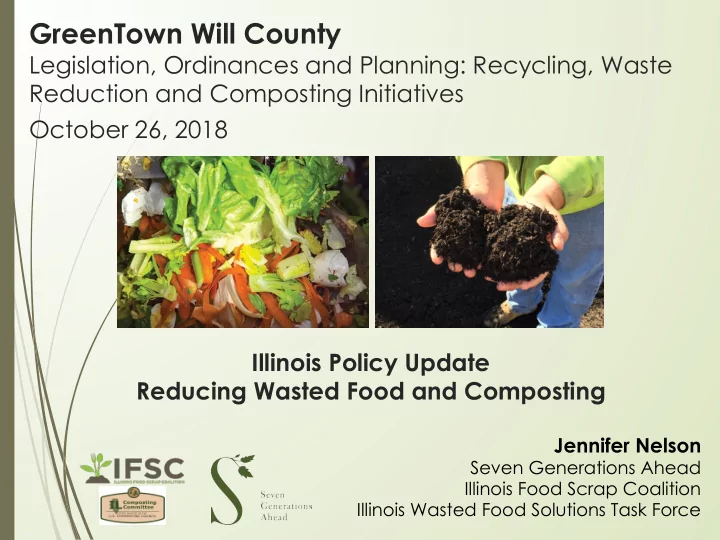
GreenTown Will County
Legislation, Ordinances and Planning: Recycling, Waste Reduction and Composting Initiatives October 26, 2018
Jennifer Nelson
Seven Generations Ahead Illinois Food Scrap Coalition Illinois Wasted Food Solutions Task Force
Illinois Policy Update Reducing Wasted Food and Composting
SLIDE 2
Project Name:
Building Illinois’ Local Food Shed Through Advancing Food Scrap Composting
Funder:
Funded through the Searle Funds at The Chicago Community Trust, Food:Land:Opportunity is a collaboration between Kinship Foundation and The Chicago Community Trust.
Partners:
Illinois Food Scrap Coalition, Illinois Green Economy Network, Illinois Environmental Council, Illinois Wasted Food Solutions Task Force
SLIDE 3
Outline
Reduce Waste/Reduce Wasted Food Food Recovery and Donation Food Scrap Composting CASE STUDIES: businesses, government agencies, institutions, and individuals take action
SLIDE 4 Illinois
- 14 million tons of waste landfilled
annually
- Nearly 20% of what is landfilled is food
scraps
- Of all compostable organics
generated, only 15% were composted (only 59% yard, and only 1% food)
SLIDE 5
Food Scraps Are Not Waste
40% of all food in the U.S. is wasted 1 out of 7 Americans are food insecure USDA & EPA U.S. Food Waste Challenge: Reduce food waste by 50% by 2030
SLIDE 6 Benefits of Food Waste Reduction
- Cost savings
- Feeding people
- Improved waste reduction and landfill
diversion - pollution prevention
- Community empowerment and resilience
- Partnerships
- Engagement and education - service
and work opportunities
SLIDE 7 FEDERAL
- Federal Food Donation Act of 2008 –
Requires food service contracts to have a clause encouraging donation. ILLINOIS
- SB2606 – requires all state agencies to have
a food donation policy and list of soup kitchens and food pantries available to all staff.
Food Donation Policies
SLIDE 8
- Create a waste reduction policy or goal for
city government (procurement, energy, waste diversion goals, recycling, composting)
- Create a food donation policy for city
government cafeterias, events, conferences
- Provide incentives to businesses that donate
leftover food
- Conduct a waste audit of any local
government institutions to identify opportunities to reduce, donate, recycle and compost
Possible Municipal Ordinances and Practices
SLIDE 9
Illinois Food Scrap Composting
SLIDE 10
Composting is a way of recycling food scraps and yard trimmings
SLIDE 11 Benefits of Composting
landfill
- Save water and energy
- Reduce pollutants
- Reduce carbon emissions
- Improve soil health,
reducing erosion and improving water retention
2015 Illinois DCEO waste characterization study
SLIDE 12 Job Creation
New industries: urban food scrap processors and rural compost
- spreaders. Opportunities for in-state manufacturing, locally
sustained jobs, and increased revenue that will remain within Illinois. On a per-ton basis, composting in Illinois employs 5 times more workers than landfilling. For every 12,250 tons of organics processed, 1 new business will be created and will sustain 18.3 employees annually with an average salary of $50k.
SLIDE 13 Projected Benefits in Illinois
If Illinois can achieve the midpoint organics diversion goal of diverting 65%, this will annually create:
- 3,185 jobs paying an average salary of $50k
- $290 million in economic output for the
state
- $10.5 million in local and state tax revenue
- Over 2 million tons of diversion away from
landfills
- Over 800k MTCO2e in GHG emissions
reduction
SLIDE 14
Food Scrap Composting Methods
On-site:
Composting Bins/Tumblers Vermicomposting In-vessel composter Dehydrator Anaerobic digester
Off-site:
Commercial composting Farm composting
SLIDE 15
- 1. Sort food scraps
- 2. Haul to a
compost facility
decompose
Commercial Composting
compost sold
SLIDE 16 Municipal Food Scrap Programs
Collection of food scraps (compostable food-soiled paper, compostable serviceware and
- ther organic wastes) sometimes through adding
these to an existing yard waste collection program
SLIDE 17 Food Scrap Composting in Illinois
50 IEPA permitted compost processors
○ 12-14 of these accept food scraps
187 We Compost partners
restaurants, institutions, businesses, schools and municipalities compost food scraps
25 Municipal food scrap programs State policies enacted to support hauling and processing of food scraps
SLIDE 18 LOCAL
- Typically no more than 5 cubic yards
- May consider small setbacks (less than 3
feet from property line)
- Enclosure of vessel used for composting
- Requirement that the pile be nuisance
free.
- Prohibition of materials: Cat/dog waste,
Meat, dairy, fats/oil/greases
Backyard Composting
SLIDE 19 Compost One Day Drop Offs
ILLINOIS One Day Drop Off
- Need permission from the municipality or county in
unincorporated areas
- Need to notify the solid waste coordinator for the county 30
days before
- No permit is needed from IEPA and no notice needs to be give
to IEPA
Permanent Drop Off
- Container only 10 cubic yards at any one time
- Must be emptied every 7 days
SLIDE 20 ILLINOIS
- Any community garden or other site in the state to
accept up to 25 cubic yards of off-site materials both landscape waste and additives such as food scrap or coffee grounds without a permit. Provided the final product can not be sold and is used on site. That 25 cubic yards is restriction on the total amount landscape waste plus additives that can be on site at any one time and is not an annual restriction.
- On site food scrap composted at an on site
composting system with the end product used on site.
Illinois Composting Permit Exemptions
SLIDE 21 Urban Farm Composting
ILLINOIS A garden or farm is allowed to compost off-site landscape waste and up to 10% additives. Size of operation can be up to 2% of the size of the property.The property has to be principally devoted to agriculture and the growing of crops.
- The finished product cannot be sold and must be used on-site
and applied at agronomic rates.
- A tipping fee cannot be charged for the acceptance of off-site
materials.
- The composting cannot occur within a flood plain or 200 feet
from a flood plain.
- The operation must register with the IEPA, annually report the
amount they are composting and certify that they are complying with the restriction laid out above.
- In addition, there is a 1/4 mile set-back requirement from
residences but municipality in the state can through an
- rdinance create a set-back that is lower than 1/4 of a mile.
SLIDE 22 Municipal Guide to Commercial Food Scrap Composting
A Municipal Guide is in development to document and share strategies and resources to encourage municipal food scrap composting
- Contract language and partner collaboration
- Overview of existing policy
- Education and engagement strategies
- Case studies of existing programs
- Compost procurement guide
- Comprehensive survey of existing municipal
programs
SLIDE 23
Case Studies - Illinois Composts!
SCHOOLS SGA Zero Waste Schools and Chicago Public Schools COLLEGES AND UNIVERSITIES College of Lake County HOSPITALS Rush Oak Park Hospital JAILS Lake County Adult Corrections MUSEUMS The Field Museum
SLIDE 24 Worki with school staff and students to shift operations and minds towards generating zero waste through source reduction, recycling, composting, and food recovery.
- Help schools plan effective waste reduction strategies
- Provide on-the-ground support for operational changes
- Educate students and staff about the How and Why of going zero waste
- Connect schools with local partners and opportunities
- Drive policy changes and infrastructure development that promote zero
waste.
SGA’s Zero Waste Schools Program
SLIDE 25
We help lunchrooms that look like this...
SLIDE 26
… become zero waste lunchrooms that look like this:
SLIDE 27 Chicago Public Schools Commercial Composting & Recycling Program
Results at Sandoval Elementary, a school of 1,015 students:
The Sandoval lunchroom went from 36 big trash bags per day to less than 7 bags per day.
SLIDE 28
College of Lake County
Off-Campus Commercial Processor
Plate waste, cafeteria food scraps
Campus Farm Composting
Food prep in kitchen and coffee shops (veggies, fruit, coffee and filters)
SLIDE 29 Rush Oak Park Hospital
- 2013-to date
- Since the program’s implementation, over 127 tons of food
scraps have been composted
- SGA works with the hospital to provide educational tours for
- ther institutions considering launching a food scrap
composting program.
SLIDE 30 Adult Corrections
Food waste in the prison system is significant:
- An estimated 200,000 tons of food is wasted
in American jails
- 65% of jobs in the green economy are
accessible to people with criminal records
SLIDE 31 Impact of Composting
WITH PROGRAM BEFORE PROGRAM
Environmental Benefits: ❖ 495 cubic yards of dining/kitchen materials diverted from landfills each year ❖ 361.35 cubic yards of food waste composted each year Economic Benefits: ❖ Lake County estimated annual savings: $3900 Educational Benefits: ❖ Engaging inmates on proper composting and recycling will provide job skills to support inmates post release
SLIDE 32 Composting at the Field Museum
Sustainable operations: recycling, food service, alternative transportation, urban agriculture/community gardening and renewable
- energy. Began composting in 2009
❖ In 2015, a staff composting program was established within the Museum, with compost bins now located near designated staff and volunteer eating areas, as well as in areas easily accessed by custodians ❖ 2016 kept 112 tons of waste- over 246,000 pounds – out of landfills ❖ In 2017 the Museum restaurants stopped giving visitors lids and straws
SLIDE 33 Using Compost at Home and at Work
WHERE? Use compost as mulch around shrubs, trees, or flowers, and on paths; as a top-dressing for lawns or indoor plants HOW? Use compost as a soil amendment to break up clay-type soils
- r to add substance and water
retention to sandy soils; WHY? Compost used as a soil amendment provides plant nutrients, supports beneficial soil life, reduces soil diseases, increases water retention, adds drainage, and promotes weed and erosion control. COMPOST
Completely decayed
- rganic matter. It is dark,
- dorless, and rich in soil
- benefits. Compost is created
from the decomposition of yard and food wastes.
vs. MULCH
Covering for soil. Mulch should not generally be mixed into the soil, it is not a fertilizer or soil amendment.
SLIDE 34 Use of End Product Compost
1. Procure compost for your community’s
- wn landscape maintenance activities.
2. Require the use of compost in development projects in your community.
SLIDE 35 Opportunities in Will County
- 1. Learn from other counties and municipalities
- 2. Identify key partners
- 3. What do your residents want?
- 4. What do your institutions and businesses
want?
- 5. Look at your hauler contract and those of
your municipalities
- 6. What are the costs and benefits?
SLIDE 36 Seven Generations Ahead
www.sevengenerationsahead.org
Illinois Food Scrap Coalition
www.illinoiscomposts.org
RECYCLING WORKS: A Tool Kit for Reducing Waste in the Workplace
https://www.illinois.gov/dceo/whyillinois/targetindustries/energ y/recycling/pages/wastereduction.aspx
USEPA Waste Reduction Model
https://www.epa.gov/warm
Tools and Resources
SLIDE 37
Thank You!
Jennifer Nelson Senior Program Manager, Seven Generations Ahead jennifer@sevengenerationsahead.org Founding Board Member, Illinois Food Scrap Coalition Founding Member, Illinois Wasted Food Solutions Task Force