Greenland ice sheet flow computations scaling-up to high spatial - - PowerPoint PPT Presentation

greenland ice sheet flow computations
SMART_READER_LITE
LIVE PREVIEW

Greenland ice sheet flow computations scaling-up to high spatial - - PowerPoint PPT Presentation

Greenland ice sheet flow computations scaling-up to high spatial resolution and fast boundary processes Ed Bueler Dept. of Mathematics and Statistics Geophysical Institute University of Alaska, Fairbanks with help from Andy Aschwanden, ARSC,


slide-1
SLIDE 1

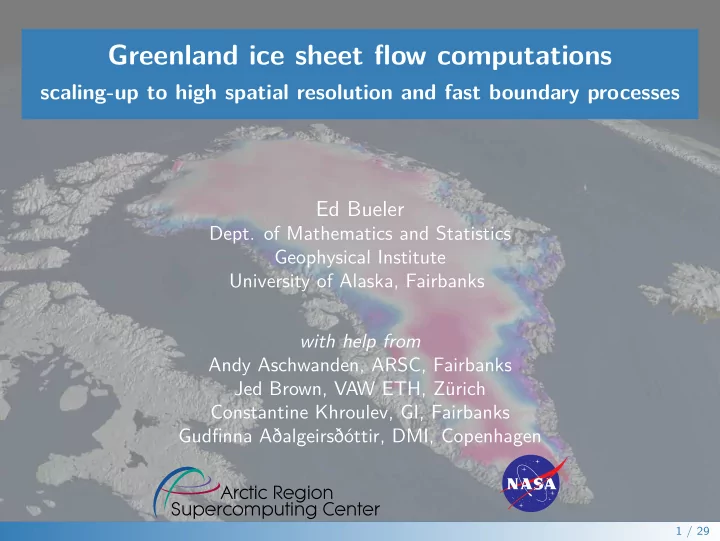
Greenland ice sheet flow computations

scaling-up to high spatial resolution and fast boundary processes Ed Bueler

  • Dept. of Mathematics and Statistics

Geophysical Institute University of Alaska, Fairbanks with help from Andy Aschwanden, ARSC, Fairbanks Jed Brown, VAW ETH, Zürich Constantine Khroulev, GI, Fairbanks Gudfinna Aðalgeirsðóttir, DMI, Copenhagen

1 / 29

slide-2
SLIDE 2

Outline

why compute Greenland’s flow? ice sheets: modeling and observations scaling-up: how to get more ISM from HPC

why Greenland? 2 / 29

slide-3
SLIDE 3

Jakobshavn Isbræ, west Greenland

MODIS image

  • M. Fahnestock

why Greenland? 3 / 29

slide-4
SLIDE 4

Jakobshavn Isbræ, west Greenland

NASA/Goddard Space Flight Center Scientific Visualization Studio

why Greenland? 4 / 29

slide-5
SLIDE 5

Speed-up of Jakobshavn Isbræ

◮ almost doubled its flow speed between the 1992 and 2000:

⊲ probably started by increase in ocean temperature from 1.7 C◦ in 1995 to 3.3 C◦ in 1998 ⊲ . . . thus increased melting under floating tongue ⊲ loss of floating tongue and its “backpressure” on upstream grounded ice ⊲ speed-up of grounded ice

◮ now drains about 7% of the entire ice sheet

Joughin et al. (2004)

why Greenland? 5 / 29

slide-6
SLIDE 6

Elevation changes: surface melt and “discharge”

IceSAT observations over 2003–2006 period; NASA/Goddard Space Flight Center Scientific Visualization Studio

why Greenland? 6 / 29

slide-7
SLIDE 7

The future of Greenland is the question

◮ before mid-90s mass loss was

dominated by surface mass balance (= precipitation minus surface melt/runoff)

◮ since 2000, mass balance has

been persistently negative

⊲ decrease in surface mass balance (more melting beats more precipitation) ⊲ increase in discharge (calving) from ice flow

◮ future mass loss partitioning:

unknown

◮ models need to predict which

climate changes have which effects

van den Broeke et al. (2009)

why Greenland? 7 / 29

slide-8
SLIDE 8

Why Greenland?

◮ its changes affect future sea level rise

⊲ 7 m rise if completely melted . . . unlikely . . . is 1 or 2 m likely?

◮ observations over the past decades show:

⊲ rapid acceleration of outlet glaciers ⊲ thinning around the margin ⊲ increased mass loss

◮ it’s a testbed for ice sheet modeling:

⊲ recent observational attention: lots of flights, ground measurements ⊲ exhibits the kind of worrying dynamics we want to “explain” ⊲ Antarctic ice sheet has 10× the area thus 10× the cost

why Greenland? 8 / 29

slide-9
SLIDE 9

Outline

why compute Greenland’s flow? ice sheets: modeling and observations scaling-up: how to get more ISM from HPC

modeling and observations 9 / 29

slide-10
SLIDE 10

How does an ice sheet lose mass?

I c e F l

  • w

Surface Melt Basal Melt Ice Discharge

modified from ICESat brochure

modeling and observations 10 / 29

slide-11
SLIDE 11

IPCC and ice sheet models

IPCC (2007), Box 4.1: Ice Sheet Dynamics and Stability “. . . but recent changes in ice sheet margins and ice streams cannot be simulated accurately with these models, . . . .”

◮ IPCC = Intergovernmental Panel on Climate Change

= {2007 Nobel Peace Prize winners} \ {Al Gore}

◮ above statement =

⇒ lots of attention from modelers progress report 2011:

◮ PISM is doing a decent job reproducing the past two decades

⊲ before anything else, get the present, observed period right! ⊲ model validation

modeling and observations 11 / 29

slide-12
SLIDE 12

Ice sheet model validation using

◮ observed mean flow speed from 2000,2006–2008 (InSAR) ◮ observed cumulative mass change from 2003–2009 (GRACE)

2003 2004 2005 2006 2007 2008 2009 2010 year 1500 1000 500 cummulative mass change [Gt]

modeling and observations 12 / 29

slide-13
SLIDE 13

Flow speed from InSAR

credit: USGS credit: I. Joughin

modeling and observations 13 / 29

slide-14
SLIDE 14

Results: Jakobshavn Isbræ

InSAR (Joughin et al., 2010) PISM: 5 km grid resolution

modeling and observations 14 / 29

slide-15
SLIDE 15

Results: Jakobshavn Isbræ

InSAR (Joughin et al., 2010) PISM: 2 km grid resolution

modeling and observations 15 / 29

slide-16
SLIDE 16

Results: Jakobshavn Isbræ

InSAR (Joughin et al., 2010) PISM: 1 km grid resolution

modeling and observations 16 / 29

slide-17
SLIDE 17

Gravity Recovery and Climate Experiment (GRACE)

thanks to A. Arendt

◮ precisely measures distance between pair of satellites ◮ estimates deviation of gravity field from uniform sphere shape

modeling and observations 17 / 29

slide-18
SLIDE 18

Observed mass changes

2003 2004 2005 2006 2007 2008 2009 2010 year 1500 1000 500 cummulative mass change [Gt]

Luthcke, et al. (unpublished; new high-resolution solutions)

modeling and observations 18 / 29

slide-19
SLIDE 19

Observed mass changes

2003 2004 2005 2006 2007 2008 2009 2010 year 1500 1000 500 cummulative mass change [Gt]

  • 176 Gt/yr

Luthcke, et al. (unpublished; new high-resolution solutions)

modeling and observations 18 / 29

slide-20
SLIDE 20

Modeled and observed mass changes

2003 2004 2005 2006 2007 2008 2009 2010 year 5000 4000 3000 2000 1000 1000 2000 cumulative mass change [Gt] GRACE PALEO1 PALEO2 PALEO3 CONST1 MERGE1

◮ new coupled models of Greenland

⊲ PISM + regional climate model (HIRHAM at DMI Copenhagen)

modeling and observations 19 / 29

slide-21
SLIDE 21

Modeled and observed mass changes

2003 2004 2005 2006 2007 2008 2009 2010 year 5000 4000 3000 2000 1000 1000 2000 cumulative mass change [Gt]

  • 206 Gt/yr
  • 176 Gt/yr

GRACE CONST1 r = 0.97 slope = 1.13

◮ new coupled models of Greenland

⊲ PISM + regional climate model (HIRHAM at DMI Copenhagen)

modeling and observations 19 / 29

slide-22
SLIDE 22

What is PISM?

◮ PISM = Parallel Ice Sheet Model

www.pism-docs.org

◮ open source (C++, python), PETSc-over-MPI, regular grid ◮ adaptive time-stepping ◮ supported by NASA; now a joint project with PIK in Germany ◮ the best ice sheet model in the world ◮ . . . was developed in Fairbanks

user base:

INK

modeling and observations 20 / 29

slide-23
SLIDE 23

What is PISM?

◮ PISM = Parallel Ice Sheet Model

www.pism-docs.org

◮ open source (C++, python), PETSc-over-MPI, regular grid ◮ adaptive time-stepping ◮ supported by NASA; now a joint project with PIK in Germany ◮ the best ice sheet model in the world ◮ . . . was developed in Fairbanks

user base:

INK

modeling and observations 20 / 29

slide-24
SLIDE 24

Outline

why compute Greenland’s flow? ice sheets: modeling and observations scaling-up: how to get more ISM from HPC

scaling-up 21 / 29

slide-25
SLIDE 25

Scaling

◮ plan for the rest of my talk: beat up PISM because it scales badly ◮ . . . though it scales way better than any other current ISM ◮ definitions in convenient 2D grid case:

⊲ strong scaling: for fixed problem, 4× the number of processors = ⇒ (1/4)th the execution time ⊲ weak scaling: for fixed number of d.o.f.s per processor, 4× the number of processors = ⇒ same execution time

scaling-up 22 / 29

slide-26
SLIDE 26

Min prerequisite for weak scaling: convergence

◮ six runs, each 100 model year

with same data

◮ on refining grids: 40, 20, 10, 5,

2.5 km

◮ surface velocity (m/year) → ◮ my first informal study ◮ results:

res procs wall clock 40 km 1 8 sec 20 km 1 75 sec 10 km 64 57 sec 5 km 64 14 min 3 km 128 56 min 2 km 128 285 min

◮ on Cray XT5

⊲ pingo.arsc.edu

scaling-up 23 / 29

slide-27
SLIDE 27

Weak scaling: the reality

◮ here’s the problem →

⊲ 100 model year runs ⊲ increase d.o.f.s and processors in proportion

◮ a la weak scaling

⊲ it is not giving constant-time for whole run ⊲ it is giving constant-time per model time step

◮ but who cares

◮ we observe: short time

steps on fine grids blocks weak scaling

1 4 16 64 256 2000 4000 6000 8000 10000 12000 14000 16000 18000 wall clock time (seconds) processors scaling-up 24 / 29

slide-28
SLIDE 28

Weak scaling: the reality

◮ here’s the problem →

⊲ 100 model year runs ⊲ increase d.o.f.s and processors in proportion

◮ a la weak scaling

⊲ it is not giving constant-time for whole run ⊲ it is giving constant-time per model time step

◮ but who cares

◮ we observe: short time

steps on fine grids blocks weak scaling

1 4 16 64 256 0.05 0.1 0.15 0.2 0.25 0.3 0.35 0.4 0.45 0.5 time per step (seconds) processors scaling-up 24 / 29

slide-29
SLIDE 29

Weak scaling: the reality

◮ here’s the problem →

⊲ 100 model year runs ⊲ increase d.o.f.s and processors in proportion

◮ a la weak scaling

⊲ it is not giving constant-time for whole run ⊲ it is giving constant-time per model time step

◮ but who cares

◮ we observe: short time

steps on fine grids blocks weak scaling

2.5 5 10 20 40 10

−3

10

−2

10

−1

10 ∆ x (km) ∆ t (model years) data ∆ t ∼ ∆ x 2.2342 scaling-up 24 / 29

slide-30
SLIDE 30

Weak scaling: the troubles

1 PISM evolves temperature and geometry by explicit time-stepping

⊲ major evolution equation is wildly-nonlinear diffusion ⊲ ice thickness H changes by ∂H ∂t

= ∇ ·

  • CH5|∇H|2∇H
  • ⊲ explicit method scales badly because

∆t ∼ ∆x2 ⊲ implicit time steps, you idiot! ⊲ but we are not solving PDEs; boundary value problem is ∗ subject to inequality H ≥ 0 ⊲ so we don’t really know how to solve well-posed implicit time steps

scaling-up 25 / 29

slide-31
SLIDE 31

Scaling: results so far; idealized ice sheets

◮ PISM: strong scaling on time-dependent run including many 2D stress

solutions

◮ Jed Brown’s hydrostatic ice solver [submitted 2011]: awesome weak

scaling on time-independent 3D stress solver; not yet in PISM!

scaling-up 26 / 29

slide-32
SLIDE 32

Scaling: results so far; idealized ice sheets

◮ PISM: strong scaling on time-dependent run including many 2D stress

solutions

◮ Jed Brown’s hydrostatic ice solver [submitted 2011]: awesome weak

scaling on time-independent 3D stress solver; not yet in PISM!

scaling-up 26 / 29

slide-33
SLIDE 33

Weak scaling: the troubles

2 liquid water at boundaries

⊲ big lakes form and drain . . . in 90 minutes (upper) ⊲ hydrograph shows brief summer period of surface melt (lower) ⊲ ice flow model must “see” liquid runoff at surface and its effect on subglacial resistance

◮ boundary liquid timescales

are minutes–weeks

◮ ice sheet model runs are

decades–millenia

  • S. Das
  • R. Hock et al. (2005)

scaling-up 27 / 29

slide-34
SLIDE 34

Weak scaling: the troubles

3 solve PDEs on domain with fractal boundary

⊲ velocity is big near the boundary ⊲ boundary is a coastline . . . Mandelbrot warned us about those things ⊲ at each timestep, want to solve nonlinear elliptic problems on this fractal

scaling-up 28 / 29

slide-35
SLIDE 35

Summary

◮ model Greenland ice sheet flow! it is on the move! ◮ PISM is getting good fit to observed flow speeds, mass changes ◮ challenges to scaling:

⊲ equations need new thinking

  • need well-posed implicit time steps
  • and better solvers too

⊲ short time-scale processes on all ice sheet surfaces

  • liquid water

⊲ fast ice dynamics along fractal boundaries

◮ much bigger Antarctic ice sheet in the background ◮ thanks for your attention!

29 / 29