Greenhouse Gases Map out the ``greenhouse effect & 1) What are - - PDF document

greenhouse gases map out the greenhouse effect
SMART_READER_LITE
LIVE PREVIEW

Greenhouse Gases Map out the ``greenhouse effect & 1) What are - - PDF document

Which of todays learning objec9ves are most difficult? Class 8: 3 Earth 1. Diagram of the Greenhouse effect, Habitability describe mechanism. 2. CO 2 Cycle, explain its feedback system to How is plate tectonics important for regula9ng


slide-1
SLIDE 1

Class 8: Earth Habitability

How is plate tectonics important for regula9ng the Earth’s temperature? What is it about Earth that makes it habitable for life?

1

Which of today’s learning objec9ves are most difficult?

3

  • 1. Diagram of the

Greenhouse effect, describe mechanism.

  • 2. CO2 Cycle, explain its

feedback system to maintain temperatures.

  • 3. List five physical

condi9ons on earth leading to habitability.

2

Greenhouse Gases & Global Warming Climate Change

What should you believe?

hNp://www.youtube.com/watch?v=I_kODETmro8

Let’s first try and understand the ‘effect’.

3

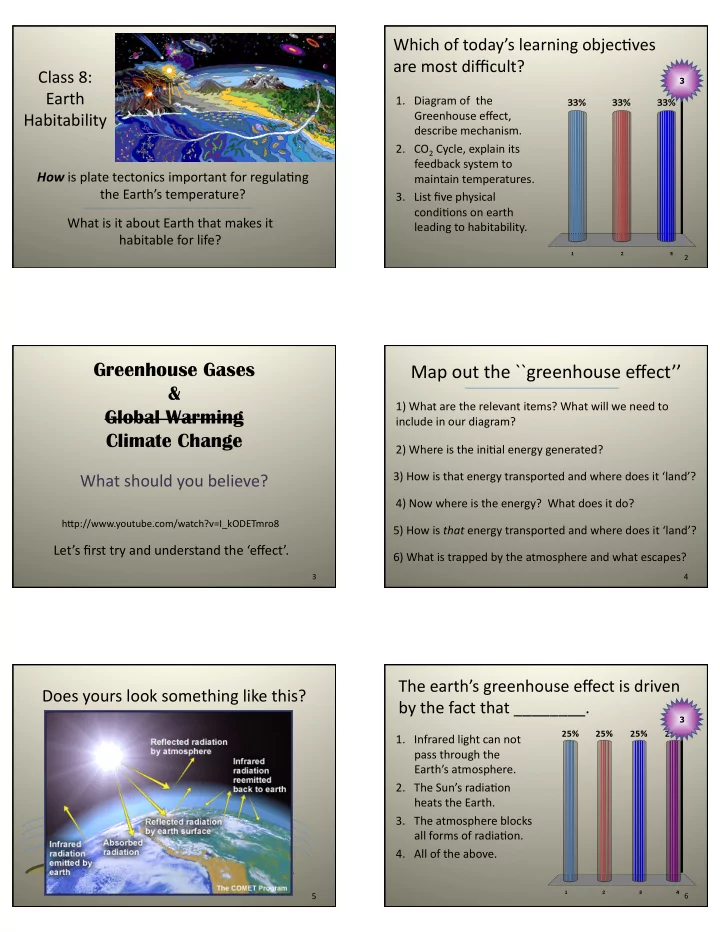
Map out the ``greenhouse effect’’

1) What are the relevant items? What will we need to include in our diagram? 2) Where is the ini9al energy generated? 3) How is that energy transported and where does it ‘land’? 4) Now where is the energy? What does it do? 5) How is that energy transported and where does it ‘land’? 6) What is trapped by the atmosphere and what escapes?

4

Does yours look something like this?

Absorp9on Reflec9on Earth surface Earth Atmosphere

5

The earth’s greenhouse effect is driven by the fact that ________.

  • 1. Infrared light can not

pass through the Earth’s atmosphere.

  • 2. The Sun’s radia9on

heats the Earth.

  • 3. The atmosphere blocks

all forms of radia9on.

  • 4. All of the above.

3 6

slide-2
SLIDE 2

Are greenhouse gases bad?

How much warmer is the Earth because of its greenhouse gases?

30 oF  59 oF (or about 30 oF warmer!)

What are the important greenhouse gases on Earth? Water (H2O) Carbon Dioxide (CO2 ) Methane (CH4 <‐ extremely effec9ve) Without Earth’s greenhouse gases, life might not have formed!

7

With regards to Global Climate Change There are some important ques9ons

Is the Earth experiencing a rapid change in its climate or climate stability? If so, have man‐made, industrial pollutants driven most

  • f this climate change?

If so, how can the world address the problem equitably and without causing enormous economic damage?

8

Do you feel we should try to limit greenhouse gas emissions?

3

  • 1. Yes, it might make a

difference with 9me.

  • 2. Yes, but I don’t think its

likely to happen globally.

  • 3. No, it will only cause

economical strife and won’t help the situa9on.

  • 4. No, I don’t believe it’s a

real issue needing ac9on.

9

Here is the CO2 Cycle on Earth

What does it do? How does it work?

Is the Greenhouse Gas, CO2, bad?

10

The CO2 cycle

Regulates Earth’s temperature through a nega9ve feedback process

11

Let’s draw a simple, CO2 Cycle model

  • 1. Draw a triangle.
  • 2. In the three corners label the three primary condi9ons or

loca9ons one finds CO2 on Earth.

  • 3. Draw arrows moving the CO2 from one spot to the next and

label how that mo9on occurs.

  • 4. Can the cycle go both ways or only one way?

12

slide-3
SLIDE 3

Let’s ‘test run’ our CO2 Cycle model

Take the condi9on where atmospheric temperatures increase. How does this change the precipita9on (rain) level? Follow all the way through the cycle. What will happen to global temperatures at the end of the cycle? ____________________________ Take the condi9on where atmospheric temperatures decrease. How does this change the precipita9on (rain) level? Follow all the way through the cycle. What will happen to global temperatures at the end of the cycle?

13

Over what 9me scale for temperature change is the CO2 cycle effec9ve?

3

  • 1. 400 years
  • 2. 4,000 years
  • 3. 400,000 years
  • 4. 4 million years

14

If we double atmospheric greenhouse gases in 100 years, what might happen?

3

  • 1. Average global

temperatures could rise.

  • 2. Some areas may be

cooler.

  • 3. Weather may become

more extreme.

  • 4. All of the above.

All of the above! This is why its now called ‘Climate Change’

15

How stable has the Earth’s temperature been in the past?

(Antarc9ca)

There is a 100,000 yr cycle of ice ages..

16

Why the cycle of Ice Ages?

1) Changing 9lt of Earth axis vs. orbital

  • plane. Small 9lt = weaker summers and
  • ceans stay cold and freeze over.

2) The CO2 may have gone through very rapid or cataclysmic changes (extreme volcanism, meteori9c impact) Runaway effect of growing polar caps might have lead to Snowball Earth. The CO2 cycle should stop the runaway.

(Milankovitch Cycle)

17

The Long‐Term habitability of Earth.

What makes Earth such a great place for life?

Geologic Ac9vity!

How are these related?

18

slide-4
SLIDE 4

Put all your materials on the floor and place your PRS clicker in front of you. Please: use just one clicker for yourself. Take care that others can not view your selec9on

  • 1. How much warmer is our Earth due

to it’s current greenhouse gases?

5

  • 1. About 5 oF
  • 2. About 10 oF
  • 3. About 30 oF
  • 4. About 50 oF

20

  • 2. Where is most of the CO2 stored on

Earth?

5

  • 1. In the surface rock
  • 2. In the atmosphere
  • 3. In the oceans
  • 4. About equal amounts

are found in all three.

21

  • 3. In the CO2 cycle, at which stage are

carbonate minerals generated?

5

  • 1. At the base of the
  • cean
  • 2. In the atmosphere

during precipita9on.

  • 3. During subduc9on
  • 4. During volcanic
  • utgassing

22

  • 4. What appears to be causing the

Ice Ages?

5

  • 1. Varying Solar

radia9on.

  • 2. Varying volcanism.
  • 3. Varia9ons in the

Earth’s axis 9lt.

  • 4. Varia9ons in CO2 in

the atmosphere

23

  • 5. The habitability of the Earth is most

strongly 9ed to its ___________

5

  • 1. Magne9c field
  • 2. Atmosphere
  • 3. Plate tectonics
  • 4. Geological Ac9vity
  • 5. Oceans

24