Green Line to the Airport COMMUNITY OPEN HOUSE DECEMBER 1, 2 AND 3, - - PowerPoint PPT Presentation

green line to the airport
SMART_READER_LITE
LIVE PREVIEW

Green Line to the Airport COMMUNITY OPEN HOUSE DECEMBER 1, 2 AND 3, - - PowerPoint PPT Presentation

Green Line to the Airport COMMUNITY OPEN HOUSE DECEMBER 1, 2 AND 3, 2015 Welcome Sign in at table near entrance To comment, use comment card provided Drop off at the end of the meeting Mail or fax later OR Stop by the Comment


slide-1
SLIDE 1

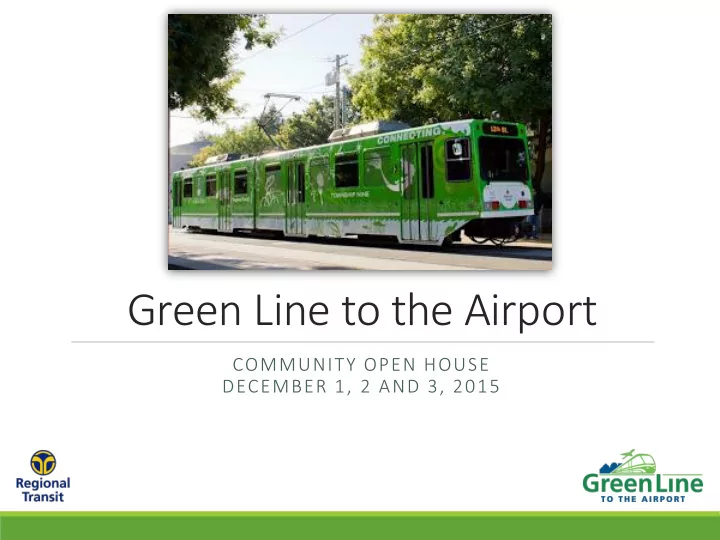
Green Line to the Airport

COMMUNITY OPEN HOUSE DECEMBER 1, 2 AND 3, 2015
slide-2
SLIDE 2

Welcome

  • Sign in at table near entrance
  • To comment, use comment card provided
  • Drop off at the end of the meeting
  • Mail or fax later

OR

  • Stop by the Comment Work Station
slide-3
SLIDE 3

About Tonight’s Meeting

  • Purpose of Meeting
  • Project Overview
  • Environmental Review Process
  • Public Comments / What’s Next
slide-4
SLIDE 4

Purpose of Meeting

To receive agency and public input on the scope of Environmental Impact Report (EIR) / Environmental Impact Statement (EIS) for the Green Line to the Airport Extension Project

slide-5
SLIDE 5

PROJECT OVERVIEW

slide-6
SLIDE 6

Project Purpose

Connecting Downtown, South and North Natomas, and the Airport

slide-7
SLIDE 7

Project Benefits

  • Improve transit linkages and coverage to

communities and activity centers within the study area

  • Alleviate roadway congestion by providing a

robust transit network that offers an alternative to automobile travel

  • Provide a safe, convenient and affordable

alternative for traveling between downtown Sacramento, South and North Natomas, and the Sacramento International Airport

slide-8
SLIDE 8

Project Benefits

  • Provide a connection directly to the region’s

major intermodal facility at the Sacramento Valley Station, where bus, light rail, and Amtrak commuter rail services provide access to a much larger region

  • Support local and regional land use plans

promoting smart growth and transit-oriented developments

  • Support local and regional plans and

strategies to improve air quality and reduce greenhouse gas emissions

slide-9
SLIDE 9

Green Line Extension

slide-10
SLIDE 10

ENVIRONMENTAL REVIEW PROCESS

slide-11
SLIDE 11

Project History

slide-12
SLIDE 12

Environmental Review Process

slide-13
SLIDE 13

EIR/EIS Topics of Study

slide-14
SLIDE 14

Green Line Extension – Target Study Areas

slide-15
SLIDE 15

American River Bridge Crossing Considerations

  • Aesthetics
  • Hydraulics / Permits
  • Transportation
  • Applicable Plans
  • Environmental

Resources / Permits

  • Costs
slide-16
SLIDE 16

Green Line serving the South Natomas Community

  • Streets serving all travel modes
  • Protecting property and quality of life
  • Connectivity between LRT and RT buses
  • Serving the community and major facilities

like the Community Center, Library, and High School

slide-17
SLIDE 17

Green Line serving North Natomas

Gateway Crossing

  • Minimize congestion
  • Address automobile / pedestrian / train conflicts
  • Optimize alignment / station location considering:

 Track Geometry  Constructability  Use of IODs  Proximity to Land Development Opportunities  Proximity to Existing Transit Supportive Uses  Visual Effects / Opportunities  Accessibility to Parking and by Pedestrians

slide-18
SLIDE 18

Green Line serving North Natomas

Sleep Train Arena Redevelopment Area

  • Possible option
  • Exciting new opportunities

to support new land uses and to promote ridership

  • Continue to serve North

Natomas Town Center but with possible shorter, less costly alignment

slide-19
SLIDE 19

Project Schedule*

slide-20
SLIDE 20

WHAT’S NEXT?

slide-21
SLIDE 21

Your Role

  • Provide comments
  • Complete comment card and drop
  • ff at the end of the meeting
  • Mail or fax later
  • Stop by the Comment Work Station
  • Stay involved
  • Sign-up for notifications
  • Check the website: www.greenline2airport.com
  • Review the draft environmental document and provide

comments

slide-22
SLIDE 22

Next Steps

  • Refine plans for the targeted

areas of study

  • Collect data to evaluate the

effects of the project

  • Continue to consult with

public agencies and stakeholders

  • Project future ridership for

the project

  • Examine available funding

sources

slide-23
SLIDE 23

Thank you!