Graphics Hardware Hardware Overview of Pipeline Architecture - - PDF document

graphics hardware
SMART_READER_LITE
LIVE PREVIEW

Graphics Hardware Hardware Overview of Pipeline Architecture - - PDF document

Graphics Hardware Hardware Overview of Pipeline Architecture Alternatives First graphics processors just did display management, not rendering per se. bitblit for block transfer of bits Computer Graphics 15-462 (Fall 2002) 2 Pipeline


slide-1
SLIDE 1

1

Graphics Hardware

Overview of Pipeline Architecture Alternatives

2 Computer Graphics 15-462 (Fall 2002)

Hardware

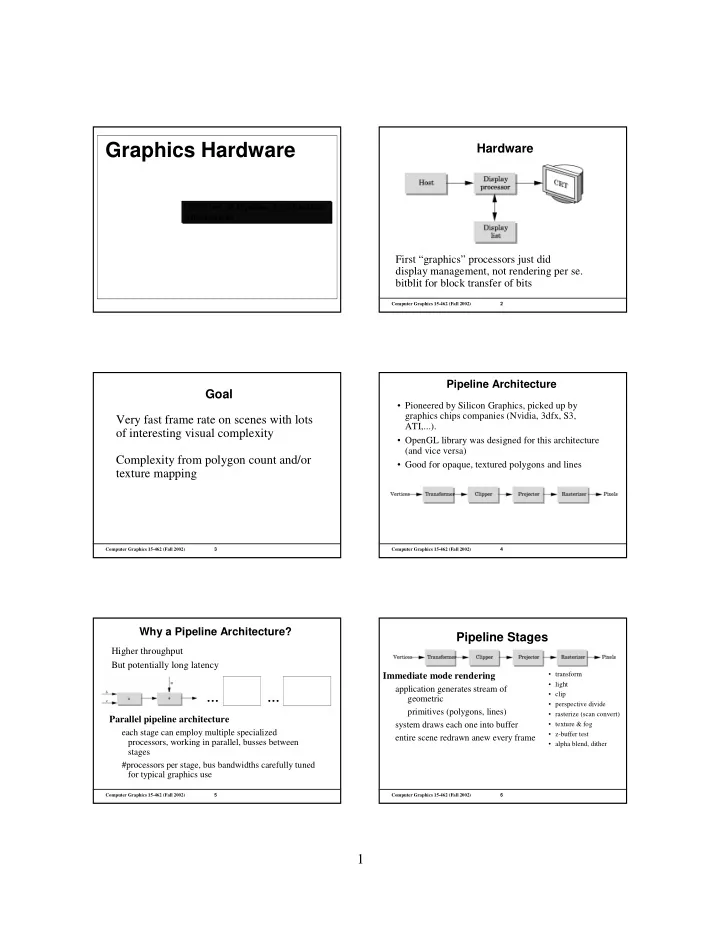
First “graphics” processors just did display management, not rendering per se. bitblit for block transfer of bits

3 Computer Graphics 15-462 (Fall 2002)

Goal Very fast frame rate on scenes with lots

  • f interesting visual complexity

Complexity from polygon count and/or texture mapping

4 Computer Graphics 15-462 (Fall 2002)

Pipeline Architecture

  • Pioneered by Silicon Graphics, picked up by

graphics chips companies (Nvidia, 3dfx, S3, ATI,...).

  • OpenGL library was designed for this architecture

(and vice versa)

  • Good for opaque, textured polygons and lines

5 Computer Graphics 15-462 (Fall 2002)

Why a Pipeline Architecture?

Higher throughput But potentially long latency

… …

Parallel pipeline architecture each stage can employ multiple specialized processors, working in parallel, busses between stages #processors per stage, bus bandwidths carefully tuned for typical graphics use

6 Computer Graphics 15-462 (Fall 2002)

Pipeline Stages

  • transform
  • light
  • clip
  • perspective divide
  • rasterize (scan convert)
  • texture & fog
  • z-buffer test
  • alpha blend, dither

Immediate mode rendering application generates stream of geometric primitives (polygons, lines) system draws each one into buffer entire scene redrawn anew every frame

slide-2
SLIDE 2

2

7 Computer Graphics 15-462 (Fall 2002)

Implementing Algorithms in Hardware

  • Z-buffer

computations are bounded, predictable

Some work well, others are harder

8 Computer Graphics 15-462 (Fall 2002)

Implementing Algorithms in Hardware

  • Ray tracing

poor memory locality computational cost difficult to predict (esp. if adaptive) SIMD (single instruction, multiple data) parallel approach keep copy of entire scene on each processor

9 Computer Graphics 15-462 (Fall 2002)

Current chip design may not be the long term answer

  • Observation: # triangles == # of pixels
  • Could focus on interactivity

Latency becomes a problem

  • Could focus on animation

Avoid repeating computations Image-based rendering?

10 Computer Graphics 15-462 (Fall 2002)

Pixel Planes and Pixel Flow (UNC)

http://www.cs.unc.edu/~pxfl/ programmable processor per pixel good for programmable shading, image processing can be used for rasterization Pixel-Planes 4: 512x512 processors with 72bits of memory But most processors idle for most triangles Pixel-Planes 5: divide screen into ~20 tiles each with a bank

  • f processors. Network is limit. 2Million tri/sec.

11 Computer Graphics 15-462 (Fall 2002)

Pixel Planes and Pixel Flow (UNC)

Pixel-Flow: Image composition. Subdivide geometry to processors and recombine by depth using special hardware Rendered on simulator and predicted to run in real time on physical hardware

12 Computer Graphics 15-462 (Fall 2002)

Talisman (Microsoft)

http://research.microsoft.com/MSRSIGGRAPH/96/Talisman/

Observation: an image is usually much like the one that preceded it in an animation. Goal: a $200-300 board image-based rendering cache images of rendered geometry re-use with affine image warping (sophisticated sprites) re-render only when necessary to reduce bandwidth and computational cost

slide-3
SLIDE 3

3

13 Computer Graphics 15-462 (Fall 2002)

Current & Future Issues

  • interaction
  • geometry compression
  • progressive transmission
  • alternative modeling schemes (not polygon soup)

parametric surfaces, implicit surfaces, subdivision surfaces generalized texture mapping: displacement mapping, light mapping programmable shaders

  • beyond just geometry:

dynamics, collision detection, AI?

Assignment 1

Height Fields

15 Computer Graphics 15-462 (Fall 2002)

Height Fields

  • Why?

Get started with OpenGL Some room for creativity

  • Where?

Wean 5336 or your machine at your risk!

  • How?

Cross-realm authentication via andrew Send problems to me or to the TA’s (soon) Make sure that you made directory with correct permissions—most common problem

16 Computer Graphics 15-462 (Fall 2002)

Height Fields

  • What?
  • When? -- Due midnight September 12th