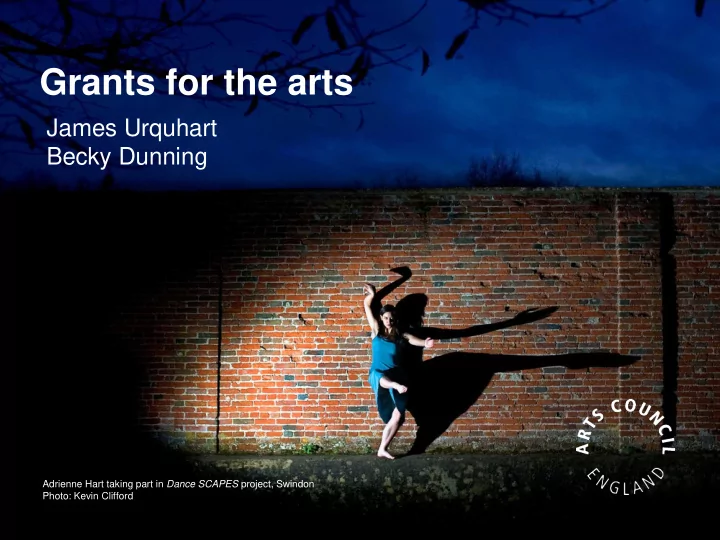
SLIDE 1 Grants for the arts
Adrienne Hart taking part in Dance SCAPES project, Swindon Photo: Kevin Clifford
James Urquhart Becky Dunning
SLIDE 2 Agenda
- 1. Introducing the programme
- 2. Eligibility
- 3. How to apply
- 4. The application form
- 5. What happens next
SLIDE 3
1 Introducing the programme
SLIDE 4 Arts Council England Arts Council England champions, develops and invests in artistic and cultural experiences that enrich people's
- lives. We support a range of activities across the arts,
museums and libraries - from theatre to digital art, reading to dance, music to literature, and crafts to collections. Between 2011 and 2015, we will invest £1.4 billion of public money from government and an estimated £1 billion from the National Lottery to help create these experiences for as many people as possible across the country.
SLIDE 5 Our funding portfolio We offer a range of different funding programmes including:
- National Portfolio funding
- Renaissance funding
- Grants for the arts
We also offer a range of strategic funding programmes which are specifically aligned to certain priorities or sectors. You can find out more about these on the funding pages of
SLIDE 6
What is Grants for the arts? A key feature of how Arts Council England delivers our mission, ‘Achieving Great Art For Everyone’ Grants for the arts distributes awards of between £1000 and usually £100,000 from the National Lottery to: individuals arts organisations people who use the arts in their work For time limited arts-related activities that: benefit people in England help artists and arts organisations in England carry out their work
SLIDE 7 Background
- first launched in April 2003 – latest refresh July 2013
- Budget – 63million for 2013/14
- customer focussed / equality of opportunity
- flexibility (applicant and activity type)
- light touch
- quick decisions
SLIDE 8 The competition
- demand is increasing
- last year, we received around 8,500 applications, 2000
more than 2012/13
- we made just over 3,300 awards
- verall success rate historically is around 40%
We will always receive more good applications than we can fund so advise applicants to consider other sources of funding while applying to us.
- Arts council’s capacity to advise has decreased
SLIDE 9
Watch this video to learn more about Grants for the arts. Ace website: http://www.artscouncil.org.uk/funding/apply-for- funding/grants-for-the-arts/ Guidance video 1
SLIDE 10
2 Eligibility
SLIDE 11
Who can apply? arts organisations / artists / researchers / local authorities / commissioners / festivals writers / musicians / museums / libraries / performers / directors/ promoters presenters / curators / designer makers / producers / universities / voluntary groups consortiums of schools / choreographers / community groups / composers / experimental artists /
SLIDE 12
What kind of activity do we fund? productions / exhibitions / participatory projects / events / festivals / carnivals / workshops / digital projects / artistic research and development / commissions/ participation / asset purchase / building renovation / making work / touring / residencies / professional development / international partnerships / organisation and business development / audience development / consortium building
SLIDE 13 What kind of activity do we not fund?
- activities that are not arts-related
- activities that provide no potential benefit to the public,
either in the short or long term
- students towards their course of study
- educational establishments towards curriculum activity
- retrospective activities, including buying goods or
services, which take place or start before we would be able to decide on the application
SLIDE 14 What don’t we fund?
- general running costs and overheads that are paid for by
- ther income, including applicants own funds
- second-hand equipment (apart from certain musical
instruments and specialist equipment)
- activities or events mainly taking place outside England
(some exceptions)
- film or video production, training or assets unless it is in
support of artists’ work in the moving image
SLIDE 15
3 How to apply
SLIDE 16 Read the guidance
- Read our How to apply guidance
- Use the information sheets on our website
- Contact us to discuss eligibility
SLIDE 17
Apply online Online application form available through Arts Council England website It includes links to all relevant guidance and will check applications before they are submitted – for instance, it will check if the budget is balanced. https://forms.artscouncil.org.uk/officeforms/Arts_Projects.of ml
SLIDE 18
Guidance video 2 Watch this video for guidance on how to apply to Grants for the arts. Ace website: http://www.artscouncil.org.uk/funding/apply-for- funding/grants-for-the-arts/how-apply/
SLIDE 19
4 The application form
SLIDE 20 The application form
- focused, directive questions relating to our four criteria
– quality, public engagement, management and finance – to ensure applicants give us exactly the information we need to know
- number of questions, and depth of information requested
increases in line with amount requested
- How to apply guidance provides step by step advice
SLIDE 21
Guidance video 4 Watch this video to learn more about the application form questions for Grants for the arts. Ace website: http://www.artscouncil.org.uk/funding/apply-for- funding/grants-for-the-arts/how-apply/
SLIDE 22 The four criteria Arts Council’s mission is ‘Great art and culture for everyone’ Application form asks focused, directive questions relating to the four criteria ACE staff use a set of published prompts to ‘unpick’ the answers and score applications against each of the four criteria
- artistic quality
- public engagement
- finance
- management
SLIDE 23 Artistic quality The quality of the activity and its ongoing effect on artistic practice In this section of the application form we want applicants to tell us about their artistic work, some more detail about the activity they would like to do, and how this activity will help them or their organisation develop. We also ask about any
- ther artists they may be working with, what their role is,
and why they have chosen to work with them.
SLIDE 24
Public Engagement How the activity increases opportunities for the public to engage in arts activities In this section of the application form we want applicants to tell us about who will engage with their activity. We ask them to estimate the numbers engaging with the activity based on what they think they will achieve. They have a chance to tell us more about the audiences and/or participants, who they are and how they will reach them
SLIDE 25 What is Public Engagement? Any of, or all of the following
- Attending / experiencing an arts event
- taking part in an arts activity
- volunteering to work at or with an arts organisation
- working with an artist or group of artists to design or
create an artwork
- helping to make decisions about arts activity in a local
community or helping an arts organisation to make decisions about its work
SLIDE 26 And why is ACE interested? It’s the ‘everyone’ in the mission statement Arts Council England’s mission is to enable everyone to experience arts that enrich their lives. We believe that great art inspires us, brings us together and teaches us about
- urselves, and the world around us. In short, it makes life
- better. We want as many people as possible to engage
with the arts.
SLIDE 27 Finance How realistic the activity is financially
– the budget should cover the whole activity – should have at least 10% match funding from other sources – can include support in kind as match funding
- Is there enough money to do the project
- Is the income and expenditure appropriate?
- Have the risks been accounted for?
- Does it leverage other funds?
- Can the applicant manage it?
Skin, ACE Dance and Music Photo: Brian Slater
SLIDE 28 Management How the activity will be managed Is it doable & can you do it? Remember Gfta funds projects (eg one-off activity which achieves clearly stated objectives within a time limit) Consider the principles of good project management:
- Capability - do you have the skills and experience or do
your partners
- Capacity
- Resources - Time, Money, People, Equipment
- Project management Triangle - time/resources/quality
SLIDE 29 Evaluation
- Evaluation helps with planning, as it makes you think
about what you’re aiming to do, how you will do it and how you will know if you’ve succeeded
- Ongoing feedback keeps you on track
- Evaluation helps prove the value of what you are doing
- Evaluation costs money and should be accounted for
SLIDE 30
Guidance video 3 Watch this video for tips on completing a Grants for the arts application form. Ace website: http://www.artscouncil.org.uk/funding/apply-for- funding/grants-for-the-arts/how-apply/
SLIDE 31
5 What happens next?
SLIDE 32 If you are unsuccessful
- Most decision meetings are competitive
- If we are not able to fund your activity this time, we will
highlight the main reason(s) the application was unsuccessful and explain our reasoning
- The information in the decision letter is the full level of
feedback that we can provide
- We recommend that unsuccessful applicants revisit the
How to apply guidance as well as any appropriate information sheets, particularly the ‘understanding the appraisal process’ guidance
- You can apply again at any time, but any new application
for the same activity must address the reasons that the
- riginal application was not successful
SLIDE 33 If you are successful
- Offer packs returned within one month
- We will normally pay the money in stages
- 90/10 for under £15k or 50/40/10 for over £15k
- Conditions monitored by Grant Management Assistants,
tasking out to RMs where needed
- Applicants cannot reapply if monitoring is in arrears
- Applicants must acknowledge our funding and the
National Lottery, including using our funding mark appropriately
- Applicants must evaluate their work and fill in an activity
report form
SLIDE 34
Watch this video for information on how we appraise applications and what you need to do if you are offered Grants for the arts funding. Ace website: http://www.artscouncil.org.uk/funding/apply-for- funding/grants-for-the-arts/after-you-apply/ Guidance video 5
SLIDE 35 The Grants for the arts cycle
Advice Entry, Eligibility & Risk Check Appraisal against criteria Decision Decision Feedback Monitoring
SLIDE 36 Monkey: Journey to the West performed at the Royal Opera House Photo: Robert Piwko
Thank you Any questions?