
SLIDE 1
1 GOVERNMENT OF MONGOLIA
MONGOLIA’S OVERVIEW
GOVERNMENT OF MONGOLIA
OCTOBER 2013
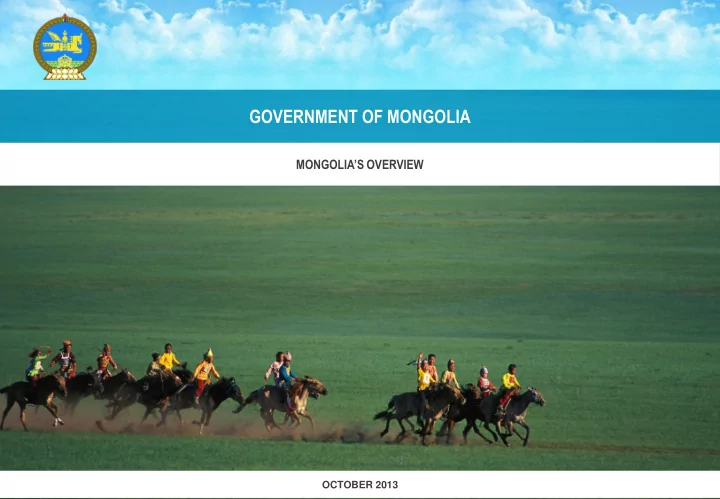
GOVERNMENT OF MONGOLIA MONGOLIAS OVERVIEW OCTOBER 2013 GOVERNMENT - - PowerPoint PPT Presentation
GOVERNMENT OF MONGOLIA MONGOLIAS OVERVIEW OCTOBER 2013 GOVERNMENT OF MONGOLIA 1 MONGOLIA OVERVIEW MONGOLIA OVERVIEW Large land per capita, abundant natural resources, well positioned for rapid economic expansion Mongolias Key Advantages
1 GOVERNMENT OF MONGOLIA
MONGOLIA’S OVERVIEW
GOVERNMENT OF MONGOLIA
OCTOBER 2013
2 GOVERNMENT OF MONGOLIA
MONGOLIA OVERVIEW
Close Proximity to the Largest Global Resource Markets Mongolia’s Key Advantages
LEADING LAND / CAPITA Territory: 1.6 million sq km Population: 2.8 million Relatively YOUNG POPULATION with a HIGH LITERACY rate among emerging economies ABUNDANCE OF UNEXPLOITED NATURAL RESOURCES Located close to some of the LARGEST global commodity MARKETS
industrialization
FLOURISHING DEMOCRACY IN THE REGION Tested with 7 CONSECUTIVE SUCCESSFUL democratic ELECTIONS Real GDP Growth
17.5%(2011)
Nominal GDP
$10.3b (2012)
GDP/Capita
RUSSIA
US$2,014 143
CHINA
US$8,227 1,351
S.KOREA
US$1,130 50
JAPAN
US$5,960 128
MONGOLIA
US$10 3 Nominal GDP 2012 in USD billions Population 2012 in millions
“Mongolia has a globally unparalleled young population and a wealth of resources, and has potential for unlimited growth.”
Source: World Bank
3 1 2
12.2%(2012) $3,160 (2012) Large land per capita, abundant natural resources, well positioned for rapid economic expansion
MONGOLIA OVERVIEW
Close Proximity to the Largest Global Resource Markets Mongolia’s Key Advantages
LEADING LAND / CAPITA Territory: 1.6 million sq km Population: 2.8 million Relatively YOUNG POPULATION with a HIGH LITERACY rate among emerging economies ABUNDANCE OF UNEXPLOITED NATURAL RESOURCES Located close to some of the LARGEST global commodity MARKETS
industrialization
FLOURISHING DEMOCRACY IN THE REGION Tested with 7 CONSECUTIVE SUCCESSFUL democratic ELECTIONS
RUSSIA
US$2,014 143
CHINA
US$8,227 1,351
S.KOREA
US$1,130 50
JAPAN
US$5,960 128
MONGOLIA
US$10 3 Nominal GDP 2012 in USD billions Population 2012 in millions
Source: World Bank
3 1 2 Real GDP Growth
17.5% (2011)
Nominal GDP
$10.3b (2012)
GDP/Capita
12.4% (2012) $3,365 (2012)
3 GOVERNMENT OF MONGOLIA Inflation Comparison – Emerging Sovereigns GDP Growth Comparison – Emerging Sovereigns
Mongolia continues to perform well compared to its emerging market peers, demonstrating robust growth momentum while maintaining moderate levels of inflation
YoY Inflation in September 2013 YoY Real GDP Growth at 1H2013
Source: National Statistical Office of Mongolia, National Bureau of Statistics of China, Badan Pusat Statistik of Indonesia, Department of Statistics of Malaysia, National Statistics Office of Philippines, General Statistics Office of Vietnam, Federal State Statistics Service of Russia, Moody’s Country Reports, (1) The Ministry of Economic Development, Mongolia Note: Exchange rate (MNT/USD) uses corresponding year end rate, 1,267.51 (2008), 1,442.84 (2009), 1,257.18 (2010), 1,396.37 (2011), 1,392.10 (2012), 1,446.48 (1H2013), 1450 (Expectation of 2013)
(US$ mm)
Real and Nominal GDP
0.5% (1.3%) 27.7% 6.4% 31.8% 17.5% 32.3% 8.9%
YoY growth of Real GDP YoY growth of Nominal GDP
3,127 2,712 3,311 3,503 3,943 1,868 5,172 4,567 6,693 7,940 10,010 5,248 2008 2009 2010 2011 2012 1H2013 22.3% 12.3% 18.8% 11.3% 14,223 5,032
11.3% 7.6% 6.1% 4.2% 7.6% 4.9% 1.4%
Mongolia China Indonesia Malaysia Philippines Vietnam Russia 2013E1
8.3% 2.7% 8.6% 2.0% 2.5% 7.3% 6.5%
Mongolia China Indonesia Malaysia Philippines Vietnam Russia
ONE OF THE FASTEST GROWING ECONOMIES GLOBALLY
4 GOVERNMENT OF MONGOLIA
DIVERSIFIED EARNINGS DRIVERS AND REVENUE BASE
Source: National Statistical Office of Mongolia, Bank of Mongolia; Note: Exchange rate (MNT/USD) uses corresponding year end rate, 1,169.97 (2007), 1,267.51 (2008), 1,442.84 (2009), 1,257.18 (2010), 1,396.37 (2011), 1,393 ( 2012), 1446.17 (2013h) (1) CAGR is calculated by using nominal GDP and total revenue in MNT during the period respectively
6% 21% 7% 15% 6% 3% 3% 36%
2012 YoY Nominal Growth Drivers
Mining and quarrying Agriculture Net taxes on products Retail trade Manufacturing Transportation Construction Electricity & utilities Communication Other
18% 14% 13% 10% 6% 6% 2% 3% 26%
2012 Nominal GDP by Sectors
Mining and quarrying Agriculture Net taxes on products Retail trade Manufacturing Transportation Construction Electricity & utitilities Communication Other
16% 16% 14% 10% 6% 6% 2% 2% 26%
1H2013 Nominal GDP by Sectors
Mining and quarrying Agriculture Net taxes on products Retail trade Manufacturing Transportation Construction Electricity & utitilities Communication Other
23% 12% 11% 9% 7% 6% 1% 30%
1H2013 YoY Nominal Growth Drivers
Mining and quarrying Agriculture Net taxes on products Retail trade Manufacturing Transportation Construction Electricity & utitilities Communication Other
5 GOVERNMENT OF MONGOLIA
Main Mineral Resources Approved Reserves (2012) Copper (thousand tons) 83,807 Coal (mln tons) 18,473 Gold (tons) 2,402 Zinc (thousand tons) 1,740 Iron ore (mln tons) 1,047 Uranium (thousand tons) 47.9 Rare Earth (thousand tons) 3,768 Conventional crude oil (mln barrel) 2,438 4,686
LARGE MINERAL RESOURCE BASE THAT CAN BE LEVERAGED FOR INDUSTRIALIZATION
A High-Growth Mineral Sector driving the Exports
railway infrastructure is in place and is expected to further increase to 50 million tons by 2017
products began in July of 2013. These exports are expected to play a crucial role in total exports of Mongolia.
(US$ mm)
Source: National Statistical Office of Mongolia, Erdenes MGL (1) Using annualized total exports, which equals the total exports as at June 30, 2012 multiplied by two
1,885 2,909 4,818 4,385 2,024
63.8% 81.0% 89.2% 91.0% 80.7% 26.9% 39.0% 54.9% 42.6% 31.1%
2,000 3,000 4,000 5,000 6,000 0.0% 10.0% 20.0% 30.0% 40.0% 50.0% 60.0% 70.0% 80.0% 90.0% 100.0% 2009 2010 2011 2012 1H2013
Total Export Mineral Export % of Total Exports Mineral Export % of Nominal GDP
Exports of key commodities continue to grow, demonstrating robust growth momentum in the coming years
Minerals – Main Composition of Total Exports (1H2013) Mongolia’s World Class Mineral Reserves
27% 20% 17% 10% 4% 7% 16% Coal Copper Iron ores& Scrap Crude oil Zinc Gold Other
6 GOVERNMENT OF MONGOLIA
LARGE MINERAL RESOURCE BASE THAT CAN BE LEVERAGED FOR INDUSTRIALIZATION (CONT’D)
ULAANBAATAR Erdenet Tumurtoi Shivee Ovoo Tavan Tolgoi Oyu Tolgoi Nariin Sukhait Baganuur Gurvanbulag Tsagaan Suvarga Dornot Mardai Asgat Tumurtein Ovoo Boroo Burenkhaan Silver 6.4 mln tons Uranium 16 thousand tons Copper / molybdenum
Iron ore 229.3 mln tons Gold ore 25 tons Rare-earth elements 47.2 thousand tons Rare-earth elements 339.0 thousand tons Lignite coal 600.0 mln tons Phosphorite 300 mln tons Coal 7,4 bln tons Copper/ molybdenum ore 10.6 mln tons of oxides; 240.1 mln tons sulphides Zinc 7.7 mln tons Uranium 29 thousand tons Uranium 2.9 thousand tons
Mongolia has vast and diverse under developed mineral deposits, providing the economy with significant long-term upside potential
This slide outlines the 15 strategic deposits that have been identified by the Mongolian government. The deposits cover a broad basket of minerals, ranging from coal, copper, gold, iron ore, molybdenum, phosphorite, rare earth oxides, silver, uranium, and zinc
Mushgia khudag Metallurgical coal 125.5 mln tons Lugiin gol Rare-earth elements 13.5 thousand tons Lignite coal 646.2 mln tons Khalzan burgedei Khotgor Copper – 37 mln tons Gold – 1,300 tons Rare-earth elements 3,429.5 thousand tons
7 GOVERNMENT OF MONGOLIA
LARGE MINERAL RESOURCE BASE THAT CAN BE LEVERAGED FOR INDUSTRIALIZATION (CONT’D)
Tavan Tolgoi Overview Oyu Tolgoi Overview
300,000 tons within this year;
reserves, content of copper, gold and silver contained in concentrates;
underground part of the deposit;
Source: Tavan Tolgoi website, Turquoise Hill website; (1) Erdenes TT is the company that holds GoM’s interests in Tavan Tolgoi
billion tons of coking and thermal coal resources;
for majority of the 50 million tons of targeted exports by 2017;
construction underway with 12% completion as of now, to be finished within 2015; 3) A 450MWt power plant project commenced at the site.
quality, highly desired coking and thermal coal.
8 GOVERNMENT OF MONGOLIA
LARGE MINERAL RESOURCE BASE THAT CAN BE LEVERAGED FOR INDUSTRIALIZATION (CONT’D)
Expanding our railway network and connecting Mongolia to its immediate neighborhood via 5 transit corridors will significantly contribute to the development of international transit traffic, trade and transportation in North-East Asia.
Source: Ministry of Roads and Transportation of Mongolia Existing Railways in Russia and China Phase I Existing Railways Potential seaports and seaways Phase II and III
Railroad Adding to Trans Mongolia Railway, a New railway, connecting commodities to the Chinese and Japanese market. Auto road Connecting the northern border point to the south, 990 km of highway project is under development. Gas pipeline Conceptual level. Connect through the Pacific to Japan Oil pipeline Conceptual level. Conceptual
to Japan Electricity transmission line Conceptual level. Conceptual
to Japan
9 GOVERNMENT OF MONGOLIA
5,779 4,023 6,109 11,307 11,123 11,033
2008 2009 2010 2011 2012 2013E
Legal environment for trade
► Mongolia has a strategic location between the 2nd and the 6th
largest economies of the world;
► Mongolia has good political and economic relations with the two
neighbors;
► The strategic location can be used to the advantage of North-East
Asian countries.
ATTRACTIVE ENVIRONMENT FOR FDI AND TRADE
Active trade with immediate regions Total Trade Volume
(US$ mm)
Strategic geographic location to be leveraged for transit trade
China 88% Russia 1.4% Others 10.6%
Source: National Statistical Office of Mongolia
1H2013 Exports 1H2013 Imports
Mongolia Russia China
Mongolia is strategically located with direct access to China and Russia, two of the largest markets in the world Trade volumes are expected to grow alongside GDP as output increases Transit trade expected to become an important driver of the economy on the wave of trade between Russia and China
► World Trade Organization Member since 1997 ► Bilateral Trade Agreements: with 23 countries ► Bilateral Investment Agreements: with 44 countries
10 GOVERNMENT OF MONGOLIA
ATTRACTIVE ENVIRONMENT FOR FDI AND TRADE (CONT’D)
Political stability: Parliamentary, Local and Presidential elections are over. There will be one ruling coalition until 2016. Favorable legal environment:
Parliament enacted following laws September, 2013
Submitted to the Parliament
Government Overview Recent Developments
Great Khural (the “Parliament”) in consultation with the President
are elected for a term of four years)
administratively into 21 aimags (provinces) and the capital city
Balanced Parliamentary and Stable Coalition Government
Mongolia is a vibrant and true democracy with stable institutions and a high degree of rule of law. The population is young and with a high literacy rate Current government is a coalition government consisting
Coalition and the Civil Will- Green Party
Democratic Party 44.0% MPP 34.0% Justice coalition (New MPRP and MNDP) 15.0% Civil Will- Green Party 3.0% Independent 4.0%
Parliamentary Election 2012 (76 seats)
11 GOVERNMENT OF MONGOLIA
1.
More Liberalized Market Condition
Government.
2.
Business Friendly
3.
Increasing Efficiency of Investment
4.
Towards Economic Diversification
The Key Factors of the new Investment Law
12 GOVERNMENT OF MONGOLIA
Invest Mongolia
(Investment and Business Promoting Agency)
Investment Strategy
implement strategies in MGL
services
Intermediation
Start-up
tackling issues
business
Securing Stability
The Key Factors of the new Investment Law (2)
13 GOVERNMENT OF MONGOLIA
BUDGET 2014
Billion tugrug
2014 consolidated budget indicators
GOVERNMENT OF MONGOLIA
15 GOVERNMENT OF MONGOLIA
PROBLEMS WITH CURRENT BUDGET
1
Name of project Location Capacity Value of 2013 budget law Changed value
/2014 / Growth /times/ Building of cultural center Zavkhan, Ikh-uul 200 seats 700 3200,0 4,57 Building of cultural center Zavkhan, Tsetsen-uul 200 seats 700 1112,9 1,59 Building of cultural center Zavkhan, Bayantes 250 seats 600 1593,0 2,66
2
Name of project Location Capacity Valueof 2013 budget law Changed value
/2014 / Growth /times/ School building Dundgovi, Gurvansaikhan 320 seats 1200,0 2605,5
2.17
School building Dundgovi, Delgerkhangai 320 seats 1200,0 2029,7
1.69
School building Khentii, Batshireet 320 seats 1200,0 1687,5
1.41
School building Zavkhan, Otgon 320 seats 950,0 1233,3
1.29
16 GOVERNMENT OF MONGOLIA
INVESTMENT BY BUDGET 2014 (3)
16
677 km paved roads
1032 iron and beton bridges 28 hostels 53 kindergardens 64 schools 48 hospitals
9 cultural centers 8 cleaning buildings
17 GOVERNMENT OF MONGOLIA
CHINGGIS BOND
Project Approved disbursement, MNT billion ₮ Disburseme nt% Comment
Rural road projects 570.0 43%
Paving of 670 km out of 1800 has been completed at this point. Roughly 243 km of foundation work has been done, on the remaining 887 km of road, ground work is underway.
“Street” project 325.9 9%
By September 2013, construction of 12 out 33 crossroads have been completed. Construction of 4 crossroads are underway and is expected to be completed by October 15.
Infrastructure civil engineering projects 198.7 30%
7 out of 8 residential district civil engineering projects funded by the Government bond is underway and is expected to be completed in 2013.
Tavan tolgoi power plant 81.5 4%
Contract draft and bidding documents are being processed. Geology and engineering study, and environmental and social assessment are completed.
New railroad 325.9 42%
45 percent of ground work is finished. Expected to be commissioned in 2015.
Equipment renovation projects by Ministry of Industry and Agriculture 270.7 100%
142 project proposals out of 148 were considered and in the 1st stage, with total cost of MNT 30.0 billion was approved for 13 projects (1 in cashmere, 2 in wool, 1 in sewing, 1 in dairy industry and 1 in greenhouse ) by commercial banks.
Housing manufacturing plant 22.8 100%
After the transfer of 7 million USD down payment for the equipment, production is
the transfer of advance payment.
State housing corporation project 162.9 12,3%
20.0 billion MNT will be disbursed to the project. It has been signed and sealed on September 30th of 2013.
Iron processing and steel manufacturing project 83.5 0%
Preparation is underway to finance 1 project for manufacturing reinforced steel, 3 export
Total 2,199.4 37,0%
18 GOVERNMENT OF MONGOLIA
Strong Government to Government Relationship
Elevate the level of cooperation
Commerce
potentials of each economy
Main purpose of the current official visit: Deepening and strengthening of Strategic Partnership – establishing Midterm Action Plan for 2013-2017
and Policy Consultative Meetings between Foreign Policy, Security and Defense Agencies
Japan, and USA
Meetings
and Mongolia
BILATERAL RELATIONSHIP (example of Mongolia and Japan)
19 GOVERNMENT OF MONGOLIA
BILATERAL RELATIONSHIP (example of Mongolia and Japan)
100,000 200,000 300,000 400,000 500,000 600,000
March 30, 2013, the Japanese Prime Minister Mr. Abe visited Mongolia and met Mongolian President Tsakhia Elbegdorj and Prime Minister Norov Altankhuyag in Ulaanbaator.
agreed between the two leaders.
Trade & Investment Promotion
development
Improvement of infrastructure basis for development
Extract of Historic Relations of two countries
Source: National Statistical Office Data Source: FIRRD, MED
1972 Diplomatic relations between Japan and Mongolia were established 1990 Japan became the biggest donor country of Mongolia 1997 “Comprehensive Partnership” between Japan and Mongolia 2010 “Strategic Partnership” following official visit to Japan by President Elbegdorj Tsakhia 2012 Two countries launched negotiations for the Mongolia-Japan Economic Partnership Agreement (EPA) 2013 Japanese Prime Minister Shinzo Abe initiated Erch Initiative
Recent Key Development Direct Investment From Japan to Mongolia Export/Import Total Trade between Mongolia and Japan
(USD 000s) (USD 000s) 10,000 20,000 30,000 40,000 50,000
Official Development Assistance Japan’s ODA to Mongolia
(JPY 100 mln) 349.01 43.07 73.16 110.77 64.09 29.24 100 200 300 400 2007 2008 2009 2010 2011 2012
Total ODA volume 1990 – 2012 211.8 billion JPY (USD 2.1 billion) ODA priority areas to Mongolia:
Ulaanbaatar as urban center
20 GOVERNMENT OF MONGOLIA