SLIDE 1
- Project „Dryport – a modal shift in practice”
- Funded by the European Union in the Interreg
IVB Northsea Programme and the German Federal Ministry of Transport, Building and Urban Development, Programme „Transnational Cooperation“
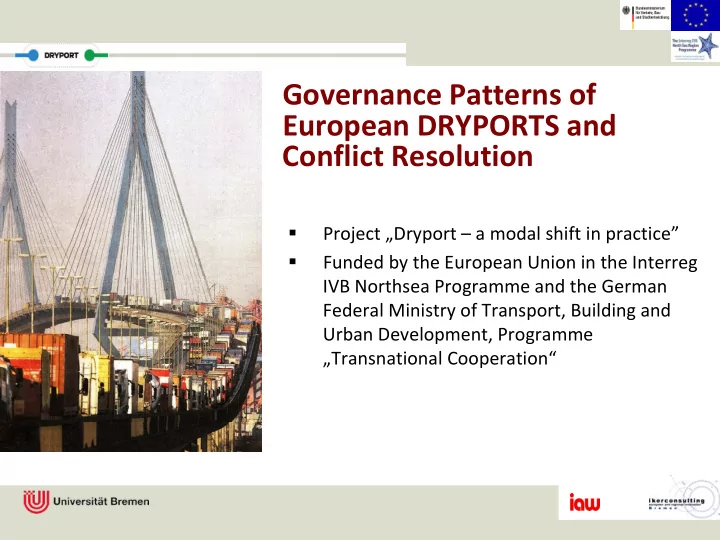
Governance Patterns of European DRYPORTS and Conflict Resolution
SLIDE 2 Governance Patterns of European DRYPORTS and Conflict Resolution
Which conditions would enable dryports to work
- as efficient partners for sea ports
and as
- valuable options for sustainable
logistics? > Suggestions for efficient integration of dryports into logistic chains, regional structures and business strategies Dryports seem to be an answer, but what is the question?
SLIDE 3
Governance Patterns of European DRYPORTS and Conflict Resolution Containerization Growing Ship Sizes Expanding World Wide Trade Integration of logistics chains
Concentration and competition through
Container Turnover 2011 (in million TEU) Rotterdam 11,9 Antwerp 8,5 Hamburg 9,0 Bremerhaven 5,9
SLIDE 4 Governance Patterns of European DRYPORTS and Conflict Resolution
Consequences
- Congestion of port capacities and
hinterland connections
- Lack of space / Missing options for
expansion
- Land use conflicts / Restrictions by
spatial planning
- Burden on environment
- Decreasing acceptance
SLIDE 5
Governance Patterns of European DRYPORTS and Conflict Resolution
Expectations
SLIDE 6 Governance Patterns of European DRYPORTS and Conflict Resolution
Four Cases in the North Sea Region
Gothenburg/ Falköping Bremerhaven/ Bremen Zeebrugge Haven Gateway
haven
köping
SLIDE 7 Governance Patterns of European DRYPORTS and Conflict Resolution
Complex conditions for the function of dryports:
Integration in logistic chains (functional dimension)
- Infrastructure (multimodal etc.)
- Spatial structure (freight village etc.)
- Connection to sea port (shuttle – rail or barge)
Integration in regional structures (regional dimension)
- local content/added value
- spatial and environmental conditions
- job creation and generation of income
Integration in business strategies (economic dimension)
- business models
- enterprise strategies
- competition vs. cooperation
SLIDE 8
Governance Patterns of European DRYPORTS and Conflict Resolution
Multiplication of options for relevant stakeholders:
Functional Integration (infrastructures, spatial planning and structures, connection to sea port) Regional/political Integration (Economic impact on regional level, conflicts of interest: citizens, private sector, state) Economic Integration (in stakeholder strategies, hinterland connections etc.)
Dryport
SLIDE 9 Governance Patterns of European DRYPORTS and Conflict Resolution
- Transfer of responsibilities for common interest to
- ne of the involved partners (Zeebrugge)
- Establishment of new institution for management of
cooperation (Bremen)
- Public authority to pull the strings (Falköping)
- Coordination left up to the market (Haven Gateway)
Key problem: Governance solutions for the integration
SLIDE 10
Governance Patterns of European DRYPORTS and Conflict Resolution
Conclusion
1. Multiplication of options is a general aim 2. Competition between ports takes place in hinterland 3. Establishment and operation of dryports is a complex (triple) task of integration 4. Management of cooperation (governance) is essential
SLIDE 11
Governance Patterns of European DRYPORTS and Conflict Resolution
Thank You!
For further information ‐ www.dryport.org ‐ www.iaw.uni‐bremen.de Project Team Günter Warsewa gwarsewa@iaw.uni‐bremen.de Jochen Tholen jtholen@uni‐bremen.de Karsten Seidel karsten.seidel@ikerconsulting.com Manuel Kühn mkuehn@iaw.uni‐bremen.de